1. Introduction
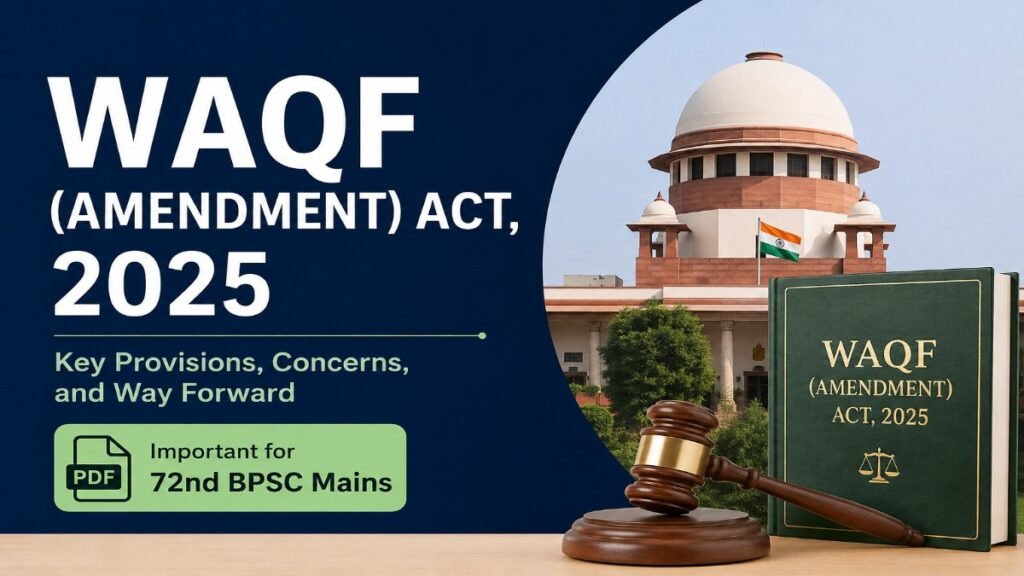
The Waqf Amendment Act, 2025 amends the Waqf Act, 1995 with the objective of improving the administration, transparency, accountability, and efficient management of Waqf properties in India. The Act introduces reforms relating to the creation, registration, survey, governance, and dispute resolution of Waqf properties, while promoting the use of digital records and strengthening institutional oversight. The government states that the amendments aim to address long-standing issues such as mismanagement, encroachment, and legal disputes over Waqf properties, whereas critics have raised concerns regarding religious autonomy and constitutional rights. These reforms are important for understanding the Waqf Amendment Act Notes from the perspective of BPSC Mains.
Master Current Affairs. Ace BPSC Mains.
BPSC Mains Current Affairs & International Relations Course
Master GS Paper-I (Section-II) with 116 exam-oriented topics, 5 structured lessons and downloadable PDF notes—all in one comprehensive course.
✔ 116 Exam-Oriented Topics • ✔ 5 Comprehensive Lessons • ✔ Downloadable PDF Notes • ✔ Updated for 72nd BPSC Mains
2. Why in News?
The Waqf Amendment Act, 2025 remained one of the most debated legislations in India due to its passage in Parliament, legal challenges before the Supreme Court, and the ongoing implementation of its provisions. These developments make the Waqf Amendment Act Notes particularly relevant for BPSC Mains preparation.
Recent Developments
- 8 August 2024: The Waqf (Amendment) Bill, 2024 was introduced in the Lok Sabha to amend the Waqf Act, 1995.
- January 2025: The Bill was examined by the Joint Parliamentary Committee (JPC), which recommended several changes before its passage.
- 3–4 April 2025: Parliament passed the Bill after extensive debate in both Houses.
- 5 April 2025: The Bill received the President’s assent and became the Waqf Amendment Act, 2025.
- April 2025 onwards: Several petitions challenging the constitutional validity of the Act were filed before the Supreme Court, mainly alleging violation of religious freedom and minority rights. The Court clubbed the petitions and began hearing the matter while granting limited interim protection on certain provisions.
- 2026: The implementation process continued across states, including verification of Waqf properties and reconstitution of Waqf Boards under the amended law.
Prepare Smarter. Study Better. Ace BPSC Mains.
BPSC Mains GS Paper 1 & 2 Complete Course
Access comprehensive BPSC Mains Notes for GS Paper 1 & 2, covering 378+ topics across 24 PDF lessons, with dedicated Bihar coverage, practice questions and downloadable study material.
✓ GS Paper 1 & 2 • ✓ 378+ Topics • ✓ 24 PDF Lessons • ✓ Bihar-Specific Coverage • ✓ Downloadable Notes
3. Definition of Waqf
Waqf is a permanent dedication of a movable or immovable property by a person professing Islam for religious, pious, or charitable purposes recognised under Islamic law. Once a property is declared as Waqf, it becomes inalienable, meaning it cannot ordinarily be sold, gifted, inherited, or transferred, and its income must be used only for the purpose for which it was created. Examples include mosques, graveyards, dargahs, schools, hospitals, orphanages, and other charitable institutions.
The administration of Waqf properties in India is governed by the Waqf Act, 1995, through the Central Waqf Council and State Waqf Boards. Waqf can be created mainly through Waqf by declaration and Waqf-alal-aulad (family Waqf for descendants with an ultimate charitable purpose). The Waqf Amendment Act, 2025 has introduced significant changes in the creation, registration, and governance of Waqf properties. This section is an important part of Waqf Amendment Act Notes and is also useful for understanding the provisions covered in a Waqf Act PDF.
4. Evolution of Waqf Laws in India
- Mussalman Waqf Act, 1923: Introduced mandatory registration and record-keeping of Waqf properties during British India.
- Waqf Act, 1954: Established the Central Waqf Council and State Waqf Boards for better administration and protection of Waqf properties.
- Waqf Act, 1995: Replaced the 1954 Act with a comprehensive legal framework, strengthened Waqf Boards, and created Waqf Tribunals for speedy dispute resolution.
- Waqf (Amendment) Act, 2013: Expanded the powers of Waqf Boards, strengthened protection against encroachment, and enhanced provisions relating to surveys and management of Waqf properties.
- Waqf Amendment Act, 2025: Introduced reforms to improve transparency, digital governance, accountability, and dispute resolution in the administration of Waqf properties. These developments are important for Waqf Amendment Act Notes and provide the legal background for understanding the provisions discussed in a Waqf Act PDF.
5. Need for the Waqf (Amendment) Act
- To improve transparency and accountability in the management of Waqf properties through digitisation, better record-keeping, and audits.
- To address disputes, encroachments, and irregularities in Waqf properties by strengthening the legal and administrative framework.
- To streamline the registration, survey, and governance of Waqf properties and improve the functioning of Waqf Boards.
- To enhance transparency, inclusiveness, and efficient utilisation of Waqf assets for religious, charitable, and community welfare purposes in line with constitutional principles. These objectives are central to understanding the Waqf Amendment Act and are important points for Waqf Amendment Act Notes.
6. Salient Features of the Waqf (Amendment) Act, 2025
- Renaming of the Act: The Waqf Act, 1995 has been renamed as the Unified Waqf Management, Empowerment, Efficiency and Development (UMEED) Act, 1995, reflecting its focus on transparent and efficient management of Waqf properties.
- Changes in Creation of Waqf: Only a person practising Islam for at least five years and having lawful ownership of the property can create a Waqf. The concept of “Waqf by User” has been removed prospectively, except for already registered Waqf-by-user properties.
- Survey and Registration of Waqf Properties: Survey of Waqf properties will now be carried out under the District Collector instead of Survey Commissioners. All Waqf properties must be registered through a centralised digital portal with proper documentation and geo-tagged records.
- Dispute Resolution and Government Land: If a property is claimed as both government land and Waqf land, the District Collector will determine its ownership before it is recorded as Waqf. The unilateral power of Waqf Boards to declare any property as Waqf has been curtailed.
- Reconstitution of Waqf Bodies: Provides for representation of women, non-Muslims, and different Muslim communities in the Central Waqf Council and State Waqf Boards. Aims to make Waqf institutions more inclusive and accountable.
- Transparency and Financial Reforms: Mandatory digitisation, auditing, and maintenance of accounts. Encourages online monitoring of Waqf properties to improve transparency and prevent encroachments. These provisions form a core part of the Waqf Amendment Act Notes and are useful for BPSC Mains preparation.
7. Significance of the Waqf (Amendment) Act, 2025
- Enhances Transparency and Accountability: Introduces mandatory digital registration, auditing, and maintenance of Waqf records, reducing scope for irregularities and improving public accountability.
- Better Protection of Waqf Properties: Strengthens mechanisms to identify genuine Waqf properties, curb encroachments, and resolve ownership disputes through a structured legal process.
- Improves Governance: Reforms the composition and functioning of the Central Waqf Council and State Waqf Boards, promoting greater institutional oversight, inclusiveness, and efficiency.
- Promotes Digital Governance: Encourages the creation of a centralised digital database and geo-tagged records, facilitating better monitoring and transparent management of Waqf assets.
- Ensures Legal Clarity: Clarifies procedures relating to the creation, survey, registration, and dispute resolution of Waqf properties, thereby reducing ambiguity and prolonged litigation. These aspects are important for understanding the Waqf Amendment Act and form key components of comprehensive Waqf Amendment Act Notes.
8. Concerns and Criticism of the Waqf (Amendment) Act, 2025
Religious Autonomy
Critics argue that the inclusion of non-Muslim members in Waqf institutions and increased government oversight may dilute the autonomy of religious institutions protected under Articles 25 and 26 of the Constitution.
Increased Executive Control
The Act empowers the District Collector to determine whether disputed land is government property before it is notified as Waqf. Opponents contend that this shifts authority from Waqf Boards to the executive, raising concerns about excessive governmental interference.
Impact on Existing Waqf Properties
The prospective abolition of ‘Waqf by User’ and changes in ownership verification may affect properties lacking formal documentation, leading to fears of prolonged litigation and uncertainty over traditional Waqf assets.
Constitutional Validity
Several political parties, religious organisations and individuals have challenged the Act before the Supreme Court, alleging that certain provisions violate minority rights, equality, and freedom of religion guaranteed under the Constitution.
Administrative Challenges
Experts have pointed out that successful implementation will require accurate digitisation of records, coordination between revenue authorities and Waqf Boards, and effective dispute resolution mechanisms to avoid administrative delays.
These concerns are important for a balanced understanding of the Waqf Amendment Act and should be covered in comprehensive Waqf Amendment Act Notes for BPSC Mains.
9. Government’s Stand
The Central Government has stated that the Waqf Amendment Act, 2025 is intended to make the administration of Waqf properties more transparent, accountable, inclusive, and efficient. According to the government, the amendments do not interfere with religious practices but focus on improving the governance and management of Waqf assets through better record-keeping, digitisation, and institutional reforms.
The Government has further argued that the Act seeks to curb encroachments, reduce litigation, protect genuine Waqf properties, and ensure that Waqf assets are utilised effectively for the welfare of the Muslim community. It has also maintained that the reforms are consistent with constitutional principles of transparency, good governance, and public accountability. These arguments are important for a balanced understanding of the Waqf Amendment Act and for comprehensive Waqf Amendment Act Notes.
10. Supreme Court Proceedings / Current Status
Soon after the Waqf Amendment Act, 2025 came into force, several petitions challenging its constitutional validity were filed before the Supreme Court by political leaders, religious organisations, and other stakeholders. The petitioners argued that certain provisions violate Articles 14, 25, 26, and 300A of the Constitution by affecting religious autonomy, equality, and property rights. The Supreme Court clubbed these petitions for a consolidated hearing.
During the proceedings, the Union Government defended the Act as a governance reform, while assuring the Court that certain contentious provisions would not be implemented until further orders. The Supreme Court has granted interim relief on some provisions while the constitutional challenge remains pending. Thus, the final validity of the Waqf Amendment Act, 2025 is yet to be decided by the Supreme Court.
This section is particularly important in Waqf Amendment Act Notes for understanding the constitutional issues and the current legal status of the Act.
11. Way Forward
The effective implementation of the Waqf Amendment Act, 2025 requires a balanced approach that ensures transparency, efficient management of Waqf properties, and protection of constitutional rights. The government should complete the digitisation and geo-tagging of Waqf properties, strengthen institutional capacity of Waqf Boards, and establish a time-bound mechanism for resolving property disputes.
At the same time, implementation should respect the principles of natural justice, religious freedom, and federalism. Constructive dialogue among the government, Waqf institutions, and stakeholders, along with the Supreme Court’s final verdict, will be crucial in ensuring that the reforms achieve their objective of better governance while safeguarding minority rights guaranteed under the Constitution.
These measures are important components of comprehensive Waqf Amendment Act Notes for BPSC Mains and should also be referred to while preparing a Waqf Act PDF.
12. Bihar Perspective
Bihar has a large number of Waqf properties administered by the Bihar State Sunni Waqf Board and the Bihar State Shia Waqf Board under the Waqf Act, 1995. These properties include mosques, graveyards, dargahs, educational institutions and other charitable assets. The State has witnessed issues relating to encroachment, incomplete records, property disputes and management of Waqf assets.
Following the enactment of the Waqf Amendment Act, 2025, Bihar has initiated the digitisation and online registration of Waqf properties through the UMEED Portal to improve transparency and prevent illegal encroachments. The Act has also generated significant political and public debate in Bihar, making it an important issue from the BPSC Mains perspective.
The Bihar-specific implications are therefore an important part of Waqf Amendment Act Notes for BPSC Mains.
Experience the Quality Before You Enroll
Download Free Sample Notes (PDF)
Download a free sample of our BPSC Mains Current Affairs Notes and experience the structured, exam-oriented content before enrolling. Explore the presentation, answer-writing approach, and overall quality of the complete course.
✔ Free Download • ✔ Exam-Oriented Notes • ✔ Updated Content • ✔ Structured for BPSC Mains
BPSC Mains Practice Questions
Q1. The Waqf Amendment Act, 2025 seeks to improve transparency and accountability in the management of Waqf properties. Critically examine its major provisions and discuss the constitutional concerns associated with the Act.
Q2. Discuss the need for the Waqf Amendment Act, 2025. How far do the recent amendments address the challenges in the administration and governance of Waqf properties in India?
These questions can be used for practice after studying the Waqf Amendment Act Notes and related Waqf Act PDF material.
Learn More from the Ministry of Minority Affairs, Government of India
Readers interested in the Waqf Amendment Act, Waqf Amendment Act Notes, the legal framework governing Waqf properties, and the latest reforms relating to Waqf administration can visit the official website of the Ministry of Minority Affairs, Government of India. The portal provides authentic information on government policies, legislative measures, welfare initiatives, and official documents related to minority affairs, including Waqf-related developments and the Waqf Amendment Act, 2025.