1. Introduction
A Caste Census in India is the process of collecting data on the caste-wise distribution and socio-economic characteristics of the population as part of the national Census. It aims to generate reliable data for evidence-based policymaking, targeted welfare schemes, reservation policies, and the socio-economic upliftment of disadvantaged communities.
The issue has gained national significance after the Cabinet Committee on Political Affairs (CCPA) decided on 30 April 2025 to include caste enumeration in Census 2027. This will be the first nationwide caste enumeration after 1931 and the first comprehensive caste enumeration in independent India as part of the official Population Census. The Caste Census 2027 is therefore expected to provide an important statistical basis for social justice, welfare policies and reservation-related debates. These developments make the topic highly relevant for Caste Census Notes for BPSC Mains.
Master Current Affairs. Ace BPSC Mains.
BPSC Mains Current Affairs & International Relations Course
Master GS Paper-I (Section-II) with 116 exam-oriented topics, 5 structured lessons and downloadable PDF notes—all in one comprehensive course.
✔ 116 Exam-Oriented Topics • ✔ 5 Comprehensive Lessons • ✔ Downloadable PDF Notes • ✔ Updated for 72nd BPSC Mains
2. Why in News?
- On 30 April 2025, the Cabinet Committee on Political Affairs (CCPA) approved the inclusion of **caste enumeration in the upcoming Population Census 2027, making it the first nationwide caste enumeration since 1931. This decision has brought the Caste Census in India into major national policy discussions.
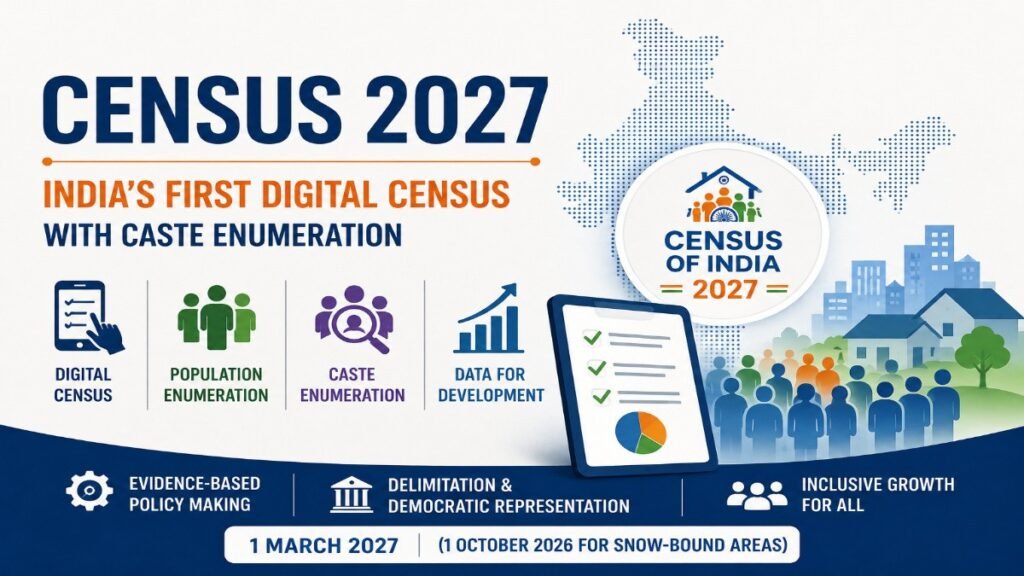
- Census 2027 will collect caste data along with population data during the Population Enumeration (Phase-II) through a digital Census with a self-enumeration facility. This makes Caste Census 2027 an important development in India’s demographic data system.
- The demand for a nationwide caste census gained momentum after the Bihar Caste-Based Survey (2022–23), which became the first comprehensive caste survey by any state after Independence and intensified the national debate on social justice and reservation policies.
- Several political parties and state governments supported caste enumeration, arguing that updated caste data is essential for evidence-based policymaking, targeted welfare schemes, and review of reservation policies.
- The inclusion of caste enumeration has emerged as a major public policy issue due to its likely impact on reservation, social justice, welfare distribution, and electoral politics in India. These developments are important for comprehensive Caste Census Notes for BPSC Mains.
3. Evolution of Caste Enumeration in India
The first synchronous Census of India (1881) included caste as one of the important demographic variables, and every decennial Census from 1881 to 1931 collected caste data for all communities. However, the 1931 Census remains the last published nationwide Census containing comprehensive caste-wise population data. Although caste information was collected during the 1941 Census, it was never fully compiled or published due to World War II and administrative disruptions.
After Independence, the Government decided that the decennial Census would enumerate only Scheduled Castes (SCs) and Scheduled Tribes (STs), while caste data for other communities was discontinued. In 2011, the Government conducted the Socio-Economic and Caste Census (SECC) as a separate exercise outside the Census Act, 1948. While the socio-economic data was released and used for welfare programmes, the caste data was not officially published due to concerns regarding data quality, inconsistencies, and the presence of lakhs of caste and sub-caste entries.
A major policy shift occurred on 30 April 2025, when the Cabinet Committee on Political Affairs (CCPA) approved the inclusion of caste enumeration in Census 2027. This decision marks the return of caste enumeration to the official Census after nearly a century and is expected to provide a scientific basis for social justice policies, welfare programmes, and reservation-related decisions. The development represents a major milestone in the Caste Census in India and is a key area for Caste Census Notes.
Prepare Smarter. Study Better. Ace BPSC Mains.
BPSC Mains GS Paper 1 & 2 Complete Course
Access comprehensive BPSC Mains Notes for GS Paper 1 & 2, covering 378+ topics across 24 PDF lessons, with dedicated Bihar coverage, practice questions and downloadable study material.
✓ GS Paper 1 & 2 • ✓ 378+ Topics • ✓ 24 PDF Lessons • ✓ Bihar-Specific Coverage • ✓ Downloadable Notes
4. Key Features of Caste Census 2027
- First Nationwide Caste Enumeration after 1931: Caste Census 2027 will be the first official nationwide caste enumeration since the 1931 Census and the first comprehensive caste enumeration in independent India as part of the decennial Census. Earlier, only Scheduled Castes (SCs) and Scheduled Tribes (STs) were enumerated in the Census.
- Part of the Official Population Census: Unlike the Socio-Economic and Caste Census (SECC), 2011 or various state-level caste surveys, caste data will now be collected as an integral part of the official Census under the Census Act, 1948, ensuring uniform methodology and legal backing.
- Enumeration during Phase-II: Caste details will be collected during the Population Enumeration (Phase-II) of Census 2027, along with other demographic, social and economic particulars of every individual.
- Digital Data Collection: Census 2027 will be India’s first fully digital Census, with caste data being collected through secure mobile applications, supported by self-enumeration, geo-referenced enumeration blocks and the Census Management & Monitoring System (CMMS) for real-time monitoring.
- Uniform and Transparent Database: The Government has stated that conducting caste enumeration through a single nationwide Census will ensure uniformity, transparency and comparability of caste data across all States and Union Territories, unlike separate state surveys that follow different methodologies.
- Large-scale Administrative Exercise: Census 2027 will involve an estimated 30 lakh enumerators, supervisors and other census officials, with an approved outlay of ₹11,718.24 crore, making it the largest digital census exercise in the world.
These features make the Caste Census 2027 an important topic for understanding the future of social justice and welfare policy in India, and they should form an essential part of Caste Census Notes for BPSC Mains.
5. Significance of Caste Census in India
Enables Evidence-based Policymaking
India has no comprehensive nationwide caste data after the 1931 Census (except for SCs and STs in subsequent Censuses). As a result, governments often rely on outdated estimates while formulating policies for Other Backward Classes (OBCs) and other communities. Updated caste data will provide a scientific basis for policymaking and reduce dependence on assumptions. The Caste Census in India will therefore strengthen evidence-based governance.
Strengthens Social Justice
The caste census will help identify the actual socio-economic status of different caste groups, enabling governments to assess whether the benefits of reservation and welfare schemes are reaching the intended beneficiaries. For example, if certain backward communities continue to lag in literacy, employment or income despite existing schemes, targeted interventions can be designed for them. This makes Caste Census 2027 particularly significant for social justice.
Improves Targeting of Welfare Schemes
Reliable caste-wise data can enhance the implementation of schemes relating to education, scholarships, skill development, housing, healthcare and livelihood. Instead of adopting a uniform approach, governments can identify the most deprived communities and allocate resources more efficiently, thereby reducing both inclusion and exclusion errors in welfare delivery. Such aspects are important components of Caste Census in India.
Provides a Scientific Basis for Reservation Policy
Reservation for SCs, STs and OBCs is intended to promote equality of opportunity. Updated caste census in India data can help governments and constitutional bodies evaluate whether the existing reservation framework reflects current demographic and socio-economic realities. It can also support future policy decisions, subject to constitutional provisions and judicial scrutiny.
Supports Inclusive Economic Planning
Caste-disaggregated data will help planners understand disparities in education, employment, land ownership, income and access to public services across communities. Such evidence can improve long-term development planning and ensure that economic growth is more inclusive and regionally balanced.
Promotes Cooperative Federalism
Several states, including Bihar, Karnataka and Telangana, have demanded updated caste data to formulate state-specific welfare policies. A nationwide caste census conducted under the Census Act, 1948 will ensure a uniform methodology, improve comparability across states, and reduce dependence on separate state surveys. The Caste Census in India can therefore provide a common evidence base for Centre-State policy formulation.
6. Bihar Perspective
Bihar became the first state in independent India to conduct a comprehensive caste-based survey. The survey was carried out in two phases during 2023, and its findings were released on 2 October 2023. The exercise covered the entire population of the state and collected both caste and socio-economic information, making Bihar a pioneer in evidence-based social policy. The survey provided the momentum for the national debate on caste enumeration, which ultimately culminated in the Union Government’s decision to include caste enumeration in Census 2027.
Major Findings of Bihar Caste Survey
- Total Population: 13.07 crore
- Extremely Backward Classes (EBC): 36.01%
- Other Backward Classes (OBC): 27.12%
- Scheduled Castes (SC): 19.65%
- Scheduled Tribes (ST): 1.68%
- General Category: 15.52%
Thus, OBCs and EBCs together constitute about 63.13% of Bihar’s population, highlighting the demographic significance of backward classes in the state.
Socio-economic Findings
The survey also collected socio-economic data, revealing significant developmental challenges. It found that over 34% of Bihar’s households earned less than ₹6,000 per month, indicating widespread poverty among vulnerable sections. The report also highlighted disparities in education, employment, income and asset ownership across different caste groups, providing an empirical basis for targeted welfare interventions.
Policy Impact
Based on the survey findings, the Bihar Government proposed increasing reservation from 50% to 65% for SCs, OBCs and EBCs (taking the total reservation to 75% including EWS). Although the enhanced reservation is currently under judicial scrutiny, the caste survey has become a landmark reference for discussions on social justice, affirmative action and reservation policy across India.
National Significance
The Bihar Caste Survey demonstrated the feasibility of large-scale caste enumeration and intensified the demand for a nationwide exercise. It significantly influenced the public discourse on evidence-based policymaking and was one of the important developments preceding the Union Government’s decision in April 2025 to include caste enumeration in the Population Census 2027.
The Bihar experience therefore provides an important case study for understanding the broader Caste Census in India, while its findings and policy implications are essential for Caste Census Notes and BPSC Mains preparation.
7. Challenges & Concerns
Reinforcement of Caste Identities
Critics argue that a nationwide caste census may reinforce caste consciousness and strengthen identity-based politics instead of promoting a casteless society envisioned under the Constitution. There are concerns that greater emphasis on caste identities may deepen social divisions and undermine the constitutional values of fraternity and national integration.
Political Misuse
Detailed caste-wise data may encourage vote-bank politics, with political parties framing electoral strategies around caste demographics. It may also trigger fresh demands for reservation, sub-categorisation of OBCs, or inclusion of new communities in the backward class list, leading to increased political competition among caste groups. This is one of the major concerns surrounding the Caste Census 2027.
Data Accuracy and Classification
Enumerating caste is administratively challenging because India has thousands of castes and sub-castes with different names across states. During the Socio-Economic and Caste Census (SECC), 2011, the raw data reportedly contained over 46 lakh caste and sub-caste entries, making classification and validation difficult. Standardisation of caste names and verification of self-declared identities remain major challenges.
Administrative Complexity
Conducting caste enumeration for a population of over 1.4 billion people requires extensive training of enumerators, robust digital infrastructure, and effective coordination between the Centre and States. Errors in data collection, coding or verification could affect the reliability of the final dataset and delay its publication.
Privacy and Data Security
The collection of sensitive caste information through a fully digital Census raises concerns regarding privacy, confidentiality and cybersecurity. Ensuring secure storage, restricted access and responsible use of caste data will be essential to maintain public trust in the Caste Census in India.
Legal and Policy Challenges
The publication of updated caste data may lead to demands for revising reservation policies, increasing quota limits, or reclassifying communities. Any such changes would have to comply with constitutional provisions and are likely to face judicial scrutiny, making implementation a complex legal and policy issue.
These challenges should be carefully examined while preparing Caste Census Notes, particularly in the context of the upcoming Caste Census 2027.
8. Way Forward
- Ensure Accurate and Scientific Enumeration: The caste census should follow a uniform national methodology, standardized caste codes, and rigorous data verification to ensure accuracy and credibility of the data.
- Use Data for Inclusive Development: Caste data should primarily be used for evidence-based policymaking, targeted welfare schemes, poverty alleviation, education, healthcare, and skill development rather than for political mobilisation.
- Safeguard Privacy and Data Security: Since caste is sensitive personal information, the Government should ensure strict confidentiality, robust cybersecurity measures, and compliance with data protection principles while collecting, storing, and using the data.
- Promote Social Harmony: The findings of the caste census should be used to strengthen social justice and inclusive governance without encouraging caste-based discrimination or social polarisation. Public awareness and stakeholder consultations should accompany the exercise.
- Periodic Review of Welfare Policies: The updated caste data should be periodically analysed by governments and expert bodies to assess the effectiveness of reservation policies and welfare programmes, ensuring that benefits reach the genuinely disadvantaged sections of society in accordance with constitutional principles.
A carefully conducted Caste Census 2027 can provide a reliable evidence base for social justice and inclusive development. The findings should be used objectively and responsibly, making the exercise an important area of study in Caste Census Notes.
Experience the Quality Before You Enroll
Download Free Sample Notes (PDF)
Download a free sample of our BPSC Mains Current Affairs Notes and experience the structured, exam-oriented content before enrolling. Explore the presentation, answer-writing approach, and overall quality of the complete course.
✔ Free Download • ✔ Exam-Oriented Notes • ✔ Updated Content • ✔ Structured for BPSC Mains
BPSC Mains Practice Questions
Q1. The decision to include caste enumeration in Census 2027 marks a significant shift in India’s public policy. Discuss the significance of a caste census for social justice and evidence-based policymaking. Also examine the major challenges associated with its implementation.
Q2. Bihar became the first state in independent India to conduct a comprehensive caste-based survey. Discuss the major findings of the Bihar Caste Survey and evaluate its impact on the national discourse on caste census and reservation policy.
These questions are important for BPSC Mains preparation and can be answered using the key concepts covered under Caste Census in India, Caste Census 2027, and Caste Census Notes.
Learn More from the Office of the Registrar General & Census Commissioner, India
Readers interested in the Caste Census in India, Caste Census 2027, caste enumeration, Census operations, and official demographic data can visit the official website of the Office of the Registrar General & Census Commissioner, India. The portal provides authentic information on the Census of India, population data, census publications, demographic statistics, and official updates related to Caste Census 2027.