1. Introduction
A Population Census is the official process of collecting, compiling, analysing and publishing demographic, social and economic information about every individual in a country at a specified time. In India, the Census is conducted by the Office of the Registrar General & Census Commissioner, India under the Census Act, 1948, generally once every ten years. The Population Census provides the basic demographic foundation for understanding population trends and planning.
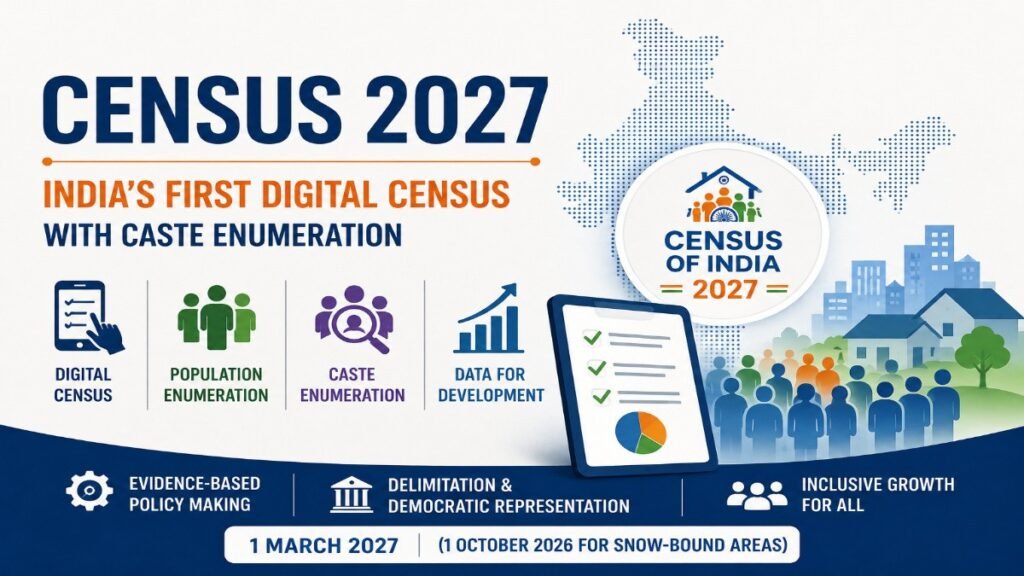
India is preparing for the 16th Census (2027), which will be the first digital Census and the first Census after 2011. It will also include caste enumeration along with population enumeration, making Census 2027 one of the most significant demographic exercises in independent India. The Census in India 2027 will therefore have major implications for policymaking, welfare planning, delimitation and democratic governance.
Master Current Affairs. Ace BPSC Mains.
BPSC Mains Current Affairs & International Relations Course
Master GS Paper-I (Section-II) with 116 exam-oriented topics, 5 structured lessons and downloadable PDF notes—all in one comprehensive course.
✔ 116 Exam-Oriented Topics • ✔ 5 Comprehensive Lessons • ✔ Downloadable PDF Notes • ✔ Updated for 72nd BPSC Mains
2. Why in News?
- The Government of India has announced that the 16th Population Census (Census 2027) will be conducted in two phases, with the reference date as 1 March 2027 (1 October 2026 for snow-bound areas). The announcement has made Census 2027 a major current affairs issue.
- Caste enumeration will be carried out along with the Population Census for the first time after Independence, making it a landmark demographic exercise.
- Census 2027 will be India’s first fully digital Census, using mobile applications, a central digital platform, and a self-enumeration facility for citizens. This marks an important technological shift in the Census in India 2027.
- The Census is crucial for post-2026 delimitation of Parliamentary constituencies and the implementation of the Women’s Reservation Act, making Census 2027 politically and constitutionally significant.
- The 2021 Census was postponed due to the COVID-19 pandemic, resulting in a 16-year gap since the last Census (2011).
3. Population Census in India
Meaning
A Population Census is the official process of collecting, compiling, analysing and publishing demographic, social and economic information relating to every individual in the country at a specified time. It provides reliable data for evidence-based policymaking and development planning. Census 2027 will continue this role while introducing digital methods for data collection and processing.
Legal Framework
- Conducted under the Census Act, 1948.
- Carried out by the Office of the Registrar General & Census Commissioner, India under the Ministry of Home Affairs.
- India has been conducting a Census every 10 years since 1881, making it one of the largest administrative exercises in the world. The Census in India 2027 will be the latest edition of this long-running demographic exercise.
Objectives
- To determine the size, distribution and composition of the population.
- To support planning for education, healthcare, housing, employment and infrastructure.
- To provide the basis for delimitation of constituencies, reservation of seats, and allocation of government resources.
- To generate authentic demographic data for research and public policy.
Key Features of Census 2027
- India’s first fully digital Census, using mobile applications and a central digital platform.
- Self-enumeration facility for citizens through an online portal.
- Caste enumeration to be conducted along with the Population Census.
- Conducted in two phases—House Listing & Housing Census, followed by Population Enumeration.
- Reference date: 1 March 2027 (1 October 2026 for snow-bound areas).
Prepare Smarter. Study Better. Ace BPSC Mains.
BPSC Mains GS Paper 1 & 2 Complete Course
Access comprehensive BPSC Mains Notes for GS Paper 1 & 2, covering 378+ topics across 24 PDF lessons, with dedicated Bihar coverage, practice questions and downloadable study material.
✓ GS Paper 1 & 2 • ✓ 378+ Topics • ✓ 24 PDF Lessons • ✓ Bihar-Specific Coverage • ✓ Downloadable Notes
4. Significance of Population Census
Foundation for Evidence-based Policymaking
- Census is the largest source of demographic, social and economic data in India, providing reliable information for policy formulation at the national, state and local levels.
- It enables governments to make data-driven decisions instead of relying on estimates. Census 2027 will provide updated demographic information for this purpose.
Basis for Development Planning and Resource Allocation
- Census data is used for planning schools, hospitals, roads, housing, drinking water, sanitation and urban infrastructure.
- It also guides the equitable allocation of financial resources among States, districts and local bodies based on population and socio-economic characteristics. The Population Census therefore remains central to development planning.
Effective Implementation of Welfare Schemes
- Census provides authentic population data for designing and targeting welfare programmes such as PMAY, National Food Security Act, health, education and social security schemes.
- Accurate demographic information helps identify beneficiaries and improves the efficiency of public expenditure. Census in India 2027 is expected to strengthen this data-based approach.
Strengthens Democratic Governance
- Census data forms the basis for delimitation of Parliamentary and Assembly constituencies and the reservation of seats for Scheduled Castes (SCs) and Scheduled Tribes (STs).
- The post-2026 delimitation exercise and implementation of the Women’s Reservation Act, 2023 are dependent on the completion of Census 2027.
Supports Socio-economic Research
- Census provides comprehensive data on population size, age structure, literacy, migration, occupation, language, religion, housing and fertility, making it an indispensable source for researchers, planners and academic institutions.
- The 2011 Census remains one of the most widely used datasets for socio-economic research, and Census 2027 is expected to provide more granular digital data.
Improves Governance through Digital Innovation
- Census 2027 will be India’s first fully digital Census, featuring mobile-based data collection, self-enumeration, geo-referenced enumeration blocks, and the Census Management & Monitoring System (CMMS) for real-time monitoring.
- These initiatives are expected to improve accuracy, transparency, speed of data processing and evidence-based governance.
5. Challenges & Concerns
Delay in Conducting the Census
The 2021 Census, originally scheduled in two phases (2020–21), was postponed due to the COVID-19 pandemic and administrative reasons. As a result, India will conduct its next Census in 2027, creating a gap of about 16 years since the 2011 Census. This has affected policy planning, welfare targeting, and demographic estimates. The delay has increased the importance of Census 2027 as a reliable and updated Population Census.
Data Privacy and Cyber Security
Since Census 2027 will be India’s first digital Census, concerns have been raised regarding the security of personal data collected through mobile applications and self-enumeration. Ensuring robust cybersecurity, data confidentiality, and compliance with data protection norms will be critical for maintaining public trust.
Caste Enumeration Debate
The inclusion of caste enumeration in Census 2027 has generated significant political and social debate. Supporters argue that it will help formulate evidence-based welfare policies and improve social justice, while critics fear it may intensify caste-based politics and social divisions.
Digital Divide and Operational Challenges
The introduction of self-enumeration and digital data collection may pose difficulties for people in rural, remote and digitally excluded areas. Ensuring digital literacy, internet access, and adequate training of enumerators will be essential for achieving complete and accurate coverage in the Census in India 2027.
Impact on Governance and Electoral Reforms
The delay in Census has also postponed several important governance reforms, including the delimitation of Parliamentary constituencies and the implementation of women’s reservation in Parliament and State Legislatures, both of which depend on updated Census data.
Experience the Quality Before You Enroll
Download Free Sample Notes (PDF)
Download a free sample of our BPSC Mains Current Affairs Notes and experience the structured, exam-oriented content before enrolling. Explore the presentation, answer-writing approach, and overall quality of the complete course.
✔ Free Download • ✔ Exam-Oriented Notes • ✔ Updated Content • ✔ Structured for BPSC Mains
BPSC Mains Practice Questions
Q1. Population Census is the backbone of evidence-based governance in India. Discuss the significance of Census 2027 in the context of digital governance, caste enumeration, delimitation of constituencies, and implementation of welfare schemes.
Q2. The Population Census is not merely a demographic exercise but a vital instrument for democratic governance and socio-economic planning. Examine the major features of Census 2027 and discuss the challenges associated with its implementation.
These questions are useful for understanding the significance of the Census in India 2027 from the perspective of BPSC Mains.
Learn More from the Office of the Registrar General & Census Commissioner, India
Readers interested in Census 2027, the Population Census, census-related data, demographic information, and the official Census in India 2027 process can visit the official website of the Office of the Registrar General & Census Commissioner, India. The portal provides authentic information on Census operations, population data, census publications, demographic statistics, and official updates related to the Census of India.