1. Introduction
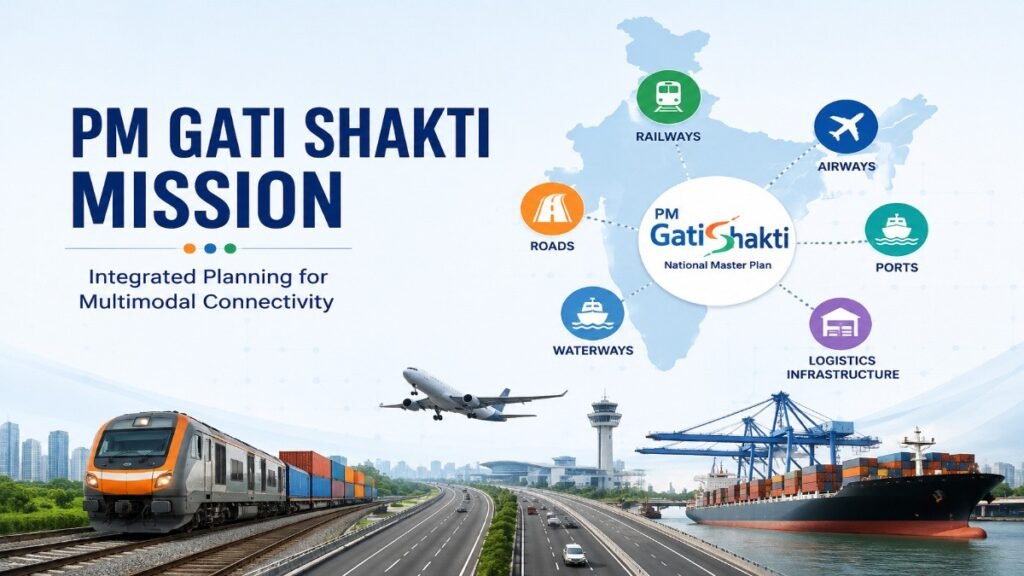
The PM Gati Shakti Mission, formally known as the PM Gati Shakti – National Master Plan (NMP), is an integrated, GIS-based multimodal infrastructure development initiative launched by the Government of India on 13 October 2021. It aims to ensure coordinated planning and seamless connectivity among different modes of transport, including roads, railways, ports, airports, waterways, logistics parks, pipelines and digital infrastructure. The Gati Shakti scheme seeks to break departmental silos and promote holistic infrastructure planning for faster economic growth.
The PM Gati Shakti Mission is an important pillar of India’s vision of becoming a developed nation (Viksit Bharat 2047). By improving multimodal connectivity, reducing logistics costs and strengthening supply-chain efficiency, the initiative supports programmes such as Make in India, National Infrastructure Pipeline (NIP) and the National Logistics Policy (NLP).
Since its launch, the National Master Plan has onboarded 44 Central Ministries, 36 States and Union Territories, and integrated 1,600+ GIS data layers. This makes the Gati Shakti scheme a major digital platform for coordinated infrastructure planning and one of India’s most important initiatives for improving logistics and connectivity.
Master Current Affairs. Ace BPSC Mains.
BPSC Mains Current Affairs & International Relations Course
Master GS Paper-I (Section-II) with 116 exam-oriented topics, 5 structured lessons and downloadable PDF notes—all in one comprehensive course.
✔ 116 Exam-Oriented Topics • ✔ 5 Comprehensive Lessons • ✔ Downloadable PDF Notes • ✔ Updated for 72nd BPSC Mains
2. Why in News?
- The PM Gati Shakti Mission completed three years in October 2024, with the Government highlighting its growing role as India’s primary platform for integrated infrastructure planning and multimodal connectivity.
- The National Master Plan (NMP) has onboarded 44 Central Ministries and 36 States and Union Territories, integrating 1,600+ GIS data layers to facilitate coordinated infrastructure planning across sectors.
- The Network Planning Group (NPG) has evaluated major infrastructure projects under the Gati Shakti scheme to identify infrastructure gaps, avoid duplication and improve multimodal connectivity. As of August 2025, the NPG had evaluated 293 projects worth about ₹13.59 lakh crore.
- The PM Gati Shakti Mission has become an important planning backbone for flagship infrastructure programmes such as Bharatmala, Sagarmala, Dedicated Freight Corridors, Inland Waterways, UDAN, Industrial Corridors and Multi-Modal Logistics Parks.
- The initiative has also been integrated with the National Logistics Policy (NLP) to reduce logistics costs, improve supply-chain efficiency and support the vision of Viksit Bharat 2047 and Make in India.
Thus, the Gati Shakti scheme has evolved beyond a transport infrastructure programme into a broader framework for integrated infrastructure planning, logistics development and economic growth.
Prepare Smarter. Study Better. Ace BPSC Mains.
BPSC Mains GS Paper 1 & 2 Complete Course
Access comprehensive BPSC Mains Notes for GS Paper 1 & 2, covering 378+ topics across 24 PDF lessons, with dedicated Bihar coverage, practice questions and downloadable study material.
✓ GS Paper 1 & 2 • ✓ 378+ Topics • ✓ 24 PDF Lessons • ✓ Bihar-Specific Coverage • ✓ Downloadable Notes
3. PM Gati Shakti Mission: An Overview
The PM Gati Shakti Mission, formally known as the PM Gati Shakti – National Master Plan (NMP), was launched by the Prime Minister on 13 October 2021 as a whole-of-government initiative for integrated infrastructure planning. It aims to break departmental silos and ensure seamless multimodal connectivity through coordinated planning among Central Ministries, State Governments and infrastructure agencies.
Objectives
The Gati Shakti scheme seeks to:
- Develop integrated multimodal infrastructure across the country.
- Improve first-mile and last-mile connectivity.
- Reduce logistics costs and transit time.
- Eliminate duplication and delays in infrastructure projects through inter-ministerial coordination.
- Enhance India’s global competitiveness by supporting Make in India, National Logistics Policy and Viksit Bharat 2047.
National Master Plan (NMP)
The National Master Plan is the core component of the PM Gati Shakti Mission. It is a GIS-based digital platform that integrates infrastructure planning across sectors on a single portal. The platform includes 44 Central Ministries, 36 States and Union Territories and 1,600+ GIS data layers.
The NMP enables Ministries and States to identify infrastructure gaps, avoid duplication of projects, optimise resource utilisation and plan projects through a common spatial database.
Technology-driven GIS Platform
The Gati Shakti scheme uses Geographic Information System (GIS) technology for data-driven planning. The platform overlays multiple datasets such as:
- Roads and highways
- Railways
- Airports
- Ports and waterways
- Industrial corridors
- Power transmission lines
- Telecom infrastructure
- Forests and protected areas
- Land-use and demographic data
This enables planners to identify the optimal location and route for new infrastructure projects while reducing delays associated with land acquisition, environmental clearances and overlapping projects.
Scope and Coverage
The PM Gati Shakti Mission covers the wider infrastructure ecosystem and integrates planning around the seven engines of economic growth:
- Railways
- Roads
- Ports
- Waterways
- Airports
- Mass Transport
- Logistics Infrastructure
These are supported by complementary sectors such as energy, telecommunications, social infrastructure and digital connectivity, creating an integrated multimodal network across the country.
Thus, the Gati Shakti scheme represents a shift from fragmented, department-wise infrastructure development towards integrated, technology-enabled and coordinated planning.
4. Key Features of PM Gati Shakti Mission
National Master Plan (NMP)
The PM Gati Shakti Mission is built around a GIS-enabled National Master Plan that integrates infrastructure planning across Ministries and States. It currently connects 44 Central Ministries, 36 States/UTs and 1,600+ GIS data layers, allowing planners to make coordinated decisions using a common spatial database.
Six Pillars of the Gati Shakti Scheme
The Gati Shakti scheme is based on six major pillars:
- Comprehensiveness: Integrates existing and proposed infrastructure projects on a single platform.
- Prioritisation: Helps Ministries identify and prioritise projects according to national requirements.
- Optimisation: Identifies infrastructure gaps and promotes efficient utilisation of resources.
- Synchronisation: Promotes coordination among Ministries and States to avoid duplication and delays.
- Analytical: Uses GIS and data analytics for evidence-based infrastructure planning.
- Dynamic: Allows infrastructure data to be updated continuously for better monitoring and project management.
Seven Engines of Infrastructure Development
The PM Gati Shakti Mission focuses on seven key engines:
- Railways
- Roads
- Ports
- Waterways
- Airports
- Mass Transport
- Logistics Infrastructure
These are supported by sectors such as energy, telecommunications, social infrastructure and digital connectivity.
Integrated Planning through Network Planning Group
The Network Planning Group (NPG) evaluates major infrastructure projects from multiple Ministries before implementation. It examines projects from the perspective of multimodal connectivity, last-mile connectivity and infrastructure gaps.
As of August 2025, the NPG had evaluated 293 infrastructure projects worth approximately ₹13.59 lakh crore. This mechanism helps ensure that projects planned under the Gati Shakti scheme complement rather than duplicate one another.
State Master Plans
All 36 States and Union Territories have been integrated with the PM Gati Shakti Mission and are developing State Master Plans aligned with the National Master Plan. This promotes coordinated infrastructure development between the Union and States.
Support to National Infrastructure Programmes
The Gati Shakti scheme serves as a planning backbone for major programmes such as:
- Bharatmala Pariyojana
- Sagarmala Programme
- Dedicated Freight Corridors
- UDAN
- Industrial Corridors
- Multi-Modal Logistics Parks
- Inland Waterways Development
- National Logistics Policy
Overall, the PM Gati Shakti Mission combines GIS technology, institutional coordination and multimodal planning to create a more integrated infrastructure network across India.
5. Achievements and Progress
Massive Institutional Integration
Since its launch in October 2021, the PM Gati Shakti Mission has emerged as India’s major integrated infrastructure planning platform. The National Master Plan (NMP) has onboarded 44 Central Ministries and 36 States and Union Territories, with more than 1,600 GIS data layers integrated into the platform. This has enabled coordinated planning across different infrastructure sectors.
Faster Infrastructure Planning
The Network Planning Group (NPG) has institutionalised integrated project appraisal by evaluating infrastructure proposals from multiple Ministries before implementation. As of August 2025, the NPG had examined 293 infrastructure projects with an estimated investment of ₹13.59 lakh crore. This process helps identify infrastructure gaps, improve multimodal connectivity and avoid duplication.
Improved Multimodal Connectivity
The Gati Shakti scheme has become a common planning platform for major infrastructure programmes such as:
- Bharatmala Pariyojana
- Sagarmala Programme
- Dedicated Freight Corridors (DFCs)
- UDAN Scheme
- Industrial Corridors
- Multi-Modal Logistics Parks (MMLPs)
- Inland Waterways Development
This integrated approach helps improve connectivity between roads, railways, ports, airports and logistics hubs, thereby reducing bottlenecks in the movement of goods and passengers.
Strengthening Logistics and Supply Chains
The PM Gati Shakti Mission complements the National Logistics Policy (2022) by promoting seamless movement of goods across different modes of transport. Better multimodal connectivity can reduce logistics costs, shorten transit time, improve supply-chain efficiency and enhance India’s competitiveness in global trade and manufacturing.
Better Centre–State Coordination
All 36 States and Union Territories have been integrated with the National Master Plan and are preparing State Master Plans aligned with the national framework. This has strengthened coordination between the Centre and States and enables infrastructure projects to be planned using a common GIS-based platform.
Technology-driven Decision Making
The Gati Shakti scheme enables Ministries and States to overlay infrastructure data with land records, forests, utility networks, industrial clusters, demographic information and environmental constraints before approving projects. This facilitates evidence-based decision-making and can help minimise land acquisition conflicts and improve project planning.
Overall, the achievements of the PM Gati Shakti Mission demonstrate a shift towards integrated, technology-enabled and multimodal infrastructure planning, although effective implementation remains critical for translating these planning gains into completed projects.
6. Significance of PM Gati Shakti Mission
Reduces Logistics Cost
The PM Gati Shakti Mission promotes integrated multimodal transport by connecting roads, railways, ports, airports and waterways through coordinated infrastructure planning. This can reduce transportation time, avoid multiple handling of cargo and lower logistics costs, thereby improving the competitiveness of Indian products in domestic and global markets.
The Gati Shakti scheme also complements the National Logistics Policy (2022) by improving the efficiency of India’s logistics and supply-chain network.
Accelerates Infrastructure Development
By integrating 44 Central Ministries, 36 States and Union Territories and 1,600+ GIS data layers, the PM Gati Shakti Mission enables better project planning and coordination. It helps identify infrastructure gaps, reduce duplication and resolve inter-departmental issues at the planning stage.
Promotes Multimodal Connectivity
The Gati Shakti scheme integrates major programmes such as Bharatmala, Sagarmala, Dedicated Freight Corridors, UDAN, Industrial Corridors and Multi-Modal Logistics Parks. This creates better connections between different modes of transport and improves the movement of both freight and passengers.
Boosts Manufacturing and Economic Growth
Efficient infrastructure lowers transportation costs, improves supply-chain reliability and can attract domestic and foreign investment. The PM Gati Shakti Mission therefore supports initiatives such as Make in India, Atmanirbhar Bharat, National Infrastructure Pipeline (NIP) and the vision of Viksit Bharat 2047.
Enhances Ease of Doing Business
The GIS-based National Master Plan allows Ministries and States to make evidence-based infrastructure decisions. Better connectivity to industrial clusters, markets, ports and logistics hubs can improve the business environment and reduce infrastructure-related bottlenecks.
Promotes Balanced Regional Development
The Gati Shakti scheme can help identify infrastructure-deficient regions and improve connectivity to aspirational districts, border areas, tribal regions, ports and economic zones. Better connectivity can expand access to markets, employment, healthcare and education and thereby contribute to more balanced regional development.
Improves Transparency and Governance
The GIS-based National Master Plan facilitates data sharing, coordinated decision-making and project monitoring among different Ministries and States. By reducing duplication and improving resource planning, the PM Gati Shakti Mission can promote more efficient utilisation of public investment and strengthen infrastructure governance.
Thus, the significance of the Gati Shakti scheme extends beyond transport infrastructure. It represents a broader shift towards integrated planning, lower logistics costs, regional connectivity and technology-enabled governance.
7. Challenges of PM Gati Shakti Mission
Inter-Ministerial Coordination
The PM Gati Shakti Mission seeks to integrate infrastructure planning across 44 Central Ministries and 36 States/UTs. However, different Ministries often have different priorities, planning cycles and approval mechanisms. Ensuring seamless coordination among multiple agencies therefore remains a challenge.
The Gati Shakti scheme has improved coordination through the National Master Plan and Network Planning Group, but achieving complete synchronisation across all infrastructure agencies requires continuous institutional cooperation.
Data Integration and Real-Time Updating
The effectiveness of the PM Gati Shakti Mission depends heavily on the accuracy and timely updating of its 1,600+ GIS data layers. Integrating and continuously updating information from multiple Ministries and States is technically and administratively complex.
Inaccurate or outdated information relating to land records, utility networks, environmental constraints and infrastructure assets can affect project planning and route optimisation.
Centre–State Coordination
Infrastructure development requires close cooperation between the Union and State Governments. Although all 36 States and Union Territories have been onboarded, differences in institutional capacity, technical expertise and administrative preparedness can affect the quality and speed of implementation of the Gati Shakti scheme.
Some States have stronger GIS capabilities and planning institutions, while others require greater technical and financial support.
Land Acquisition and Environmental Clearances
Despite GIS-based planning, infrastructure projects can still face delays because of land acquisition disputes, forest clearances, environmental approvals and rehabilitation issues.
For example, linear infrastructure such as highways, railway corridors and transmission lines often passes through agricultural land, forests and densely populated areas, requiring multiple statutory approvals.
Financing and Timely Project Execution
The PM Gati Shakti Mission supports infrastructure projects involving investments worth several lakh crore rupees. Ensuring adequate financing, timely release of funds and efficient execution is therefore a major challenge.
As of August 2025, the Network Planning Group had evaluated 293 infrastructure projects worth about ₹13.59 lakh crore. Converting this large project pipeline into completed infrastructure requires sustained financial support and effective monitoring.
Capacity Building and Technology Adoption
The Gati Shakti scheme is a technology-intensive initiative requiring officials to use GIS, spatial data, satellite imagery and digital decision-support tools. Shortage of trained GIS professionals and uneven digital capacity among implementing agencies can limit the effectiveness of the platform.
Therefore, continuous training and institutional capacity building are essential for ensuring that the PM Gati Shakti Mission translates its digital planning capabilities into efficient infrastructure execution.
8. Way Forward
- Strengthen Inter-Ministerial Coordination: Institutional mechanisms such as the Network Planning Group (NPG) should be further strengthened to ensure seamless coordination among 44 Central Ministries, States and implementing agencies. Regular review meetings and integrated project monitoring can minimise delays and duplication of infrastructure projects.
- Improve Quality and Real-Time Updating of GIS Data: Ministries and States should continuously update the 1,600+ GIS data layers on the National Master Plan to improve planning accuracy. Integration of satellite imagery, land records, utility maps and environmental databases should be enhanced for evidence-based decision-making.
- Strengthen Centre–State Partnership: All States and Union Territories should prepare and regularly update their State Master Plans in alignment with the National Master Plan. Technical and financial support should be provided to States with limited GIS and planning capacity.
- Accelerate Land Acquisition and Statutory Clearances: Greater use of GIS-based planning, advance land identification, digital land records and single-window clearance mechanisms can reduce delays in land acquisition, forest clearance and environmental approvals.
- Enhance Investment and Private Sector Participation: Greater participation through Public-Private Partnerships (PPP), Infrastructure Investment Trusts (InvITs) and innovative financing mechanisms should be encouraged to meet the growing investment requirements of large infrastructure projects under the PM Gati Shakti Mission.
- Build Skilled Human Resources and Adopt Emerging Technologies: Continuous training in GIS, Artificial Intelligence (AI), Remote Sensing and data analytics should be provided to officials involved in infrastructure planning. Wider adoption of digital technologies can improve project monitoring, logistics efficiency and evidence-based governance.
- Align with Viksit Bharat 2047: The Gati Shakti scheme should continue to function as a digital backbone for programmes such as the National Logistics Policy, Bharatmala, Sagarmala, Dedicated Freight Corridors, Industrial Corridors and PM Gati Shakti Cargo Terminals, supporting India’s objective of becoming a globally competitive manufacturing and logistics hub by 2047.
A stronger institutional framework, better data integration, adequate financing and skilled manpower will help the PM Gati Shakti Mission translate integrated planning into faster and more efficient infrastructure development.
Experience the Quality Before You Enroll
Download Free Sample Notes (PDF)
Download a free sample of our BPSC Mains Current Affairs Notes and experience the structured, exam-oriented content before enrolling. Explore the presentation, answer-writing approach, and overall quality of the complete course.
✔ Free Download • ✔ Exam-Oriented Notes • ✔ Updated Content • ✔ Structured for BPSC Mains
BPSC Mains Practice Questions
Q1. “PM Gati Shakti has transformed India’s infrastructure planning from a sectoral approach to an integrated multimodal framework.” Discuss the key features, achievements and significance of the PM Gati Shakti Mission. Also examine the major challenges in its effective implementation.
Q2. Evaluate the role of PM Gati Shakti – National Master Plan in reducing logistics costs and improving multimodal connectivity in India. How does its convergence with the National Logistics Policy contribute to the vision of Viksit Bharat 2047?
These questions are important for BPSC Mains because they require an integrated understanding of the PM Gati Shakti Mission, the Gati Shakti scheme, multimodal infrastructure, logistics development, Centre–State coordination and India’s long-term development goals.
Learn More from the Ministry of Commerce & Industry, Government of India
Readers interested in the PM Gati Shakti Mission, the Gati Shakti scheme, National Master Plan, multimodal connectivity, logistics development and integrated infrastructure planning can visit the official website of the Ministry of Commerce & Industry, Government of India. The portal provides authentic information on logistics, infrastructure development, trade facilitation and initiatives supporting India’s economic growth.