1. Introduction
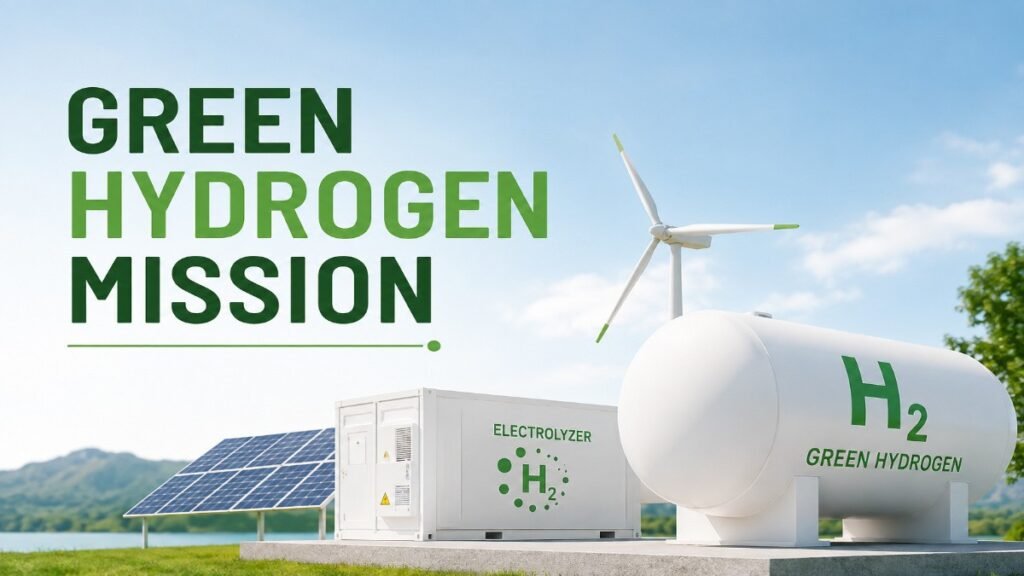
Green Hydrogen is hydrogen produced by the electrolysis of water using electricity generated entirely from renewable energy sources such as solar and wind power. Since the process does not emit carbon dioxide, it is regarded as a clean fuel capable of decarbonising hard-to-abate sectors such as steel, fertilisers, refineries, shipping and heavy transport. The Green Hydrogen Mission is considered a key pillar of India’s transition towards a low-carbon economy and the achievement of its Net Zero emissions target by 2070.
To accelerate its adoption, the Union Cabinet approved the National Green Hydrogen Mission (NGHM) on 4 January 2023 with an outlay of ₹19,744 crore under the Ministry of New and Renewable Energy (MNRE). The Green Hydrogen Mission aims to make India a global hub for the production, utilisation and export of Green Hydrogen and its derivatives. By 2030, India targets 5 Million Metric Tonnes (MMT) of annual Green Hydrogen production, 125 GW of additional renewable energy capacity, over ₹8 lakh crore in investments, creation of over 6 lakh jobs, reduction of fossil fuel imports by over ₹1 lakh crore, and avoidance of nearly 50 MMT of CO₂ emissions annually.
Master Current Affairs. Ace BPSC Mains.
BPSC Mains Current Affairs & International Relations Course
Master GS Paper-I (Section-II) with 116 exam-oriented topics, 5 structured lessons and downloadable PDF notes—all in one comprehensive course.
✔ 116 Exam-Oriented Topics • ✔ 5 Comprehensive Lessons • ✔ Downloadable PDF Notes • ✔ Updated for 72nd BPSC Mains
2. Key Features of the National Green Hydrogen Mission
- Strategic Interventions for Green Hydrogen Transition (SIGHT) Programme: The flagship component of the Green Hydrogen Mission with an outlay of ₹17,490 crore, comprising: ₹4,440 crore for domestic electrolyser manufacturing and ₹13,050 crore for Green Hydrogen production incentives.
- Green Hydrogen Hubs: The Green Hydrogen Mission envisages the development of Green Hydrogen Hubs in regions having high renewable energy potential and industrial demand. These hubs will support production, storage, transportation and utilisation of Green Hydrogen, with dedicated financial support under the Mission.
- Pilot Projects: Pilot projects are being implemented in steel, shipping and heavy transport (hydrogen-powered buses and trucks) to demonstrate the commercial viability of Green Hydrogen in hard-to-abate sectors.
- Green Hydrogen Certification Scheme: The Green Hydrogen Mission has introduced the Green Hydrogen Certification Scheme of India (GHCI) to certify that hydrogen qualifies as “green” based on a prescribed emission standard of 2 kg CO₂ equivalent per kg of hydrogen. This enhances transparency, export credibility and investor confidence.
- Research & Development (R&D): An allocation of ₹400 crore has been made to support indigenous technologies, improve electrolyser efficiency, reduce production costs, and develop advanced solutions for hydrogen storage, transportation and utilisation.
- Skill Development: The Green Hydrogen Mission promotes skilling, upskilling and reskilling of the workforce in collaboration with the Ministry of Skill Development and Entrepreneurship to create a specialised Green Hydrogen ecosystem.
- Enabling Policy Framework: To encourage investment, the Government provides measures such as waiver of interstate transmission charges, renewable energy banking, time-bound open access, and facilitation of land and infrastructure for Green Hydrogen projects.
Prepare Smarter. Study Better. Ace BPSC Mains.
BPSC Mains GS Paper 1 & 2 Complete Course
Access comprehensive BPSC Mains Notes for GS Paper 1 & 2, covering 378+ topics across 24 PDF lessons, with dedicated Bihar coverage, practice questions and downloadable study material.
✓ GS Paper 1 & 2 • ✓ 378+ Topics • ✓ 24 PDF Lessons • ✓ Bihar-Specific Coverage • ✓ Downloadable Notes
3. Achievements, Progress & Significance
Strong Policy and Financial Support
The Government has operationalised the Strategic Interventions for Green Hydrogen Transition (SIGHT) Programme, which is the flagship component of the Green Hydrogen Mission. Under the electrolyser manufacturing incentive, 15 companies have been awarded incentives to establish a 3,000 MW annual electrolyser manufacturing capacity with a total incentive of ₹4,440 crore. This is expected to reduce India’s dependence on imported electrolysers and strengthen domestic manufacturing.
Significant Progress in Green Hydrogen Production
Under the Green Hydrogen production incentive, 18 companies have been allocated a cumulative production capacity of 8.62 lakh tonnes (862,000 tonnes) per annum. In addition, incentives have been awarded for the procurement of 20,000 tonnes per annum of Green Hydrogen for refineries, marking an important step towards commercial adoption in the petroleum sector.
Development of Green Hydrogen Ecosystem
The Green Hydrogen Mission has initiated the development of Green Hydrogen Hubs and launched pilot projects in steel, mobility and shipping sectors. Financial support includes:
- ₹455 crore for low-carbon steel pilot projects.
- ₹496 crore for mobility pilot projects.
- ₹115 crore for shipping pilot projects.
- ₹400 crore for Green Hydrogen Hubs and related infrastructure.
These initiatives aim to demonstrate the commercial viability of Green Hydrogen in hard-to-abate sectors.
Strengthens Energy Security
India imports nearly 85% of its crude oil and around 50% of its natural gas requirements. By promoting domestic production of Green Hydrogen, the Green Hydrogen Mission seeks to reduce dependence on imported fossil fuels and enhance India’s long-term energy security. By 2030, the Mission aims to reduce fossil fuel imports by over ₹1 lakh crore annually.
Supports Net Zero and Decarbonisation
Green Hydrogen offers one of the most effective pathways to decarbonise sectors where direct electrification is difficult, including steel, fertilisers, refineries, shipping and heavy transport. The Green Hydrogen Mission targets the avoidance of nearly 50 Million Metric Tonnes (MMT) of CO₂ emissions every year by 2030, contributing significantly to India’s Net Zero by 2070 commitment.
Promotes Industrial Growth and Employment
The Green Hydrogen Mission is expected to attract over ₹8 lakh crore of investments and generate more than 6 lakh employment opportunities by 2030. It also supports the objectives of Make in India, Atmanirbhar Bharat and Production-Linked Manufacturing by creating a domestic ecosystem for electrolysers, fuel cells and Green Hydrogen technologies.
Positions India as a Global Green Hydrogen Hub
With abundant solar and wind energy resources, India has the potential to become one of the world’s most competitive producers of Green Hydrogen and Green Ammonia. The Green Hydrogen Mission aims to establish India as a global hub for the production, utilisation and export of Green Hydrogen and its derivatives, particularly to markets such as Europe, Japan and South Korea, where demand for clean hydrogen is expected to grow rapidly.
4. Challenges & Way Forward
High Cost of Green Hydrogen Production
The biggest challenge for the Green Hydrogen Mission is the high production cost of Green Hydrogen compared to Grey Hydrogen produced from natural gas. The cost is driven by expensive electrolysers and the large quantity of renewable electricity required for electrolysis. According to MNRE, reducing production cost remains a key priority under the Mission. Expand the SIGHT incentive scheme, promote domestic electrolyser manufacturing, and achieve economies of scale to make Green Hydrogen commercially competitive.
Limited Domestic Manufacturing Capacity
India is still developing indigenous manufacturing of electrolysers, the core technology used to produce Green Hydrogen. Dependence on imported equipment increases project costs and supply-chain risks. Strengthen the Make in India ecosystem through Production-Linked Incentives (PLI), R&D and technology partnerships. Under the Green Hydrogen Mission, 15 companies have already been allocated incentives to establish 3,000 MW per annum electrolyser manufacturing capacity.
Huge Renewable Energy Requirement
Producing Green Hydrogen requires a massive supply of renewable electricity. To achieve the Green Hydrogen Mission target of 5 MMT annual production by 2030, India will require around 125 GW of additional renewable energy capacity, posing challenges in land availability, transmission infrastructure and grid integration. Accelerate solar and wind capacity addition, strengthen interstate transmission networks and promote renewable energy banking and open access policies.
Storage and Transportation Challenges
Hydrogen is highly inflammable, has low volumetric energy density, and requires specialised storage tanks, pipelines or conversion into derivatives such as Green Ammonia for long-distance transport. The absence of adequate hydrogen infrastructure increases logistics costs. Develop dedicated Hydrogen Hubs, pipelines, storage facilities and export terminals under the National Green Hydrogen Mission.
Limited Domestic Demand
Currently, nearly 99% of India’s hydrogen consumption is concentrated in petroleum refineries and fertiliser production, while the use of Green Hydrogen in sectors such as steel, shipping and heavy transport is still at a pilot stage. Low initial demand affects commercial viability. Introduce Green Hydrogen Purchase Obligations (GHPOs), expand pilot projects, and promote Green Hydrogen use in refineries, fertilisers, steel, shipping and heavy mobility to create sustained domestic demand.
Need for Research, Innovation and Skilled Workforce
Green Hydrogen technologies such as advanced electrolysers, storage systems and fuel cells are still evolving. India also requires a skilled workforce for manufacturing, operation and maintenance. Increase investment in R&D, strengthen academia–industry collaboration through the Strategic Hydrogen Innovation Partnership (SHIP), and implement large-scale skill development and reskilling programmes under the Green Hydrogen Mission.
Experience the Quality Before You Enroll
Download Free Sample Notes (PDF)
Download a free sample of our BPSC Mains Current Affairs Notes and experience the structured, exam-oriented content before enrolling. Explore the presentation, answer-writing approach, and overall quality of the complete course.
✔ Free Download • ✔ Exam-Oriented Notes • ✔ Updated Content • ✔ Structured for BPSC Mains
BPSC Mains Practice Questions
Q1. The Green Hydrogen Mission has the potential to transform India from an energy-importing nation to a global hub for clean energy. Discuss the objectives, key features and significance of the Mission. Also examine the major challenges in achieving its 2030 targets.
Q2. Green Hydrogen is considered a key pillar for achieving India’s Net Zero target by 2070*. Evaluate the role of the Green Hydrogen Mission in promoting energy security, industrial decarbonisation and sustainable economic growth in India.*
Learn More from the Ministry of New and Renewable Energy, Government of India
Readers interested in the Green Hydrogen Mission, National Green Hydrogen Mission, Green Hydrogen production, SIGHT Programme, Green Hydrogen Hubs, pilot projects, research and development, skill development, certification, and India’s clean energy transition can visit the official website of the Ministry of New and Renewable Energy, Government of India. The portal provides authentic information on the objectives, financial outlay, policy framework, implementation mechanisms, infrastructure development, research and development, and various initiatives being undertaken under the Green Hydrogen Mission.