1. Introduction
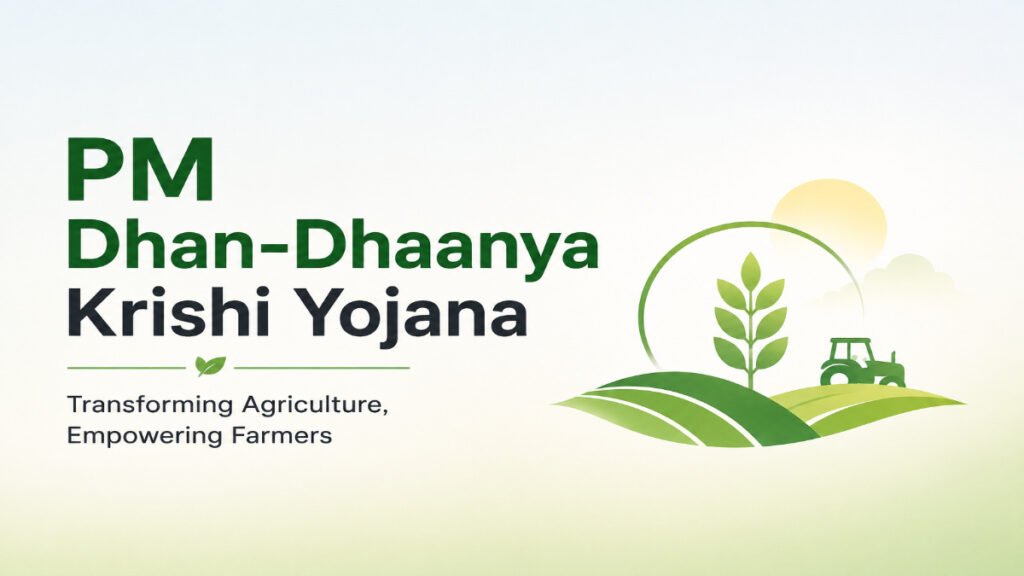
The PM Dhan-Dhaanya Krishi Yojana (PM-DDKY) is a flagship agricultural development scheme approved by the Union Cabinet on 16 July 2025 following its announcement in the Union Budget 2025–26. The scheme aims to transform 100 low-performing agricultural districts across India by improving agricultural productivity, promoting crop diversification, expanding irrigation facilities, strengthening post-harvest infrastructure and improving farmers’ access to institutional credit. The PM Dhan-Dhaanya Krishi Yojana will be implemented for six years (2025–26 to 2030–31) through the convergence of 36 existing schemes of 11 Central Ministries, State Government schemes and local private-sector participation.
The scheme is in the news because it is the first national programme focused exclusively on underperforming agricultural districts, inspired by the Aspirational District Programme. It seeks to benefit nearly 1.7 crore farmers through an annual outlay of about ₹24,000 crore, making the PM Dhan-Dhaanya Krishi Yojana one of India’s largest district-based agricultural development initiatives.
Master Current Affairs. Ace BPSC Mains.
BPSC Mains Current Affairs & International Relations Course
Master GS Paper-I (Section-II) with 116 exam-oriented topics, 5 structured lessons and downloadable PDF notes—all in one comprehensive course.
✔ 116 Exam-Oriented Topics • ✔ 5 Comprehensive Lessons • ✔ Downloadable PDF Notes • ✔ Updated for 72nd BPSC Mains
2. Objectives and Key Features
The primary objective of PM Dhan-Dhaanya Krishi Yojana is to enhance agricultural productivity and improve farmers’ income by addressing structural challenges in low-performing districts. The scheme promotes crop diversification, sustainable farming practices, improved irrigation coverage, expansion of post-harvest storage at Panchayat and Block levels, and easier availability of both short-term and long-term agricultural credit. It also seeks to reduce regional disparities in agricultural development and strengthen food and nutritional security.
A unique feature of the PM Dhan-Dhaanya Krishi Yojana is its district-centric planning approach, under which each selected district will prepare a customised agricultural development plan based on local needs. District selection is based on three indicators—low agricultural productivity, low cropping intensity and below-average credit disbursement. The implementation will be monitored through measurable performance indicators with active participation of district administrations, farmers’ organisations and local institutions. The convergence model is expected to ensure efficient utilisation of existing resources rather than creating parallel schemes.
Prepare Smarter. Study Better. Ace BPSC Mains.
BPSC Mains GS Paper 1 & 2 Complete Course
Access comprehensive BPSC Mains Notes for GS Paper 1 & 2, covering 378+ topics across 24 PDF lessons, with dedicated Bihar coverage, practice questions and downloadable study material.
✓ GS Paper 1 & 2 • ✓ 378+ Topics • ✓ 24 PDF Lessons • ✓ Bihar-Specific Coverage • ✓ Downloadable Notes
3. Significance, Challenges and Way Forward
PM Dhan-Dhaanya Krishi Yojana has the potential to reduce regional inequalities in Indian agriculture by focusing resources on the country’s most backward agricultural districts. By improving productivity, irrigation, storage and credit availability, the scheme can enhance farmers’ incomes, reduce post-harvest losses, encourage crop diversification and strengthen rural livelihoods. It also complements national initiatives such as PM-KISAN, PM Krishi Sinchai Yojana, Digital Agriculture Mission and the vision of Viksit Bharat @2047.
However, the scheme may face challenges such as effective coordination among multiple ministries, timely implementation by State Governments, inadequate institutional capacity at the district level, uneven availability of irrigation infrastructure and limited awareness among farmers. Ensuring transparent monitoring, timely release of funds and effective convergence of existing schemes will be critical for its success. Greater use of digital agriculture, climate-resilient farming practices, Farmer Producer Organisations (FPOs), scientific extension services and regular performance evaluation can help the PM Dhan-Dhaanya Krishi Yojana achieve its objective of transforming India’s lagging agricultural districts into engines of rural prosperity.
Experience the Quality Before You Enroll
Download Free Sample Notes (PDF)
Download a free sample of our BPSC Mains Current Affairs Notes and experience the structured, exam-oriented content before enrolling. Explore the presentation, answer-writing approach, and overall quality of the complete course.
✔ Free Download • ✔ Exam-Oriented Notes • ✔ Updated Content • ✔ Structured for BPSC Mains
BPSC Mains Practice Questions
Q1. Discuss the objectives and key features of the PM Dhan-Dhaanya Krishi Yojana. How can it contribute to improving agricultural productivity in India?
Learn More from the Department of Agriculture & Farmers Welfare, Government of India
Readers interested in the PM Dhan-Dhaanya Krishi Yojana, agricultural productivity, crop diversification, irrigation, post-harvest infrastructure, institutional credit, farmer welfare and district-based agricultural development initiatives can visit the official website of the Department of Agriculture & Farmers Welfare, Government of India. The portal provides authentic information on government agricultural schemes, farmer welfare programmes, agricultural policies, productivity enhancement initiatives and measures aimed at strengthening India’s agricultural sector.