1. Introduction
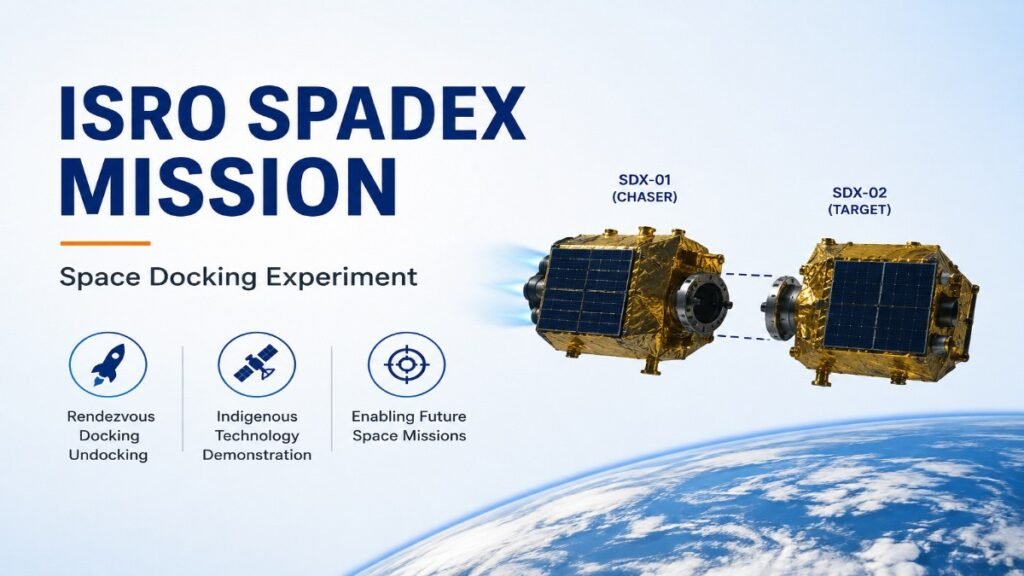
The ISRO SPADEX Mission (Space Docking Experiment) is a technology demonstration mission of the Indian Space Research Organisation (ISRO) designed to develop and validate in-space rendezvous, docking and undocking technologies using two small satellites—SDX-01 (Chaser) and SDX-02 (Target), each weighing about 220 kg. The ISRO SPADEX Mission was successfully launched aboard PSLV-C60 from the Satish Dhawan Space Centre, Sriharikota, on 30 December 2024 into a 470 km circular Low Earth Orbit (LEO).
The ISRO SPADEX Mission gained national importance after ISRO successfully docked the two satellites on 16 January 2025, making India the fourth country in the world, after the United States, Russia and China, to demonstrate indigenous space docking capability. Subsequently, ISRO successfully undocked the satellites on 13 March 2025 and carried out a second fully autonomous docking with power transfer on 20–21 April 2025, successfully completing all major mission objectives.
Master Current Affairs. Ace BPSC Mains.
BPSC Mains Current Affairs & International Relations Course
Master GS Paper-I (Section-II) with 116 exam-oriented topics, 5 structured lessons and downloadable PDF notes—all in one comprehensive course.
✔ 116 Exam-Oriented Topics • ✔ 5 Comprehensive Lessons • ✔ Downloadable PDF Notes • ✔ Updated for 72nd BPSC Mains
2. Objectives and Key Features
The primary objective of the ISRO SPADEX Mission is to demonstrate autonomous rendezvous, docking and undocking between two spacecraft in orbit. It also aims to validate technologies required for future satellite servicing, in-space assembly, orbital refuelling, human spaceflight and space station operations. The mission further demonstrates power transfer between docked satellites, composite spacecraft control and payload operations after undocking.
Key Features
- Demonstrates autonomous space docking technology using two indigenous satellites.
- Uses SDX-01 (Chaser) and SDX-02 (Target) satellites of approximately 220 kg each.
- Successfully launched by PSLV-C60 into a 470 km Low Earth Orbit.
- Demonstrates rendezvous, docking, undocking and autonomous navigation.
- Successfully validated bi-directional power transfer between docked satellites.
- Supports payload operations after undocking.
- Serves as a cost-effective technology demonstrator for future Indian space missions.
The capabilities demonstrated by the ISRO SPADEX Mission are important for developing India’s future orbital infrastructure and advanced space exploration capabilities.
Prepare Smarter. Study Better. Ace BPSC Mains.
BPSC Mains GS Paper 1 & 2 Complete Course
Access comprehensive BPSC Mains Notes for GS Paper 1 & 2, covering 378+ topics across 24 PDF lessons, with dedicated Bihar coverage, practice questions and downloadable study material.
✓ GS Paper 1 & 2 • ✓ 378+ Topics • ✓ 24 PDF Lessons • ✓ Bihar-Specific Coverage • ✓ Downloadable Notes
3. Significance, Challenges and Way Forward
The ISRO SPADEX Mission is a landmark achievement in India’s space programme as docking technology is a critical enabling capability for complex space missions involving multiple spacecraft. It will play a vital role in the proposed Bharatiya Antariksh Station (BAS), the Chandrayaan-4 lunar sample return mission, future Gaganyaan missions, satellite servicing and deep-space exploration. The successful demonstration also strengthens India’s technological self-reliance under Atmanirbhar Bharat and enhances its position in the global space sector.
Despite the achievement, future challenges include developing advanced autonomous navigation systems, robotic servicing capabilities, orbital refuelling technologies and long-duration docking systems required for space station operations. Going forward, ISRO should build upon the ISRO SPADEX Mission by integrating these technologies into Bharatiya Antariksh Station, future lunar missions and commercial satellite servicing, while promoting greater participation of the private sector through IN-SPACe. This will strengthen India’s long-term capabilities in human spaceflight and deep-space exploration.
BPSC Mains Practice Question
Q1. Discuss the objectives, key features and significance of the ISRO SPADEX Mission. How will indigenous space docking technology strengthen India’s future space exploration programme?
Learn More from ISRO, Government of India
Readers interested in the ISRO SPADEX Mission, space docking technology, rendezvous and undocking, SDX-01 and SDX-02 satellites, autonomous navigation, power transfer and future applications such as the Bharatiya Antariksh Station and lunar missions can visit the official website of the Indian Space Research Organisation (ISRO). ISRO provides authentic information on the SpaDeX mission, its objectives, technologies, mission milestones and future applications in India’s space programme.