1. Introduction
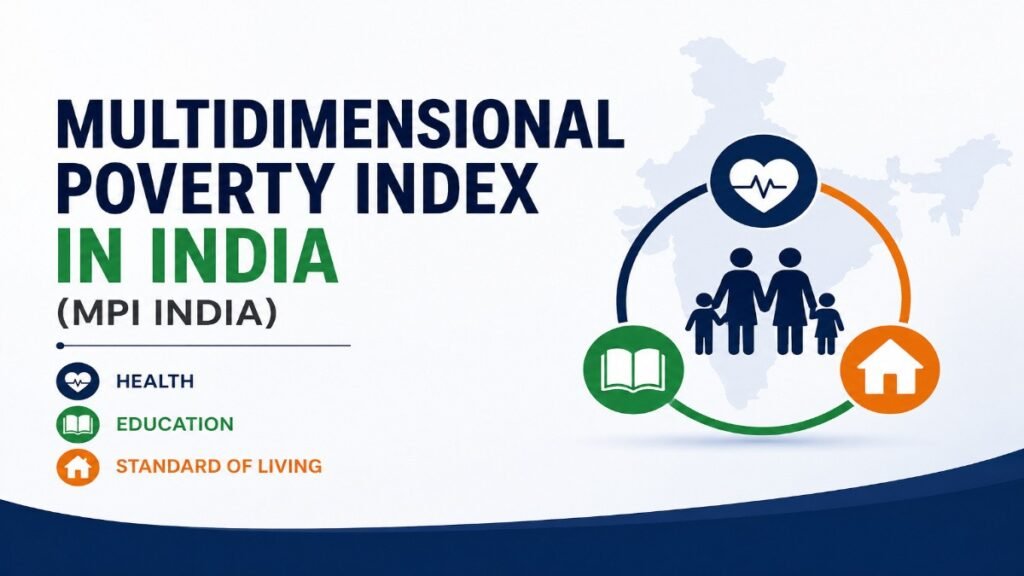
The Multidimensional Poverty Index in India (MPI) is India’s official tool for measuring poverty beyond income by assessing multiple deprivations experienced by households in the areas of health, education and standard of living. Released by NITI Aayog using the Alkire–Foster methodology and based on data from the National Family Health Survey (NFHS), the index provides a comprehensive picture of poverty and supports evidence-based policymaking.
The National MPI Report 2023, based on NFHS-5 (2019–21), highlights significant progress in poverty reduction. It estimates that 13.5 crore (135 million) people moved out of multidimensional poverty between 2015–16 and 2019–21, with the national multidimensional poverty rate declining from 24.85% to 14.96%. MPI India also serves as an important instrument for monitoring Sustainable Development Goal (SDG) Target 1.2 and identifying priority areas for targeted interventions, particularly in states such as Bihar, where poverty reduction remains a key developmental challenge.
The Multidimensional Poverty Index in India therefore provides a broader understanding of poverty by capturing overlapping disadvantages rather than focusing only on income or consumption.
Master Current Affairs. Ace BPSC Mains.
BPSC Mains Current Affairs & International Relations Course
Master GS Paper-I (Section-II) with 116 exam-oriented topics, 5 structured lessons and downloadable PDF notes—all in one comprehensive course.
✔ 116 Exam-Oriented Topics • ✔ 5 Comprehensive Lessons • ✔ Downloadable PDF Notes • ✔ Updated for 72nd BPSC Mains
2. National Multidimensional Poverty Index (MPI): Concept and Methodology
The Multidimensional Poverty Index in India is India’s official measure of poverty that assesses deprivation across multiple dimensions rather than relying solely on income or consumption expenditure. It was developed by NITI Aayog in collaboration with the United Nations Development Programme (UNDP) and the Oxford Poverty and Human Development Initiative (OPHI). The index helps identify households experiencing overlapping deprivations and supports targeted policy interventions aimed at achieving inclusive and sustainable development.
Objectives
- Measure poverty beyond income by capturing multiple deprivations.
- Identify the intensity and nature of poverty across states and districts.
- Assist governments in designing targeted welfare programmes.
- Monitor India’s progress towards Sustainable Development Goal (SDG) Target 1.2.
- Facilitate evidence-based policymaking and efficient allocation of resources.
Methodology
- Based on the internationally accepted Alkire–Foster (AF) Methodology.
- Uses household-level data from the National Family Health Survey (NFHS).
- The latest National MPI Report 2023 is based on NFHS-5 (2019–21) and compares progress with NFHS-4 (2015–16).
- A household is classified as multidimensionally poor if it is deprived in one-third or more of the weighted indicators.
The methodology used under MPI India enables policymakers to understand not only how many people are poor but also the multiple forms of deprivation they experience. This makes the Multidimensional Poverty Index in India an important tool for evidence-based poverty reduction and an essential topic in National MPI Report 2023-based analysis.
Dimensions and Indicators
The Multidimensional Poverty Index in India measures poverty across three dimensions comprising twelve indicators.
| Dimension | Indicators |
|---|---|
| Health | Nutrition, Child & Adolescent Mortality, Maternal Health |
| Education | Years of Schooling, School Attendance |
| Standard of Living | Cooking Fuel, Sanitation, Drinking Water, Electricity, Housing, Bank Account, Assets |
Data Source
- National Family Health Survey (NFHS) conducted by the Ministry of Health and Family Welfare.
- Latest report based on NFHS-5 (2019–21).
- Enables comparison with NFHS-4 (2015–16) to assess progress over time.
The MPI India framework thus provides a more comprehensive and realistic assessment of poverty by capturing the multiple deprivations faced by households, making it an important tool for inclusive policymaking and monitoring socio-economic development.
Prepare Smarter. Study Better. Ace BPSC Mains.
BPSC Mains GS Paper 1 & 2 Complete Course
Access comprehensive BPSC Mains Notes for GS Paper 1 & 2, covering 378+ topics across 24 PDF lessons, with dedicated Bihar coverage, practice questions and downloadable study material.
✓ GS Paper 1 & 2 • ✓ 378+ Topics • ✓ 24 PDF Lessons • ✓ Bihar-Specific Coverage • ✓ Downloadable Notes
3. Key Findings of the Latest National MPI Report (2023)
The National MPI Report 2023 highlights a significant decline in multidimensional poverty across India between 2015–16 (NFHS-4) and 2019–21 (NFHS-5). The report attributes this progress to sustained economic growth, improved access to basic services and the effective implementation of various social welfare schemes.
Significant Decline in Multidimensional Poverty
- India’s Multidimensional Poverty Headcount Ratio declined from 24.85% (2015–16) to 14.96% (2019–21).
- Around 13.5 crore (135 million) people escaped multidimensional poverty during this period.
- The report indicates that India is making substantial progress towards achieving SDG Target 1.2, which aims to reduce multidimensional poverty by at least half by 2030.
These findings make the National MPI Report 2023 an important source for understanding the progress of the Multidimensional Poverty Index in India and the changing poverty profile reflected in MPI India.
Rural–Urban Performance
- Rural multidimensional poverty declined from 32.59% to 19.28%.
- Urban multidimensional poverty declined from 8.65% to 5.27%.
- Although rural poverty remains significantly higher than urban poverty, the pace of poverty reduction has been faster in rural areas due to improved access to housing, sanitation, electricity, banking services and drinking water.
State-wise Performance
- Kerala recorded the lowest multidimensional poverty in the country, followed by Goa, Sikkim, Tamil Nadu and Punjab.
- States with the largest reduction in the number of multidimensionally poor people were: Uttar Pradesh, Bihar, Madhya Pradesh, Odisha and Rajasthan
- These five states accounted for a major share of India’s overall decline in multidimensional poverty.
The state-wise findings of MPI India are particularly important for understanding regional variations in poverty and for designing state-specific interventions under the broader framework of the Multidimensional Poverty Index in India.
Major Drivers of Poverty Reduction
According to the report, the improvement was driven by better outcomes in several key indicators, including:
- Improved access to sanitation under the Swachh Bharat Mission.
- Expansion of electricity coverage through rural electrification programmes.
- Increased access to clean cooking fuel under the Pradhan Mantri Ujjwala Yojana.
- Better housing through the Pradhan Mantri Awas Yojana.
- Higher financial inclusion due to the Pradhan Mantri Jan Dhan Yojana.
- Improvements in school attendance, nutrition, drinking water and healthcare services.
Significance of the Findings
- Demonstrates that poverty reduction requires interventions beyond income enhancement.
- Highlights the positive impact of integrated social welfare programmes on improving living standards.
- Provides policymakers with evidence to identify priority sectors and vulnerable regions.
- Reinforces the importance of multidimensional indicators in monitoring inclusive and sustainable development.
The findings indicate that while India has made remarkable progress in reducing multidimensional poverty, continued efforts are required to address persistent challenges in nutrition, education, healthcare and regional disparities, particularly in states with higher poverty levels. The National MPI Report 2023 therefore provides an important basis for assessing the effectiveness of policies aimed at reducing multidimensional deprivation.
4. Bihar’s Performance in the National MPI
Bihar continues to face significant multidimensional poverty challenges despite recording one of the largest improvements in the country. According to the National MPI Report 2023, the state has made notable progress between 2015–16 (NFHS-4) and 2019–21 (NFHS-5) due to improved access to basic services and the implementation of various welfare schemes. However, Bihar still remains among the states with relatively high multidimensional poverty, highlighting the need for sustained policy interventions.
Key Highlights
- Bihar recorded one of the largest absolute reductions in the number of multidimensionally poor people between 2015–16 and 2019–21.
- The state witnessed significant improvements in sanitation, electricity, housing, access to bank accounts and clean cooking fuel.
- Increased school attendance and expansion of social welfare schemes also contributed to poverty reduction.
- Despite these gains, Bihar continues to perform below the national average on several human development indicators.
The Bihar experience is particularly important for understanding MPI India, as it demonstrates how improvements in basic services can contribute to reducing multidimensional poverty. It also highlights the continuing challenges that must be addressed to further improve the Multidimensional Poverty Index in India.
Areas of Improvement
- Expansion of household electricity connections.
- Increased access to improved sanitation facilities.
- Greater financial inclusion through Pradhan Mantri Jan Dhan Yojana.
- Improved housing under Pradhan Mantri Awas Yojana.
- Wider coverage of LPG connections through Pradhan Mantri Ujjwala Yojana.
- Better school enrolment and attendance.
- Improved access to drinking water in several districts.
Persisting Challenges
- High levels of malnutrition, particularly among women and children.
- Poor maternal and child health indicators.
- Low average years of schooling and learning outcomes.
- High dependence on agriculture and informal employment.
- Limited industrialisation and employment opportunities.
- Regional disparities between northern and southern districts.
- Inadequate healthcare infrastructure in many rural areas.
Policy Implications for Bihar
- Strengthen nutrition and maternal health programmes.
- Improve the quality of school education and skill development.
- Generate non-farm employment through industrialisation and MSME development.
- Expand access to quality healthcare, especially in rural and aspirational districts.
- Ensure convergence of poverty alleviation schemes through better monitoring and data-driven governance.
- Promote district-specific development strategies to address regional disparities.
The National MPI Report 2023 highlights that Bihar has made substantial progress in reducing multidimensional poverty, but sustained investments in human capital, employment generation and social infrastructure will be essential for achieving inclusive and long-term poverty reduction. Bihar’s progress and remaining gaps are therefore an important part of Multidimensional Poverty Index in India analysis and MPI India-based development assessment.
5. Significance of the National Multidimensional Poverty Index
The Multidimensional Poverty Index in India provides a more comprehensive assessment of poverty by measuring deprivations in health, education and standard of living, rather than relying solely on income. It has emerged as an important policy tool for designing targeted interventions and monitoring India’s progress towards inclusive development.
- Comprehensive Measurement of Poverty: Captures multiple dimensions of deprivation, providing a holistic picture of poverty beyond income or consumption levels.
- Evidence-Based Policymaking: Enables governments to identify specific areas of deprivation and formulate targeted policies for poverty reduction.
- Better Targeting of Welfare Schemes: Helps identify vulnerable households and regions, improving the efficiency and effectiveness of government welfare programmes.
- Monitoring Sustainable Development Goals (SDGs): Serves as an important indicator for tracking progress towards SDG Target 1.2, which aims to reduce multidimensional poverty in all its forms.
- State and District-Level Planning: Facilitates comparison of poverty levels across states and districts, enabling region-specific development strategies and better resource allocation.
- Promotes Convergence of Government Schemes: Encourages coordinated implementation of programmes related to health, nutrition, education, housing, sanitation, drinking water and financial inclusion.
- Measures Impact of Public Policies: Assesses the effectiveness of flagship schemes such as Swachh Bharat Mission, Jal Jeevan Mission, PM Awas Yojana, PM Ujjwala Yojana, Ayushman Bharat and PM Jan Dhan Yojana in reducing multidimensional poverty.
- Supports Cooperative and Competitive Federalism: Provides comparable data that encourages states to improve their social development outcomes through healthy competition and the adoption of best practices.
- Focuses on Human Development: Highlights the importance of improving education, healthcare and living conditions as essential components of poverty alleviation.
- Guides Inclusive Development: Assists policymakers in ensuring that economic growth is accompanied by improvements in the quality of life of the poorest and most vulnerable sections of society.
Thus, MPI India has become an indispensable instrument for measuring inclusive development, evaluating policy outcomes and accelerating poverty reduction. The findings of the National MPI Report 2023 demonstrate how multidimensional indicators can guide more targeted and effective interventions. Therefore, the Multidimensional Poverty Index in India is important not only as a poverty measurement tool but also as a framework for evidence-based and inclusive policymaking.
6. Challenges and Limitations
Despite being a comprehensive measure of poverty, the Multidimensional Poverty Index in India has certain methodological and implementation-related limitations that need to be addressed to improve its effectiveness.
- Dependence on NFHS Data: The MPI is based on the National Family Health Survey (NFHS), which is conducted at long intervals. As a result, the index may not capture recent changes in poverty levels.
- No Direct Measurement of Income: The MPI focuses on deprivations in health, education and living standards but does not directly measure income, consumption expenditure or employment, which are also important dimensions of poverty.
- Quality versus Access: The index primarily measures access to basic services, but it does not adequately assess the quality of education, healthcare, drinking water or housing.
- Regional Disparities: Significant variations persist across states and districts. National averages may mask severe deprivation in specific regions, particularly in aspirational districts and remote rural areas.
- Limited Coverage of Urban Poverty: Indicators used in MPI India may not fully capture the complexities of urban poverty, such as homelessness, informal employment, overcrowded housing and migration-related vulnerabilities.
- Static Indicator Framework: The current set of indicators may not fully reflect emerging dimensions of poverty, such as digital exclusion, climate vulnerability, access to quality internet services and financial resilience.
- Implementation Challenges: Effective use of MPI requires timely data collection, strong institutional coordination and convergence among multiple government departments, which remain challenging in many states.
Addressing these limitations through more frequent data collection, inclusion of quality-based indicators and better integration of emerging development challenges will make MPI India a more robust tool for measuring poverty and guiding public policy. Such improvements can further strengthen the usefulness of the Multidimensional Poverty Index in India for evidence-based policymaking.
7. Conclusion
The Multidimensional Poverty Index in India marks a significant shift in India’s approach to poverty measurement by recognizing that poverty extends beyond income to include deprivations in health, education and standard of living. The National MPI Report 2023 highlights India’s remarkable progress, with 13.5 crore people escaping multidimensional poverty between 2015–16 and 2019–21, reflecting the positive impact of sustained economic growth and targeted welfare interventions.
However, persistent regional disparities, nutritional deficiencies, educational gaps and healthcare challenges—particularly in states such as Bihar—indicate that the benefits of development have not reached all sections of society equally. Going forward, strengthening human capital, generating quality employment, improving public service delivery and ensuring greater convergence of welfare programmes will be crucial for achieving Sustainable Development Goal (SDG) 1.2 and realizing the vision of inclusive, equitable and sustainable development.
The findings of MPI India show that poverty reduction requires a multidimensional approach that combines economic opportunities with better access to essential services. The National MPI Report 2023 therefore provides an important framework for assessing India’s progress and designing policies that address the diverse forms of deprivation faced by vulnerable communities.
BPSC Mains Practice Question
Q1. “The Multidimensional Poverty Index in India provides a more comprehensive assessment of poverty than traditional income-based measures.” Discuss the methodology, key findings of the National MPI Report 2023, and its significance for policymaking in India, with special reference to Bihar.
This question covers important areas of MPI India, including multidimensional poverty measurement, the Alkire–Foster methodology, poverty reduction, welfare interventions, regional disparities and Bihar’s development challenges.
Learn More from NITI Aayog, Government of India
Readers interested in the Multidimensional Poverty Index in India, MPI India, the National MPI Report 2023, multidimensional poverty measurement, poverty reduction, state-wise poverty data and policy interventions can visit the official website of NITI Aayog, Government of India. The portal provides authentic information on the National MPI, development indicators, poverty reduction, policy initiatives and evidence-based approaches to inclusive development.