1. Introduction to Ayushman Bharat Scheme
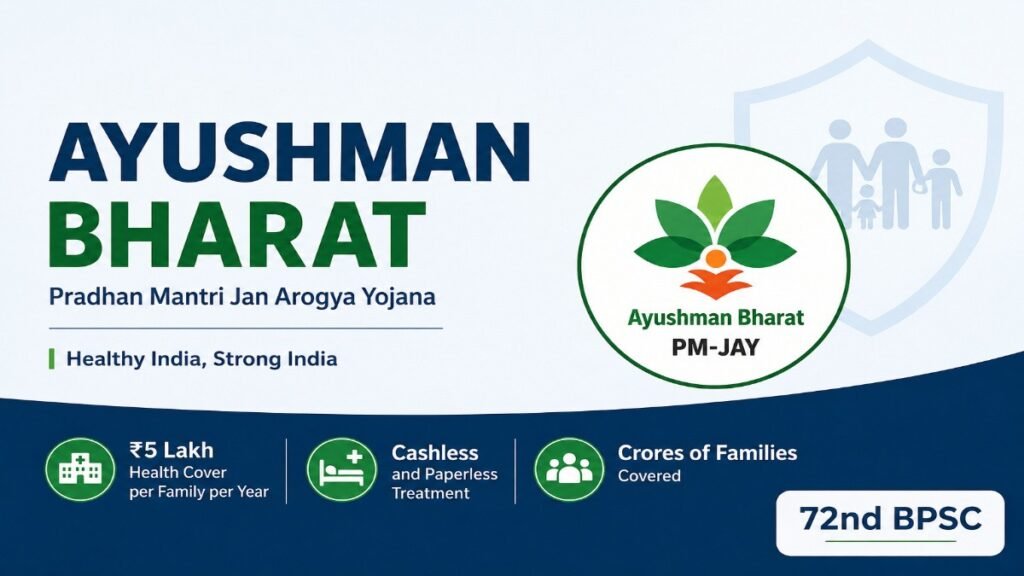
Ayushman Bharat scheme, launched on 23 September 2018, is India’s flagship healthcare reform programme aimed at achieving Universal Health Coverage (UHC) under the National Health Policy, 2017. It seeks to provide accessible, affordable and quality healthcare by strengthening both primary healthcare and financial protection against catastrophic medical expenditure. The scheme is implemented by the National Health Authority (NHA) in partnership with State Health Agencies. The Ayushman Bharat scheme comprises two complementary pillars:
- Ayushman Arogya Mandirs (formerly Health and Wellness Centres), which provide comprehensive primary healthcare services, including preventive, promotive and curative care.
- Ayushman Bharat–Pradhan Mantri Jan Arogya Yojana (AB PM-JAY), which offers cashless health insurance coverage of up to ₹5 lakh per eligible family per year for secondary and tertiary hospitalisation at empanelled public and private hospitals.
Since its launch, Ayushman Bharat has emerged as the world’s largest government-funded health assurance scheme. A major milestone in the evolution of the Ayushman Bharat yojna was the 2024–25 expansion, under which all senior citizens aged 70 years and above became eligible for health coverage irrespective of their income or socio-economic status. This expansion has significantly widened the scheme’s reach and strengthened India’s commitment to universal healthcare.
Master Current Affairs. Ace BPSC Mains.
BPSC Mains Current Affairs & International Relations Course
Master GS Paper-I (Section-II) with 116 exam-oriented topics, 5 structured lessons and downloadable PDF notes—all in one comprehensive course.
✔ 116 Exam-Oriented Topics • ✔ 5 Comprehensive Lessons • ✔ Downloadable PDF Notes • ✔ Updated for 72nd BPSC Mains
2. Major Expansion of Ayushman Bharat Scheme
Universal Health Coverage for Senior Citizens (70+ Years)
The most significant expansion of the Ayushman Bharat scheme was approved by the Union Cabinet on 11 September 2024, extending AB PM-JAY coverage to all citizens aged 70 years and above, irrespective of their income, social category or economic status. This marks a major shift from a poverty-based eligibility model towards age-based universal health coverage for the elderly. Under this expansion:
- Around 6 crore senior citizens belonging to 4.5 crore families are expected to benefit.
- Every eligible senior citizen receives a distinct Ayushman Vay Vandana Card.
- Senior citizens are entitled to ₹5 lakh annual cashless health coverage for secondary and tertiary hospitalisation.
This expansion has significantly widened the scope of the Ayushman Bharat yojna and strengthened financial protection for India’s elderly population.
Additional Financial Protection for Existing PM-JAY Families
The expansion provides additional protection to elderly members already covered under PM-JAY. Senior citizens (70+) belonging to existing PM-JAY beneficiary families receive a separate top-up health cover of ₹5 lakh per year, which does not have to be shared with younger family members. This substantially reduces out-of-pocket expenditure on healthcare for elderly patients suffering from chronic and high-cost diseases.
Senior citizens who are already beneficiaries under Ayushman Bharat scheme such as CGHS, ECHS or Ayushman CAPF have the flexibility either to continue with their existing scheme or opt for AB PM-JAY, thereby enhancing beneficiary choice.
Expansion of Digital Health Ecosystem
The Government has expanded the Ayushman Bharat scheme beyond health insurance by integrating it with the Ayushman Bharat Digital Mission (ABDM). Beneficiaries can now generate an Ayushman Bharat Health Account (ABHA), which serves as a unique digital health identity and enables secure storage and sharing of electronic health records across healthcare providers.
This integration supports paperless treatment, digital prescriptions, online health records, interoperability among hospitals and faster claim settlement, making healthcare delivery more efficient and patient-centric.
Expansion of Healthcare Infrastructure and Beneficiary Access
The Government continues to expand the Ayushman Bharat yojna through:
- Increasing the number of empanelled public and private hospitals.
- Expansion of Ayushman Arogya Mandirs providing comprehensive primary healthcare.
- Inclusion of more treatment packages covering critical illnesses.
- Simplification of Ayushman Card generation through online portals, mobile applications and Common Service Centres (CSCs).
These measures have improved geographical accessibility and strengthened the continuum of care from primary to tertiary healthcare.
Towards Universal and Inclusive Healthcare
The recent expansion of the Ayushman Bharat scheme reflects India’s broader objective of achieving Universal Health Coverage (UHC) under SDG 3 (Good Health and Well-being). By extending coverage to all elderly citizens irrespective of income, the scheme addresses the growing healthcare needs of an ageing population while reducing catastrophic health expenditure. It also strengthens India’s position as home to the world’s largest government-funded health assurance programme.
Prepare Smarter. Study Better. Ace BPSC Mains.
BPSC Mains GS Paper 1 & 2 Complete Course
Access comprehensive BPSC Mains Notes for GS Paper 1 & 2, covering 378+ topics across 24 PDF lessons, with dedicated Bihar coverage, practice questions and downloadable study material.
✓ GS Paper 1 & 2 • ✓ 378+ Topics • ✓ 24 PDF Lessons • ✓ Bihar-Specific Coverage • ✓ Downloadable Notes
3. Implementation of Ayushman Bharat Scheme
Institutional Framework for Implementation
The Ayushman Bharat scheme is implemented by the National Health Authority (NHA) at the national level in partnership with State Health Agencies (SHAs). States may implement the scheme through an insurance model, trust model or mixed model depending on their administrative preference. Beneficiaries receive cashless and paperless treatment at empanelled public and private hospitals anywhere in India, making the scheme fully portable across states.
The implementation of the Ayushman Bharat yojna is supported by a robust IT platform for beneficiary identification, hospital empanelment, claim processing, fraud detection and grievance redressal, ensuring transparency and efficiency.
Digital Implementation and Ayushman Bharat Digital Mission (ABDM)
The implementation of Ayushman Bharat scheme has been significantly strengthened through the Ayushman Bharat Digital Mission (ABDM). Beneficiaries can generate an Ayushman Bharat Health Account (ABHA), a unique digital health ID that enables secure storage and sharing of electronic health records across hospitals and healthcare providers. Digital integration has enabled:
- Online Ayushman Card generation.
- Paperless hospital admissions.
- Faster claim settlement.
- Digital prescriptions and health records.
- Improved portability and continuity of care across India.
Expansion of Healthcare Infrastructure
Implementation of the Ayushman Bharat scheme has been accompanied by continuous expansion of healthcare infrastructure. As of 2025, over 29,900 empanelled hospitals, including more than 13,200 private hospitals, were providing treatment under AB PM-JAY. Simultaneously, the network of Ayushman Arogya Mandirs (Health & Wellness Centres) has expanded rapidly to strengthen comprehensive primary healthcare across rural and urban India.
The Government has also expanded treatment packages and encouraged greater participation of private hospitals to improve access to quality healthcare.
Implementation Progress: Key Achievements
The implementation of the Ayushman Bharat scheme has witnessed remarkable progress since its launch:
- More than 42 crore Ayushman Cards have been issued (October 2025).
- Over 9.84 crore hospital admissions have been authorised.
- Treatment worth more than ₹1.40 lakh crore has been provided under the scheme.
- Over 86 lakh senior citizens (70+) have already enrolled under the recently launched Ayushman Vay Vandana initiative.
These achievements demonstrate the rapid expansion of the Ayushman Bharat yojna and its growing role in providing financial protection and access to quality healthcare for millions of beneficiaries across India.
Challenges in Implementation
Despite significant progress, several implementation challenges remain for the Ayushman Bharat scheme:
- Uneven availability of empanelled hospitals in remote and rural areas.
- Low awareness among eligible beneficiaries.
- Delays in claim settlement in some states.
- Cases of fraud and misuse by a few hospitals.
- Digital literacy and connectivity gaps affecting ABHA and Ayushman Card enrolment.
- Variations in implementation capacity across states.
Addressing these challenges through stronger monitoring, wider hospital participation, digital inclusion and faster claim processing will be crucial for achieving the objective of Universal Health Coverage (UHC) under the Ayushman Bharat yojna.
4. Bihar Perspective
Implementation Status of Ayushman Bharat scheme in Bihar
Bihar implements Ayushman Bharat–Pradhan Mantri Jan Arogya Yojana (AB PM-JAY) through the Bihar Integrated Social Welfare and Health Society (BISWASS) under the State Health Agency. The scheme provides cashless health insurance of ₹5 lakh per eligible family per year for secondary and tertiary care. In Bihar, over 1.21 crore eligible families (approximately 5.5 crore beneficiaries) are covered under the scheme, making it one of the largest beneficiary states in the country.
To expand coverage, the State Government has also implemented the Mukhyamantri Jan Arogya Yojana (MM-JAY) for eligible families not covered under PM-JAY, thereby improving financial protection against catastrophic health expenditure.
Expansion of Healthcare Infrastructure
Bihar has significantly strengthened healthcare access under the Ayushman Bharat scheme by expanding the network of empanelled hospitals. As of 28 February 2026, the state had 1,188 empanelled hospitals, including both government and private healthcare institutions, enabling beneficiaries to avail cashless treatment across a wide range of specialties.
The state is also expanding Ayushman Arogya Mandirs (Health & Wellness Centres) to improve comprehensive primary healthcare, early disease detection and referral services, particularly in rural and underserved areas.
Digital Implementation and Senior Citizen Expansion
Bihar has actively implemented the Ayushman Bharat Digital Mission (ABDM) through ABHA IDs, online Ayushman Card generation and digital verification systems. Following the Union Government’s decision to extend PM-JAY to all citizens aged 70 years and above, Bihar conducted a special campaign for issuing Ayushman Vay Vandana Cards to eligible senior citizens, thereby accelerating enrolment under the expanded Ayushman Bharat yojna.
These digital initiatives have improved beneficiary identification, portability of services and faster claim settlement while promoting paperless healthcare delivery.
Key Challenges
Despite considerable progress, Bihar continues to face implementation challenges in the Ayushman Bharat scheme, such as:
- Shortage of specialist doctors and healthcare professionals.
- Uneven distribution of empanelled private hospitals across districts.
- Low awareness among eligible beneficiaries in remote areas.
- Digital literacy and internet connectivity constraints.
- Delays in claim settlement and hospital reimbursements in some cases.
Addressing these challenges through increased investment in healthcare infrastructure, wider hospital empanelment, stronger awareness campaigns and digital capacity building will be essential for achieving Universal Health Coverage (UHC) in Bihar through the Ayushman Bharat yojna.
5. Way Forward
- Expand hospital network: Increase empanelment of quality private hospitals, especially in rural, tribal and aspirational districts, to improve accessibility and reduce regional disparities.
- Strengthen digital health ecosystem: Accelerate universal adoption of ABHA ID, electronic health records and interoperability under the Ayushman Bharat Digital Mission (ABDM) to ensure seamless, paperless and portable healthcare.
- Improve awareness and enrolment: Conduct intensive IEC campaigns through ASHA workers, Anganwadi centres, Panchayats and Common Service Centres (CSCs) to increase Ayushman Card generation, particularly among senior citizens and vulnerable populations.
- Ensure timely claim settlement and prevent fraud: Strengthen AI-based fraud detection, transparent claim processing and grievance redressal to improve the confidence of hospitals and beneficiaries.
- Enhance financial sustainability: Periodically revise treatment package rates, encourage greater private sector participation and ensure adequate budgetary support so that quality healthcare remains financially viable for service providers.
- Strengthen primary healthcare: Expand Ayushman Arogya Mandirs with adequate doctors, diagnostics, medicines and telemedicine facilities to reduce disease burden and unnecessary hospitalisation.
These measures can further strengthen the Ayushman Bharat scheme and help the Ayushman Bharat yojna move closer to the broader goal of Universal Health Coverage (UHC) in India.
BPSC Mains Practice Question
Q1. “The recent expansion of the Ayushman Bharat scheme marks a significant step towards Universal Health Coverage in India.” Discuss the major expansion measures and evaluate their impact on healthcare accessibility and financial protection.
Learn More from the National Health Authority, Government of India
Readers interested in the Ayushman Bharat scheme, Ayushman Bharat yojna, PM-JAY, Ayushman Cards, eligibility, cashless healthcare, empanelled hospitals, beneficiary services and the implementation of India’s flagship health assurance programme can visit the official website of the National Health Authority (NHA), Government of India. The portal provides authentic information on Ayushman Bharat PM-JAY, beneficiary services, implementation guidelines and India’s public health assurance initiatives.