1. Introduction
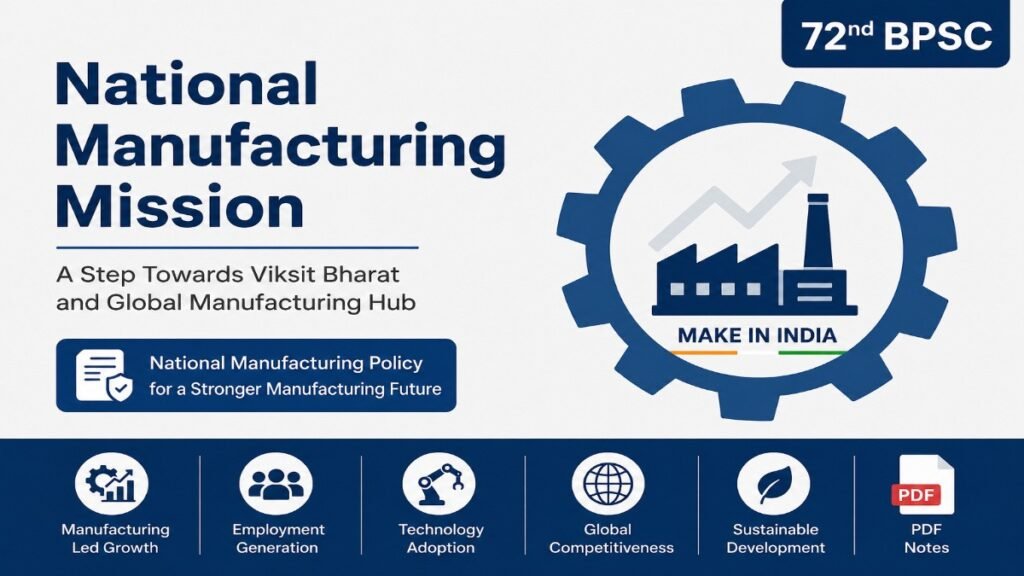
The National Manufacturing Mission (NMM) is a flagship initiative announced by the Government of India in the Union Budget 2025–26 to accelerate manufacturing-led economic growth under the ‘Make in India’ programme. The Mission aims to strengthen India’s manufacturing ecosystem by providing an integrated policy framework for small, medium and large industries, thereby enhancing global competitiveness, promoting innovation and creating large-scale employment. The National Manufacturing Mission seeks to build upon the objectives of India’s broader National Manufacturing Policy and provide a stronger policy framework for the next phase of industrial development.
The Mission seeks to transform India into a global manufacturing hub and contribute towards the vision of Viksit Bharat @2047 by increasing manufacturing output, attracting investments, integrating Indian firms into Global Value Chains (GVCs), and promoting clean and advanced manufacturing technologies. The National Manufacturing Mission therefore represents an important step towards strengthening India’s manufacturing base, while complementing the long-term objectives associated with the National Manufacturing Policy.
Master Current Affairs. Ace BPSC Mains.
BPSC Mains Current Affairs & International Relations Course
Master GS Paper-I (Section-II) with 116 exam-oriented topics, 5 structured lessons and downloadable PDF notes—all in one comprehensive course.
✔ 116 Exam-Oriented Topics • ✔ 5 Comprehensive Lessons • ✔ Downloadable PDF Notes • ✔ Updated for 72nd BPSC Mains
2. Why in News?
- The National Manufacturing Mission was announced in the Union Budget 2025–26 to strengthen the Make in India initiative and promote manufacturing-led economic growth.
- The Mission aims to provide a comprehensive policy framework for small, medium and large industries to improve India’s manufacturing competitiveness. The National Manufacturing Mission also builds on the broader objectives of the National Manufacturing Policy by creating a more integrated approach to industrial development.
- It focuses on five priority areas—ease and cost of doing business, future-ready workforce, MSME support, technology adoption, and production of quality products with global standards.
- The initiative seeks to increase domestic value addition, reduce import dependence, strengthen India’s integration with Global Value Chains (GVCs), and support the vision of Viksit Bharat @2047.
- The Mission complements ongoing initiatives such as Make in India, Production Linked Incentive (PLI) Scheme, PM Gati Shakti, National Logistics Policy, Startup India, and Skill India, creating an integrated ecosystem for manufacturing growth. The National Manufacturing Mission thus provides an important policy framework for achieving the long-term industrial objectives associated with the National Manufacturing Policy.
Prepare Smarter. Study Better. Ace BPSC Mains.
BPSC Mains GS Paper 1 & 2 Complete Course
Access comprehensive BPSC Mains Notes for GS Paper 1 & 2, covering 378+ topics across 24 PDF lessons, with dedicated Bihar coverage, practice questions and downloadable study material.
✓ GS Paper 1 & 2 • ✓ 378+ Topics • ✓ 24 PDF Lessons • ✓ Bihar-Specific Coverage • ✓ Downloadable Notes
3. Objectives
The National Manufacturing Mission (NMM) aims to provide an integrated policy framework to transform India into a globally competitive manufacturing hub. Its key objectives are:
- Promote manufacturing-led economic growth and increase the sector’s contribution to India’s GDP.
- Generate large-scale employment opportunities, particularly for youth and skilled workers.
- Strengthen Micro, Small and Medium Enterprises (MSMEs) by improving access to finance, technology and markets.
- Enhance India’s participation in Global Value Chains (GVCs) and boost exports.
- Encourage innovation, research & development (R&D) and adoption of advanced manufacturing technologies.
- Reduce the cost of doing business through regulatory reforms and better infrastructure.
- Promote clean and sustainable manufacturing in line with India’s climate commitments.
- Attract higher domestic and foreign investments into the manufacturing sector.
- Improve the quality and global competitiveness of products manufactured in India.
- Contribute towards achieving the vision of Viksit Bharat @2047 through industrial transformation.
The National Manufacturing Mission also complements the broader objectives of the National Manufacturing Policy by focusing on competitiveness, investment, technology adoption, employment generation and sustainable industrial development.
4. Key Features
The Union Budget 2025–26 identified five strategic focus areas under the National Manufacturing Mission:
- Ease and Cost of Doing Business: Simplifying regulations, reducing compliance burden and improving industrial infrastructure.
- Future-Ready Workforce: Strengthening skilling, reskilling and industry-oriented human resource development.
- Vibrant and Dynamic MSMEs: Improving access to credit, technology, markets and integration with larger supply chains.
- Technology Availability: Promoting innovation, digital manufacturing, automation, Artificial Intelligence (AI) and advanced manufacturing technologies.
- Quality Products: Enhancing product quality, adherence to global standards and export competitiveness.
The Mission also envisages:
- A coordinated implementation framework involving the Central Government, State Governments and industry stakeholders.
- Policy support and governance mechanisms for effective execution.
- Promotion of clean-tech manufacturing, including sectors such as solar PV cells, EV batteries and high-voltage transmission equipment.
- Synergy with existing initiatives such as Make in India, PLI Scheme, PM Gati Shakti, National Logistics Policy and Skill India to create an integrated manufacturing ecosystem.
These features of the National Manufacturing Mission are aimed at translating the broader vision of the National Manufacturing Policy into a more integrated and technology-driven manufacturing ecosystem.
5. Significance for India’s Economy
Accelerating Manufacturing-led Economic Growth
The National Manufacturing Mission aims to make manufacturing the primary engine of India’s economic growth. It seeks to increase the manufacturing sector’s share in GDP from 12.9% (2023) to 25% by 2035, thereby reducing excessive dependence on the services sector. A stronger manufacturing base will enhance industrial productivity, improve domestic value addition and support the vision of Viksit Bharat @2047. The Mission also strengthens the broader objectives of the National Manufacturing Policy by focusing on long-term industrial expansion and competitiveness.
Employment Generation and Skill Development
Manufacturing is one of the most labour-intensive sectors of the economy. The Mission targets the creation of nearly 143 million jobs by 2035 through the expansion of industries, industrial clusters and MSMEs. Simultaneously, it promotes industry-oriented skill development, reskilling and upskilling to ensure the availability of a future-ready workforce aligned with emerging technologies and industrial demand.
Enhancing Exports and Global Competitiveness
The National Manufacturing Mission seeks to strengthen India’s position in Global Value Chains (GVCs) by promoting quality manufacturing, technology adoption and internationally competitive products. It aims to increase merchandise exports to around USD 1.2 trillion by 2035, making India a preferred global manufacturing destination while reducing dependence on imports of strategic goods.
Strengthening MSMEs and Industrial Ecosystem
MSMEs form the backbone of India’s manufacturing sector. The Mission focuses on improving their access to finance, technology, innovation, skilled manpower and domestic as well as international markets. A stronger MSME ecosystem will enhance supply chains, encourage entrepreneurship, promote balanced regional development and improve the competitiveness of Indian industries.
Promoting Technology and Sustainable Manufacturing
The Mission encourages the adoption of advanced manufacturing technologies such as automation, Artificial Intelligence (AI), digital manufacturing and Industry 4.0. It also promotes clean-tech manufacturing in sectors like solar PV cells, EV batteries, wind energy equipment and grid-scale batteries, supporting India’s energy transition, climate commitments and long-term industrial sustainability.
Significance for Bihar
The National Manufacturing Mission offers significant opportunities for Bihar by promoting industrialisation, employment generation and investment. The development of the Industrial Manufacturing Cluster (IMC) at Gaya under the Amritsar–Kolkata Industrial Corridor, along with proposed defence, pharmaceutical and industrial infrastructure projects, can strengthen Bihar’s manufacturing base. The Mission can also help Bihar leverage its abundant workforce, improve MSME competitiveness and accelerate inclusive economic growth.
6. Challenges
Policy and Implementation Uncertainty
Although the National Manufacturing Mission was announced in the Union Budget 2025–26, its full operational framework is still under development. Effective implementation requires strong coordination among the Central Government, State Governments, industry associations and regulatory agencies. Delays in finalising implementation guidelines, governance mechanisms and institutional responsibilities may slow down the Mission’s intended outcomes.
Infrastructure and Logistics Bottlenecks
India continues to face high logistics costs, inadequate multimodal connectivity, congested ports and uneven industrial infrastructure across states. These challenges increase production costs and reduce the global competitiveness of Indian manufacturers. Developing world-class industrial corridors, plug-and-play industrial parks and efficient transport networks remains essential for the Mission’s success.
Skill Gap and Workforce Readiness
The rapid adoption of advanced manufacturing technologies such as Artificial Intelligence (AI), robotics and automation has increased the demand for highly skilled workers. However, there is a shortage of industry-ready manpower in many emerging sectors. Bridging the skill gap through industry-oriented education, vocational training and continuous reskilling will be critical to achieving the objectives of the National Manufacturing Mission and the broader goals of the National Manufacturing Policy.
Challenges Faced by MSMEs
Despite being the backbone of India’s manufacturing sector, MSMEs continue to struggle with limited access to affordable finance, modern technology, quality infrastructure and global markets. High compliance costs and limited research and development (R&D) capabilities further constrain their productivity and competitiveness. Addressing these structural issues is essential for inclusive manufacturing growth.
Dependence on Imports and Global Supply Chain Risks
Several strategic manufacturing sectors, including electronics, semiconductors, solar equipment and pharmaceutical raw materials, remain dependent on imported components and critical minerals. Geopolitical tensions, trade disruptions and supply chain shocks expose India’s manufacturing sector to external vulnerabilities. Enhancing domestic value addition and diversifying supply sources are therefore key priorities under the National Manufacturing Mission.
Environmental and Sustainability Concerns
Rapid industrialisation may increase pressure on natural resources, energy consumption and environmental quality if not managed sustainably. Balancing manufacturing growth with climate commitments requires greater adoption of clean technologies, energy-efficient production systems, circular economy practices and stricter environmental compliance.
7. Way Forward
The success of the National Manufacturing Mission will depend on timely implementation through strong coordination between the Union Government, State Governments and industry stakeholders. Priority should be given to improving the ease of doing business, reducing logistics costs, developing world-class industrial infrastructure, strengthening MSMEs, and promoting research, innovation and advanced manufacturing technologies. Simultaneously, greater investment in skill development, digital manufacturing and Industry 4.0 technologies will help build a future-ready workforce capable of supporting high-value manufacturing.
India should also focus on increasing domestic value addition, integrating with Global Value Chains (GVCs), and promoting clean-tech manufacturing in sectors such as semiconductors, electric vehicles, batteries and renewable energy equipment. Stable policy support, faster regulatory clearances, enhanced public-private partnerships and greater investment in green manufacturing can transform India into a globally competitive manufacturing hub and accelerate the vision of Viksit Bharat @2047. These measures can also strengthen the long-term objectives of the National Manufacturing Policy by creating a competitive, sustainable and technology-driven manufacturing ecosystem.
Experience the Quality Before You Enroll
Download Free Sample Notes (PDF)
Download a free sample of our BPSC Mains Current Affairs Notes and experience the structured, exam-oriented content before enrolling. Explore the presentation, answer-writing approach, and overall quality of the complete course.
✔ Free Download • ✔ Exam-Oriented Notes • ✔ Updated Content • ✔ Structured for BPSC Mains
BPSC Mains Practice Questions
Q1. Discuss the objectives and key features of the National Manufacturing Mission. How can it contribute to making India a global manufacturing hub under the vision of Viksit Bharat @2047?
Q2. Critically examine the significance of the National Manufacturing Mission for India’s manufacturing sector. Discuss the major challenges in its implementation and suggest suitable measures to enhance India’s global manufacturing competitiveness.
Learn More from the Ministry of Commerce & Industry, Government of India
Readers interested in the National Manufacturing Mission, National Manufacturing Policy, Make in India, manufacturing sector reforms, industrial development, investment promotion, MSME support, exports, Global Value Chains, and initiatives aimed at strengthening India’s manufacturing ecosystem can visit the official website of the Ministry of Commerce & Industry, Government of India. The portal provides authentic information on government policies, programmes, industrial development initiatives, trade and investment measures, and efforts to enhance India’s global manufacturing competitiveness.