1. Introduction
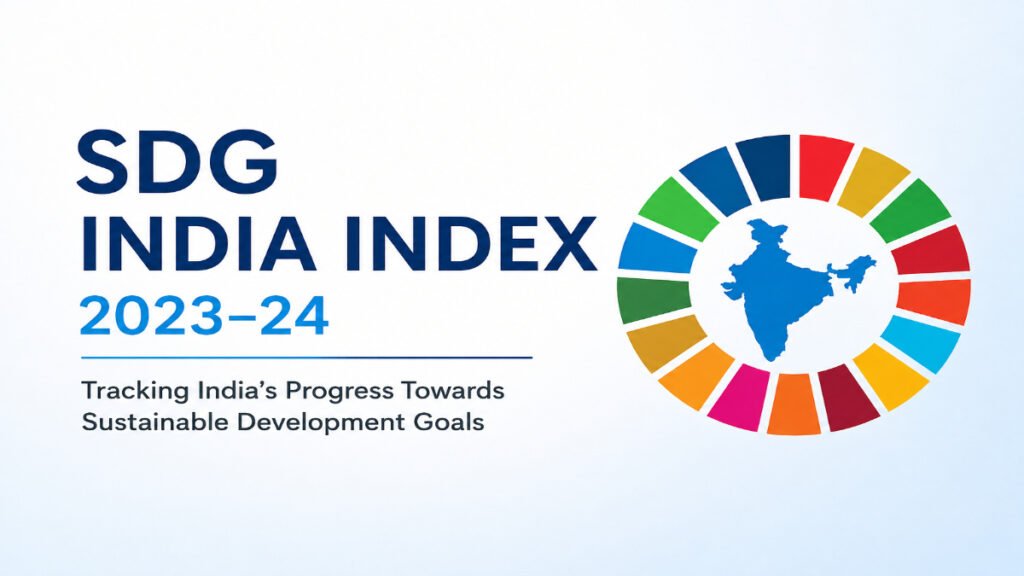
The SDG India Index is India’s official framework for measuring the progress of States and Union Territories towards achieving the 17 Sustainable Development Goals (SDGs) adopted under the United Nations 2030 Agenda for Sustainable Development. Released periodically by NITI Aayog, the Index serves as a comprehensive monitoring tool to assess the performance of states across key socio-economic and environmental indicators while promoting Cooperative and Competitive Federalism.
The SDG India Index 2023–24 (4th Edition), released in July 2024, highlights India’s continued progress towards sustainable development. India’s composite score improved from 66 (2020–21) to 71 (2023–24), reflecting significant advancements in sectors such as clean water and sanitation, affordable and clean energy, industry and infrastructure. The Index also identifies priority areas requiring greater policy attention, including poverty, hunger, gender equality and climate action. For states like Bihar, the Index provides valuable insights into developmental achievements and existing challenges, thereby guiding evidence-based policymaking and targeted interventions for achieving the SDGs by 2030.
The SDG India Index is therefore an important tool for understanding India’s progress towards sustainable development and forms the foundation for analysing the SDG India Index 2024 and preparing comprehensive SDG India Index notes PDF for BPSC Mains.
Prepare Smarter. Study Better. Ace BPSC Mains.
BPSC Mains GS Paper 1 & 2 Complete Course
Access comprehensive BPSC Mains Notes for GS Paper 1 & 2, covering 378+ topics across 24 PDF lessons, with dedicated Bihar coverage, practice questions and downloadable study material.
✓ GS Paper 1 & 2 • ✓ 378+ Topics • ✓ 24 PDF Lessons • ✓ Bihar-Specific Coverage • ✓ Downloadable Notes
2. SDG India Index 2023–24: Framework and Methodology
The SDG India Index is India’s principal tool for monitoring the progress of States and Union Territories towards achieving the Sustainable Development Goals (SDGs). It is prepared by NITI Aayog in consultation with the Ministry of Statistics and Programme Implementation (MoSPI), Central Ministries, State Governments and UN agencies. The Index provides a standardized framework for comparing state performance, identifying development gaps and promoting evidence-based policymaking.
Objectives
- Monitor the progress of States and Union Territories towards achieving the 17 Sustainable Development Goals (SDGs).
- Promote Cooperative and Competitive Federalism by encouraging healthy competition among states.
- Support evidence-based policy formulation and implementation.
- Identify sector-specific and region-specific development gaps.
- Facilitate efficient allocation of resources and targeted interventions.
- Track India’s progress towards achieving the SDGs by 2030.
Methodology
- The SDG India Index 2023–24 is the 4th edition of the Index.
- It evaluates the performance of all 28 States and 8 Union Territories.
- The Index is based on 113 national indicators aligned with the 17 Sustainable Development Goals (SDGs).
- Indicators are selected using official data provided by Central Ministries and government agencies.
- Each State and Union Territory receives a composite score ranging from 0 to 100, with a higher score indicating better progress towards achieving the SDGs.
- The overall score is calculated by aggregating the performance across all the selected indicators.
The methodology of the SDG India Index enables comparison among States and Union Territories and helps policymakers identify areas requiring greater attention. These methodological details are particularly important for understanding the SDG India Index 2024 and preparing comprehensive SDG India Index notes PDF for BPSC Mains.
Prepare Smarter. Study Better. Ace BPSC Mains.
BPSC Mains GS Paper 1 & 2 Complete Course
Access comprehensive BPSC Mains Notes for GS Paper 1 & 2, covering 378+ topics across 24 PDF lessons, with dedicated Bihar coverage, practice questions and downloadable study material.
✓ GS Paper 1 & 2 • ✓ 378+ Topics • ✓ 24 PDF Lessons • ✓ Bihar-Specific Coverage • ✓ Downloadable Notes
Classification of States
Based on their composite scores, States and Union Territories are classified into four categories:
| Score | Category |
|---|---|
| 0–49 | Aspirant |
| 50–64 | Performer |
| 65–99 | Front Runner |
| 100 | Achiever |
The Index serves as an important governance tool by enabling governments to regularly assess development outcomes, compare performance across states and design targeted policies for achieving inclusive, sustainable and balanced development.
3. Key Findings of the SDG India Index 2023–24
- India’s overall composite score improved from 66 (2020–21) to 71 (2023–24), indicating steady progress towards achieving the Sustainable Development Goals (SDGs) by 2030.
- No State or Union Territory falls under the ‘Aspirant’ category in the latest edition, reflecting broad-based improvements across the country.
- Uttarakhand and Kerala emerged as the best-performing States, each securing a composite score of 79.
- Other high-performing States include Tamil Nadu, Goa and Himachal Pradesh.
- Bihar improved its composite score from 52 (2020–21) to 57 (2023–24) and continued to remain in the ‘Performer’ category.
- Jharkhand also remained among the lower-performing States, highlighting persistent regional disparities.
The SDG India Index 2023–24 therefore shows broad-based improvement across the country, while also highlighting differences in development outcomes among States. These findings form a key part of the SDG India Index 2024 analysis and are important factual points for SDG India Index notes PDF.
India’s Performance across SDGs
India recorded notable progress in:
- SDG 6 – Clean Water and Sanitation
- SDG 7 – Affordable and Clean Energy
- SDG 9 – Industry, Innovation and Infrastructure
- SDG 11 – Sustainable Cities and Communities
- SDG 16 – Peace, Justice and Strong Institutions
Despite overall improvement, several SDGs continue to require greater policy attention, particularly:
- SDG 2 – Zero Hunger
- SDG 5 – Gender Equality
- SDG 10 – Reduced Inequalities
- SDG 13 – Climate Action
Role of Government Schemes
The Index highlights the positive impact of flagship government programmes such as:
- Jal Jeevan Mission
- Swachh Bharat Mission
- Ayushman Bharat
- PM Awas Yojana
- PM Jan Dhan Yojana
- PM Ujjwala Yojana
These initiatives have contributed to improvements in basic services and social development indicators. The SDG India Index therefore provides a useful framework for assessing the contribution of government interventions towards sustainable development.
Inter-State Disparities
The report emphasizes that inter-state disparities persist despite national progress, underscoring the need for targeted interventions in lagging States and districts.
The Index continues to serve as an important instrument for promoting Cooperative and Competitive Federalism, enabling States to benchmark their performance and adopt best practices from better-performing regions.
Overall, the SDG India Index 2023–24 indicates that India is making steady progress towards the 2030 Sustainable Development Goals, while highlighting the need for accelerated action in areas such as poverty reduction, nutrition, gender equality and climate resilience.
4. Bihar’s Performance in the SDG India Index 2023–24
Bihar recorded a gradual improvement in the SDG India Index 2023–24, reflecting progress in several social and economic indicators. The state’s composite score increased from 52 (2020–21) to 57 (2023–24), enabling it to remain in the ‘Performer’ category. Although this improvement indicates positive outcomes from various government initiatives, Bihar continues to rank among the lower-performing states, highlighting the need for sustained efforts to achieve the Sustainable Development Goals (SDGs) by 2030.
Key Improvements
- Improvement in access to clean drinking water through the Jal Jeevan Mission.
- Better sanitation coverage under the Swachh Bharat Mission.
- Increased household electrification and improved access to basic infrastructure.
- Expansion of financial inclusion through Pradhan Mantri Jan Dhan Yojana.
- Better healthcare access through Ayushman Bharat and other public health programmes.
- Progress in affordable housing under the Pradhan Mantri Awas Yojana.
The improvement in Bihar’s score in the SDG India Index indicates progress in basic services and social development. However, the state’s overall position shows that further efforts are required to accelerate sustainable development.
Major Challenges
- High incidence of poverty and multidimensional deprivation.
- Persistent malnutrition among women and children.
- Low learning outcomes and educational attainment.
- Gender inequality and lower female labour force participation.
- Limited industrialisation and employment opportunities.
- Regional disparities in infrastructure and public service delivery.
- Climate vulnerability, particularly due to recurrent floods and droughts.
Policy Priorities for Bihar
- Accelerate poverty reduction through employment-oriented growth.
- Improve nutrition, maternal health and child healthcare services.
- Enhance the quality of school education and skill development.
- Promote industrialisation, MSMEs and investment to generate quality jobs.
- Strengthen climate-resilient infrastructure and disaster management.
- Improve governance through better implementation and convergence of flagship welfare schemes.
- Focus on district-specific strategies to reduce regional disparities and improve SDG outcomes.
While Bihar has made measurable progress in recent years, achieving the SDGs by 2030 will require sustained investments in human capital, infrastructure, livelihoods and institutional capacity to ensure inclusive and balanced development. The Bihar-specific findings of the SDG India Index 2024 are therefore particularly important for BPSC aspirants studying state-level development indicators and preparing SDG India Index notes PDF.
5. Significance of the SDG India Index
The SDG India Index has become an important governance and policy tool for monitoring India’s progress towards the 2030 Sustainable Development Goals (SDGs). It not only measures the performance of States and Union Territories but also supports evidence-based decision-making and promotes balanced regional development.
- Monitors Progress towards SDGs: Tracks the performance of States and Union Territories across all 17 Sustainable Development Goals, enabling regular assessment of India’s progress towards the 2030 Agenda.
- Promotes Cooperative and Competitive Federalism: Encourages healthy competition among States while fostering cooperation through the sharing of best practices and successful development models.
- Supports Evidence-Based Policymaking: Provides reliable data that helps governments identify priority sectors, formulate targeted policies and improve programme implementation.
- Identifies Development Gaps: Highlights sector-wise and state-wise disparities, enabling policymakers to focus on lagging regions and vulnerable population groups.
- Facilitates Better Resource Allocation: Assists governments in prioritising investments and allocating resources more efficiently to sectors requiring greater attention.
- Strengthens Monitoring of Government Schemes: Evaluates the impact of flagship programmes such as Jal Jeevan Mission, Swachh Bharat Mission, Ayushman Bharat, PM Awas Yojana and Poshan Abhiyaan on sustainable development outcomes.
- Improves Governance and Accountability: Encourages States to regularly monitor development indicators, improve administrative efficiency and strengthen institutional accountability.
- Supports District and State-Level Planning: Helps State Governments integrate SDG targets into development plans and design region-specific strategies for inclusive growth.
- Enhances International Commitments: Demonstrates India’s progress towards fulfilling its commitments under the United Nations 2030 Agenda for Sustainable Development.
- Promotes Inclusive and Sustainable Development: Ensures that economic growth is accompanied by improvements in health, education, gender equality, environmental sustainability and quality of life, thereby contributing to balanced and equitable development.
Thus, the SDG India Index serves as a comprehensive policy dashboard that enables governments to monitor progress, identify challenges and accelerate India’s journey towards achieving the Sustainable Development Goals by 2030. The SDG India Index 2024 is particularly useful for comparing state-level performance and identifying development gaps. These aspects are also important for SDG India Index notes PDF prepared for BPSC Mains.
6. Challenges and Limitations
- Data Time Lag: The Index relies on official datasets that are updated periodically, limiting its ability to capture real-time progress.
- Inter-State Disparities: Wide developmental differences among States and Union Territories make uniform progress towards the SDGs challenging.
- Quality versus Access: Many indicators measure access to services but do not adequately assess their quality or outcomes.
- Data Availability: Reliable and comparable data for certain SDG indicators remain limited, particularly at the district level.
- Implementation Capacity: Differences in administrative and institutional capacity across states affect the pace of SDG implementation.
- Emerging Challenges: Issues such as climate change, rapid urbanisation, digital divide and migration require greater attention within the SDG framework.
These limitations indicate that while the SDG India Index provides a valuable framework for measuring sustainable development, its findings need to be interpreted alongside ground-level data and qualitative assessments. Improving data availability, measurement of service quality and implementation capacity will further strengthen the usefulness of the SDG India Index 2024.
For BPSC Mains preparation, these limitations are important components of SDG India Index notes PDF, particularly when critically evaluating the effectiveness of the Index as a tool for monitoring India’s progress towards the SDGs.
7. Conclusion
The SDG India Index has emerged as an important instrument for assessing India’s progress towards achieving the Sustainable Development Goals (SDGs) and promoting data-driven governance. The SDG India Index 2023–24 reflects steady national progress, with India’s composite score improving to 71, while also highlighting persistent regional disparities and sector-specific challenges.
For states like Bihar, the Index provides a valuable roadmap for identifying developmental gaps and prioritising policy interventions. Sustained investments in health, education, employment, gender equality and climate resilience, along with stronger implementation of welfare programmes and cooperative federalism, will be essential for achieving the SDGs by 2030 and ensuring inclusive, equitable and sustainable development.
The findings of the SDG India Index 2024 show that measuring development through multiple indicators can help governments identify areas requiring greater attention and improve policy implementation. For BPSC aspirants, the SDG India Index is therefore an important topic for understanding India’s sustainable development journey and Bihar’s position within it.
BPSC Mains Practice Question
“The SDG India Index has emerged as an important tool for monitoring sustainable development and promoting cooperative federalism in India.” Discuss the key findings of the SDG India Index 2023–24 and evaluate its significance for policymaking, with special reference to Bihar.
This question covers important areas of the SDG India Index, including its methodology, state-wise performance, India’s progress towards the 17 SDGs, Cooperative and Competitive Federalism, development gaps, and Bihar’s performance.
Learn More from NITI Aayog, Government of India
Readers interested in the SDG India Index, SDG India Index 2024, Sustainable Development Goals, state-wise SDG performance, development indicators, Cooperative and Competitive Federalism and India’s progress towards the 2030 Agenda can visit the official website of NITI Aayog, Government of India. The portal provides authentic information on the SDG India Index, development monitoring, policy initiatives and India’s efforts towards achieving inclusive and sustainable development.