1. Introduction
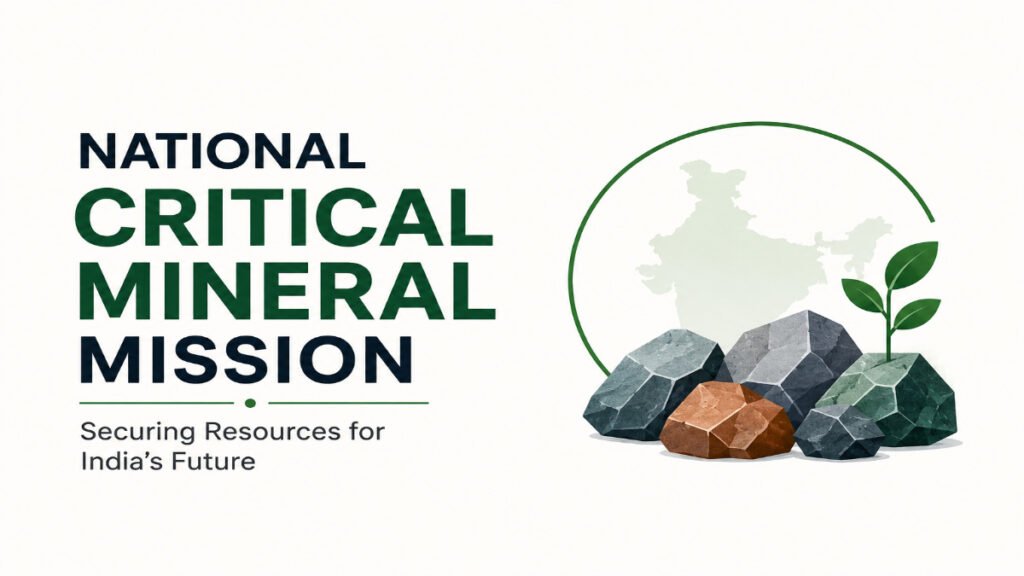
The National Critical Mineral Mission (NCMM) was approved by the Union Cabinet on 29 January 2025 to establish a resilient, secure and self-reliant value chain for critical minerals, which are essential for India’s clean energy transition and high-technology industries. The Critical mineral mission will be implemented for seven years (2024–25 to 2030–31) with a total outlay of ₹34,300 crore, including ₹16,300 crore as Central Government expenditure and ₹18,000 crore expected investment by Public Sector Undertakings (PSUs) and other stakeholders. It covers the entire mineral value chain—exploration, mining, beneficiation, processing, recovery from overburden and tailings, recycling, and overseas acquisition of mineral assets.
The Mission is significant because India is highly dependent on imports for several critical minerals required for electric vehicles (EVs), battery storage systems, solar photovoltaic modules, wind turbines, semiconductors, aerospace, telecommunications and defence manufacturing. To reduce this strategic vulnerability, the Critical mineral mission envisages 1,200 exploration projects by the Geological Survey of India (GSI) during 2024–25 to 2030–31, auction of 100+ critical mineral blocks, promotion of domestic processing facilities and strengthening overseas mineral acquisition through Khanij Bidesh India Ltd. (KABIL).
Master Current Affairs. Ace BPSC Mains.
BPSC Mains Current Affairs & International Relations Course
Master GS Paper-I (Section-II) with 116 exam-oriented topics, 5 structured lessons and downloadable PDF notes—all in one comprehensive course.
✔ 116 Exam-Oriented Topics • ✔ 5 Comprehensive Lessons • ✔ Downloadable PDF Notes • ✔ Updated for 72nd BPSC Mains
2. Objectives and Key Features
The primary objective of the Critical mineral mission is to ensure long-term availability of critical minerals for India’s economic growth, energy transition and national security. The Mission seeks to increase domestic exploration and production, reduce import dependence, develop processing and refining capacity, promote recycling of critical minerals, encourage private sector participation and strengthen India’s integration into global critical mineral supply chains. It also aims to support flagship initiatives such as Atmanirbhar Bharat, Make in India, National Green Hydrogen Mission, electric mobility and the country’s commitment to achieve Net Zero emissions by 2070.
The Mission adopts a comprehensive implementation strategy. The Geological Survey of India (GSI) will undertake 1,200 exploration projects, while the Ministry of Mines will facilitate the auction of more than 100 critical mineral blocks. Financial assistance will be provided for mineral exploration, mining projects and technology development. The Critical mineral mission promotes establishment of domestic beneficiation, processing and refining facilities, encourages recycling and recovery of minerals from end-of-life products, supports acquisition of overseas mineral assets by Indian companies through KABIL, and aims to simplify regulatory approvals for strategic mining projects. It also encourages research and innovation through collaboration among government agencies, PSUs, private industry and research institutions.
Prepare Smarter. Study Better. Ace BPSC Mains.
BPSC Mains GS Paper 1 & 2 Complete Course
Access comprehensive BPSC Mains Notes for GS Paper 1 & 2, covering 378+ topics across 24 PDF lessons, with dedicated Bihar coverage, practice questions and downloadable study material.
✓ GS Paper 1 & 2 • ✓ 378+ Topics • ✓ 24 PDF Lessons • ✓ Bihar-Specific Coverage • ✓ Downloadable Notes
3. Significance, Challenges and Way Forward
The Critical mineral mission is a strategic initiative that will strengthen India’s resource security, energy security, industrial competitiveness and national security. It will support domestic manufacturing of electric vehicles, batteries, renewable energy equipment, electronics, defence systems and semiconductors by ensuring a reliable supply of essential raw materials. The Mission is expected to reduce import dependence, attract private investment, create employment, promote advanced manufacturing and make India an important participant in global critical mineral value chains. It also aligns with the MMDR (Amendment) Act, 2023, which introduced a separate category of critical minerals and facilitated their exploration and mining.
However, the Mission faces challenges such as limited domestic reserves of several critical minerals, China’s dominance in global processing and refining, environmental concerns associated with mining, long project gestation periods and technological dependence. Going forward, India should accelerate exploration, strengthen strategic partnerships with resource-rich countries, expand domestic refining and recycling capacity, invest in advanced extraction technologies and promote sustainable mining practices. A coordinated approach involving the Central Government, State Governments, PSUs, private industry and research institutions will be essential to build a resilient critical mineral ecosystem and achieve the objectives of Viksit Bharat @2047. The Critical mineral mission can therefore play an important role in strengthening India’s long-term resource security.
Experience the Quality Before You Enroll
Download Free Sample Notes (PDF)
Download a free sample of our BPSC Mains Current Affairs Notes and experience the structured, exam-oriented content before enrolling. Explore the presentation, answer-writing approach, and overall quality of the complete course.
✔ Free Download • ✔ Exam-Oriented Notes • ✔ Updated Content • ✔ Structured for BPSC Mains
BPSC Mains Practice Questions
Q1. “Critical minerals are the backbone of the green and digital economy.” In this context, critically examine the significance, challenges and future prospects of the Critical mineral mission.
Learn More from the Ministry of Mines, Government of India
Readers interested in the Critical mineral mission, critical minerals, mineral exploration, mining, processing, recycling, strategic mineral security, overseas mineral acquisition and India’s critical mineral supply chain can visit the official website of the Ministry of Mines, Government of India. The portal provides authentic information on government policies, critical mineral initiatives, exploration and mining activities, regulatory measures, and programmes aimed at strengthening India’s mineral security and self-reliance.