1. Introduction
Agriculture remains the backbone of the Indian economy, supporting the livelihood of nearly 46% of the country’s workforce, while contributing around 16% to India’s Gross Value Added (GVA). However, the sector faces multiple challenges such as declining farm productivity, fragmented landholdings, climate change, water scarcity, soil degradation, post-harvest losses, and rising input costs. These challenges have made the adoption of Technology in Indian Agriculture essential for achieving sustainable and profitable agriculture.
Agricultural technology (AgriTech) refers to the application of scientific knowledge, digital technologies, biotechnology, farm mechanization, precision farming, artificial intelligence (AI), drones, satellite-based monitoring, Internet of Things (IoT), and data analytics to improve agricultural productivity, resource-use efficiency, and farmers’ income. Technology in Indian Agriculture enables farmers to make informed decisions, optimize the use of water, fertilizers, and pesticides, reduce production costs, and minimize crop losses. Agricultural Technology in India is therefore becoming an important tool for improving productivity and resource-use efficiency.
Agriculture and Farmers Welfare, Recognizing the transformative role of Technology in Indian Agriculture, the Government of India has launched several initiatives such as the Digital Agriculture Mission, AgriStack, e-NAM, Kisan Drones, and Sub-Mission on Agricultural Mechanization (SMAM) to modernize Indian agriculture. The integration of advanced technologies is expected to play a crucial role in achieving food security, climate-resilient agriculture, sustainable resource management, and the goal of Viksit Bharat 2047. AgriTech in India is consequently becoming increasingly important for modernizing agricultural production and improving farmers’ access to technology.
Master Science & Technology. Maximize Your BPSC Mains Score.
Enroll in the BPSC Science & Tech Course Today
Master Science & Technology for BPSC Mains GS Paper-2 with 75+ exam-oriented topics, 6 structured lessons, and downloadable PDF notes—all in one course.
✔ 75+ Exam-Oriented Topics • ✔ 6 Comprehensive Lessons • ✔ Downloadable PDF Notes • ✔ Updated for 72nd BPSC Mains
2. Major Challenges in Indian Agriculture
Low Agricultural Productivity
Indian agriculture continues to suffer from low productivity compared to global standards due to fragmented landholdings, inadequate mechanization, low adoption of modern technologies, and dependence on monsoon rainfall. According to the Economic Survey 2025–26, agriculture and allied sectors contribute about 16% of India’s Gross Value Added (GVA) while supporting nearly 46% of the workforce, indicating relatively low labour productivity. This highlights the need for Technology in Indian Agriculture for productivity enhancement. Agricultural Technology in India can help address these productivity constraints through better mechanization, precision farming and data-based decision-making.
Small and Fragmented Landholdings
According to the Agriculture Census 2015–16, over 86% of India’s farmers are small and marginal farmers owning less than 2 hectares of land. Small farm sizes limit the adoption of large agricultural machinery, reduce economies of scale, and make farming less profitable. Affordable technologies, custom hiring centres, and precision farming can help overcome these limitations. Technology in Indian Agriculture can make advanced machinery and precision-based solutions more accessible to small farmers.
Water Scarcity and Inefficient Irrigation
Agriculture consumes nearly 80% of India’s freshwater resources, yet irrigation efficiency remains low due to the dominance of flood irrigation. According to NITI Aayog’s Composite Water Management Index, several regions of India face increasing water stress. Smart irrigation technologies such as drip irrigation, sprinkler systems, IoT-based soil moisture sensors, and automated irrigation can significantly improve water-use efficiency. Digital Agriculture in India can further support efficient monitoring and management of irrigation resources.
Soil Degradation and Declining Soil Fertility
Excessive use of chemical fertilizers, continuous monocropping, soil erosion, and nutrient imbalance have adversely affected soil health. According to the Indian Council of Agricultural Research (ICAR), a large proportion of Indian soils suffers from deficiencies of essential micronutrients such as zinc and boron. Technologies like precision nutrient management, soil testing, biofertilizers, and nano fertilizers can restore soil fertility and improve crop productivity. Modern Farming Technology in India can therefore support more efficient and sustainable management of soil nutrients.
Climate Change and Extreme Weather Events
Agriculture is highly vulnerable to rising temperatures, erratic rainfall, droughts, floods, and heat waves. The Economic Survey 2025–26 highlights climate resilience as a priority for ensuring sustainable agricultural growth. Climate-smart technologies, weather forecasting, AI-based advisory systems, and drought-resistant crop varieties are becoming increasingly important for minimizing climate-related risks. Technology in Indian Agriculture can help farmers respond to changing weather conditions through timely forecasts and location-specific advisories.
Pest and Disease Outbreaks
Crop losses due to pests, diseases, and invasive species reduce agricultural productivity every year. Traditional methods often detect infestations at a late stage, resulting in excessive pesticide use. Technologies such as drones, satellite imagery, artificial intelligence, and remote sensing enable early detection and targeted pest management, thereby reducing crop losses and input costs. Agricultural Technology in India can make pest and disease management more timely, precise, and resource-efficient.
Post-Harvest Losses
India loses a significant quantity of agricultural produce due to inadequate storage, transportation, and cold chain infrastructure. According to estimates of the Ministry of Food Processing Industries (MoFPI), post-harvest losses in perishables remain substantial. Modern storage technologies, cold chains, food processing, and digital supply chain management can significantly reduce these losses. AgriTech in India can improve post-harvest management through better storage, processing, logistics, and supply-chain solutions.
Poor Market Access and Price Realization
Many farmers depend on local intermediaries due to limited access to organized markets, resulting in lower price realization. Digital platforms such as e-NAM, Farmer Producer Organizations (FPOs), and digital marketplaces help farmers access wider markets, improve price transparency, and increase their bargaining power. Digital Agriculture in India can strengthen these market linkages and improve access to information and organized agricultural markets.
Low Technology Adoption and Digital Divide
Despite rapid technological advancements, the adoption of modern agricultural technologies remains uneven because of low digital literacy, inadequate rural internet connectivity, limited credit availability, and high initial investment costs. Bridging this digital divide is essential for achieving inclusive agricultural growth. Technology in Indian Agriculture will be more effective when farmers have affordable access to digital infrastructure, finance, training, and technical support.
Prepare Smarter. Study Better. Ace BPSC Mains.
BPSC Mains GS Paper 1 & 2 Complete Course
Access comprehensive BPSC Mains Notes for GS Paper 1 & 2, covering 378+ topics across 24 PDF lessons, with dedicated Bihar coverage, practice questions and downloadable study material.
✓ GS Paper 1 & 2 • ✓ 378+ Topics • ✓ 24 PDF Lessons • ✓ Bihar-Specific Coverage • ✓ Downloadable Notes
3. Role of Technology in Addressing Agricultural Challenges
Precision Agriculture (Smart Farming)
Precision Agriculture is a modern farming approach that uses GPS, Geographic Information System (GIS), sensors, drones, Internet of Things (IoT), and data analytics to manage crops and fields with high precision. Instead of applying the same quantity of water, fertilizers, or pesticides across the entire field, inputs are applied only where and when they are needed, thereby increasing productivity while reducing costs and environmental damage. Technology in Indian Agriculture makes such site-specific farming possible, while Agricultural Technology in India is increasingly being used to improve resource-use efficiency and farm productivity.
Artificial Intelligence (AI) and Machine Learning (ML)
Artificial Intelligence (AI) and Machine Learning (ML) are transforming Indian agriculture by analyzing large volumes of agricultural data to provide real-time crop advisory, disease diagnosis, weather forecasting, yield prediction, and market intelligence. These technologies help farmers make informed decisions, reduce risks, and improve farm productivity. Technology in Indian Agriculture is increasingly using AI and ML to support data-driven farming decisions.
Internet of Things (IoT) and Smart Farming
The Internet of Things (IoT) connects farm equipment, sensors, and mobile devices to collect and transmit real-time data, enabling farmers to monitor crop and field conditions remotely and make informed decisions. Technology in Indian Agriculture uses IoT-based systems to improve farm monitoring, irrigation management, and resource-use efficiency.
- Soil moisture sensors help optimize irrigation, reducing water wastage and improving water-use efficiency.
- IoT-enabled devices monitor soil nutrients, temperature, humidity, and crop health, enabling timely farm operations.
- Smart irrigation systems automatically regulate water supply based on crop requirements, reducing labour and input costs.
- IoT is increasingly being used in polyhouses, greenhouses, and precision horticulture for automated climate control.
- Example: ICAR and several agri-startups are promoting IoT-based smart farming solutions, while the Digital Agriculture Mission supports data-driven agriculture.
Drone Technology (Kisan Drones)
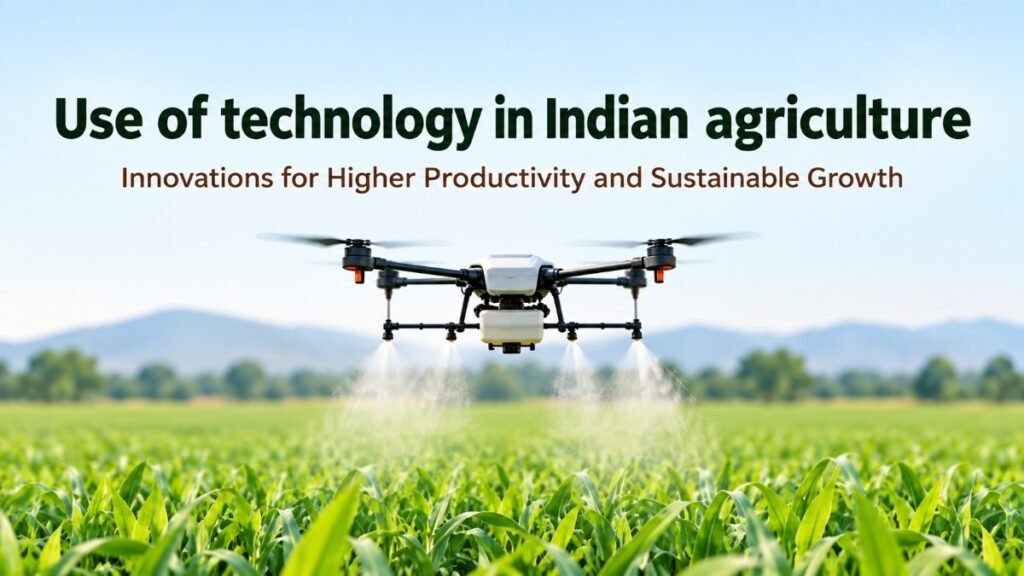
Agricultural drones are increasingly used for crop monitoring, precision spraying, field mapping, and crop damage assessment, improving efficiency while reducing input costs. Technology in Indian Agriculture has expanded the use of Kisan Drones for precision-based farm operations.
- Drones enable precision spraying of fertilizers and pesticides, reducing chemical consumption, labour requirements, and farmers’ exposure to hazardous chemicals.
- They help monitor crop health using multispectral imaging, allowing early detection of nutrient deficiencies and pest infestations.
- Drones assist in crop loss assessment under the Pradhan Mantri Fasal Bima Yojana (PMFBY), enabling faster and more accurate insurance claim settlement.
- The Government promotes Kisan Drones through financial assistance under the Sub-Mission on Agricultural Mechanization (SMAM) and supports drone demonstrations through Krishi Vigyan Kendras (KVKs).
- Example: Garuda Aerospace, ideaForge, and Marut Drones are supplying agricultural drones for precision farming across several Indian states.
Remote Sensing, GIS and Satellite Technology
Remote sensing and satellite technology enable continuous monitoring of agricultural fields from space, helping farmers and governments make timely and data-driven decisions. These technologies are an important part of Technology in Indian Agriculture, particularly for crop monitoring, forecasting, and agricultural planning.
- Satellite imagery is used for crop acreage estimation, drought monitoring, flood assessment, crop health monitoring, and yield forecasting.
- Geographic Information System (GIS) maps soil characteristics, irrigation status, and land use, supporting scientific crop planning and resource management.
- These technologies improve the accuracy of crop insurance claims, disaster assessment, and agricultural planning.
- Example: ISRO’s FASAL (Forecasting Agricultural Output using Space, Agro-meteorology and Land-based Observations) programme provides pre-harvest estimates of major crops such as wheat, rice, cotton, and sugarcane.
- Example: The Mahalanobis National Crop Forecast Centre (MNCFC) uses satellite data and GIS for crop forecasting, drought assessment, and monitoring the Pradhan Mantri Fasal Bima Yojana (PMFBY).
Biotechnology in Agriculture
Biotechnology improves agricultural productivity by developing high-yielding, disease-resistant, climate-resilient, and nutritionally improved crop varieties while reducing dependence on chemical inputs. Agricultural Technology in India also includes biotechnology-based solutions that can improve crop quality, resilience, and productivity.
- Tissue culture enables rapid multiplication of disease-free planting material for crops such as banana, potato, sugarcane, and bamboo.
- Biofertilizers and biopesticides improve soil fertility and control pests in an environmentally sustainable manner.
- Marker-Assisted Selection (MAS) accelerates the development of improved crop varieties with desirable traits such as drought tolerance and disease resistance.
- Genome editing (CRISPR-Cas9) has emerged as a promising technology for developing climate-resilient and nutrient-efficient crops without introducing foreign genes.
- Example: India has commercialized Bt Cotton, which has significantly reduced bollworm infestation and made India one of the world’s largest cotton producers. Tissue-culture banana cultivation is widely adopted in Maharashtra, Gujarat, and Tamil Nadu, resulting in higher productivity and uniform crop quality.
Nanotechnology in Agriculture
Nanotechnology improves nutrient-use efficiency by delivering fertilizers and pesticides in a controlled and targeted manner, thereby increasing crop productivity while reducing environmental pollution. Technology in Indian Agriculture is also being used to improve the efficiency of agricultural inputs through nanotechnology.
- Nano fertilizers improve nutrient absorption, reduce fertilizer losses, and lower the consumption of conventional chemical fertilizers.
- They minimize nutrient leaching, greenhouse gas emissions, and soil degradation, supporting sustainable agriculture.
- Nanotechnology is also being explored for nano pesticides, soil health monitoring, and smart nutrient delivery systems.
- Example: IFFCO Nano Urea Liquid, launched in 2021, can replace a conventional 45 kg bag of urea with a 500 ml bottle under recommended conditions, reducing transportation costs and nitrogen losses.
- Example: India has also introduced IFFCO Nano DAP (2023) to improve phosphorus-use efficiency and reduce dependence on imported fertilizers.
Farm Mechanization
Farm mechanization involves the use of modern machinery to improve agricultural efficiency, reduce labour dependence, and enhance productivity across different farming operations. Modern Farming Technology in India has an important role in improving the timeliness and efficiency of agricultural operations.
- Modern machines such as tractors, seed drills, combine harvesters, laser land levellers, and Happy Seeders reduce labour costs and improve the timeliness of farm operations.
- Mechanization helps address rural labour shortages, increases cropping intensity, and minimizes post-harvest losses.
- Custom Hiring Centres (CHCs) enable small and marginal farmers to rent expensive farm machinery at affordable rates.
- Example: The Happy Seeder, developed by Punjab Agricultural University, allows direct sowing of wheat without burning paddy stubble, helping reduce air pollution in north India.
- Example: The Government promotes mechanization through the Sub-Mission on Agricultural Mechanization (SMAM), which provides financial assistance for purchasing agricultural machinery and establishing Custom Hiring Centres.
Water Management Technologies
Efficient water management technologies help improve irrigation efficiency, conserve water resources, and enhance crop productivity, which is crucial as agriculture accounts for nearly 80% of India’s freshwater use. Technology in Indian Agriculture can improve water-use efficiency through precision irrigation and automated water management.
- Drip irrigation delivers water directly to the root zone, reducing water consumption by 30–70% and increasing crop yields by 20–50% in suitable crops.
- Sprinkler irrigation ensures uniform water distribution and is particularly suitable for undulating and sandy soils.
- Solar-powered irrigation pumps reduce dependence on diesel and grid electricity while lowering irrigation costs.
- Automated irrigation systems integrated with soil moisture sensors optimize irrigation based on crop water requirements.
- Example: Under the Pradhan Mantri Krishi Sinchai Yojana (PMKSY), the ‘Per Drop More Crop’ component promotes micro-irrigation technologies such as drip and sprinkler systems across India.
Digital Agriculture
Digital Agriculture integrates Artificial Intelligence (AI), Big Data, mobile applications, cloud computing, and digital platforms to improve farm management, market access, and delivery of government services. Digital Agriculture in India is a major component of Technology in Indian Agriculture, enabling farmers and governments to use agricultural data for better decision-making.
- AgriStack aims to create a digital database of farmers, enabling targeted delivery of government schemes, credit, insurance, and advisory services.
- e-NAM (National Agriculture Market) connects Agricultural Produce Market Committees (APMCs) through an online trading platform, improving price discovery and market transparency.
- Mobile applications provide real-time information on weather, crop advisory, pest management, market prices, and government schemes.
- Digital technologies improve transparency in crop insurance, subsidy delivery, and agricultural extension services.
- Examples: e-NAM, Kisan Suvidha App, Meghdoot App (weather-based agro-advisory), and the Digital Agriculture Mission (2021–2025) are promoting technology-driven agricultural governance in India.
Post-Harvest and Supply Chain Technologies
Post-harvest technologies reduce crop losses, improve product quality, and enhance farmers’ income through efficient storage, processing, and marketing. Technology in Indian Agriculture can reduce post-harvest losses by strengthening storage, processing, transportation, and digital supply chains.
- Cold storage and cold chain infrastructure preserve perishable commodities such as fruits, vegetables, dairy products, and fish, reducing post-harvest losses.
- Scientific warehouses and silos protect food grains from moisture, pests, and spoilage, ensuring food security.
- Food processing technologies increase the shelf life and value of agricultural produce, creating additional income opportunities for farmers.
- Blockchain technology enables traceability of agricultural products from farm to consumer, improving food safety and export quality standards.
- Example: The PM Kisan SAMPADA Yojana supports modern food processing and cold chain infrastructure, while the e-NAM platform and ONDC are improving digital marketing and market access for agricultural produce.
4. Government Initiatives Promoting Technology in Indian Agriculture
- Digital Agriculture Mission (2024): A flagship mission with an outlay of ₹2,817 crore to build a Digital Public Infrastructure (DPI) for agriculture through AgriStack, Krishi Decision Support System (KDSS), Digital Crop Survey, AI, remote sensing, and data analytics for farmer-centric services.
- AgriStack: A digital platform that creates a unique Farmer ID linked with land records, crops, and government benefits. As of February 2026, more than 8.48 crore Farmer IDs have been generated, while the Digital Crop Survey has covered over 28.5 crore crop plots during Kharif 2025.
- Bharat-VISTAAR (Union Budget 2026–27): An AI-powered, multilingual digital platform launched with a budget allocation of ₹150 crore to provide personalized advisories on crop management, weather, soil health, pest alerts, market prices, and government schemes. It integrates major schemes such as PM-KISAN, PMFBY, Soil Health Card, PMKSY, and SMAM.
- Kisan Drone Initiative: The Government promotes the use of drones for crop monitoring, precision spraying, and crop damage assessment through the Sub-Mission on Agricultural Mechanization (SMAM). In addition, a ₹1,261 crore Central Sector Scheme supports the deployment of drones through 15,000 Women Self-Help Groups (SHGs).
- PM Krishi Sinchai Yojana (PMKSY): Through its ‘Per Drop More Crop’ component, the scheme promotes micro-irrigation technologies such as drip and sprinkler irrigation, improving water-use efficiency and supporting precision agriculture. Technology in Indian Agriculture is being strengthened through such government initiatives, while Agricultural Technology in India is increasingly integrated into schemes focused on productivity, irrigation, mechanization and digital services.
5. Challenges in Adoption of Agricultural Technology
- Small and fragmented landholdings: Over 86% of Indian farmers are small and marginal farmers owning less than 2 hectares, making advanced technologies economically unviable for individual adoption.
- High initial investment: Technologies such as drones, precision farming equipment, IoT devices, and automated irrigation systems require substantial capital, which is beyond the reach of many small farmers.
- Digital divide and low awareness: Limited digital literacy, inadequate internet connectivity, and lack of technical knowledge, particularly in rural areas, hinder the adoption of modern agricultural technologies.
- Limited access to institutional credit: Small and marginal farmers often face difficulties in obtaining affordable credit for investing in advanced farm machinery and digital technologies.
- Weak rural infrastructure: Inadequate electricity supply, poor mobile network coverage, lack of repair and maintenance facilities, and insufficient cold chain infrastructure reduce the effectiveness of technology adoption.
- Data privacy and interoperability issues: The expansion of digital platforms such as AgriStack raises concerns regarding data security, privacy, and integration of databases across different states and departments.
These challenges can slow the wider adoption of Technology in Indian Agriculture, particularly among small and marginal farmers. Expanding affordable Agricultural Technology in India requires better rural infrastructure, access to finance, digital literacy, and appropriate technical support. Modern Farming Technology in India must therefore remain accessible, affordable and suitable for India’s diverse farming conditions.
6. Way Forward
- Promote affordable technologies through Custom Hiring Centres (CHCs), Farmer Producer Organizations (FPOs), and agricultural cooperatives to make modern equipment accessible to small farmers.
- Strengthen digital infrastructure by expanding broadband connectivity, digital literacy, and AI-based agricultural extension services in rural areas.
- Increase investment in research and innovation through ICAR, agricultural universities, startups, and public-private partnerships for developing indigenous agricultural technologies.
- Promote climate-smart and precision agriculture by expanding the adoption of drones, IoT, AI, satellite technology, nano fertilizers, and micro-irrigation.
- Improve market linkages by strengthening e-NAM, AgriStack, digital supply chains, food processing, and cold storage infrastructure to enhance farmers’ income.
- Ensure responsible use of technology by establishing robust data protection mechanisms, ethical AI frameworks, and farmer-centric digital governance.
Strengthening Technology in Indian Agriculture through affordable access, research, digital infrastructure and farmer training can support sustainable agricultural growth. AgriTech in India can further improve productivity, resource efficiency and market access, while Digital Agriculture in India can help deliver more efficient and transparent agricultural services.
7. Conclusion
Technology has emerged as a key driver of India’s agricultural transformation by improving productivity, resource-use efficiency, climate resilience, and farmers’ income. The effective integration of digital technologies, biotechnology, precision farming, drones, and smart irrigation with supportive government policies and farmer capacity building will be crucial for achieving sustainable agriculture, food security, and the vision of Viksit Bharat 2047. Technology in Indian Agriculture will continue to play an important role in building a more productive, resilient and sustainable agricultural sector.
BPSC Mains Practice Questions
- “Science and technology can transform Indian agriculture from input-intensive farming to knowledge- and technology-driven farming.” Discuss how precision agriculture, AI, drones, IoT, biotechnology, satellite technology and digital platforms can improve agricultural productivity, reduce input costs and increase farmers’ income in India.
- How can the wider adoption of science and technology help address the major challenges faced by Indian farmers, including small landholdings, climate change, water scarcity, pest attacks, post-harvest losses and poor market access? Examine its potential to enhance farmers’ income and suggest measures for inclusive technology adoption.
Learn More About Technology in Indian Agriculture
For official information on digital agriculture, AgriStack, farmer-centric digital infrastructure, AI, remote sensing and technology-based agricultural initiatives, visit the Ministry of Agriculture & Farmers Welfare, Government of India: Ministry of Agriculture & Farmers Welfare – Digital Agriculture Mission. The Ministry provides official information on government initiatives aimed at promoting Technology in Indian Agriculture and improving productivity, resource efficiency and farmers’ income.