1. Introduction
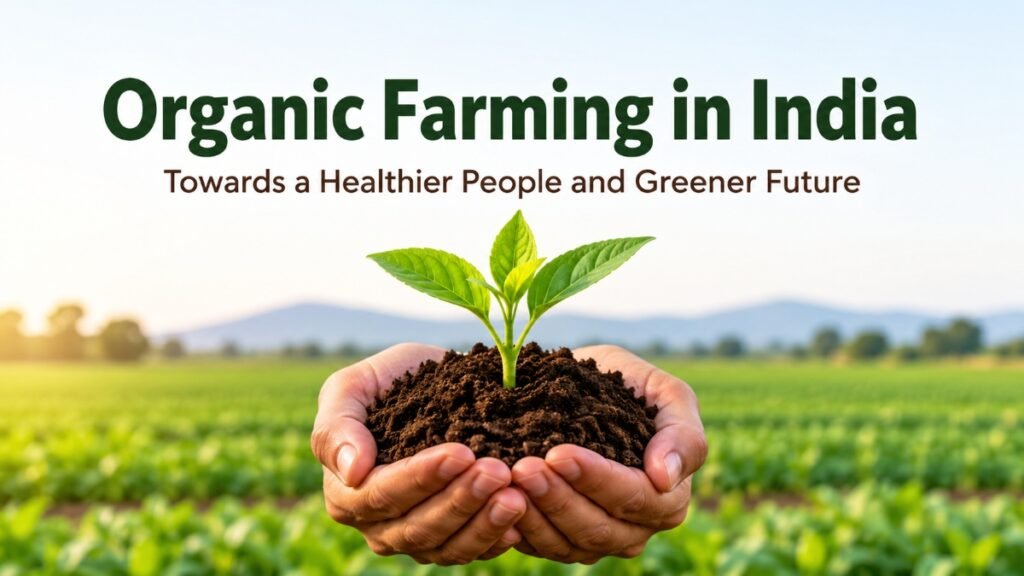
Organic farming in India is a sustainable agricultural system that maintains the health of soil, ecosystems, plants, animals, and humans by relying on natural biological processes instead of synthetic chemical fertilizers and pesticides. According to IFOAM (International Federation of Organic Agriculture Movements), organic agriculture is a production system that sustains the health of soils, ecosystems, and people through ecological processes, biodiversity, and natural cycles.
Organic farming in India emphasizes the use of compost, farmyard manure (FYM), vermicompost, green manure, biofertilizers, crop rotation, biological pest control, and integrated nutrient management while prohibiting genetically modified organisms (GMOs) and most synthetic agrochemicals. In India, organic farming is rooted in traditional agricultural practices and has gained renewed importance due to concerns over soil degradation, declining soil fertility, groundwater pollution, climate change, and increasing demand for safe and chemical-free food.
Organic Agriculture in India supports sustainable agriculture, conserves biodiversity, improves soil health, reduces environmental pollution, and contributes to achieving the Sustainable Development Goals (SDGs), particularly SDG 2 (Zero Hunger), SDG 12 (Responsible Consumption and Production), and SDG 13 (Climate Action).
Master Science & Technology. Maximize Your BPSC Mains Score.
Enroll in the BPSC Science & Tech Course Today
Master Science & Technology for BPSC Mains GS Paper-2 with 75+ exam-oriented topics, 6 structured lessons, and downloadable PDF notes—all in one course.
✔ 75+ Exam-Oriented Topics • ✔ 6 Comprehensive Lessons • ✔ Downloadable PDF Notes • ✔ Updated for 72nd BPSC Mains
2. Need for Organic Farming
The intensive use of chemical fertilizers, pesticides, and monocropping since the Green Revolution has significantly increased agricultural production but has also resulted in declining soil fertility, depletion of soil organic carbon, groundwater contamination, biodiversity loss, and increasing greenhouse gas emissions. Organic farming in India addresses these challenges by improving soil health, enhancing microbial activity, conserving biodiversity, reducing environmental pollution, and increasing the resilience of agriculture to climate change through sustainable management of natural resources.
Organic Farming also promotes food safety by producing chemical residue-free crops, reduces farmers’ dependence on costly chemical inputs through the use of locally available organic resources, and generates additional rural employment in compost production, certification, processing, and value addition. Growing domestic and global demand for organic products provides better income opportunities for farmers, while the adoption of Organic Agriculture in India supports India’s commitments under the National Mission for Sustainable Agriculture (NMSA), the Paris Agreement, and the Sustainable Development Goals (SDGs), particularly SDG 2 (Zero Hunger), SDG 12 (Responsible Consumption and Production), SDG 13 (Climate Action), and SDG 15 (Life on Land).
Prepare Smarter. Study Better. Ace BPSC Mains.
BPSC Mains GS Paper 1 & 2 Complete Course
Access comprehensive BPSC Mains Notes for GS Paper 1 & 2, covering 378+ topics across 24 PDF lessons, with dedicated Bihar coverage, practice questions and downloadable study material.
✓ GS Paper 1 & 2 • ✓ 378+ Topics • ✓ 24 PDF Lessons • ✓ Bihar-Specific Coverage • ✓ Downloadable Notes
3. Principles of Organic Farming
- Principle of Health: Organic farming sustains the health of soil, plants, animals, humans, and the environment as one interconnected system.
- Principle of Ecology: It is based on natural ecological cycles, biodiversity, nutrient recycling, and sustainable use of natural resources.
- Principle of Fairness: It promotes fair relationships among farmers, consumers, workers, and future generations while ensuring animal welfare.
- Principle of Care: It follows the precautionary approach by avoiding technologies and practices that may harm human health or the environment.
4. Key Features and Components of Organic Farming
Soil Health Management
- Improves soil fertility through compost, farmyard manure (FYM), vermicompost, green manure, and biofertilizers.
- Enhances soil organic carbon, microbial activity, and water-holding capacity.
Organic farming in India places strong emphasis on maintaining healthy soil through natural nutrient sources and biological processes. These Organic Farming Practices help improve long-term soil fertility and reduce dependence on synthetic inputs.
Crop Management
- Promotes crop rotation, mixed cropping, intercropping, cover crops, and mulching.
- Maintains soil fertility and reduces pest and disease incidence.
These Organic Farming Practices support biodiversity and help maintain the natural balance of agricultural ecosystems.
Nutrient Management
- Relies on natural nutrient sources and biological nitrogen fixation instead of synthetic fertilizers.
- Encourages recycling of crop residues and livestock waste.
Pest and Disease Management
- Uses biological control agents, neem-based pesticides, pheromone traps, and Integrated Pest Management (IPM).
- Minimizes chemical pesticide use while protecting beneficial organisms.
Weed Management
- Controls weeds through manual weeding, mulching, crop rotation, cover crops, and mechanical methods.
- Reduces dependence on chemical herbicides.
Livestock Integration
- Integrates livestock with crop farming to recycle nutrients through dung and urine.
- Ensures animal welfare by avoiding growth hormones, routine antibiotics, and GM feed.
5. Organic Farming Certification System in India
India has established a robust certification system to ensure the authenticity and quality of organic products. The National Programme for Organic Production (NPOP), launched in 2001 and implemented by APEDA, provides third-party certification primarily for export-oriented organic products. For domestic markets, the Participatory Guarantee System (PGS-India), introduced in 2011, offers a low-cost, community-based certification mechanism for small and marginal farmers. Additionally, the Jaivik Bharat Logo, launched by FSSAI in 2017, enables consumers to easily identify certified organic food products. Together, these certification systems ensure that organic products comply with prescribed standards from production and processing to packaging and marketing.
Organic Farming Certification in India is therefore an important component of Organic farming in India, as certification helps establish the authenticity of organic products and improves consumer confidence. Organic Farming Certification in India operates through mechanisms such as NPOP and PGS-India, covering different market and farmer requirements. These systems form an important part of the broader framework for Organic Agriculture in India.
6. Organic Farming in India
- India has one of the largest numbers of organic farmers in the world and is among the leading producers of organic agricultural products.
- According to FiBL & IFOAM (World of Organic Agriculture 2025), India has over 2.3 million organic producers, the highest globally.
- As per APEDA, India had around 10.17 million hectares under organic certification (cultivable land and wild harvest combined) in 2023–24.
- Major organically cultivated crops include oilseeds, cereals, pulses, cotton, spices, tea, coffee, fruits, medicinal plants, and vegetables.
- Leading organic farming states include Madhya Pradesh, Maharashtra, Rajasthan, Gujarat, Karnataka, Odisha, and Sikkim.
- Sikkim became India’s first fully organic state in 2016, while several North-Eastern states are expanding organic cultivation under government support.
- India exports organic products such as soybean, oilseeds, cereals, tea, coffee, spices, processed foods, medicinal plants, fruits, and vegetables to markets including the USA, European Union, Canada, Switzerland, Australia, and Japan.
- The organic sector is witnessing steady growth due to increasing domestic demand, export opportunities, and government initiatives promoting sustainable agriculture.
Organic farming in India has therefore emerged as an important component of sustainable agricultural development. The expansion of Organic Agriculture in India is supported by growing demand, export opportunities and government initiatives. Organic Farming Notes are particularly relevant for understanding India’s transition towards sustainable agriculture.
7. Government Initiatives for Organic Farming
- Paramparagat Krishi Vikas Yojana (PKVY): Launched in 2015 and now implemented under PM-Rashtriya Krishi Vikas Yojana (PM-RKVY), it promotes cluster-based Organic Farming in India through financial assistance for organic inputs, certification, training, branding, and marketing. Farmers receive ₹31,500 per hectare for 3 years, including ₹15,000 through DBT for organic inputs.
- Mission Organic Value Chain Development for North Eastern Region (MOVCD-NER): Launched in 2015, it promotes certified Organic Agriculture in India across the eight North-Eastern states through a value-chain approach covering production, processing, certification, and marketing. Farmers receive ₹46,500 per hectare for 3 years.
- National Programme for Organic Production (NPOP): Implemented by APEDA, it provides third-party certification, quality standards, and facilitates exports of Indian organic products to international markets. Organic Farming Certification in India under NPOP is particularly important for accessing export markets.
- Participatory Guarantee System (PGS-India): A low-cost, community-based certification system for domestic organic markets, particularly benefiting small and marginal farmers. It is an important mechanism for Organic Farming Certification in India.
- Jaivik Bharat Logo: Introduced by FSSAI in 2017, it enables consumers to identify certified organic food products sold in India.
- Jaivik Kheti Portal: A dedicated digital platform for registration of organic farmers, certification agencies, buyers, FPOs, and marketing of organic produce, improving market linkages.
- Bharatiya Prakritik Krishi Paddhati (BPKP): Promotes chemical-free farming based on indigenous practices such as Jeevamrit, Beejamrit, mulching, and biomass recycling. Certification is provided through the PGS-India framework.
Government initiatives are central to expanding Organic Farming in India by supporting farmers with financial assistance, certification, training and market linkages. These measures also strengthen Organic Farming Practices and improve opportunities for farmers adopting sustainable agricultural methods.
8. Advantages of Organic Farming
Improves Soil Health and Fertility
Organic farming in India enhances soil fertility by increasing soil organic carbon (SOC), improving soil structure, and promoting the growth of beneficial microorganisms such as bacteria, fungi, and earthworms. The continuous application of compost, green manure, crop residues, and biofertilizers improves nutrient cycling and water-holding capacity, ensuring sustainable productivity over the long term. According to the Indian Council of Agricultural Research (ICAR), soils rich in organic matter exhibit better nutrient availability and resilience against degradation.
Conserves Biodiversity
Organic farming in India avoids synthetic pesticides and herbicides, thereby protecting pollinators, birds, earthworms, and beneficial insects. Crop rotation, mixed cropping, and agroforestry create diverse habitats that enhance ecological balance. According to the Food and Agriculture Organization (FAO), organic farms generally support higher levels of biodiversity than conventional farms, contributing to ecosystem stability and natural pest control.
Reduces Environmental Pollution
The elimination of synthetic fertilizers and pesticides significantly reduces contamination of soil, groundwater, rivers, and lakes. Organic farming in India also minimizes nitrate leaching and chemical residues in food, helping preserve ecosystems and public health. This makes organic farming an environmentally sustainable alternative to intensive chemical-based agriculture.
Enhances Climate Change Mitigation and Resilience
Organic farming in India contributes to carbon sequestration by increasing soil organic carbon and reducing greenhouse gas emissions associated with the manufacture and application of synthetic fertilizers. Healthy soils also retain more moisture, enabling crops to better withstand droughts and extreme weather events. Consequently, organic farming is increasingly recognized as an important component of climate-smart agriculture.
Produces Safe and Nutritious Food
Organic food is produced without synthetic pesticide residues, genetically modified organisms (GMOs), or unnecessary antibiotics and growth hormones. Growing consumer awareness regarding food safety has increased the demand for certified organic products in both domestic and international markets, making Organic Farming in India an important contributor to healthy diets.
Increases Farmers’ Income through Premium Pricing
Certified organic products generally command 20–50% higher market prices than conventionally produced crops due to increasing consumer demand. Government support through certification, branding, Farmer Producer Organizations (FPOs), and export promotion further improves farmers’ income and market access, particularly for small and marginal farmers. These Benefits of Organic Farming make organic agriculture increasingly relevant for sustainable rural livelihoods.
Reduces Dependence on External Inputs
Organic farming in India relies on locally available resources such as farmyard manure, compost, crop residues, green manure, and biofertilizers. This reduces farmers’ dependence on costly chemical fertilizers and pesticides, lowers cultivation costs over time, and enhances self-reliance in agricultural production. Such Organic Farming Practices also promote efficient recycling of farm resources.
Promotes Sustainable Rural Development
Organic farming in India is relatively labour-intensive, creating employment opportunities in compost preparation, vermicomposting, organic input production, certification, processing, packaging, and value addition. It also encourages community participation through cluster-based farming models such as Paramparagat Krishi Vikas Yojana (PKVY), strengthening rural livelihoods.
Boosts Organic Exports
India exports a wide range of organic products, including cereals, oilseeds, tea, coffee, spices, medicinal plants, fruits, vegetables, and processed foods to countries such as the USA, European Union, Canada, Australia, and Japan. Under the National Programme for Organic Production (NPOP), India has established internationally recognized certification standards, enhancing its competitiveness in the global organic market. These developments demonstrate the growing importance of Organic Agriculture in India in international trade.
9. Challenges in Organic Farming
Lower Productivity during the Transition Period
Organic farming in India often experiences a decline in crop yields during the initial 2–3 years as the soil gradually restores its biological fertility after discontinuing chemical inputs. This transition period discourages many farmers from adopting organic practices.
High Certification Cost and Complex Procedures
Obtaining organic certification involves inspections, documentation, and compliance with prescribed standards, making the process costly and time-consuming for small and marginal farmers. Although PGS-India has reduced this burden for domestic markets, export certification remains expensive. The cost and complexity of Organic Farming Certification in India can therefore discourage smaller farmers.
Limited Availability of Organic Inputs
The availability of quality compost, vermicompost, biofertilizers, biopesticides, and other organic inputs remains inadequate in many regions. Large-scale Organic Farming in India requires a consistent supply of these inputs, which is often lacking.
Marketing and Supply Chain Constraints
Organic farmers face challenges in storage, transportation, branding, certification, and market linkages. The absence of dedicated organic markets in many states reduces their ability to obtain premium prices.
Higher Labour Requirement
Practices such as manual weeding, compost preparation, mulching, and biological pest management require more labour than conventional farming, increasing production costs, especially where agricultural labour is scarce.
Lack of Awareness and Technical Knowledge
Many farmers are unfamiliar with scientific organic farming practices, certification procedures, and market opportunities. Limited extension services and inadequate training slow the adoption of organic agriculture.
Limited Research and Technology Support
Compared to conventional agriculture, research on high-yielding organic crop varieties, organic nutrient management, and biological pest control is relatively limited, affecting productivity and scalability.
Limited Domestic Market and Consumer Awareness
Despite growing demand, organic products constitute only a small share of India’s food market due to higher prices, limited availability, and low consumer awareness about certified organic products.
Difficulty in Meeting India’s Food Security Requirements
With a population exceeding 1.4 billion, complete replacement of conventional farming by Organic Farming in India is currently impractical. Lower yields in certain crops may affect national food security, making a balanced approach necessary.
Risk of Fraud and Mislabeling
The increasing demand for organic products has led to instances of false labeling and counterfeit certification, reducing consumer confidence and affecting genuine organic producers. These concerns also highlight the importance of effective Organic Farming Certification in India.
10. Organic Farming vs Natural Farming vs Conventional Farming
| Basis | Organic Farming | Natural Farming | Conventional Farming |
| Concept | Relies on natural inputs and certified organic practices. | Mimics natural ecosystems with minimal external inputs. | Depends on chemical fertilizers, pesticides, and modern agricultural technologies. |
| External Inputs | Organic manures, biofertilizers, and biopesticides are permitted. | Almost no external inputs; emphasizes on-farm preparations such as Jeevamrit and Beejamrit. | High dependence on synthetic fertilizers, pesticides, and herbicides. |
| Certification | Mandatory for marketing as “organic” under NPOP or PGS-India. | No separate national certification system; generally promoted through government programmes. | No certification required. |
| Productivity | Moderate; may decline during the transition period. | Generally lower in the initial years. | High productivity due to intensive input use. |
| Environmental Impact | Conserves soil, water, and biodiversity with low pollution. | Offers maximum ecological conservation and improves soil health. | Associated with soil degradation, water pollution, and biodiversity loss due to excessive chemical use. |
| Cost of Cultivation | Moderate after the transition period. | Lowest due to minimal external inputs. | Higher because of increasing costs of chemical inputs. |
| Government Support | PKVY, MOVCD-NER, NPOP, PGS-India. | National Mission on Natural Farming (NMNF) and BPKP. | Supported through fertilizer subsidy, irrigation, mechanization, MSP, etc. |
11. Way Forward
- Strengthen financial support: Expand the coverage of Paramparagat Krishi Vikas Yojana (PKVY) and provide higher incentives during the 2–3 years transition period to offset initial yield losses. Strengthening financial support can further encourage Organic Farming in India.
- Simplify certification: Make PGS-India and NPOP certification more affordable, transparent, and digital to encourage greater participation by small and marginal farmers.
- Promote research and innovation: Increase investment in research on biofertilizers, biopesticides, climate-resilient organic crop varieties, and precision organic farming through ICAR and agricultural universities.
- Develop robust value chains: Strengthen Farmer Producer Organizations (FPOs), cold storage, processing, branding, e-commerce, and export infrastructure to improve market access and farmers’ incomes.
- Enhance farmer awareness: Expand training, extension services, and digital advisory platforms to promote scientific Organic Farming Practices and certification procedures.
- Adopt a region-specific approach: Encourage Organic Farming in India in rainfed, tribal, hilly, and North-Eastern regions where chemical input use is already low and the transition is easier.
- Integrate with climate-smart agriculture: Promote organic farming alongside natural farming, agroforestry, and sustainable water management to achieve India’s climate commitments and Sustainable Development Goals (SDGs). Organic Agriculture in India can contribute to this broader transition towards sustainable agriculture.
12. Conclusion
Organic farming in India is a sustainable and environmentally friendly agricultural system that improves soil health, conserves biodiversity, reduces pollution, and produces safe food. With continued government support, scientific research, improved certification, and stronger market linkages, Organic Farming in India can play a vital role in enhancing farmers’ income, ensuring food security, promoting climate-resilient agriculture, and achieving sustainable agricultural development in India.
BPSC/UPSC Mains Practice Questions
- “Organic farming can contribute to sustainable agricultural development, but its large-scale adoption faces several structural challenges.” Discuss the major benefits and challenges of organic farming in India.
- Compare organic farming, natural farming and conventional farming in India with reference to input use, certification, productivity, environmental impact and government support. Also suggest measures to promote sustainable agricultural practices.
Learn More About Organic Farming in India
For official information on organic farming, organic production standards, certification, and the National Programme for Organic Production (NPOP), visit the Agricultural and Processed Food Products Export Development Authority (APEDA), Government of India: APEDA – National Programme for Organic Production (NPOP). APEDA provides official information on Organic Farming Certification in India, organic production standards, accredited certification bodies, and India’s organic export framework.