1. Introduction
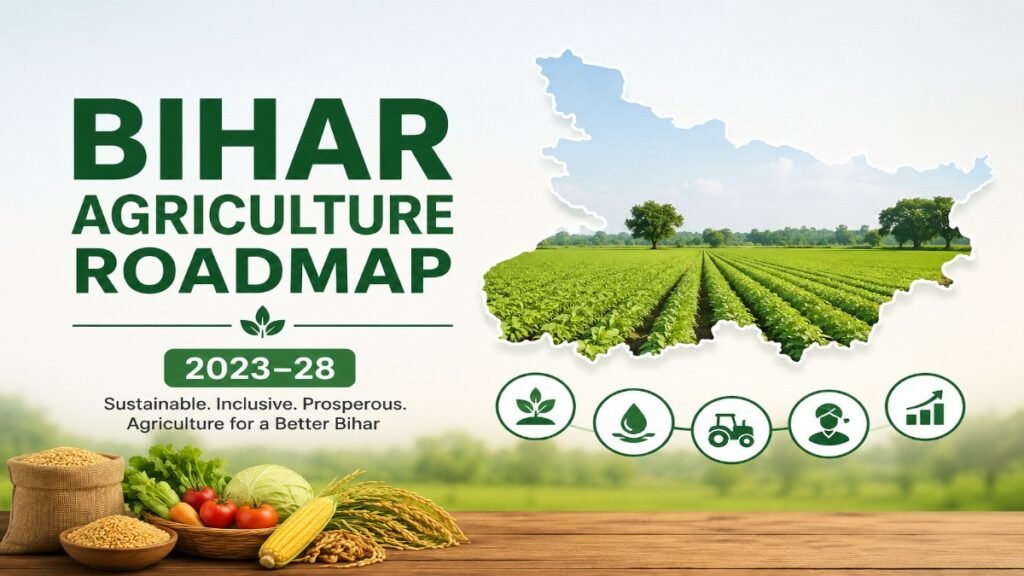
The Bihar Agriculture Roadmap (BARM) is a comprehensive long-term policy framework of the Government of Bihar aimed at transforming agriculture from a subsistence-based activity into a productive, sustainable, technology-driven and market-oriented sector.
Unlike isolated agricultural schemes, the Bihar Agriculture Roadmap adopts an integrated approach by bringing together agriculture and allied sectors—including horticulture, animal husbandry, fisheries, cooperatives, irrigation, agricultural research, extension services, food processing and marketing—under a common development strategy. Its primary objective is to enhance farmers’ income, ensure food and nutritional security, promote sustainable use of natural resources, and strengthen rural livelihoods.
Bihar has been implementing the Bihar Agriculture Roadmap since 2008, making it one of the few Indian states to adopt a structured, multi-sectoral roadmap for agricultural development. The journey has evolved through four phases:
| Agriculture Road Map | Period |
|---|---|
| First Agriculture Road Map | 2008–2012 |
| Second Agriculture Road Map | 2012–2017 |
| Third Agriculture Road Map | 2017–2022 |
| Fourth Agriculture Road Map (Latest Phase) | 2023–2028 |
The Fourth Bihar Agriculture Roadmap (2023–28) was formally launched on 18 October 2023 by the President of India, Smt. Droupadi Murmu, in Patna. The roadmap seeks to address emerging challenges such as climate change, fragmented landholdings, declining soil health and market inefficiencies while leveraging opportunities in digital agriculture, crop diversification, value addition and Farmer Producer Organisations (FPOs). It also places special emphasis on promoting climate-resilient agriculture, water conservation, organic farming, modern technology, and integrated development of allied sectors, making agriculture more profitable and sustainable for Bihar’s predominantly small and marginal farmers.
Recognising Bihar’s strategic importance in India’s food security, the Agriculture Roadmap in Bihar envisions agriculture as a key driver of inclusive economic growth. With 93.6 lakh hectares of geographical area, 50.45 lakh hectares under net sown area and a cropping intensity of 144%, the state possesses significant agricultural potential. The Bihar Krishi Roadmap aims to harness these strengths through coordinated planning, institutional convergence and farmer-centric interventions, thereby contributing to the broader goal of sustainable agricultural development in Bihar.
Master Current Affairs. Ace BPSC Mains.
BPSC Mains Current Affairs & International Relations Course
Master GS Paper-I (Section-II) with 116 exam-oriented topics, 5 structured lessons and downloadable PDF notes—all in one comprehensive course.
✔ 116 Exam-Oriented Topics • ✔ 5 Comprehensive Lessons • ✔ Downloadable PDF Notes • ✔ Updated for 72nd BPSC Mains
2. Why in News?
The Fourth Bihar Agriculture Roadmap (2023–2028) has remained in focus due to the Bihar Government’s continued rollout of schemes, budgetary allocations, and policy interventions aimed at making agriculture more productive, climate-resilient, technology-driven and market-oriented. Since its launch on 18 October 2023, the Bihar Agriculture Roadmap has become the principal framework guiding agricultural development in the state.
In 2025–26 and 2026–27, the state government accelerated the implementation of the Agriculture Roadmap in Bihar by approving and funding several programmes under its various components. These include:
- Promotion of crop diversification through expansion of oilseeds, pulses and millets.
- Financial support for the National Food Security & Nutrition Mission under the Bihar Agriculture Roadmap.
- Expansion of the Digital Agriculture Mission, including Farmer Registry, AgriStack and Digital Crop Survey.
- Promotion of agricultural drones for pesticide and liquid fertilizer spraying.
- Strengthening of the Chief Minister Horticulture Mission, including support for dragon fruit cultivation, fruit development and integrated horticulture.
- Continued assistance for ATMA (Agricultural Technology Management Agency) and agricultural extension services to improve technology dissemination among farmers.
The Bihar Krishi Roadmap has also gained renewed importance due to its alignment with emerging national priorities. The Union Budget 2025–26 announced the establishment of a Makhana Board in Bihar, a major initiative for improving production, processing, value addition and marketing of makhana through Farmer Producer Organisations (FPOs). In addition, the Budget proposed a National Mission on High Yielding Seeds, which complements the Road Map’s emphasis on climate-resilient agriculture and improved seed systems.
Another reason for the continued relevance of the Bihar Agriculture Roadmap is Bihar’s increasing focus on climate-smart agriculture. The roadmap promotes water conservation, micro-irrigation, soil health management, organic farming along the Ganga corridor, integrated farming systems and efficient use of natural resources to address the growing challenges of floods, droughts and climate variability.
Further, the Bihar Government has reiterated its commitment to fast-track implementation of the Fourth Bihar Agriculture Roadmap during the 2024–29 governance agenda, with priorities including expansion of irrigation, promotion of dairy and fisheries, establishment of milk cooperatives, strengthening agricultural infrastructure and increasing farmers’ income.
Prepare Smarter. Study Better. Ace BPSC Mains.
BPSC Mains GS Paper 1 & 2 Complete Course
Access comprehensive BPSC Mains Notes for GS Paper 1 & 2, covering 378+ topics across 24 PDF lessons, with dedicated Bihar coverage, practice questions and downloadable study material.
✓ GS Paper 1 & 2 • ✓ 378+ Topics • ✓ 24 PDF Lessons • ✓ Bihar-Specific Coverage • ✓ Downloadable Notes
3. Key Features of the Fourth Bihar Agriculture Road Map (2023–28)
- Integrated Development Approach: The Bihar Agriculture Roadmap covers agriculture along with horticulture, animal husbandry, fisheries, cooperatives, irrigation, agricultural research, extension services, food processing and agricultural marketing under a single policy framework.
- Duration: The Fourth Bihar Agriculture Roadmap is being implemented for 2023–2028 as the fourth phase of Bihar’s long-term agricultural development strategy.
- Climate-Resilient Agriculture: The Agriculture Roadmap in Bihar promotes climate-smart farming through water conservation, soil health management, crop diversification, micro-irrigation and sustainable use of natural resources.
- Crop Diversification: The Bihar Krishi Roadmap encourages cultivation of pulses, oilseeds, millets, fruits, vegetables, medicinal plants and other high-value crops to improve farm income.
- Promotion of Farmer Producer Organisations (FPOs): The Bihar Agriculture Roadmap strengthens farmer collectivisation, aggregation, value addition and market access for small and marginal farmers.
- Digital and Modern Agriculture: The Agriculture Roadmap in Bihar focuses on AgriStack, Farmer Registry, Digital Crop Survey, agricultural mechanisation, drones and precision farming technologies.
- Strengthening Allied Sectors: The Bihar Agriculture Roadmap gives equal importance to dairy, fisheries, poultry, beekeeping, mushroom cultivation and horticulture for income diversification.
- Special Focus Areas: The Bihar Krishi Roadmap promotes organic farming in the Ganga corridor and area-specific interventions for Tal, Diara and Chaur regions based on local agro-climatic conditions.
- Farmer-Centric Objectives: The Bihar Agriculture Roadmap aims to increase farmers’ income, ensure food and nutritional security, generate rural employment and strengthen post-harvest infrastructure and agricultural value chains.
4. Significance of the Bihar Agriculture Road Map
- Enhances Agricultural Growth: The Bihar Agriculture Roadmap provides a long-term policy framework for increasing agricultural productivity through improved seeds, mechanisation, irrigation and scientific farming practices.
- Increases Farmers’ Income: The Bihar Krishi Roadmap promotes crop diversification, allied sectors (dairy, fisheries, horticulture, beekeeping), value addition and better market linkages to create multiple income sources.
- Ensures Food and Nutritional Security: The Agriculture Roadmap in Bihar encourages the production of cereals, pulses, oilseeds, fruits and vegetables to improve both food availability and nutritional outcomes.
- Promotes Climate-Resilient Agriculture: The Bihar Agriculture Roadmap focuses on water conservation, micro-irrigation, organic farming, soil health management and climate-smart technologies to address floods, droughts and changing weather patterns.
- Supports Rural Employment: The Bihar Agriculture Roadmap expands opportunities in agriculture and allied activities such as food processing, dairy, fisheries and horticulture, thereby reducing disguised unemployment and migration.
- Strengthens Agricultural Infrastructure: The Agriculture Roadmap in Bihar emphasises the development of irrigation facilities, storage, cold chains, processing units, rural markets and logistics to reduce post-harvest losses.
- Encourages Technology Adoption: The Bihar Krishi Roadmap promotes digital agriculture, AgriStack, Farmer Registry, agricultural drones and precision farming to improve efficiency and transparency.
- Empowers Small and Marginal Farmers: The Bihar Agriculture Roadmap supports Farmer Producer Organisations (FPOs), cooperative institutions and collective farming models to improve access to credit, inputs and markets.
- Boosts Bihar’s Economy: Since agriculture contributes over one-fifth of Bihar’s Gross State Value Added (GSVA), improvements under the Bihar Agriculture Roadmap directly support inclusive economic growth, poverty reduction and rural development.
5. Bihar-Specific Initiatives and Achievements
- Organic Farming along the Ganga Corridor: Under the Bihar Agriculture Roadmap, around 20,000 acres have been identified under the Jaivik Corridor to promote chemical-free farming, improve soil health and create premium market opportunities for farmers.
- Promotion of Makhana: Bihar accounts for nearly 90% of India’s makhana production. The Bihar Krishi Roadmap focuses on scientific cultivation, processing, branding and exports. The Union Budget 2025–26 also announced the establishment of a Makhana Board in Bihar.
- Crop Diversification: The Agriculture Roadmap in Bihar gives special emphasis to the cultivation of millets, pulses, oilseeds, fruits, vegetables, dragon fruit and medicinal plants to enhance farmers’ income and reduce dependence on traditional crops.
- Area-Specific Agricultural Development: The Bihar Agriculture Roadmap provides dedicated interventions for Tal, Diara and Chaur regions based on their unique agro-climatic conditions to improve productivity and climate resilience.
- Expansion of Allied Sectors: The Bihar Agriculture Roadmap promotes dairy, fisheries, poultry, beekeeping, mushroom cultivation and horticulture as alternative income sources for rural households. Bihar has emerged as a leading producer of fish, honey and mushrooms under the previous Agriculture Road Maps.
- Digital and Modern Agriculture: The Bihar Krishi Roadmap supports the implementation of Farmer Registry, Digital Crop Survey, AgriStack, agricultural mechanisation and drone-based farming to improve efficiency and service delivery.
- Achievements of Earlier Road Maps: Successive phases of the Bihar Agriculture Roadmap have contributed to a significant increase in the productivity of paddy, wheat and maize, while strengthening irrigation, seed production, agricultural mechanisation and extension services across the state.
- Improved Agricultural Potential: Bihar has a net sown area of 50.45 lakh hectares and a cropping intensity of 144%, providing a strong foundation for sustainable agricultural growth under the Fourth Bihar Agriculture Roadmap.
6. Challenges in Implementation
Small and Fragmented Landholdings
- Around 97% of farmers in Bihar are small and marginal, limiting economies of scale and adoption of modern technologies.
- Fragmentation reduces the viability of mechanisation and commercial farming, posing a major challenge to the effective implementation of the Bihar Agriculture Roadmap.
Climate and Natural Disasters
- Bihar is highly vulnerable to annual floods in North Bihar and drought-like conditions in South Bihar.
- Climate change has increased the frequency of erratic rainfall, affecting crop productivity and farm incomes. Addressing these challenges remains a key objective of the Agriculture Roadmap in Bihar.
Irrigation and Water Management Issues
- Uneven irrigation coverage across districts.
- Overdependence on monsoon rainfall in many regions.
- Limited adoption of micro-irrigation and efficient water-use technologies, despite the emphasis of the Bihar Krishi Roadmap on climate-resilient agriculture.
Weak Agricultural Infrastructure
- Inadequate cold storage, warehouses and food processing facilities.
- High post-harvest losses due to poor storage and supply chain infrastructure, which continue to affect the success of the Bihar Agriculture Roadmap.
Marketing and Value Chain Constraints
- Limited access to organised markets and value addition.
- Farmers often receive low prices due to dependence on local intermediaries.
- Weak export infrastructure for high-value crops such as makhana, fruits and vegetables, limiting the full potential of the Agriculture Roadmap in Bihar.
Low Technology Adoption
- Limited awareness and affordability of agricultural machinery, drones and digital platforms among small farmers.
- Shortage of quality extension services in remote areas continues to slow the implementation of the Bihar Krishi Roadmap.
Institutional and Financial Challenges
- Need for better coordination among departments implementing the Bihar Agriculture Roadmap.
- Limited access to institutional credit and crop insurance for small and tenant farmers.
- Strengthening of Farmer Producer Organisations (FPOs) remains a work in progress.
Implementation and Monitoring
- Delays in execution of projects and uneven implementation across districts.
- Need for stronger real-time monitoring, outcome-based evaluation and timely fund utilisation to ensure the effective implementation of the Bihar Agriculture Roadmap.
7. Way Forward
- Promote Climate-Smart Agriculture: Expand climate-resilient crop varieties, micro-irrigation, watershed development and integrated farming systems to reduce vulnerability to floods and droughts. These measures will strengthen the long-term objectives of the Bihar Agriculture Roadmap.
- Strengthen Farmer Producer Organisations (FPOs): Improve access to credit, quality inputs, storage, processing and markets through stronger FPOs and cooperative institutions, as envisaged under the Bihar Krishi Roadmap.
- Accelerate Digital Agriculture: Ensure universal implementation of Farmer Registry, AgriStack, Digital Crop Survey and AI-enabled advisory services to improve productivity and transparency under the Agriculture Roadmap in Bihar.
- Develop Agri-Value Chains: Establish more food processing units, cold storage facilities, warehouses and logistics infrastructure to minimise post-harvest losses and increase farmers’ income, thereby enhancing the effectiveness of the Bihar Agriculture Roadmap.
- Promote High-Value Agriculture: Encourage cultivation and branding of makhana, maize, fruits, vegetables, medicinal plants and organic produce to enhance exports and value addition, in line with the priorities of the Bihar Krishi Roadmap.
- Increase Investment in Research and Extension: Strengthen collaboration among Bihar Agricultural University (Sabour), Dr. Rajendra Prasad Central Agricultural University (Pusa) and Krishi Vigyan Kendras (KVKs) for technology transfer and farmer training to support the goals of the Bihar Agriculture Roadmap.
- Improve Access to Institutional Finance: Expand coverage of crop insurance, institutional credit and agricultural subsidies, particularly for small, marginal and tenant farmers, to ensure inclusive implementation of the Agriculture Roadmap in Bihar.
- Strengthen Monitoring and Convergence: Ensure effective coordination among agriculture and allied departments through outcome-based monitoring, timely fund utilisation and district-level implementation reviews for the successful execution of the Bihar Agriculture Roadmap.
- Leverage Central Government Initiatives: Align the Bihar Agriculture Roadmap with schemes such as PM-RKVY, PMKSY, Digital Agriculture Mission, National Food Security & Nutrition Mission and the Makhana Board initiative for greater financial and institutional support.
Conclusion
The Bihar Agriculture Roadmap represents a comprehensive and integrated strategy for transforming Bihar’s agricultural sector into a productive, climate-resilient and market-oriented system. By promoting sustainable farming practices, strengthening allied sectors, encouraging digital agriculture and improving agricultural infrastructure, the Bihar Krishi Roadmap aims to enhance farmers’ income and ensure long-term food and nutritional security. Effective implementation of the Agriculture Roadmap in Bihar, supported by institutional coordination, technological innovation and continuous investment, will be crucial for achieving inclusive rural development and sustainable agricultural growth in the state.
Experience the Quality Before You Enroll
Download Free Sample Notes (PDF)
Download a free sample of our BPSC Mains Current Affairs Notes and experience the structured, exam-oriented content before enrolling. Explore the presentation, answer-writing approach, and overall quality of the complete course.
✔ Free Download • ✔ Exam-Oriented Notes • ✔ Updated Content • ✔ Structured for BPSC Mains
BPSC Mains Practice Questions
Q1. Discuss the key features of the Fourth Bihar Agriculture Road Map (2023–28). How does it seek to promote sustainable and climate-resilient agricultural development in the state?
Q2. Critically examine the significance of the Fourth Bihar Agriculture Road Map (2023–28) in transforming Bihar’s agricultural sector. Discuss the major implementation challenges and suggest suitable measures for its effective execution.
External Reference
For detailed and authentic information on the Bihar Agriculture Roadmap, its objectives, departmental initiatives, schemes, and implementation, readers may refer to the official website of the Department of Agriculture, Government of Bihar. This is the primary official source for updates related to the Bihar Agriculture Roadmap, Bihar Krishi Roadmap, and the Agriculture Roadmap in Bihar.