1. Introduction
GST Rationalisation refers to the process of simplifying and restructuring the Goods and Services Tax (GST) rate structure by reducing multiple tax slabs, correcting anomalies, resolving the inverted duty structure, and making the tax system more efficient, transparent and business-friendly. The objective is to create a simpler, revenue-neutral and growth-oriented indirect tax regime that benefits consumers, businesses and governments alike. GST rationalisation is carried out through the GST Council, a constitutional body established under Article 279A of the Constitution by the 101st Constitutional Amendment Act, 2016.
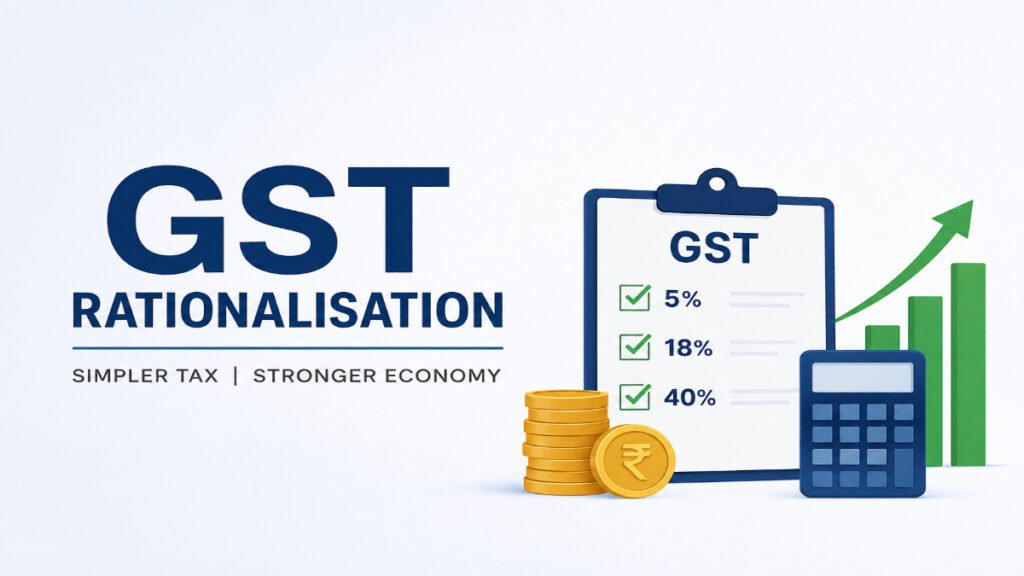
Since the introduction of GST on 1 July 2017, India has followed a multi-rate tax structure consisting of 0%, 5%, 12%, 18% and 28%, along with special rates for precious metals and compensation cess on luxury and sin goods. Over time, this structure led to classification disputes, inverted duty structures, higher compliance costs and litigation. To address these issues, the 56th GST Council (September 2025) approved a major GST rate cut and rationalisation by moving towards a simplified two-rate structure of 5% (merit rate) and 18% (standard rate), while introducing a 40% special rate for selected luxury and demerit goods such as tobacco and pan masala. These changes came into effect from 22 September 2025 and represent the most significant GST reform since its launch in 2017.
Master Current Affairs. Ace BPSC Mains.
BPSC Mains Current Affairs & International Relations Course
Master GS Paper-I (Section-II) with 116 exam-oriented topics, 5 structured lessons and downloadable PDF notes—all in one comprehensive course.
✔ 116 Exam-Oriented Topics • ✔ 5 Comprehensive Lessons • ✔ Downloadable PDF Notes • ✔ Updated for 72nd BPSC Mains
Objectives of GST Rationalisation
- Simplify the GST rate structure.
- Correct the inverted duty structure.
- Reduce classification disputes and tax litigation.
- Improve tax compliance and voluntary registration.
- Promote Ease of Doing Business.
- Enhance domestic manufacturing under Make in India.
- Boost consumption and economic growth while maintaining revenue neutrality.
- Strengthen cooperative federalism through consensus-based decisions in the GST Council.
2. Why in News?
- The 56th GST Council Meeting, held on 3 September 2025 under the chairmanship of the Union Finance Minister, approved the most comprehensive GST rate rationalisation since the introduction of GST in 2017. The reforms aim to simplify the tax structure, reduce the burden on consumers and improve ease of doing business.
- The GST Council approved a simplified two-rate GST structure, retaining; 5% as the Merit Rate for essential goods, 18% as the Standard Rate for most goods and services and a 40% special demerit rate for selected luxury and sin goods such as tobacco and pan masala.
- These reforms came into effect from 22 September 2025. GST was reduced or exempted on several household essentials, healthcare products, agricultural inputs and life & health insurance policies, making them more affordable for the common man. Simultaneously, higher taxation was imposed on luxury and demerit goods to protect government revenue.
- The rationalisation exercise seeks to eliminate the 12% and 28% slabs, reduce classification disputes, correct the inverted duty structure, simplify compliance and promote a “Simple Tax” regime.
- The reforms are expected to benefit consumers, MSMEs, farmers, labour-intensive industries and manufacturers, while strengthening Make in India, boosting domestic demand and supporting long-term economic growth.
Prepare Smarter. Study Better. Ace BPSC Mains.
BPSC Mains GS Paper 1 & 2 Complete Course
Access comprehensive BPSC Mains Notes for GS Paper 1 & 2, covering 378+ topics across 24 PDF lessons, with dedicated Bihar coverage, practice questions and downloadable study material.
✓ GS Paper 1 & 2 • ✓ 378+ Topics • ✓ 24 PDF Lessons • ✓ Bihar-Specific Coverage • ✓ Downloadable Notes
3. Recent GST Rate Rationalisation (2025)
Simplification of the GST Rate Structure
The 56th GST Council, in its meeting held on 3 September 2025, approved the most significant restructuring of the GST regime since its introduction in 2017. The Council rationalised the existing four major GST slabs (5%, 12%, 18% and 28%) into a simplified structure comprising 5% (Merit Rate) and 18% (Standard Rate), while introducing a 40% Special Demerit Rate for selected luxury and sin goods. The objective is to make GST simpler, reduce classification disputes, improve tax compliance and promote economic growth. Most of these revised rates became effective from 22 September 2025. The GST rate cut under this reform is therefore an important component of the broader GST rationalisation exercise.
Reduction in GST on Essential Goods and Services
As part of the GST rationalisation exercise, the GST Council reduced tax rates or granted exemptions on several essential goods and services to reduce the burden on households and boost consumption. Significant decisions include GST exemption on individual life insurance and health insurance premiums, reduction of GST on packaged drinking water (up to 20 litres) from 18% to 5%, lower tax on exercise notebooks and educational stationery, and reduced GST on selected healthcare products, dairy products and agricultural inputs. These measures are expected to improve affordability and increase disposable income, particularly for middle- and lower-income households.
Higher GST on Luxury and Demerit Goods
To compensate for the revenue loss arising from lower taxes on essential goods, the GST Council introduced a 40% Special Demerit GST Rate on selected luxury and harmful products. These include pan masala, gutkha, cigarettes, chewing tobacco and certain tobacco products. However, these products will continue to be taxed under the existing GST plus Compensation Cess regime until all outstanding compensation cess-related loan obligations are discharged, after which the new 40% structure will be implemented. This approach aims to discourage consumption of harmful products while protecting government revenue. The higher rate on selected products complements the broader GST rate cut on essential goods under GST rationalisation.
Removal of the Inverted Duty Structure
One of the major objectives of GST rationalisation is to address the Inverted Duty Structure (IDS), a situation where the GST paid on inputs exceeds the GST payable on the final product. This results in accumulation of Input Tax Credit (ITC), delayed refunds and blockage of working capital for businesses. Through rationalisation of tax rates, the GST Council has attempted to reduce such anomalies in sectors such as textiles, fertilisers, chemicals and food processing, thereby improving cash flow, reducing refund claims and making domestic manufacturing more competitive.
Trade Facilitation and Compliance Reforms
GST rationalisation was accompanied by several measures aimed at improving the ease of doing business. The GST Council recommended simplification of HSN classifications, reduction in classification-related disputes, operationalisation of the GST Appellate Tribunal (GSTAT), faster refund processing (including provisional refunds in inverted duty cases), and changes in valuation and place-of-supply rules. These reforms are intended to reduce litigation, improve compliance, enhance transparency and strengthen India’s indirect tax administration.
4. Need for GST Rationalisation
Simplification of the GST Rate Structure
Since its introduction in 2017, GST has operated with multiple tax slabs—0%, 5%, 12%, 18% and 28%, along with special rates and Compensation Cess. Over time, this multi-rate structure made the tax system complex for businesses and consumers. Similar products often attracted different GST rates, increasing confusion and compliance costs. Therefore, GST rationalisation was considered necessary to create a simpler, more transparent and predictable indirect tax system. The 56th GST Council addressed this issue by moving towards a simplified rate structure.
Elimination of Classification Disputes
One of the biggest challenges under GST has been the classification of goods and services. Minor differences in product characteristics often resulted in different tax rates, leading to litigation and uncertainty. For example: The famous “popcorn dispute” highlighted this anomaly:
- Loose salted popcorn – 5% GST
- Packaged popcorn – 12% GST
- Caramel popcorn – 18% GST
Similarly, disputes arose regarding food products, footwear, beverages and several consumer goods. GST rationalisation seeks to minimise such ambiguities by reducing the number of tax slabs and simplifying product classification.
Correction of the Inverted Duty Structure
An Inverted Duty Structure (IDS) arises when the GST on raw materials (inputs) is higher than the GST on the finished product (output). This results in accumulation of Input Tax Credit (ITC), delayed refunds and blockage of working capital.
Several industries such as textiles, fertilisers, pharmaceuticals, footwear and renewable energy equipment have faced this problem. GST rationalisation helps align input and output tax rates, thereby reducing refund claims, improving liquidity and making domestic manufacturing more competitive.
Improving Tax Compliance and Reducing Litigation
A complex GST structure increases the likelihood of classification errors, tax disputes and prolonged litigation. Businesses often spend significant resources on compliance and legal interpretation rather than productive activities. By reducing the number of tax slabs and simplifying classifications, GST rationalisation is expected to:
- Improve voluntary compliance.
- Reduce litigation before tax authorities and courts.
- Lower compliance costs for businesses, especially MSMEs.
- Improve the efficiency of GST administration.
Boosting Consumption and Economic Growth
High GST rates on several goods reduce consumer demand and increase the cost of doing business. GST rate cuts lower taxes on essential goods and selected services, thereby increasing disposable income, encouraging consumption and stimulating economic activity.
The 2025 GST reforms reduced GST on several essential goods, educational items, healthcare products and insurance services, which is expected to boost domestic demand and support sectors such as manufacturing, retail and services. Increased consumption also contributes to higher GDP growth through the multiplier effect.
Enhancing Ease of Doing Business
One of the objectives of GST was to create a “One Nation, One Tax” regime. However, multiple tax rates, frequent notifications and complex compliance procedures increased the burden on businesses. GST rationalisation promotes Ease of Doing Business by:
- Simplifying the tax structure.
- Reducing compliance costs.
- Improving predictability of taxation.
- Facilitating investment and manufacturing.
- Supporting initiatives such as Make in India and Atmanirbhar Bharat.
Achieving Revenue Neutrality and Fiscal Sustainability
GST rationalisation also seeks to maintain a balance between consumer welfare and government revenue. While GST rates on essential goods have been reduced through the GST rate cut, higher taxation on luxury and demerit goods helps compensate for revenue losses.
This approach enables the Government to protect fiscal resources while encouraging consumption of essential goods and discouraging the use of harmful products such as tobacco and pan masala. Thus, the reforms aim to achieve revenue neutrality without compromising long-term fiscal sustainability.
5. Impact of GST Rationalisation on the Indian Economy
Benefits to Consumers
One of the immediate objectives of GST rationalisation is to reduce the tax burden on consumers. The 56th GST Council lowered GST on several essential goods and services, including life and health insurance premiums, packaged drinking water, educational stationery and selected healthcare products. Lower GST rates reduce the final retail price of goods and services, increase disposable income and improve household purchasing power. According to the Government, these reforms are intended to provide direct relief to households, farmers and the middle class, while encouraging higher consumption.
Positive Impact on Businesses and MSMEs
GST rationalisation simplifies the tax structure by reducing the number of tax slabs and correcting the Inverted Duty Structure (IDS). This lowers compliance costs, reduces litigation arising from classification disputes and improves the cash flow of businesses by reducing the accumulation of Input Tax Credit (ITC). MSMEs, which often face higher compliance costs relative to their size, are expected to benefit significantly from a simpler GST regime and faster refund mechanisms.
Boost to Consumption and Economic Growth
Lower GST rates on essential and mass-consumption goods are expected to stimulate domestic demand. Higher consumer spending increases production, investment and employment, generating a multiplier effect throughout the economy. According to SBI Research, GST rationalisation could generate an additional ₹1.98 lakh crore in aggregate demand, with a direct consumption boost of about ₹70,000 crore. The Chief Economic Adviser (CEA) has also observed that GST reforms will help offset external economic shocks by strengthening domestic demand.
Impact on Inflation
Reduction in GST rates on essential goods and services is expected to moderate inflation by lowering consumer prices. Economists estimate that if the benefit of the GST rate cut is fully passed on to consumers, retail inflation could decline by up to 1.1 percentage points. Lower inflation also enhances the purchasing power of households and supports sustained economic growth.
Impact on Government Revenue
GST rationalisation involves a trade-off between lower tax rates and revenue collection. The Government estimates that GST rate reductions may result in a gross revenue loss of about ₹93,000 crore, while the introduction of a 40% special demerit rate on selected luxury and sin goods is expected to generate around ₹45,000 crore in additional revenue. Thus, the net revenue impact is estimated at about ₹48,000 crore, which the Government expects to recover over time through higher compliance and increased consumption.
Boost to Manufacturing and Exports
Correction of the Inverted Duty Structure reduces production costs by ensuring that GST on inputs is not higher than GST on finished goods. This improves liquidity, enhances the competitiveness of domestic industries and supports initiatives such as Make in India and Atmanirbhar Bharat. Export-oriented industries also benefit because lower production costs improve India’s competitiveness in global markets.
Formalisation of the Economy and Ease of Doing Business
A simpler GST structure with fewer tax slabs, improved classification and reduced litigation is expected to encourage voluntary tax compliance and bring more businesses into the formal economy. Greater digitalisation, simplified return filing and operationalisation of the GST Appellate Tribunal (GSTAT) are likely to improve the Ease of Doing Business, strengthen tax administration and increase long-term tax buoyancy. GST rationalisation can therefore contribute to a more efficient and predictable indirect tax system.
6. Challenges & Way Forward
Balancing Revenue Neutrality
One of the biggest challenges in GST rationalisation is maintaining a balance between lower tax rates and government revenue. Reduction in GST on essential goods and services can adversely affect both Central and State tax collections, particularly because GST is the largest source of indirect tax revenue for many States.
For example, the 2025 GST rationalisation is estimated to result in a gross revenue loss of around ₹93,000 crore. Although the newly introduced 40% GST rate on selected luxury and demerit goods is expected to generate approximately ₹45,000 crore, the Government may still face a net revenue loss of about ₹48,000 crore in the short term. Sustaining welfare expenditure and capital investment under such circumstances remains a fiscal challenge.
GST rate cuts should continue to follow the principle of Revenue Neutral Rate (RNR). The Government should broaden the tax base, improve compliance through technology and compensate revenue losses by expanding formal economic activity rather than increasing tax rates.
Achieving Consensus in the GST Council
The GST Council, constituted under Article 279A, functions on the principle of cooperative federalism, requiring consensus between the Centre and States. Since GST revenue forms a substantial part of State finances, any major rate revision often leads to differing viewpoints among States regarding revenue implications.
Example: During discussions on GST rationalisation and compensation issues, several States expressed concerns about protecting their fiscal autonomy and ensuring stable revenue flows. Reaching unanimous agreement on major reforms therefore remains a significant challenge.
The GST Council should continue adopting a consultative and consensus-based approach, supported by robust revenue analysis and transparent data sharing to strengthen cooperative federalism.
Remaining Classification Disputes
Although GST rationalisation has simplified the tax structure, classification disputes have not been eliminated completely. Differences in product specifications, packaging and usage can still lead to litigation.
Example: The well-known “Popcorn GST dispute” highlighted how loose popcorn, packaged popcorn and caramel popcorn attracted different GST rates before rationalisation, leading to public criticism and interpretational disputes. Similar issues have arisen in sectors such as food products, footwear and consumer goods.
The Government should periodically review HSN classifications, issue detailed explanatory notes and strengthen advance ruling mechanisms to minimise litigation.
Correcting the Inverted Duty Structure Across All Sectors
Although the 2025 reforms address the Inverted Duty Structure (IDS) in several sectors, anomalies still persist in industries such as textiles, renewable energy equipment, chemicals and electronics. These anomalies continue to block Input Tax Credit (ITC) and increase working capital requirements.
The GST Council should undertake sector-wise periodic reviews to align input and output tax rates and ensure faster refund of accumulated ITC through digital processing.
Improving GST Compliance and Reducing Tax Evasion
Despite technological improvements, challenges such as fake invoicing, fraudulent ITC claims, tax evasion and non-compliance continue to affect GST administration. These practices reduce government revenue and create unfair competition.
Greater use of Artificial Intelligence (AI), data analytics, e-invoicing, e-way bills and real-time invoice matching should be encouraged. Strengthening the GST Network (GSTN) and digital audit mechanisms can further improve compliance and transparency.
Strengthening the GST Appellate Tribunal (GSTAT)
A large number of GST disputes remain pending before various judicial forums, increasing uncertainty for taxpayers and delaying revenue recovery.
The operationalisation of the GST Appellate Tribunal (GSTAT) across the country should be expedited to ensure speedy dispute resolution, reduce litigation costs and improve investor confidence. A strong appellate mechanism will also promote uniform interpretation of GST laws.
Towards a Simpler and Stable GST Regime
The long-term success of GST rationalisation depends on creating a simple, predictable and stable tax system. Frequent changes in tax rates and notifications increase compliance costs and create uncertainty for businesses. India should continue progressing towards a stable GST framework characterised by:
- Fewer tax slabs.
- Minimal exemptions.
- Predictable tax policy.
- Simplified return filing.
- Fully digital compliance.
- Strong Centre–State coordination through the GST Council.
Such reforms will strengthen Ease of Doing Business, promote Make in India, improve tax buoyancy and support India’s long-term economic growth.
Experience the Quality Before You Enroll
Download Free Sample Notes (PDF)
Download a free sample of our BPSC Mains Current Affairs Notes and experience the structured, exam-oriented content before enrolling. Explore the presentation, answer-writing approach, and overall quality of the complete course.
✔ Free Download • ✔ Exam-Oriented Notes • ✔ Updated Content • ✔ Structured for BPSC Mains
BPSC Mains Practice Questions
Q1. GST Rationalisation is regarded as the biggest reform in India’s indirect tax regime since the introduction of GST in 2017. Discuss the major recommendations of the 56th GST Council regarding GST rate rationalisation. Examine its likely impact on consumers, businesses, government revenue and the Indian economy.
Q2. Why was GST rate rationalisation necessary in India? Analyse how the recent reforms seek to simplify the GST structure, correct the inverted duty structure and improve Ease of Doing Business. Also discuss the challenges associated with implementing these reforms.
Learn More from the Goods and Services Tax Council, Government of India
Readers interested in GST rationalisation, GST rate cut, GST rates, GST Council decisions, GST reforms, tax slabs, GST notifications, compliance reforms, and the latest developments in India’s Goods and Services Tax regime can visit the official website of the Goods and Services Tax Council, Government of India. The portal provides authentic information on GST Council meetings, rate changes, recommendations, notifications, circulars, and other important developments related to GST policy and administration.