1. Introduction
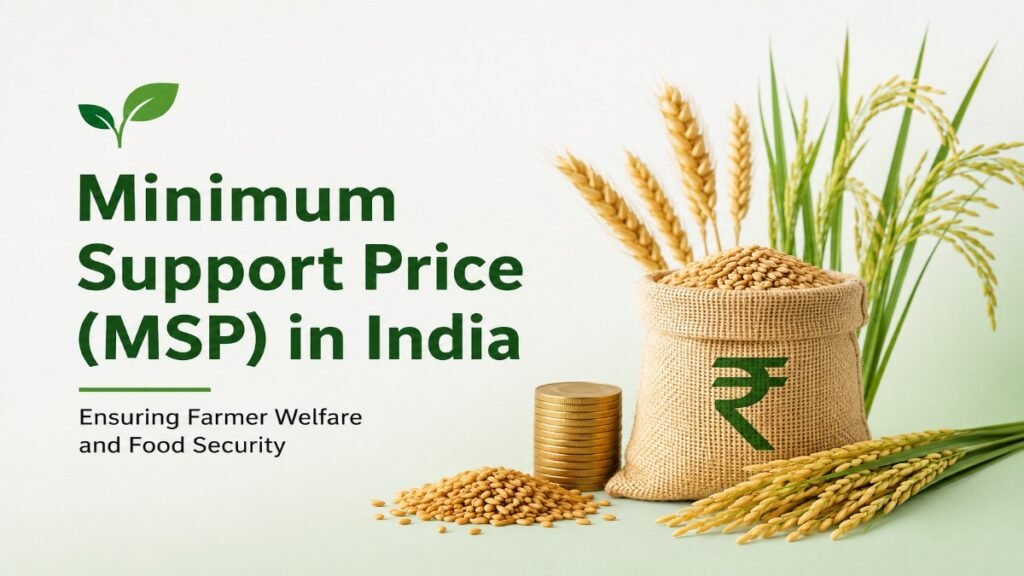
Minimum Support Price in India is the minimum remunerative price announced by the Government of India at which it is prepared to purchase specified agricultural crops from farmers if market prices fall below that level. It acts as a price safety net, protecting farmers from distress sales, ensuring remunerative returns and encouraging higher agricultural production. MSP in India is one of the key instruments of India’s agricultural price policy and supports farmer income, food security and price stability.
The Minimum Support Price in India system was introduced during the Green Revolution in the mid-1960s to encourage farmers to adopt high-yielding varieties of crops and increase foodgrain production. Today, MSP is recommended by the Commission for Agricultural Costs and Prices (CACP) and approved by the Cabinet Committee on Economic Affairs (CCEA) before the sowing season. Currently, MSP is announced for 22 mandated crops, while Fair and Remunerative Price (FRP) is fixed separately for sugarcane.
Understanding MSP in India is important for analysing agricultural income security, food security, procurement policy and the challenges faced by Indian farmers. These aspects also form the foundation of Minimum Support Price Notes for understanding India’s agricultural price policy.
Master Current Affairs. Ace BPSC Mains.
BPSC Mains Current Affairs & International Relations Course
Master GS Paper-I (Section-II) with 116 exam-oriented topics, 5 structured lessons and downloadable PDF notes—all in one comprehensive course.
✔ 116 Exam-Oriented Topics • ✔ 5 Comprehensive Lessons • ✔ Downloadable PDF Notes • ✔ Updated for 72nd BPSC Mains
Difference between MSP, Procurement Price and FRP
| Basis | MSP | Procurement Price | FRP |
|---|---|---|---|
| Meaning | Minimum guaranteed price announced by the Government | Price at which government agencies actually procure foodgrains | Minimum price payable to sugarcane farmers |
| Applicable Crops | 22 notified crops | Mainly wheat and paddy | Sugarcane only |
| Recommended by | CACP | Government, based on MSP and procurement policy | CACP recommends; Government fixes |
| Objective | Protect farmers from price fluctuations | Build buffer stocks for PDS and food security | Ensure fair returns to sugarcane growers and protect sugar mills’ interests |
The distinction between these three concepts is important for understanding Minimum Support Price in India. While MSP in India provides a price benchmark and safety net for farmers, procurement price relates to the actual purchase of foodgrains by government agencies, whereas FRP specifically applies to sugarcane. These distinctions are also important for Minimum Support Price Notes and BPSC Mains preparation.
2. How is MSP Determined?
Role of the Commission for Agricultural Costs and Prices (CACP)
The Commission for Agricultural Costs and Prices (CACP) is an advisory body under the Ministry of Agriculture & Farmers’ Welfare. Every year, it recommends MSPs for 22 notified crops, while the Fair and Remunerative Price (FRP) for sugarcane is recommended separately. Based on these recommendations, the Cabinet Committee on Economic Affairs (CCEA) takes the final decision and announces MSPs before the sowing season so that farmers can make informed cropping decisions.
The CACP plays a central role in determining Minimum Support Price in India, making its recommendations an important part of MSP in India and a key topic in Minimum Support Price Notes.
Cost Concepts Used in MSP Calculation
CACP estimates the cost of cultivation using three important cost concepts:
- A2 Cost: Actual paid-out expenses incurred by the farmer, such as seeds, fertilizers, pesticides, hired labour, irrigation, fuel, machinery and interest on working capital.
- A2 + FL Cost: Includes A2 plus the imputed value of unpaid family labour. Since 2018–19, the Government has ensured that MSP is at least 1.5 times the A2+FL cost for all mandated crops.
- C2 Cost: The most comprehensive cost, which includes A2 + FL along with the rental value of owned land and interest on owned fixed capital assets (excluding land). Farmer organisations often demand MSP based on C2 + 50%, as recommended by the M.S. Swaminathan Commission.
Factors Considered by CACP
While recommending MSP, CACP considers several economic and agricultural factors, including:
- Cost of production (A2, A2+FL and C2).
- Demand and supply of the crop.
- Changes in input prices and general inflation.
- Inter-crop price parity to encourage balanced cropping patterns.
- Impact on consumers and food inflation.
- Domestic and international market prices.
- Terms of trade between agriculture and non-agriculture.
- Likely implications for food security, procurement and buffer stock requirements.
MSP Formula and Government Policy
In the Union Budget 2018–19, the Government announced that MSP for all notified crops would be fixed at a minimum of 1.5 times the A2+FL cost of production. However, several farmer organisations argue that this formula does not fully reflect the actual cost of cultivation and continue to demand implementation of the Swaminathan Commission’s recommendation of MSP = C2 + 50%. This difference remains at the centre of the ongoing MSP debate in India.
The distinction between the A2+FL and C2 approaches is therefore essential for understanding how Minimum Support Price in India is determined and why the methodology remains an important issue in MSP in India.
Crops Covered under MSP
The Government currently announces MSP for 22 agricultural crops, comprising:
- 7 cereals
- 5 pulses
- 7 oilseeds
- 4 commercial crops
In addition, the Fair and Remunerative Price (FRP) is announced separately for sugarcane. Procurement under MSP, however, is concentrated mainly in wheat and paddy, while procurement of pulses and oilseeds is relatively limited. These crop categories and procurement patterns are important factual areas for Minimum Support Price Notes and for understanding the practical functioning of MSP in India.
3. Significance of Minimum Support Price (MSP)
Ensures Income Security for Farmers
- Minimum Support Price in India acts as a price safety net, protecting farmers from distress sales when market prices fall below production costs.
- The Government procured 1,223 lakh metric tonnes (LMT) of crops during 2024–25, with MSP payments of around ₹3.47 lakh crore made directly to farmers, providing assured income support.
- Example: Wheat and paddy farmers in Punjab, Haryana and Madhya Pradesh benefit significantly through assured procurement at MSP.
Thus, MSP in India plays an important role in protecting farmers from sharp price fluctuations and ensuring greater income stability.
Strengthens Food Security
- MSP encourages farmers to produce adequate quantities of rice and wheat, enabling the Government to maintain buffer stocks for the Public Distribution System (PDS) and food security programmes.
- Procurement by agencies such as the Food Corporation of India (FCI) ensures uninterrupted supply under the National Food Security Act (NFSA), 2013.
- Example: During years of drought or global food shortages, buffer stocks procured under MSP help stabilise domestic food availability.
Therefore, Minimum Support Price in India is closely linked with India’s food security system because assured procurement supports the availability of foodgrains for welfare programmes.
Promotes Agricultural Production
- Assured prices encourage farmers to adopt improved seeds, fertilisers, irrigation and modern technology, thereby increasing agricultural productivity.
- MSP played a crucial role in the Green Revolution, helping India achieve self-sufficiency in foodgrain production.
- Example: Wheat production increased substantially after the introduction of MSP-backed procurement during the Green Revolution.
The production-support role of MSP in India remains an important aspect of agricultural price policy and is frequently discussed in Minimum Support Price Notes.
Stabilises Agricultural Markets
- MSP protects farmers against price volatility caused by bumper harvests, market gluts or sudden demand fluctuations.
- It provides a benchmark price that strengthens farmers’ bargaining power in agricultural markets.
- Example: MSP procurement prevents sharp price crashes during peak arrival seasons of wheat and paddy.
By providing a price benchmark, Minimum Support Price in India helps reduce the impact of sudden market fluctuations on farmers.
Supports Rural Economy and Agricultural Investment
- Assured income under MSP increases farmers’ purchasing power, stimulating rural consumption, investment and employment.
- Higher farm incomes enable greater investment in irrigation, farm mechanisation and quality inputs, contributing to long-term agricultural growth.
- Example: States with effective MSP procurement generally record higher investment in farm machinery and agricultural infrastructure.
Therefore, the broader significance of MSP in India extends beyond individual farmers to rural demand, agricultural investment and the overall rural economy.
Prepare Smarter. Study Better. Ace BPSC Mains.
BPSC Mains GS Paper 1 & 2 Complete Course
Access comprehensive BPSC Mains Notes for GS Paper 1 & 2, covering 378+ topics across 24 PDF lessons, with dedicated Bihar coverage, practice questions and downloadable study material.
✓ GS Paper 1 & 2 • ✓ 378+ Topics • ✓ 24 PDF Lessons • ✓ Bihar-Specific Coverage • ✓ Downloadable Notes
4. Challenges and Criticism of MSP
Limited Procurement Beyond Rice and Wheat
- Although MSP is announced for 22 crops, effective procurement is largely confined to wheat and paddy, leaving farmers growing pulses, oilseeds and coarse cereals with little benefit.
- Procurement infrastructure for crops such as tur, urad, moong and oilseeds remains weak in many states, forcing farmers to sell below MSP.
- Example: Wheat and paddy procurement is extensive in Punjab and Haryana, whereas procurement of pulses and oilseeds is relatively limited across most states.
Thus, the effectiveness of Minimum Support Price in India remains uneven across crops, and strengthening procurement beyond wheat and paddy is a major requirement for improving MSP in India.
Regional Imbalance in MSP Benefits
- MSP benefits are concentrated in a few states with strong procurement infrastructure, such as Punjab, Haryana, Madhya Pradesh, Chhattisgarh and Telangana.
- According to available estimates, around 95% of paddy farmers in Punjab benefit from MSP procurement, compared with only 3.6% in Uttar Pradesh, indicating significant regional disparities.
- States such as Bihar, West Bengal and Assam continue to experience low procurement due to inadequate mandis, storage and procurement centres.
This regional imbalance is one of the major concerns in MSP in India, as the announcement of MSP alone does not guarantee that farmers will actually receive the notified price.
Fiscal Burden on the Government
- Large-scale procurement, storage, transportation and food subsidies impose a substantial burden on the Union Government’s finances.
- The Food Corporation of India (FCI) incurs high carrying costs due to excess foodgrain stocks, increasing subsidy requirements.
- Rising MSPs also increase procurement costs and subsidy expenditure, affecting fiscal consolidation.
Therefore, the fiscal sustainability of Minimum Support Price in India remains an important concern, particularly when procurement is expanded across a larger number of crops.
Distorted Cropping Pattern and Environmental Concerns
- Assured MSP procurement encourages excessive cultivation of rice and wheat, discouraging diversification towards pulses, oilseeds and millets.
- This has contributed to groundwater depletion, soil degradation, stubble burning and declining biodiversity, particularly in north-western India.
- Example: Punjab and Haryana continue to face severe groundwater depletion due to intensive paddy cultivation supported by assured procurement.
Thus, MSP in India needs to be aligned with crop diversification, nutritional security and climate-resilient agriculture rather than encouraging excessive dependence on water-intensive crops.
WTO and International Trade Concerns
- Under the WTO Agreement on Agriculture (AoA), procurement at MSP is treated as trade-distorting domestic support (Amber Box) if it exceeds the permissible limit.
- India has repeatedly invoked the Peace Clause to continue providing MSP-based support for food security without facing legal action at the WTO.
- This remains a major issue in India’s agricultural trade negotiations and food security discussions.
The WTO dimension is therefore an important component of Minimum Support Price Notes, particularly when examining the international implications of Minimum Support Price in India.
Demand for Legal Guarantee of MSP
- Farmer organisations continue to demand a statutory legal guarantee ensuring that no crop is purchased below MSP. This has been a central demand during the 2024–25 farmers’ protests.
- The Government argues that a universal legal guarantee could involve very high fiscal costs, market distortions and implementation challenges.
- The debate remains one of the most important contemporary issues in India’s agricultural policy.
The demand for a legal guarantee has therefore become a central issue in the debate over MSP in India and the future design of Minimum Support Price in India.
5. Recent Developments (2024–2026)
Revision in MSP for Kharif and Rabi Crops
- The Cabinet Committee on Economic Affairs (CCEA) approved higher MSPs for 14 Kharif crops for the 2025–26 marketing season, continuing the policy of providing at least 50% return over the cost of production (A2+FL).
- For Kharif 2026–27, the Government further increased MSPs, with the highest absolute increase for sunflower seed (₹622/quintal), followed by cotton (₹557/quintal), nigerseed (₹515/quintal) and sesamum (₹500/quintal).
- The MSP for common paddy increased from ₹2,369/quintal (2025–26) to ₹2,441/quintal (2026–27), while Grade A paddy was fixed at ₹2,461/quintal.
These revisions reflect the Government’s continued emphasis on strengthening Minimum Support Price in India as a price safety net for farmers. The latest changes are therefore important for understanding the evolving MSP in India and should be included in updated Minimum Support Price Notes.
Continued Commitment to 1.5 Times Cost of Production
- The Government has reiterated that MSPs will continue to provide at least 1.5 times the all-India weighted average cost of production (A2+FL) for all mandated crops.
- Crops such as bajra, tur (arhar), urad and maize continue to receive returns significantly above the minimum 50% benchmark, encouraging crop diversification.
The continuation of the 1.5-times cost principle remains a significant feature of Minimum Support Price in India and an important aspect of the ongoing MSP in India policy framework.
Ongoing Debate on Legal Guarantee of MSP
- Farmer organisations continue to demand a statutory legal guarantee for MSP, ensuring that no agricultural produce is purchased below the notified MSP. This remains a major issue following the 2024–25 farmers’ protests.
- The Government maintains that a universal legal guarantee could impose a substantial fiscal burden, create market distortions and pose implementation challenges, while favouring continued procurement and other farmer support measures.
The demand for a legal guarantee continues to be one of the most important contemporary issues concerning MSP in India and the future of Minimum Support Price in India.
Greater Focus on Crop Diversification
- Recent MSP revisions have provided higher percentage increases for pulses, oilseeds and coarse cereals than for rice and wheat to encourage diversification away from water-intensive crops.
- This policy aligns with national priorities of improving nutritional security, reducing edible oil imports, conserving groundwater and promoting climate-resilient agriculture.
A stronger focus on crop diversification can help address some of the structural limitations of Minimum Support Price in India while making MSP in India more consistent with nutritional, environmental and agricultural sustainability objectives.
6. Bihar Perspective
Limited Reach of MSP in Bihar
Bihar abolished the Agricultural Produce Market Committee (APMC) Act in 2006, allowing farmers to sell produce directly to private traders. However, the absence of a strong mandi network has weakened the effectiveness of Minimum Support Price in India in the state.
Unlike Punjab and Haryana, a small proportion of Bihar’s farmers are able to sell their produce at MSP, forcing many to accept lower prices from private traders and commission agents. This makes the effective implementation of MSP in India a major concern for Bihar’s small and marginal farmers.
Procurement through PACS
Paddy and wheat procurement in Bihar is carried out mainly through Primary Agricultural Credit Societies (PACS), in coordination with the Bihar State Food & Civil Supplies Corporation (BSFC) and other state agencies.
Despite annual procurement drives, many farmers face delays in registration, procurement and MSP payments, reducing the effectiveness of the scheme. Strengthening this procurement mechanism is therefore essential for improving the reach of Minimum Support Price in India in Bihar.
Key Challenges
- Inadequate procurement centres, limited storage and warehousing facilities, weak market infrastructure and poor awareness about MSP continue to constrain procurement in Bihar.
- Small and marginal farmers, who constitute the majority of cultivators in Bihar, often sell immediately after harvest due to urgent cash needs, leading to distress sales below MSP.
These challenges demonstrate that merely announcing MSP is not sufficient; effective procurement infrastructure is equally important for ensuring that farmers actually receive the notified price under Minimum Support Price in India.
Measures Required
- Strengthen the PACS procurement network, expand modern warehouses and cold storage facilities, establish more procurement centres and improve digital registration and payment systems.
- Promote Farmer Producer Organisations (FPOs), improve rural market infrastructure and integrate farmers with e-NAM to ensure greater access to remunerative prices and enhance the effectiveness of Minimum Support Price in India in Bihar.
For BPSC Mains, the Bihar perspective is particularly important because it highlights the gap between the announcement of MSP in India and its actual availability to farmers at the field level.
BPSC Mains Practice Questions
Q1. “Explain the concept of Minimum Support Price (MSP). Discuss its significance in ensuring farmers’ income security and food security in India.”
Q2. “Critically examine the Minimum Support Price in India regime. Discuss the challenges associated with the present MSP system and evaluate the demand for providing a legal guarantee to MSP.”
These questions cover the major themes of MSP in India, including farmer income security, food security, procurement, legal guarantee and the limitations of the existing MSP framework.
Learn More from the Ministry of Agriculture & Farmers Welfare, Government of India
Readers interested in Minimum Support Price in India, MSP in India, MSP determination, CACP recommendations, agricultural procurement, farmer income support, crop prices and recent changes in the MSP regime can visit the official website of the Ministry of Agriculture & Farmers Welfare, Government of India. The Ministry provides authentic information on agricultural price policy, MSP announcements, farmer welfare measures, procurement and initiatives aimed at strengthening India’s agricultural sector.