1. Introduction
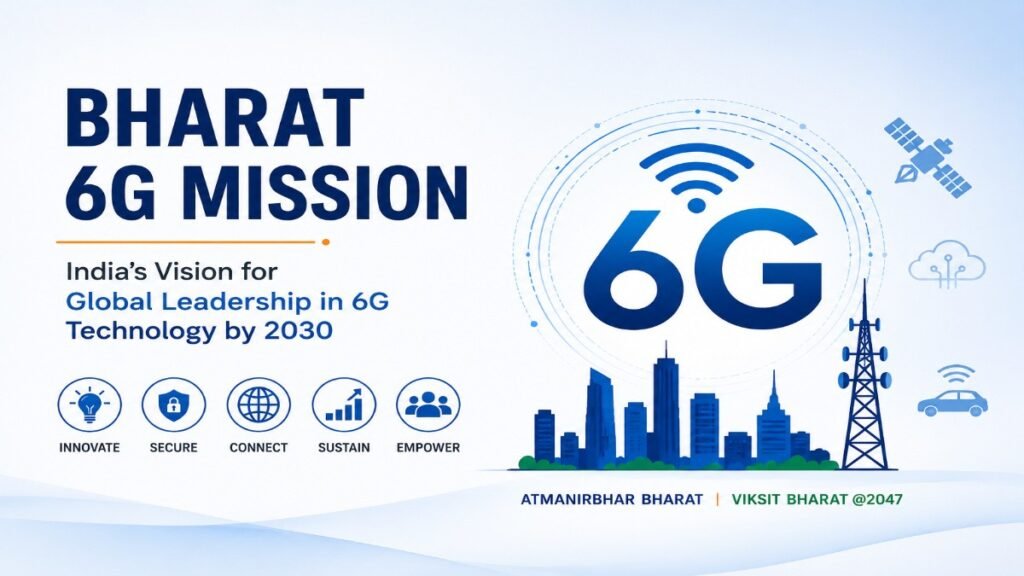
The Bharat 6G Mission is India’s flagship initiative to make the country a global leader in 6G technology by 2030. The mission was launched with the release of the Bharat 6G Vision Document by the Prime Minister on 23 March 2023. It aims to design, develop and deploy indigenous 6G technologies based on the principles of affordability, sustainability, ubiquity, intelligence and security, while positioning India as a major contributor to global 6G standards, patents and innovation.
The Bharat 6G Mission has remained in focus due to rapid progress in 6G research. The Department of Telecommunications (DoT) has released the Spectrum Roadmap for 6G, established the Bharat 6G Alliance, approved over 104 R&D projects worth about ₹271 crore under the Telecom Technology Development Fund (TTDF), and strengthened international cooperation through the Bharat 6G Symposium and collaboration with global 6G alliances.
Master Current Affairs. Ace BPSC Mains.
BPSC Mains Current Affairs & International Relations Course
Master GS Paper-I (Section-II) with 116 exam-oriented topics, 5 structured lessons and downloadable PDF notes—all in one comprehensive course.
✔ 116 Exam-Oriented Topics • ✔ 5 Comprehensive Lessons • ✔ Downloadable PDF Notes • ✔ Updated for 72nd BPSC Mains
2. Objectives and Key Features
The Bharat 6G Mission seeks to build an indigenous 6G ecosystem through research, innovation, manufacturing and standardisation. It aims to develop technologies that provide ubiquitous, intelligent, secure and ultra-fast connectivity, while promoting Atmanirbhar Bharat and supporting the vision of Viksit Bharat @2047.
Key Features
- Target: Position India among the global leaders in 6G technology by 2030.
- Based on the Bharat 6G Vision Document released on 23 March 2023.
- Establishment of the Bharat 6G Alliance (B6GA) comprising industry, academia, startups, research institutions and standards organisations.
- Funding of 104 indigenous 6G R&D projects worth approximately ₹271 crore through the Telecom Technology Development Fund (TTDF).
- Development of 6G THz Testbed and Advanced Optical Communication Test Bed for indigenous research.
- Establishment of 100 5G Labs across academic institutions to create a 6G-ready ecosystem.
- Promotion of indigenous Intellectual Property Rights (IPRs), patents and global standard-setting.
- Active participation in International Telecommunication Union (ITU) discussions on IMT-2030 (6G) standards.
- Publication of a Spectrum Roadmap for 6G covering short-term (2025–26), medium-term (2027–30) and long-term (2031–35) spectrum planning.
The Bharat 6G Mission therefore combines research, infrastructure development, standardisation and industry participation to build India’s indigenous capabilities in next-generation telecommunications.
Prepare Smarter. Study Better. Ace BPSC Mains.
BPSC Mains GS Paper 1 & 2 Complete Course
Access comprehensive BPSC Mains Notes for GS Paper 1 & 2, covering 378+ topics across 24 PDF lessons, with dedicated Bihar coverage, practice questions and downloadable study material.
✓ GS Paper 1 & 2 • ✓ 378+ Topics • ✓ 24 PDF Lessons • ✓ Bihar-Specific Coverage • ✓ Downloadable Notes
3. Significance, Challenges and Way Forward
The Bharat 6G Mission is expected to strengthen India’s leadership in next-generation telecommunications by reducing dependence on imported technologies and creating a robust domestic innovation ecosystem. It will accelerate advancements in Artificial Intelligence (AI), Internet of Things (IoT), Extended Reality (XR), autonomous vehicles, Industry 4.0, smart cities, precision agriculture, telemedicine and satellite communications. The mission also aims to increase India’s share in global telecom patents, standards and manufacturing, thereby boosting high-value employment and digital economic growth.
However, India faces challenges such as high R&D costs, limited semiconductor manufacturing capacity, shortage of advanced telecom research infrastructure, cybersecurity concerns and intense global competition. Going forward, greater investment in telecom research, stronger industry-academia collaboration, faster commercialisation of indigenous technologies, enhanced participation in global standard-setting bodies and expansion of international partnerships will be essential for achieving the objectives of the Bharat 6G Mission and making India a global 6G powerhouse by 2030.
BPSC Mains Practice Question
Q1. Discuss the objectives, key features and significance of the Bharat 6G Mission. How can indigenous 6G technology contribute to India’s digital transformation and global technological leadership?
Learn More from the Department of Telecommunications, Government of India
Readers interested in the Bharat 6G Mission, Bharat 6G Vision Document, 6G research and development, spectrum planning, Bharat 6G Alliance, telecom innovation, indigenous technologies and India’s roadmap for next-generation connectivity can visit the official website of the Department of Telecommunications (DoT), Government of India. The portal provides authentic information on India’s telecommunications policies, 5G and 6G initiatives, spectrum management, research programmes and efforts to strengthen India’s indigenous telecom ecosystem.