1. Introduction and Concept of Electric Mobility
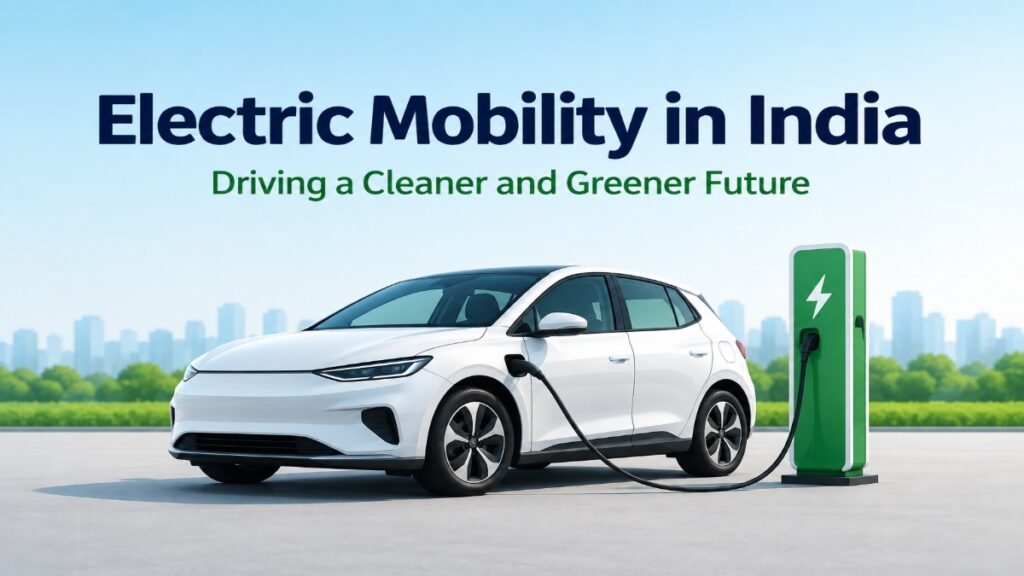
Electric Mobility in India refers to the use of electric-powered vehicles (EVs) and supporting infrastructure for the transportation of people and goods. Unlike conventional vehicles powered by petrol or diesel, EVs use electricity stored in rechargeable batteries or fuel cells, making transportation cleaner, more energy-efficient, and environmentally sustainable. Electric Mobility in India is not limited to electric vehicles alone. It encompasses an entire ecosystem comprising electric vehicles, advanced batteries, charging infrastructure, battery swapping systems, renewable energy integration, smart grids, and digital technologies that enable sustainable transport.
The rapid adoption of Electric Mobility in India is being driven by concerns over climate change, air pollution, rising fossil fuel imports, and energy security. With the transport sector accounting for a significant share of global greenhouse gas emissions, countries across the world are promoting EVs as a key component of the clean energy transition. For India, Electric Mobility in India is strategically important because the country imports over 85% of its crude oil requirement, making it vulnerable to global oil price fluctuations. The transition to electric vehicles can reduce import dependence, improve urban air quality, strengthen energy security, and support the vision of Net Zero emissions by 2070 and Viksit Bharat 2047.
Types of Electric Vehicles (EVs)
- Battery Electric Vehicle (BEV): Battery Electric Vehicles operate entirely on electricity stored in rechargeable batteries and do not have an internal combustion engine. They produce zero tailpipe emissions and are considered the cleanest form of road transport. Examples include electric cars, buses, two-wheelers, and three-wheelers.
- Hybrid Electric Vehicle (HEV): Hybrid Electric Vehicles combine an internal combustion engine with an electric motor. The battery is charged through regenerative braking and the engine itself, eliminating the need for external charging. HEVs offer better fuel efficiency and lower emissions than conventional vehicles.
- Plug-in Hybrid Electric Vehicle (PHEV): Plug-in Hybrid Electric Vehicles use both an electric motor and a conventional engine, but unlike HEVs, their batteries can also be charged externally. They can operate for short distances purely on electricity before switching to the fuel-powered engine, making them suitable for both city and long-distance travel.
- Fuel Cell Electric Vehicle (FCEV): Fuel Cell Electric Vehicles generate electricity through a chemical reaction between hydrogen and oxygen inside a fuel cell. They emit only water vapour as a by-product and are considered a promising technology for heavy-duty transport. However, their commercial deployment remains limited due to high costs and inadequate hydrogen infrastructure.
Components of the Electric Mobility Ecosystem
- Electric Vehicles (EVs): Includes electric two-wheelers, three-wheelers, passenger cars, buses, and commercial vehicles.
- Battery Technology: Lithium-ion batteries currently dominate the market, while research is progressing on sodium-ion, solid-state, and other advanced battery technologies.
- Charging Infrastructure: Public charging stations, home charging systems, fast chargers, and battery swapping stations ensure convenient charging and reduce range anxiety.
- Renewable Energy Integration: Charging EVs using electricity generated from solar, wind, and other renewable sources maximises environmental benefits and reduces lifecycle emissions.
- Smart Grid and Digital Technologies: Smart charging, vehicle-to-grid (V2G) technology, digital payment systems, and intelligent energy management improve the efficiency and reliability of electric mobility.
Electric Mobility in India is therefore not merely a shift from petrol and diesel vehicles to electric vehicles, but a comprehensive transformation of the transportation sector towards a cleaner, smarter, energy-efficient, and sustainable mobility ecosystem. Electric Vehicles in India are an important component of this transition, while EV Battery Technology is central to improving the performance and affordability of the electric mobility ecosystem.
Master Science & Technology. Maximize Your BPSC Mains Score.
Enroll in the BPSC Science & Tech Course Today
Master Science & Technology for BPSC Mains GS Paper-2 with 75+ exam-oriented topics, 6 structured lessons, and downloadable PDF notes—all in one course.
✔ 75+ Exam-Oriented Topics • ✔ 6 Comprehensive Lessons • ✔ Downloadable PDF Notes • ✔ Updated for 72nd BPSC Mains
2. Status of Electric Mobility in India
- Electric Mobility in India has emerged as one of the fastest-growing electric vehicle (EV) markets in the world, driven by supportive government policies, rising fuel prices, technological advancements, and increasing consumer awareness.
- The Electric Mobility in India ecosystem is expanding rapidly across electric two-wheelers, three-wheelers, passenger cars, buses, and commercial vehicles, making the transition to clean mobility increasingly visible.
- Electric two-wheelers (E-2Ws) account for the largest share of EV sales in India, followed by electric three-wheelers (E-3Ws). These segments have witnessed the fastest adoption due to their lower operating costs and suitability for urban transport.
- India has also witnessed a steady increase in the adoption of electric buses, with several State Transport Undertakings (STUs) procuring e-buses under central government schemes to promote sustainable public transport.
- As of 2025, EVs account for approximately 8–9% of annual vehicle registrations in India, indicating a rapid increase from previous years. The Government aims to accelerate this share further during the present decade.
Charging Infrastructure
- Availability of charging infrastructure has improved significantly but remains concentrated in major cities and along important highways.
- The PM E-DRIVE Scheme has allocated ₹2,000 crore for establishing around 72,000 public EV charging stations across the country.
- The proposed charging network will be deployed along 50 National Highway corridors, major cities, railway stations, airports, metro stations, fuel outlets, toll plazas, and State highways to reduce range anxiety and promote long-distance EV travel.
Battery Manufacturing and Domestic Ecosystem
- India is promoting indigenous manufacturing of Advanced Chemistry Cell (ACC) batteries to reduce dependence on imported lithium-ion batteries and strengthen supply chain resilience.
- Domestic companies are investing in battery manufacturing, battery recycling, and cell assembly, supported by the Production Linked Incentive (PLI) Scheme.
- Recent discoveries of lithium resources in Jammu & Kashmir and ongoing exploration in other states have strengthened India’s long-term strategy for critical mineral security, although commercial production is yet to begin.
Leading States in EV Adoption
- States such as Maharashtra, Karnataka, Tamil Nadu, Gujarat, Uttar Pradesh, Delhi, and Telangana have emerged as major EV manufacturing and adoption hubs due to favourable EV policies, charging infrastructure, and industrial investment.
- Several states have introduced dedicated EV policies offering incentives such as purchase subsidies, exemption from road tax and registration fees, charging infrastructure support, and manufacturing incentives.
Major Indian EV Manufacturers
- India has developed a strong domestic EV manufacturing ecosystem led by companies such as Tata Motors, Mahindra Electric, Ola Electric, Ather Energy, TVS Motor, Bajaj Auto, Hero MotoCorp, Ashok Leyland, and JBM Auto.
- Domestic manufacturers are increasingly focusing on localisation of components, battery technology, and software-driven mobility solutions under the Make in India and Atmanirbhar Bharat initiatives.
Recent Developments
- The PM Electric Drive Revolution in Innovative Vehicle Enhancement (PM E-DRIVE) Scheme, launched in 2024 with an outlay of ₹10,900 crore, has replaced the FAME-II demand incentive framework and focuses on accelerating EV adoption, charging infrastructure, e-buses, e-trucks, e-ambulances, and domestic manufacturing.
- The Government has approved support for over 28 lakh electric vehicles, deployment of 14,028 electric buses, modernisation of vehicle testing infrastructure, and nationwide charging infrastructure under PM E-DRIVE.
- India is simultaneously strengthening its EV ecosystem through battery manufacturing, charging infrastructure expansion, and critical mineral security, positioning Electric Mobility in India as a key pillar of Net Zero 2070 and Viksit Bharat 2047.
The expansion of Electric Vehicles in India is therefore closely linked with battery manufacturing, charging infrastructure and critical mineral security. For UPSC and BPSC aspirants, these developments are important areas in Electric Vehicle Notes, particularly for understanding India’s transition towards sustainable transportation.
Prepare Smarter. Study Better. Ace BPSC Mains.
BPSC Mains GS Paper 1 & 2 Complete Course
Access comprehensive BPSC Mains Notes for GS Paper 1 & 2, covering 378+ topics across 24 PDF lessons, with dedicated Bihar coverage, practice questions and downloadable study material.
✓ GS Paper 1 & 2 • ✓ 378+ Topics • ✓ 24 PDF Lessons • ✓ Bihar-Specific Coverage • ✓ Downloadable Notes
3. Significance of Electric Mobility for India
Reducing Air Pollution and Improving Public Health
The transport sector is one of the largest contributors to urban air pollution in India, emitting pollutants such as Particulate Matter (PM₂.₅), Nitrogen Oxides (NOₓ), and Carbon Monoxide (CO). According to the Ministry of Environment, Forest and Climate Change (MoEFCC), the transport sector contributes nearly one-third of PM₂.₅ emissions in major Indian cities. Electric vehicles produce zero tailpipe emissions, thereby improving urban air quality and reducing the incidence of respiratory and cardiovascular diseases. Large-scale electrification of public transport can significantly improve the quality of life in rapidly urbanising cities.
Enhancing Energy Security
India imports more than 85% of its crude oil requirement, making the economy highly vulnerable to global oil price fluctuations and geopolitical disruptions. The transport sector accounts for the largest share of petroleum consumption in the country. Increased adoption of Electric Mobility in India can substantially reduce dependence on imported fossil fuels by shifting transportation towards domestically produced electricity, particularly from renewable energy sources. This would improve India’s energy security and reduce the oil import bill.
Supporting Climate Change Mitigation
The transport sector contributes around 12–14% of India’s total greenhouse gas emissions. Since electric vehicles do not emit carbon dioxide during operation, they play a vital role in reducing emissions from road transport. When charged using renewable energy, EVs offer even greater environmental benefits. Electric Mobility in India is therefore an important component of India’s commitments under the Paris Agreement, the Panchamrit goals, and the target of achieving Net Zero emissions by 2070.
Promoting Economic Growth and Employment
Electric Mobility in India is creating new opportunities in vehicle manufacturing, battery production, charging infrastructure, software development, power electronics, and battery recycling. According to NITI Aayog and Rocky Mountain Institute (RMI), India’s EV ecosystem has the potential to generate around 5 crore (50 million) direct and indirect jobs by 2030 across manufacturing, services, and allied industries. The sector is also attracting significant domestic and foreign investments, strengthening India’s position as an emerging global manufacturing hub.
Strengthening Make in India and Atmanirbhar Bharat
Electric mobility supports the objectives of Make in India and Atmanirbhar Bharat by encouraging domestic manufacturing of electric vehicles, batteries, motors, power electronics, and charging equipment. Government initiatives such as the Production Linked Incentive (PLI) Scheme for automobiles and Advanced Chemistry Cell (ACC) batteries aim to reduce import dependence and develop a globally competitive EV manufacturing ecosystem. Increased localisation will also improve India’s export competitiveness in clean mobility technologies.
Driving Technological Innovation
The transition to Electric Mobility in India is accelerating innovation in battery technology, battery management systems, artificial intelligence, Internet of Things (IoT), smart charging, and vehicle-to-grid (V2G) technologies. Research is also progressing on solid-state batteries, sodium-ion batteries, and hydrogen fuel-cell technologies, which can improve energy density, charging speed, and safety. These technological advancements have applications beyond transportation, including renewable energy storage and smart electricity grids.
Promoting Sustainable Urban Mobility
Electric mobility is transforming urban transportation through electric buses, metro feeder services, electric auto-rickshaws, shared mobility, and last-mile connectivity. Electric buses reduce both air pollution and noise pollution while offering lower operating costs compared to diesel buses. The expansion of EV-based public transport supports the objectives of the Smart Cities Mission, PM e-Bus Sewa Scheme, and sustainable urban development by providing cleaner, affordable, and efficient mobility solutions.
Accelerating Renewable Energy Integration
Electric vehicles can complement India’s rapidly growing renewable energy capacity by increasing demand for clean electricity and supporting grid flexibility. Smart charging systems and future Vehicle-to-Grid (V2G) technologies can enable EV batteries to store surplus solar and wind energy and feed electricity back to the grid during peak demand. This integration will improve grid stability, enhance renewable energy utilisation, and contribute to the development of a resilient low-carbon energy system.
Overall, the Electric Mobility Benefits for India extend from cleaner cities and reduced oil dependence to industrial development, employment generation and technological innovation. Understanding these Electric Mobility Benefits is essential for Electric Vehicle Notes prepared for UPSC and BPSC examinations.
4. Challenges in Electric Mobility
High Initial Cost of Electric Vehicles
The purchase price of electric vehicles remains significantly higher than comparable petrol or diesel vehicles, primarily due to the high cost of lithium-ion batteries, which account for nearly 35–40% of an EV’s total cost. Although operating and maintenance costs are lower over the vehicle’s lifetime, the higher upfront investment discourages adoption, especially among middle-income consumers. While government incentives have reduced this gap, affordability continues to be a major challenge.
Inadequate Charging Infrastructure
The availability of charging stations remains uneven across the country and is largely concentrated in metropolitan cities. Rural and semi-urban areas continue to face limited access to public charging facilities, making long-distance travel difficult. According to the Ministry of Power, India requires a dense charging network to support large-scale EV adoption, and the Government has therefore approved the installation of about 72,000 public charging stations under the PM E-DRIVE Scheme. Until such infrastructure is widely available, charging accessibility will remain a major constraint.
Range Anxiety and Charging Time
Many consumers hesitate to purchase EVs due to range anxiety, which is the fear that the battery may run out before reaching a charging station. Although newer electric cars offer driving ranges of 300–500 km per charge, charging still takes considerably longer than refuelling conventional vehicles. Even fast chargers generally require 30–60 minutes to recharge most batteries, while home charging may take several hours. This limits the convenience of EVs, particularly for long-distance travel.
Dependence on Imported Batteries and Critical Minerals
India is heavily dependent on imports of lithium-ion cells, battery components, and critical minerals such as lithium, cobalt, nickel, and graphite. A large share of battery cells is currently imported from countries such as China, South Korea, and Japan. This dependence exposes India to supply chain disruptions, geopolitical risks, and price volatility. Although recent lithium discoveries in Jammu & Kashmir and ongoing exploration in other states are encouraging, commercial mining and processing are still at an early stage.
Limited Domestic Manufacturing Ecosystem
While India has become a major market for electric vehicles, domestic manufacturing of battery cells, semiconductors, advanced power electronics, and rare-earth magnets remains limited. Much of the value addition still occurs outside the country. Strengthening indigenous manufacturing through technology transfer, research and development, and localisation is essential for achieving Atmanirbhar Bharat in the EV sector.
Battery Recycling and Disposal
The rapid growth of Electric Mobility in India will generate a large volume of end-of-life lithium-ion batteries in the coming years. Improper disposal can lead to environmental pollution and loss of valuable critical minerals. India currently has limited large-scale battery recycling capacity, although the Battery Waste Management Rules, 2022 have introduced the framework of Extended Producer Responsibility (EPR) to ensure environmentally sound collection, recycling, and recovery of battery materials.
Electricity Grid Readiness
Large-scale adoption of electric vehicles will significantly increase electricity demand, especially during peak charging hours. Without adequate grid modernisation, this may place additional pressure on the power distribution system. Expansion of renewable energy, smart grids, energy storage systems, and intelligent charging technologies will be essential to ensure that EV charging does not adversely affect grid stability.
Consumer Awareness and Financing Constraints
Many consumers continue to have misconceptions regarding battery life, maintenance costs, resale value, and safety of electric vehicles. Limited awareness, coupled with inadequate financing options and relatively higher insurance premiums, discourages EV adoption. Greater public awareness campaigns, attractive financing schemes, and consumer education are required to accelerate market penetration.
Shortage of Skilled Workforce
Electric Mobility in India requires specialised skills in battery technology, power electronics, software integration, charging infrastructure, and EV maintenance. India currently faces a shortage of trained technicians, battery engineers, and service professionals. Expanding skill development programmes through initiatives such as Skill India and industry-academia partnerships will be crucial to support the rapidly growing EV ecosystem.
Environmental Concerns Beyond Tailpipe Emissions
Although EVs eliminate tailpipe emissions, their overall environmental benefits depend on the source of electricity used for charging. Since coal still accounts for a significant share of India’s electricity generation, the lifecycle emissions of EVs remain higher than when they are charged using renewable energy. In addition, mining of lithium, cobalt, and other critical minerals raises environmental and social concerns. Therefore, the long-term success of Electric Mobility in India must be accompanied by clean electricity generation, sustainable mining practices, and efficient battery recycling.
For UPSC and BPSC aspirants, these challenges are important components of Electric Vehicle Notes, particularly for questions involving energy security, critical minerals, environmental sustainability, technology and India’s manufacturing capabilities. EV Battery Technology and charging infrastructure will remain particularly important for the continued expansion of EV in India.
5. Government Initiatives to Promote Electric Mobility
National Electric Mobility Mission Plan (NEMMP), 2020
- Launched in 2013, the National Electric Mobility Mission Plan (NEMMP) 2020 laid the foundation for India’s transition towards Electric Mobility in India.
- The mission aimed to promote electric and hybrid vehicles through demand incentives, research and development, domestic manufacturing, and charging infrastructure.
- It envisaged reducing dependence on imported petroleum, improving energy security, and lowering vehicular emissions.
FAME India Scheme (Faster Adoption and Manufacturing of Electric Vehicles)
The FAME Scheme has been India’s flagship programme for promoting Electric Mobility in India.
FAME-I (2015–2019)
- Focused on demand incentives for electric and hybrid vehicles.
- Supported pilot projects, technology development, and charging infrastructure.
- Encouraged early adoption of electric two-wheelers, three-wheelers, cars, and buses.
FAME-II (2019–2024)
- Implemented with an outlay of ₹11,500 crore.
- Provided demand incentives for electric two-wheelers, three-wheelers, four-wheelers, and buses.
- Supported installation of 9,159 public charging stations across the country.
- Incentivised over 16 lakh electric vehicles and sanctioned 6,862 electric buses for State Transport Undertakings.
PM Electric Drive Revolution in Innovative Vehicle Enhancement (PM E-DRIVE)
- In September 2024, the Government launched the PM E-DRIVE Scheme, replacing the FAME-II demand incentive programme.
- The scheme has a total outlay of ₹10,900 crore and aims to accelerate Electric Mobility in India while strengthening domestic manufacturing and charging infrastructure.
Major Features
- Provides demand incentives for electric two-wheelers, three-wheelers, e-ambulances, e-trucks, and e-buses.
- Targets support for more than 28 lakh electric vehicles.
- Allocates ₹2,000 crore for setting up nearly 72,000 public charging stations across cities and national highways.
- Allocates ₹780 crore for upgrading vehicle testing agencies and strengthening R&D infrastructure.
- Introduced Aadhaar-based e-vouchers to ensure transparent and direct subsidy delivery to EV buyers.
PM e-Bus Sewa Scheme
- The Government has launched the PM e-Bus Sewa initiatives to promote clean and sustainable public transport.
- The PM e-Bus Sewa–Payment Security Mechanism (PSM) Scheme has an outlay of ₹3,435 crore to facilitate deployment of more than 38,000 electric buses across Indian cities.
- The scheme aims to reduce urban air pollution, improve public transport, and encourage states to electrify their bus fleets.
Production Linked Incentive (PLI) Schemes
PLI Scheme for Advanced Chemistry Cell (ACC) Battery Storage
- Approved with a financial outlay of ₹18,100 crore.
- Aims to establish 50 GWh of domestic Advanced Chemistry Cell (ACC) battery manufacturing capacity.
- Reduces dependence on imported lithium-ion batteries and strengthens India’s battery value chain.
PLI Scheme for Automobile and Auto Components
- Promotes domestic manufacturing of advanced automotive technologies, including electric vehicles and EV components.
- Encourages investment, localisation, exports, and technological innovation under the Make in India initiative.
National Mission on Transformative Mobility and Battery Storage
- Approved in 2019 to create an integrated ecosystem for Electric Mobility in India.
- Focuses on giga-scale battery manufacturing, localisation of EV components, and development of a complete battery value chain from manufacturing to recycling.
- Supports research, innovation, and indigenous technology development.
EV Charging Infrastructure Initiatives
- The Ministry of Power has issued comprehensive guidelines for the development of EV charging infrastructure.
- Charging stations are planned at intervals of about every 3 km in urban areas and every 25 km on both sides of major highways, ensuring greater convenience for EV users.
- The Government has also promoted installation of charging stations at metro stations, airports, railway stations, fuel outlets, shopping complexes, and public parking areas.
Battery Swapping and Battery Recycling
- The Government is promoting Battery Swapping to reduce charging time, particularly for electric two-wheelers, three-wheelers, and commercial fleets.
- The Battery Waste Management Rules, 2022 introduced Extended Producer Responsibility (EPR), making battery manufacturers responsible for collection, recycling, and environmentally sound disposal of used batteries.
- These measures support the development of a circular economy for critical minerals such as lithium, cobalt, and nickel.
Critical Minerals and Domestic Battery Supply Chain
- To reduce dependence on imported battery materials, the Government has intensified exploration of critical minerals such as lithium, cobalt, nickel, graphite, and rare earth elements.
- The National Critical Mineral Mission, approved in 2025, aims to strengthen domestic exploration, mining, processing, recycling, and overseas acquisition of critical mineral assets, thereby ensuring long-term raw material security for India’s EV industry.
State EV Policies
- More than 25 States and Union Territories have notified dedicated EV policies.
- States such as Delhi, Maharashtra, Tamil Nadu, Karnataka, Gujarat, Uttar Pradesh, Telangana, and Kerala provide incentives including:
- Purchase subsidies.
- Exemption from road tax and registration fees.
- Capital support for charging infrastructure.
- Incentives for EV manufacturing and battery production.
- Concessional electricity tariffs for charging stations.
These state policies complement the Central Government’s initiatives and have accelerated EV adoption across the country.
The policy framework supporting Electric Mobility in India covers the entire EV ecosystem—from vehicle demand and domestic manufacturing to batteries, charging infrastructure and critical minerals. Together, these initiatives are intended to create the conditions necessary for sustained growth of EV in India. Electric Mobility Benefits can be maximised when these policies are implemented alongside clean electricity, battery recycling and efficient public transport.
6. Way Forward
Make Electric Vehicles More Affordable
The high upfront cost of EVs remains the biggest barrier to mass adoption. The Government should continue targeted incentives for affordable electric two-wheelers, three-wheelers, commercial vehicles, and public transport while gradually shifting from purchase subsidies to production-linked incentives as the industry matures. Innovative financing models, battery leasing, and low-interest loans can further improve affordability.
Strengthen Domestic Battery Manufacturing
India must develop an end-to-end battery value chain, including mining, refining, cell manufacturing, battery packs, and recycling. Faster implementation of the PLI Scheme for ACC Batteries, promotion of gigafactories, and investment in next-generation battery technologies such as solid-state and sodium-ion batteries will reduce import dependence and strengthen Atmanirbhar Bharat.
Secure Critical Mineral Supply
Ensuring uninterrupted access to lithium, cobalt, nickel, graphite, and rare earth elements is essential for the EV industry. India should accelerate domestic exploration, operationalise recently discovered lithium reserves, strengthen the National Critical Mineral Mission, and diversify overseas sourcing through strategic partnerships with mineral-rich countries.
Expand Charging Infrastructure
A dense network of public charging stations in cities, highways, workplaces, residential complexes, and rural areas is essential to eliminate range anxiety. Fast-charging stations, battery-swapping facilities, and uniform charging standards should be expanded through public-private partnerships to make EV charging as convenient as conventional refuelling.
Promote Renewable Energy-Based Charging
The environmental benefits of Electric Mobility in India can be fully realised only when EVs are powered by clean electricity. Integrating charging stations with solar energy, energy storage systems, and smart grids will reduce lifecycle emissions and support India’s transition towards a low-carbon transport sector.
Develop a Circular Economy for Batteries
India should establish an efficient ecosystem for battery collection, reuse, recycling, and recovery of valuable minerals. Effective implementation of the Battery Waste Management Rules, 2022, along with investment in advanced recycling technologies, will reduce environmental risks and minimise dependence on imported raw materials.
Promote Research, Innovation and Skill Development
Greater investment in research on advanced batteries, hydrogen fuel cells, power electronics, and smart mobility technologies will enhance India’s global competitiveness. Simultaneously, specialised training programmes should be expanded to create a skilled workforce for EV manufacturing, battery maintenance, charging infrastructure, and recycling.
Accelerate Electrification of Public Transport
Priority should be given to electrifying buses, taxis, government vehicle fleets, and urban freight transport. This will maximise environmental benefits, reduce fuel consumption, and create large-scale demand that can further drive domestic manufacturing and reduce production costs.
7. Conclusion
Electric Mobility in India represents a transformative opportunity for India to achieve cleaner transportation, energy security, reduced oil imports, and sustainable economic growth. With strong policy support, expanding domestic manufacturing, improved charging infrastructure, and technological innovation, India is well positioned to become a global hub for electric mobility. A balanced approach combining electric vehicles, renewable energy, battery recycling, and indigenous manufacturing will play a pivotal role in achieving Net Zero emissions by 2070, strengthening Atmanirbhar Bharat, and realising the vision of Viksit Bharat 2047.
The Future of Electric Mobility in India will depend on affordable EVs, reliable charging infrastructure, domestic EV Battery Technology, critical mineral security, and effective battery recycling. These areas should form an important part of comprehensive Electric Vehicle Notes for UPSC and BPSC preparation.
BPSC Mains Practice Questions
- “Electric mobility is not merely a transition from conventional vehicles to electric vehicles, but a transformation of India’s entire transportation and energy ecosystem.” Discuss the significance of Electric Mobility in India in reducing oil import dependence, urban air pollution and greenhouse gas emissions. Examine the challenges related to batteries, charging infrastructure, critical minerals, affordability and grid readiness.
- India’s transition towards electric mobility requires a coordinated approach involving technology, manufacturing, infrastructure and policy support. Critically examine the role of FAME, PM E-DRIVE, PLI schemes, battery manufacturing initiatives and charging infrastructure in promoting Electric Mobility in India. Suggest measures to make India’s EV ecosystem globally competitive and environmentally sustainable.
Learn More About Electric Mobility
For official information on electric vehicles, EV policies, charging infrastructure, FAME/PM E-DRIVE schemes, and India’s electric mobility ecosystem, visit the Ministry of Heavy Industries (MHI), Government of India official website: Ministry of Heavy Industries – Electric Mobility Initiatives