1. Introduction
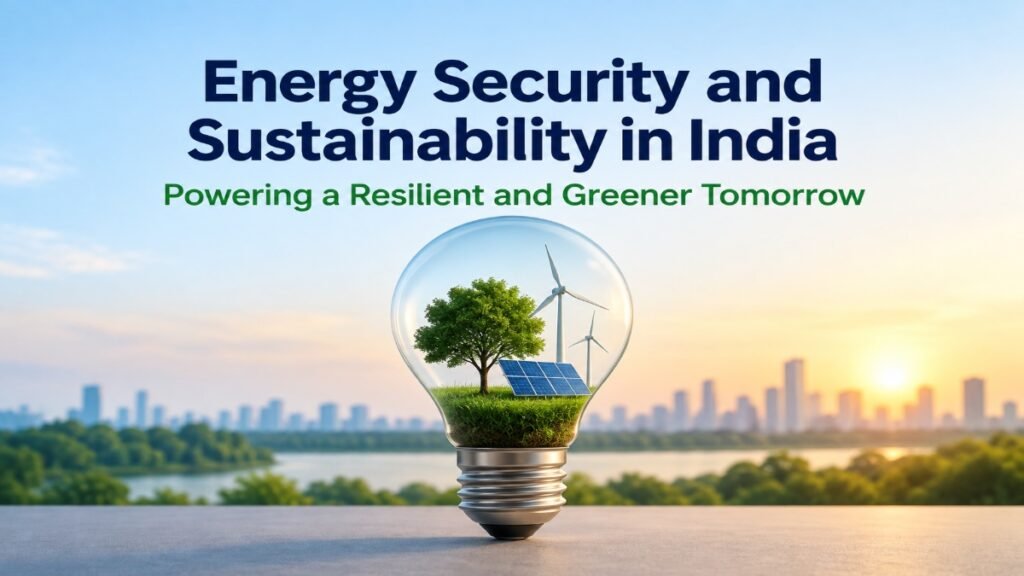
Energy Security and Sustainability in India is a critical issue for India’s economic development, environmental protection, and long-term national interests. Energy security refers to the uninterrupted availability of energy at affordable prices to meet the present and future needs of households, industries, agriculture, and transportation. It encompasses four dimensions—availability, accessibility, affordability, and reliability of energy supply. Energy Security in India is therefore essential for maintaining economic stability and ensuring reliable energy access.
Sustainability refers to meeting the present energy needs without compromising the ability of future generations to meet their own needs. It emphasises the use of clean, renewable, and energy-efficient technologies while minimising environmental degradation and greenhouse gas emissions. Energy Sustainability in India focuses on developing an energy system that can meet growing demand while protecting natural resources and the environment.
The energy security versus sustainability debate has emerged because countries, especially developing economies like India, need to balance rapid economic growth with environmental protection. While fossil fuels such as coal, oil, and natural gas continue to provide reliable and affordable energy, they are also the largest contributors to climate change and air pollution. On the other hand, renewable energy is environmentally sustainable but faces challenges related to intermittency, storage, and high initial investment. Thus, Energy Security and Sustainability in India requires a balanced approach between reliable energy supply and sustainable energy development.
For India, striking this balance is particularly challenging because it is the world’s fastest-growing major economy and the third-largest energy consumer after China and the United States. At the same time, India imports more than 85% of its crude oil requirement and around 50% of its natural gas, making energy security a strategic priority. This makes Energy Security and Sustainability in India an important component of India’s long-term development strategy.
India has also committed to achieving Net Zero emissions by 2070, reducing the emission intensity of GDP by 45% from 2005 levels by 2030, and achieving 50% cumulative installed electric power capacity from non-fossil fuel sources by 2030. These commitments require a careful balance between ensuring uninterrupted energy supply and accelerating the transition to clean energy. Therefore, Energy Security and Sustainability in India represents the need to simultaneously ensure energy availability, affordability and reliability while advancing environmental sustainability and the clean energy transition in India.
Master Science & Technology. Maximize Your BPSC Mains Score.
Enroll in the BPSC Science & Tech Course Today
Master Science & Technology for BPSC Mains GS Paper-2 with 75+ exam-oriented topics, 6 structured lessons, and downloadable PDF notes—all in one course.
✔ 75+ Exam-Oriented Topics • ✔ 6 Comprehensive Lessons • ✔ Downloadable PDF Notes • ✔ Updated for 72nd BPSC Mains
2. Why Energy Security is Important for India
Meeting the Rising Energy Demand
India’s rapidly growing population, urbanisation, industrialisation, and expanding middle class are driving a continuous increase in energy demand. Reliable energy availability is essential for households, agriculture, transport, industries, and infrastructure development. Therefore, Energy Security and Sustainability in India must address the growing energy requirements of the economy while ensuring that energy remains affordable and accessible.
Reducing Dependence on Energy Imports
India is highly dependent on imports for crude oil and natural gas. More than 85% of India’s crude oil requirement and around 50% of its natural gas requirement are met through imports. Such dependence exposes India to international price fluctuations, geopolitical conflicts, supply disruptions, and exchange-rate risks. Strengthening Energy Security in India through domestic energy production, renewable energy, nuclear power, and diversification of energy sources is therefore strategically important.
Supporting Economic Growth and Industrialisation
Energy is the foundation of economic activity and industrial development. Manufacturing, transportation, construction, agriculture, and the services sector all require reliable energy supplies. Interruptions or sharp increases in energy prices can increase production costs and affect economic growth. Energy Security and Sustainability in India therefore requires a reliable energy system capable of supporting India’s long-term economic and industrial expansion.
Ensuring Energy Access and Social Development
Affordable and reliable energy is essential for improving living standards and promoting social development. Electricity access supports education, healthcare, communication, irrigation, household activities, and rural development. Ensuring universal and affordable energy access is an important component of Energy Security and Sustainability in India, particularly for vulnerable and rural communities.
Strengthening National Security and Strategic Autonomy
Energy dependence can have implications for national security because disruptions in international energy supplies can affect the economy and essential services. Diversification of energy sources and greater domestic energy production can reduce external vulnerabilities. In this context, Energy Security in India contributes to strategic autonomy by reducing excessive dependence on external energy suppliers.
Achieving Affordable and Reliable Energy Supply
Energy security is not limited to the availability of energy; it also requires that energy remains affordable and reliably available to consumers. India therefore needs a diversified energy mix that includes coal, oil, natural gas, renewable energy, hydropower, and nuclear energy. A balanced approach to Energy Security and Sustainability in India can help ensure reliable energy supply while gradually reducing environmental impacts.
Prepare Smarter. Study Better. Ace BPSC Mains.
BPSC Mains GS Paper 1 & 2 Complete Course
Access comprehensive BPSC Mains Notes for GS Paper 1 & 2, covering 378+ topics across 24 PDF lessons, with dedicated Bihar coverage, practice questions and downloadable study material.
✓ GS Paper 1 & 2 • ✓ 378+ Topics • ✓ 24 PDF Lessons • ✓ Bihar-Specific Coverage • ✓ Downloadable Notes
3. Why Sustainability is Equally Important
Addressing Climate Change
Climate change is one of the biggest challenges associated with continued dependence on fossil fuels. Coal, petroleum, and natural gas are major sources of greenhouse gas emissions, particularly Carbon Dioxide (CO₂). India’s transition towards renewable energy, energy efficiency, green hydrogen, and other low-carbon technologies is essential for reducing emissions and achieving its Net Zero emissions target by 2070. Thus, Energy Security and Sustainability in India requires the expansion of cleaner energy sources alongside reliable energy supply.
Reducing Air Pollution and Protecting Public Health
Fossil fuel combustion is a major source of Particulate Matter (PM₂.₅), Sulphur Dioxide (SO₂), Nitrogen Oxides (NOₓ), and Carbon Dioxide (CO₂), which adversely affect public health. According to the World Air Quality Report, several Indian cities continue to rank among the world’s most polluted. Expanding renewable energy, electric mobility, cleaner fuels, and energy-efficient technologies can significantly improve air quality and reduce respiratory and cardiovascular diseases. Energy Sustainability in India therefore has important public health benefits.
Conserving Natural Resources
Conventional energy sources such as coal, petroleum, and natural gas are finite resources that take millions of years to form. Excessive extraction also leads to land degradation, deforestation, water pollution, and biodiversity loss. Sustainable energy promotes efficient utilisation of natural resources by encouraging renewable sources such as solar, wind, hydro, biomass, and green hydrogen, thereby reducing ecological pressure. Sustainable Energy in India can therefore contribute to resource conservation while supporting long-term development.
Ensuring Long-Term Energy Sustainability
India’s energy demand will continue to increase over the coming decades, making it essential to develop energy sources that are environmentally sustainable and economically viable. Investments in renewable energy, energy storage systems, nuclear power, green hydrogen, and energy efficiency will help ensure uninterrupted energy supply for future generations while reducing dependence on exhaustible fossil fuels. This is a central objective of Energy Security and Sustainability in India.
Supporting Sustainable Development Goals (SDGs)
Sustainable energy is central to achieving several United Nations Sustainable Development Goals (SDGs), particularly SDG 7 (Affordable and Clean Energy), SDG 9 (Industry, Innovation and Infrastructure), SDG 11 (Sustainable Cities and Communities), SDG 12 (Responsible Consumption and Production), and SDG 13 (Climate Action). Thus, energy sustainability contributes not only to environmental protection but also to inclusive economic and social development. Energy Security and Sustainability in India is closely connected with these broader sustainable development objectives.
Promoting Green Growth and Green Jobs
The transition to sustainable energy creates new economic opportunities in sectors such as renewable energy, electric mobility, battery manufacturing, green hydrogen, energy storage, and waste-to-energy. According to the International Renewable Energy Agency (IRENA), the global renewable energy sector employed over 16 million people in 2023, indicating the significant employment potential of green industries. Sustainable energy therefore supports both economic growth and employment generation. This makes Sustainable Energy in India an important component of India’s future economic transformation.
Preserving Intergenerational Equity
Sustainable development is based on the principle that present generations should meet their needs without compromising the ability of future generations to meet theirs. Excessive dependence on fossil fuels accelerates climate change, resource depletion, and environmental degradation, imposing significant costs on future generations. Adopting sustainable energy practices ensures long-term environmental security, resource conservation, and a healthier planet for future generations. Therefore, Energy Security and Sustainability in India must consider both present energy requirements and the interests of future generations.
4. Energy Security vs Sustainability Debate
Coal-Based Energy vs Clean Energy Transition
Coal remains a major component of India’s electricity generation, accounting for around 70–75% of total electricity generation. India also possesses the world’s fifth-largest coal reserves. Coal therefore remains important for meeting India’s growing energy demand and ensuring reliable electricity supply. However, coal-based energy contributes significantly to greenhouse gas emissions and air pollution. The challenge for Energy Security and Sustainability in India is to reduce the environmental impact of coal while ensuring that energy security is not compromised. This requires a gradual Clean Energy Transition in India rather than an abrupt phase-out of conventional energy sources.
Affordable Energy vs Environmental Protection
Developing economies like India need affordable energy to support industrialisation, employment generation, poverty reduction, and improvements in living standards. However, low-cost fossil fuel-based energy can impose environmental and health costs through pollution and greenhouse gas emissions. Renewable energy is cleaner but may involve high initial investment and infrastructure requirements. Energy Security and Sustainability in India therefore requires policies that balance energy affordability with environmental protection and ensure that the transition does not disproportionately affect vulnerable sections of society.
Fossil Fuel Imports vs Renewable Energy Expansion
India’s dependence on imported crude oil and natural gas creates vulnerabilities due to international price fluctuations and geopolitical disruptions. At the same time, India has significant potential for solar, wind, hydropower, and other renewable energy sources. Expanding domestic renewable energy can reduce import dependence, improve energy security, and support decarbonisation. India’s India Energy Transition therefore involves reducing dependence on imported fossil fuels while developing a diversified domestic energy system. Energy Security and Sustainability in India can be strengthened through greater deployment of renewable energy along with storage and grid infrastructure.
Baseload Power vs Intermittent Renewable Energy
Conventional sources such as coal and nuclear power can provide relatively stable electricity generation, whereas solar and wind power are variable because their generation depends on weather and natural conditions. Increasing renewable energy capacity therefore requires adequate energy storage, flexible generation, transmission infrastructure, and smart grids. A balanced energy mix is essential for Energy Security and Sustainability in India. India’s Clean Energy Transition in India must consequently be supported by battery storage, pumped-storage hydropower, modern transmission networks, and improved grid management.
Economic Growth vs Emission Reduction
India needs sustained economic growth to generate employment, improve living standards, and support infrastructure development. At the same time, reducing greenhouse gas emissions is necessary to address climate change and fulfil India’s international climate commitments. The Energy Security and Sustainability in India approach therefore seeks to decouple economic growth from increasing energy-related emissions through renewable energy, energy efficiency, cleaner technologies, electrification, and low-carbon fuels.
Domestic Resource Utilisation vs Global Climate Commitments
India has substantial domestic coal resources and continues to use coal to meet a significant share of its energy requirements. At the same time, India has made international commitments to reduce emission intensity and achieve Net Zero emissions by 2070. This creates a policy challenge between utilising domestic resources for energy security and accelerating decarbonisation. Energy Security and Sustainability in India therefore requires a calibrated approach that recognises India’s developmental needs while progressively increasing the share of cleaner energy sources.
Short-Term Energy Needs vs Long-Term Sustainability
India’s immediate priority is to ensure adequate and affordable energy for its growing economy and population. However, excessive investment in high-carbon infrastructure can create long-term environmental and economic risks. Conversely, a rapid transition without adequate infrastructure and storage could create reliability challenges. Energy Security and Sustainability in India therefore requires long-term planning, technological innovation, energy diversification, and a phased transition towards cleaner energy.
Examples Reflecting India’s Balanced Approach
India’s energy policies increasingly reflect an attempt to balance energy security with environmental sustainability. Examples include:
- Continued use of coal for reliable electricity generation while expanding renewable energy capacity.
- Rapid expansion of solar and wind energy to reduce dependence on fossil fuels.
- Promotion of nuclear energy as a low-carbon source of reliable electricity.
- Development of green hydrogen for hard-to-abate sectors.
- Promotion of electric mobility to reduce dependence on imported petroleum.
- Expansion of energy efficiency programmes to reduce energy consumption without compromising economic activity.
- Development of battery storage, pumped-storage hydropower, and smart grids to integrate variable renewable energy.
These measures demonstrate that Energy Security and Sustainability in India are increasingly being addressed together rather than as completely competing objectives. The broader India Energy Transition seeks to maintain reliable and affordable energy supplies while progressively increasing the role of clean and sustainable energy.
5. Government Initiatives
The Government of India has introduced several policies and programmes to balance Energy Security and Sustainability in India. These initiatives focus on energy diversification, renewable energy expansion, energy efficiency, clean fuels, nuclear energy, and reduction of dependence on imported fossil fuels.
National Action Plan on Climate Change (NAPCC)
The National Action Plan on Climate Change (NAPCC) provides an overarching framework for India’s climate action. It includes eight national missions covering areas such as solar energy, energy efficiency, sustainable habitat, water conservation, Himalayan ecosystems, green India, sustainable agriculture, and strategic knowledge for climate change. These missions contribute to both environmental sustainability and long-term Energy Security and Sustainability in India.
National Green Hydrogen Mission
The National Green Hydrogen Mission aims to establish India as a global hub for the production, utilisation, and export of green hydrogen. Green hydrogen can reduce dependence on fossil fuels in sectors such as fertilisers, refining, steel, shipping, and heavy transport. It can therefore support Energy Sustainability in India while strengthening long-term energy security.
National Solar Mission
The Jawaharlal Nehru National Solar Mission promotes the development and deployment of solar energy in India. Solar power helps diversify India’s energy mix, reduce dependence on fossil fuels, and lower greenhouse gas emissions. The expansion of solar energy is an important component of Clean Energy Transition in India and Energy Security and Sustainability in India.
PM Surya Ghar: Muft Bijli Yojana
The PM Surya Ghar: Muft Bijli Yojana promotes rooftop solar installations in residential households. It aims to increase distributed renewable energy generation, reduce electricity expenditure for households, and encourage clean electricity production. Such decentralised generation can contribute to Sustainable Energy in India and improve long-term energy resilience.
PM E-DRIVE Scheme
The PM E-DRIVE Scheme promotes electric mobility and the adoption of electric vehicles. Greater electrification of transport can reduce dependence on imported petroleum products and support the transition towards cleaner transportation. It therefore forms an important part of India Energy Transition and the broader objective of Energy Security and Sustainability in India.
Promotion of Biofuels and Ethanol Blending
India has promoted ethanol blending with petrol and other biofuels to reduce dependence on imported crude oil, utilise domestic agricultural resources, and lower emissions. The expansion of ethanol blending, including the E20 programme, contributes to diversification of the transport fuel mix and strengthens Energy Security in India.
Nuclear Energy Development
Nuclear power provides low-carbon and reliable electricity and can complement variable renewable energy sources. India is expanding its nuclear energy programme, including the development of 700 MW Pressurised Heavy Water Reactors (PHWRs) and research into Small Modular Reactors (SMRs). Nuclear energy can therefore play an important role in balancing energy reliability and environmental sustainability under Energy Security and Sustainability in India.
Energy Efficiency Programmes
The Energy Conservation Act, National Mission for Enhanced Energy Efficiency (NMEEE), Perform, Achieve and Trade (PAT) scheme, and UJALA programme promote efficient energy consumption across industries, households, and other sectors. Improving energy efficiency reduces energy demand, lowers costs, and reduces emissions without compromising economic activity. Energy efficiency is therefore a key pillar of Energy Sustainability in India.
National Critical Mineral Mission
Critical minerals such as lithium, cobalt, nickel, graphite, and rare earth elements are essential for batteries, renewable energy technologies, electric vehicles, and other clean-energy technologies. The National Critical Mineral Mission seeks to strengthen domestic exploration, processing, recycling, and supply chains for critical minerals. This is important for India’s Clean Energy Transition in India and for reducing vulnerabilities in clean-energy supply chains.
Mission LiFE
Mission LiFE (Lifestyle for Environment) promotes behavioural changes aimed at reducing wasteful consumption and encouraging sustainable lifestyles. Energy conservation, responsible consumption, and resource efficiency under Mission LiFE can reduce pressure on energy resources and contribute to Sustainable Energy in India.
Together, these initiatives demonstrate India’s attempt to integrate energy security with environmental objectives. The overall approach to Energy Security and Sustainability in India involves diversification of energy sources, expansion of renewable energy, promotion of energy efficiency, development of clean fuels, and strengthening domestic energy capabilities.
6. Way Forward
Diversification of Energy Mix
India should adopt a diversified energy mix that combines coal, natural gas, nuclear energy, hydropower, solar, wind, biomass, and green hydrogen. Diversification can reduce dependence on any single energy source and improve resilience against supply disruptions and price volatility. A balanced energy mix is essential for achieving Energy Security and Sustainability in India.
Investment in Energy Storage and Smart Grids
The expansion of solar and wind energy requires reliable storage and modern electricity infrastructure. India should increase investments in battery energy storage systems, pumped-storage hydropower, smart grids, and advanced transmission networks. These technologies can address the intermittency of renewable energy and improve grid stability, thereby supporting the Clean Energy Transition in India.
Promoting Green Hydrogen and Clean Technologies
India should accelerate the development of green hydrogen, advanced nuclear technologies, carbon capture and storage (CCS), and cleaner coal technologies. These technologies can help reduce emissions from sectors that are difficult to electrify while maintaining energy reliability. Such technological diversification can strengthen Energy Security and Sustainability in India.
Strengthening Domestic Manufacturing
India should develop domestic manufacturing capabilities for solar panels, batteries, wind turbines, electric vehicles, electrolyzers, and other clean-energy technologies. Reducing dependence on imported clean-energy equipment will strengthen domestic supply chains and improve strategic autonomy during the India Energy Transition.
Improving Energy Efficiency
Energy efficiency should remain a central component of India’s energy strategy. Greater adoption of energy-efficient appliances, buildings, industrial technologies, vehicles, and production processes can reduce energy consumption while maintaining economic output. Improving efficiency can simultaneously support Energy Security in India and Energy Sustainability in India.
Mobilising Climate Finance and Private Investment
The transition towards sustainable energy requires substantial investment. India should encourage private investment, public-private partnerships, green bonds, climate finance, and innovative financing mechanisms to support renewable energy, storage, energy efficiency, and low-carbon technologies. Greater access to affordable finance can accelerate Sustainable Energy in India.
Promoting Research and Development
India should strengthen research and development in areas such as advanced battery storage, green hydrogen, nuclear technology, carbon capture, renewable energy integration, and energy-efficient technologies. Indigenous innovation can reduce technology costs and improve the reliability and scalability of clean-energy solutions.
Strengthening International Cooperation
India should continue international cooperation for technology transfer, climate finance, critical mineral supply chains, renewable energy development, and clean-energy research. Cooperation through international platforms can support India’s developmental priorities while accelerating the global transition towards sustainable energy.
Overall, the way forward for Energy Security and Sustainability in India is not to choose between energy security and sustainability but to integrate both through diversification, technological innovation, energy efficiency, domestic manufacturing, storage infrastructure, and clean-energy investment. This balanced approach can enable India to meet its growing energy requirements while progressing towards its long-term climate commitments.
7. Conclusion
The debate between energy security and sustainability is not a choice between two competing objectives but a challenge of achieving both simultaneously. For a developing country like India, reliable, affordable, and accessible energy is essential for economic growth, industrialisation, poverty reduction, and national security. At the same time, rising environmental degradation, climate change, and resource constraints make sustainability indispensable for long-term development.
India therefore needs a balanced energy strategy that combines conventional energy sources with renewable energy, nuclear power, energy efficiency, energy storage, green hydrogen, and other clean technologies. A diversified energy mix can reduce import dependence while ensuring reliable energy supply and supporting environmental protection.
The success of Energy Security and Sustainability in India will ultimately depend on technological innovation, domestic manufacturing, investment, efficient energy use, and effective policy implementation. A carefully managed India Energy Transition can enable India to meet its growing energy requirements while progressing towards its climate commitments and ensuring a sustainable energy future for present and future generations.
BPSC Mains Practice Questions
- “Energy security and sustainability are complementary objectives rather than competing priorities for India.” Discuss the major challenges involved in balancing the two and suggest a suitable strategy for achieving Energy Security and Sustainability in India.
- India’s energy transition requires balancing economic growth, energy affordability, energy security, and environmental sustainability. Examine the major policy measures taken by the Government of India in this regard and suggest the way forward.
Learn More About Energy Security and Sustainability in India
For official information on India’s energy security, energy transition, renewable energy integration, energy efficiency, and sustainability initiatives, visit the Ministry of Power, Government of India: Ministry of Power – Government of India