1. Introduction
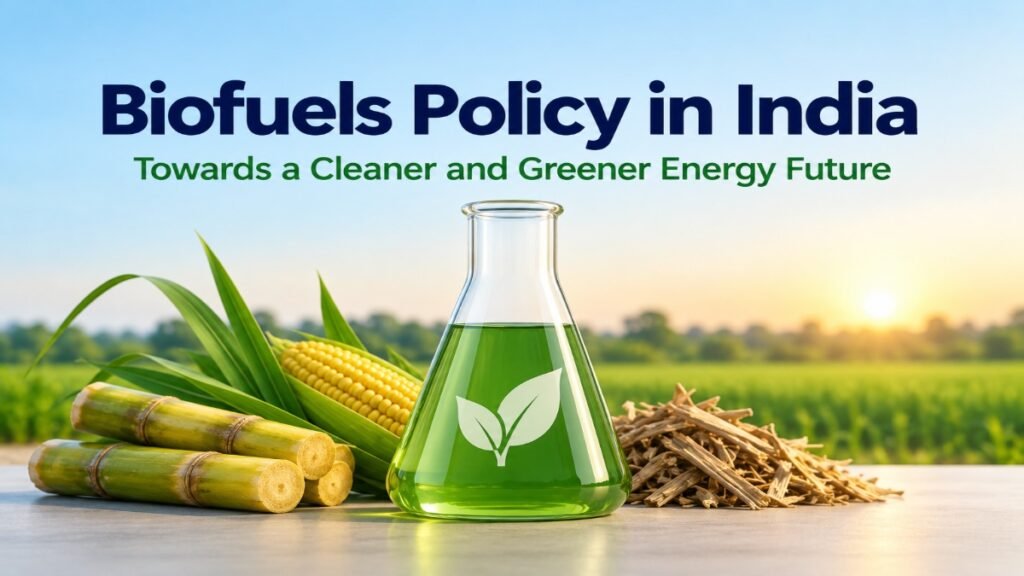
Biofuels are fuels produced from renewable biological resources such as sugarcane, maize, damaged food grains, crop residues, used cooking oil, and agricultural waste. Among various biofuels, ethanol has become the cornerstone of India’s biofuel strategy due to its ability to replace a portion of petrol, thereby reducing fossil fuel consumption and greenhouse gas emissions. The Biofuels Policy in India provides an important framework for promoting renewable fuels and reducing dependence on conventional fossil fuels.
The National Policy on Biofuels, 2018 (amended in 2022) provides the policy framework for promoting biofuels in India. It advanced the target of 20% ethanol blending in petrol (E20) from 2030 to 2025-26. The Ethanol Blended Petrol (EBP) Programme, implemented by the Ministry of Petroleum & Natural Gas, aims to increase ethanol blending while improving farmers’ income, reducing crude oil imports, and supporting India’s Net Zero by 2070 goal. The National Biofuels Policy is therefore an important component of the Biofuels Policy in India and India’s broader clean energy strategy.
Master Science & Technology. Maximize Your BPSC Mains Score.
Enroll in the BPSC Science & Tech Course Today
Master Science & Technology for BPSC Mains GS Paper-2 with 75+ exam-oriented topics, 6 structured lessons, and downloadable PDF notes—all in one course.
✔ 75+ Exam-Oriented Topics • ✔ 6 Comprehensive Lessons • ✔ Downloadable PDF Notes • ✔ Updated for 72nd BPSC Mains
2. Significance of the Ethanol Blending Programme
- Enhances energy security by reducing dependence on imported crude oil. India imports over 85% of its crude oil requirement, and higher Ethanol Blending in India helps reduce this dependence. The Biofuels Policy in India therefore supports greater energy security by promoting domestically produced renewable fuel.
- Reduces greenhouse gas emissions, as ethanol is a renewable and cleaner-burning fuel. According to the Government, the EBP Programme has helped avoid over 680 lakh metric tonnes of CO₂ emissions since its inception. This is one of the important environmental benefits associated with the Biofuels Policy in India.
- Saves foreign exchange by lowering crude oil imports. The Government estimates that ethanol blending has resulted in foreign exchange savings exceeding ₹1.1 lakh crore. Increasing Ethanol Production in India can further support this objective.
- Improves farmers’ income by creating additional demand for sugarcane, maize, damaged food grains, and agricultural residues, thereby diversifying farm income.
- Strengthens the sugar sector by utilising surplus sugar for ethanol production, reducing excess sugar stocks and improving the financial health of sugar mills.
- Promotes rural employment by encouraging investment in ethanol distilleries, storage infrastructure, logistics, and biomass supply chains. Expansion of the Ethanol Blending Programme in India can therefore generate employment opportunities across rural and industrial areas.
- Supports the circular economy through the utilisation of agricultural residues and waste biomass that would otherwise be burnt, thereby reducing stubble burning and environmental pollution.
- Progress of the Programme: Ethanol blending in petrol has increased from about 1.5% in 2014 to around 19% during the 2024–25 ethanol supply year, bringing India close to its E20 target. The progress of Ethanol Blending in India demonstrates the growing role of ethanol in India’s transport fuel mix and the implementation of the National Biofuels Policy.
Prepare Smarter. Study Better. Ace BPSC Mains.
BPSC Mains GS Paper 1 & 2 Complete Course
Access comprehensive BPSC Mains Notes for GS Paper 1 & 2, covering 378+ topics across 24 PDF lessons, with dedicated Bihar coverage, practice questions and downloadable study material.
✓ GS Paper 1 & 2 • ✓ 378+ Topics • ✓ 24 PDF Lessons • ✓ Bihar-Specific Coverage • ✓ Downloadable Notes
3. Challenges
- Feedstock dependence: Nearly half of India’s ethanol production still depends on sugarcane, a highly water-intensive crop grown mainly in water-stressed states such as Maharashtra and Karnataka. Diversifying feedstocks is therefore important for the long-term sustainability of the Biofuels Policy in India.
- Food versus fuel debate: Diversion of food grains such as maize and rice towards ethanol production raises concerns regarding food security and inflation, particularly during years of poor agricultural output. The National Biofuels Policy must therefore maintain an appropriate balance between fuel requirements and food security.
- Water-intensive production: Sugarcane cultivation consumes large quantities of water, making excessive reliance on sugarcane-based ethanol environmentally unsustainable. Sustainable Ethanol Production in India therefore requires greater use of water-efficient feedstocks and advanced technologies.
- Vehicle compatibility: Older vehicles are generally compatible with only E10 fuel, while widespread adoption of E20 Fuel in India requires flex-fuel engines and modifications in vehicle design. Ensuring vehicle compatibility is therefore important for the effective implementation of the Biofuels Policy in India.
- Limited second-generation (2G) ethanol production: Although 2G ethanol produced from crop residues offers greater environmental benefits, commercial production remains limited due to high technology costs. Scaling up 2G technologies can strengthen the sustainability of the Ethanol Blending Programme in India.
- Infrastructure constraints: Expansion of distilleries, storage facilities, transportation networks, and blending infrastructure is still inadequate in several regions. Strengthening this infrastructure is essential for achieving the objectives of Ethanol Blending in India and the Biofuels Policy in India.
4. Government Initiatives
- National Policy on Biofuels, 2018 (amended in 2022) advances the E20 target to 2025-26 and expands the range of feedstocks eligible for ethanol production. The National Biofuels Policy provides the core policy framework for the Biofuels Policy in India.
- The Government provides interest subvention and financial assistance for establishing and expanding ethanol distilleries to increase domestic production capacity. This can support the expansion of Ethanol Production in India.
- Pradhan Mantri JI-VAN Yojana promotes second-generation (2G) ethanol from agricultural residues such as paddy straw, reducing stubble burning and supporting sustainable biofuel production.
- Oil Marketing Companies (OMCs) are expanding ethanol procurement and blending infrastructure across the country, while automobile manufacturers have introduced E20-compatible and flex-fuel vehicles. These measures support the wider adoption of E20 Fuel in India and strengthen the Ethanol Blending Programme in India.
- Going forward, India should diversify ethanol feedstocks towards crop residues, bamboo, municipal waste, and other non-food biomass, promote water-efficient crops, expand 2G biofuel technologies, strengthen biomass supply chains, and balance energy security with food security. These measures can make Ethanol Blending in India more sustainable while supporting the objectives of the Biofuels Policy in India.
5. Conclusion
The Ethanol Blending Programme has become a key pillar of India’s clean energy transition by reducing oil imports, lowering carbon emissions, improving farmers’ income, and promoting rural development. However, long-term success will depend on expanding sustainable feedstocks, reducing dependence on sugarcane, promoting advanced biofuels, and ensuring that energy security is achieved without compromising food and water security. The Biofuels Policy in India will therefore remain important for achieving a balanced and sustainable biofuel transition.
BPSC Mains Practice Question
“The Ethanol Blending Programme is an important component of India’s energy security and clean energy strategy.” Discuss its significance, major challenges, and the measures required to make ethanol blending sustainable in India.
Learn More About Biofuels Policy in India
For official information on the Ethanol Blended Petrol (EBP) Programme, ethanol procurement, blending policy, and India’s biofuel initiatives, visit the Ministry of Petroleum & Natural Gas, Government of India: Ministry of Petroleum & Natural Gas – Ethanol Blended Petrol Programme. The Ministry also hosts the official National Policy on Biofuels–2018 Amendment, 2022 notification.