1. Introduction and Key Features
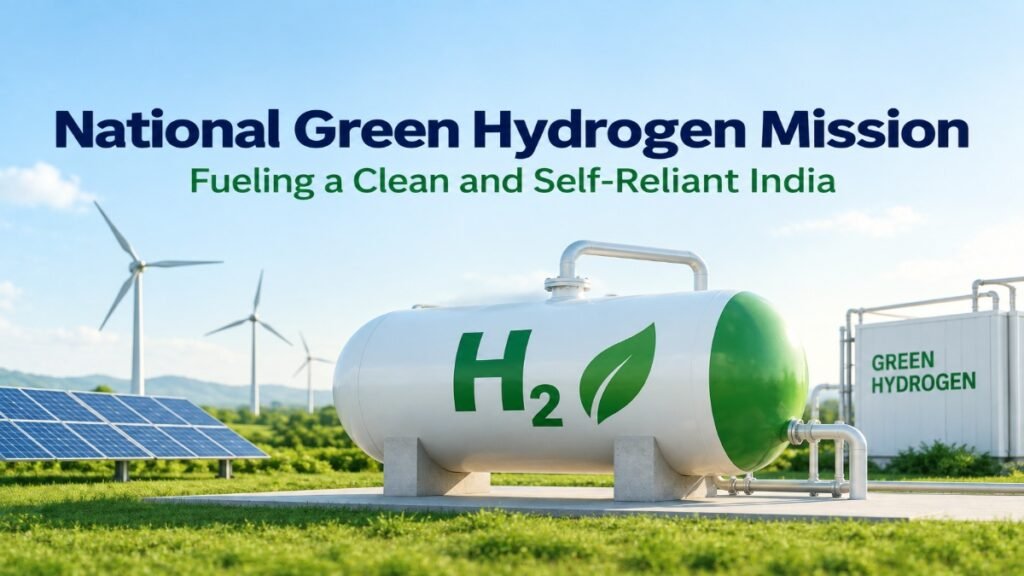
Green Hydrogen in India is hydrogen produced by splitting water through electrolysis using electricity generated entirely from renewable energy sources such as solar and wind. It is considered a clean fuel because its production and use emit no carbon dioxide, with water vapour being the only by-product. The National Green Hydrogen Mission is therefore an important step towards developing clean energy in India.
The National Green Hydrogen Mission (NGHM) was launched by the Government of India on 4 January 2023 with an initial outlay of ₹19,744 crore. The mission is being implemented by the Ministry of New and Renewable Energy (MNRE) to make India a global hub for the production, utilisation, and export of Green Hydrogen and its derivatives. The Green Hydrogen Mission India framework is designed to strengthen domestic production and accelerate India’s transition towards a low-carbon economy.
Key Targets (by 2030)
- Achieve at least 5 million Metric Tonnes (MMT) of Green Hydrogen production annually.
- Develop around 125 GW of additional renewable energy capacity to support green hydrogen production.
- Attract investments of over ₹8 lakh crore in the sector.
- Create more than 6 lakh direct and indirect employment opportunities.
- Reduce fossil fuel imports by over ₹1 lakh crore annually.
- Avoid nearly 50 million Metric Tonnes (MMT) of CO₂ emissions every year.
- The Mission focuses on promoting domestic electrolyser manufacturing, production of green hydrogen and green ammonia, research and innovation, pilot projects, development of hydrogen hubs, skilling, and export infrastructure. It is expected to play a crucial role in achieving Net Zero emissions by 2070, strengthening energy security, and advancing the vision of Atmanirbhar Bharat. The National Green Hydrogen Mission is thus central to the Green Hydrogen Policy in India and the country’s long-term clean energy strategy.
Master Science & Technology. Maximize Your BPSC Mains Score.
Enroll in the BPSC Science & Tech Course Today
Master Science & Technology for BPSC Mains GS Paper-2 with 75+ exam-oriented topics, 6 structured lessons, and downloadable PDF notes—all in one course.
✔ 75+ Exam-Oriented Topics • ✔ 6 Comprehensive Lessons • ✔ Downloadable PDF Notes • ✔ Updated for 72nd BPSC Mains
2. Significance of the National Green Hydrogen Mission
- Strengthens India’s energy security by reducing dependence on imported crude oil, natural gas, and other fossil fuels. Green Hydrogen in India can become an indigenous clean fuel, thereby reducing import bills and enhancing energy independence. The National Green Hydrogen Mission can therefore play an important role in strengthening India’s long-term energy security.
- Supports India’s Net Zero target by 2070 by providing a clean alternative to fossil fuels in sectors where direct electrification is difficult. It will help India fulfil its commitments under the Paris Agreement and the Panchamrit Goals announced at COP26. The Green Hydrogen Mission India framework therefore supports India’s long-term decarbonisation strategy.
- Decarbonises hard-to-abate industries such as steel, cement, refineries, fertilisers, chemicals, shipping, and aviation, where renewable electricity alone cannot significantly reduce emissions. These applications highlight the wider Green Hydrogen Benefits for India’s industrial transition.
- Promotes renewable energy expansion, as achieving the Mission’s production target requires about 125 GW of additional renewable energy capacity, thereby accelerating India’s clean energy transition. The National Green Hydrogen Mission can consequently create additional demand for renewable electricity.
- Boosts economic growth and employment by attracting investments of over ₹8 lakh crore and generating more than 6 lakh jobs across manufacturing, infrastructure, research, logistics, and allied industries. These are important Green Hydrogen Benefits for India’s emerging clean-energy economy.
- Promotes Atmanirbhar Bharat by encouraging indigenous manufacturing of electrolysers, hydrogen storage systems, fuel cells, and related technologies, thereby reducing dependence on imported clean energy equipment. This is an important objective of the Green Hydrogen Policy in India.
- Enhances India’s export potential by positioning the country as a global supplier of Green Hydrogen, Green Ammonia, and electrolyser technology, especially to energy-importing countries in Europe, Japan, and South Korea. The National Green Hydrogen Mission can therefore support India’s emergence as a major participant in the global hydrogen economy.
- Encourages technological innovation through research and development in hydrogen production, storage, transportation, fuel cells, and industrial applications, strengthening India’s clean technology ecosystem. These technological developments are among the important Green Hydrogen Benefits associated with the Mission.
- Improves environmental quality by reducing greenhouse gas emissions and air pollutants, thereby contributing to cleaner industries and improved public health. The expansion of Green Hydrogen in India can therefore support India’s broader environmental objectives.
- Supports the development of a Hydrogen Economy, where hydrogen becomes an important clean fuel for electricity generation, heavy transport, industrial processes, and long-duration energy storage, ensuring long-term sustainable development. The National Green Hydrogen Mission is intended to provide the policy and institutional foundation for this emerging hydrogen economy.
Prepare Smarter. Study Better. Ace BPSC Mains.
BPSC Mains GS Paper 1 & 2 Complete Course
Access comprehensive BPSC Mains Notes for GS Paper 1 & 2, covering 378+ topics across 24 PDF lessons, with dedicated Bihar coverage, practice questions and downloadable study material.
✓ GS Paper 1 & 2 • ✓ 378+ Topics • ✓ 24 PDF Lessons • ✓ Bihar-Specific Coverage • ✓ Downloadable Notes
3. Challenges
- High production cost remains the biggest challenge, as Green Hydrogen currently costs around 2–3 times more than hydrogen produced from fossil fuels (Grey Hydrogen), mainly due to the high cost of renewable electricity and electrolysers. The National Green Hydrogen Mission must therefore focus on reducing production costs to make Green Hydrogen in India commercially competitive.
- Limited domestic electrolyser manufacturing increases dependence on imports and raises project costs. India is still developing a large-scale indigenous manufacturing ecosystem. Strengthening domestic manufacturing is therefore an important objective of the Green Hydrogen Policy in India.
- High renewable energy requirement poses a challenge, as achieving the Mission target will require nearly 125 GW of additional renewable energy capacity along with a robust transmission network. Meeting this requirement is essential for the successful implementation of the National Green Hydrogen Mission.
- Storage and transportation of hydrogen are technically difficult because hydrogen is highly inflammable, has low volumetric energy density, and requires specialised storage tanks, pipelines, or conversion into green ammonia. These infrastructure requirements can increase the overall cost of the Green Hydrogen Mission India.
- Water requirement is another concern, as electrolysis requires large quantities of purified water, making sustainable water management essential in water-stressed regions. The National Green Hydrogen Mission therefore needs to ensure that hydrogen production does not create additional pressure on scarce water resources.
- Lack of demand and infrastructure for hydrogen refuelling stations, pipelines, storage facilities, and industrial utilisation slows commercial adoption. Creating reliable demand and supporting infrastructure will be essential to realise the Green Hydrogen Benefits and achieve the Mission’s long-term objectives.
4. Government Initiatives
- National Green Hydrogen Mission (2023) with an outlay of ₹19,744 crore to establish India as a global hub for Green Hydrogen production, utilisation, and exports. The National Green Hydrogen Mission provides the overall policy framework for developing the domestic hydrogen ecosystem.
- SIGHT Programme (Strategic Interventions for Green Hydrogen Transition) provides financial incentives for domestic manufacturing of electrolysers and production of Green Hydrogen. It is an important component of the Green Hydrogen Policy in India for reducing costs and encouraging domestic manufacturing.
- Green Hydrogen Hubs are being developed to promote integrated production, storage, transport, and industrial utilisation in regions having abundant renewable energy resources. These hubs can support the expansion of Green Hydrogen in India.
- Pilot projects have been launched in sectors such as steel, shipping, mobility, and decentralised energy to demonstrate commercial viability. Such projects are intended to identify practical applications and accelerate adoption under the Green Hydrogen Mission India framework.
- Green Hydrogen Certification Scheme has been introduced to certify hydrogen produced using renewable energy and establish transparent standards for domestic and international trade.
- Research and Development Scheme supports innovation in electrolysers, fuel cells, hydrogen storage technologies, and next-generation clean energy solutions.
- India is strengthening international cooperation through the International Solar Alliance (ISA), Global Biofuels Alliance, and bilateral partnerships with countries such as Japan, Germany, Australia, the UAE, and the European Union for technology transfer and market development. The National Green Hydrogen Mission can benefit from such cooperation through access to technology, investment, expertise, and international markets.
5. Way Forward
- Scale up domestic manufacturing of electrolysers and fuel cells through greater private sector participation and research incentives. The National Green Hydrogen Mission should support a competitive domestic manufacturing ecosystem to reduce costs and import dependence.
- Expand renewable energy capacity and dedicated transmission infrastructure to provide low-cost green electricity for hydrogen production. This will be essential for scaling Green Hydrogen in India and meeting the Mission’s production targets.
- Develop hydrogen storage, transportation, refuelling, and export infrastructure through public-private partnerships. Such infrastructure is necessary to convert the Green Hydrogen Mission India from a production-focused programme into a commercially viable hydrogen economy.
- Promote demand by mandating Green Hydrogen use in fertiliser plants, refineries, steel, shipping, and heavy transport sectors. Creating assured demand can accelerate investment and help realise the Green Hydrogen Benefits.
- Strengthen research, skill development, and international collaboration to reduce production costs and improve technological competitiveness. These measures can further strengthen the Green Hydrogen Policy in India and support India’s emergence as a global hydrogen hub.
6. Conclusion
The National Green Hydrogen Mission has the potential to transform India into a global leader in clean energy by reducing fossil fuel dependence, promoting green industrialisation, and accelerating the transition towards a low-carbon economy. Successful implementation of the National Green Hydrogen Mission will be instrumental in achieving Net Zero emissions by 2070, strengthening energy security, advancing Atmanirbhar Bharat, and realising the vision of Viksit Bharat 2047.
BPSC Mains Practice Question
“The National Green Hydrogen Mission can play a transformative role in India’s energy transition.” Discuss its objectives, significance, major challenges, and the measures required for its successful implementation.
Learn More About National Green Hydrogen Mission
For official information on the National Green Hydrogen Mission, including its objectives, SIGHT programme, Green Hydrogen Hubs, pilot projects, infrastructure, R&D and implementation framework, visit the Ministry of New and Renewable Energy (MNRE), Government of India: National Green Hydrogen Mission – MNRE