1. Introduction
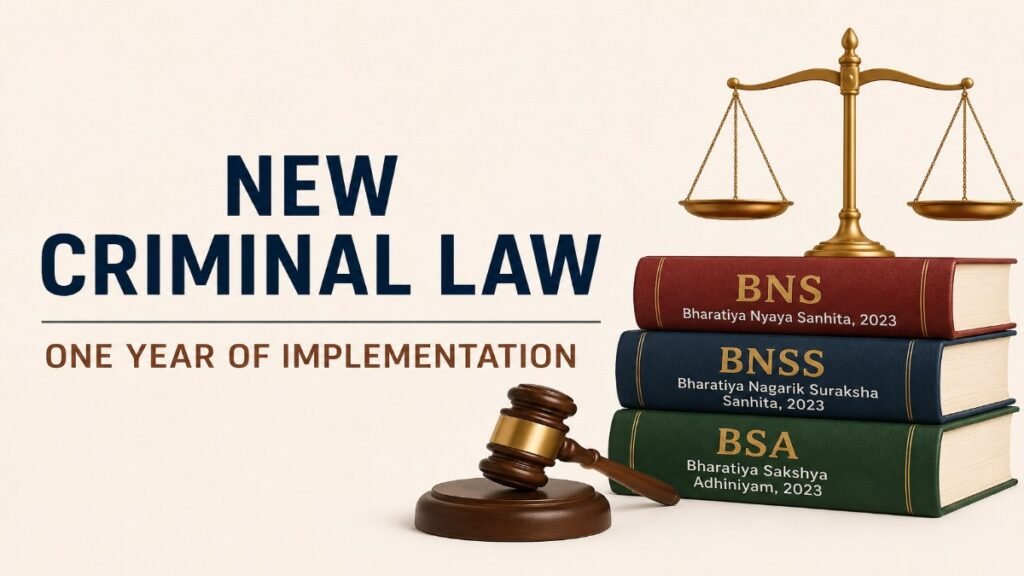
The New Criminal Law refers to the Bharatiya Nyaya Sanhita (BNS), 2023, Bharatiya Nagarik Suraksha Sanhita (BNSS), 2023, and Bharatiya Sakshya Adhiniyam (BSA), 2023, which came into force on 1 July 2024, replacing the colonial-era Indian Penal Code (IPC), 1860, Code of Criminal Procedure (CrPC), 1973, and Indian Evidence Act, 1872. These New Criminal Laws seek to modernise India’s criminal justice system by making it justice-oriented, technology-driven, victim-centric and time-bound.
After completing one year of implementation (July 2024–July 2025), the focus has shifted from legislative reforms to ground-level execution. The Government has reviewed the implementation across States, emphasizing e-FIR, Zero FIR, e-Sakshya, mandatory forensic investigation, digital charge sheets, audio-video recording of searches and improved coordination among police, prosecution, judiciary and forensic institutions. The Bharatiya Nyaya Sanhita, along with BNSS and BSA, forms the core of this New Criminal Law framework.
Master Current Affairs. Ace BPSC Mains.
BPSC Mains Current Affairs & International Relations Course
Master GS Paper-I (Section-II) with 116 exam-oriented topics, 5 structured lessons and downloadable PDF notes—all in one comprehensive course.
✔ 116 Exam-Oriented Topics • ✔ 5 Comprehensive Lessons • ✔ Downloadable PDF Notes • ✔ Updated for 72nd BPSC Mains
2. Why in News?
- 1 July 2025 marked the completion of one year of implementation of the Bharatiya Nyaya Sanhita (BNS), Bharatiya Nagarik Suraksha Sanhita (BNSS) and Bharatiya Sakshya Adhiniyam (BSA), prompting the Union Government and States to review their implementation. The one-year review brought the New Criminal Law framework into focus.
- The Ministry of Home Affairs (MHA) directed States and Union Territories to strengthen the implementation of key reforms such as e-Sakshya, e-FIR, Zero FIR, mandatory forensic investigation, digital charge sheets and time-bound investigation.
- Several States, including Bihar, accelerated the training of police officers, prosecutors and forensic personnel for effective enforcement of the New Criminal Laws. Bihar Police alone has trained over 3,100 officers through its Advanced Training School (ATS) for implementation of the new criminal laws.
- During the one-year review, the Government highlighted the progress made in digitalisation of the criminal justice system, while also identifying challenges such as shortage of forensic experts, infrastructure gaps and capacity building.
- The completion of one year has shifted the focus from legislative reforms to assessing the actual impact of the New Criminal Law on policing, investigation, prosecution and delivery of justice, making it an important current affairs topic for BPSC Mains. The Bharatiya Nyaya Sanhita is a key component of this reform framework.
Prepare Smarter. Study Better. Ace BPSC Mains.
BPSC Mains GS Paper 1 & 2 Complete Course
Access comprehensive BPSC Mains Notes for GS Paper 1 & 2, covering 378+ topics across 24 PDF lessons, with dedicated Bihar coverage, practice questions and downloadable study material.
✓ GS Paper 1 & 2 • ✓ 378+ Topics • ✓ 24 PDF Lessons • ✓ Bihar-Specific Coverage • ✓ Downloadable Notes
3. Overview of the New Criminal Laws
Bharatiya Nyaya Sanhita (BNS), 2023
The Bharatiya Nyaya Sanhita (BNS), 2023 replaced the Indian Penal Code (IPC), 1860 and came into force on 1 July 2024. It serves as India’s principal substantive criminal law by defining offences and prescribing punishments. While retaining many provisions of the IPC, the Bharatiya Nyaya Sanhita introduces a justice-oriented approach by recognising new offences such as terrorism, organised crime, mob lynching and snatching, strengthening provisions relating to crimes against women and children, introducing community service as a punishment for certain petty offences, and replacing the colonial offence of sedition with provisions protecting the sovereignty, unity and integrity of India.
Bharatiya Nagarik Suraksha Sanhita (BNSS), 2023
The Bharatiya Nagarik Suraksha Sanhita (BNSS), 2023 replaced the Code of Criminal Procedure (CrPC), 1973 and governs the entire criminal procedure—from registration of FIR to investigation, arrest, trial and appeal. It aims to make the New Criminal Law framework technology-driven, efficient and time-bound by providing for electronic FIR (e-FIR), Zero FIR, audio-video recording of searches and seizures, mandatory forensic investigation for offences punishable with seven years or more, digital charge sheets, electronic summons and greater use of video conferencing.
Bharatiya Sakshya Adhiniyam (BSA), 2023
The Bharatiya Sakshya Adhiniyam (BSA), 2023 replaced the Indian Evidence Act, 1872 and modernises India’s law of evidence in line with the digital era. It gives statutory recognition to electronic and digital evidence, including emails, CCTV footage, electronic records, mobile phone data and other digital documents, thereby facilitating faster and more reliable criminal trials. The Act seeks to strengthen the admissibility, authenticity and evidentiary value of digital records while supporting a modern, technology-enabled criminal justice system.
Together, the Bharatiya Nyaya Sanhita, Bharatiya Nagarik Suraksha Sanhita and Bharatiya Sakshya Adhiniyam constitute the three pillars of India’s New Criminal Law framework.
4. Major Reforms under the New Criminal Laws
Justice-Centric Approach
The new criminal laws shift the focus from a punishment-centric to a justice-centric system. They emphasize victim rights, speedy justice, use of technology, and reformative measures. For the first time, community service has been introduced as a punishment for certain petty offences, reflecting the principle of reformative justice instead of mere imprisonment.
Technology-driven Criminal Justice
The reforms aim to create a fully digital criminal justice system. Key provisions include e-FIR, Zero FIR, electronic summons, digital charge sheets, video conferencing, electronic case diaries, and recognition of electronic evidence under the Bharatiya Sakshya Adhiniyam. These measures are intended to improve transparency, efficiency and accessibility of justice under the New Criminal Law framework.
Mandatory Forensic Investigation
To improve the quality of investigation and conviction rates, the BNSS mandates forensic investigation for offences punishable with imprisonment of seven years or more. Crime scenes must be examined by forensic experts, and digital evidence such as DNA profiling, CCTV footage, mobile phone records and cyber evidence has been given greater importance.
Recognition of New and Emerging Crimes
The Bharatiya Nyaya Sanhita (BNS) incorporates several offences that were either absent or inadequately addressed in the IPC. These include terrorism, organised crime, mob lynching, snatching and crimes affecting the sovereignty, unity and integrity of India. The reforms also strengthen provisions relating to crimes against women and children, reflecting contemporary security challenges.
Time-bound Investigation and Trial
The new laws prescribe statutory timelines for various stages of the criminal justice process, including registration of FIRs, investigation, filing of charge sheets, framing of charges and pronouncement of judgments. The objective is to reduce pendency and ensure speedy justice, which is an integral part of Article 21 of the Constitution.
Victim-Centric Criminal Justice System
The reforms provide greater protection and participation to victims by ensuring timely information on investigation, wider use of Zero FIR, improved witness protection, and enhanced safeguards for women and children during investigation and trial. These measures seek to make the criminal justice system more accessible and citizen-centric.
The Bharatiya Nyaya Sanhita, along with the BNSS and BSA, therefore represents a significant shift towards a technology-driven, victim-centric and justice-oriented New Criminal Law framework.
5. One Year of Implementation (Achievements & Progress)
Digital Transformation of Criminal Justice
One of the most significant achievements during the first year has been the digitalisation of the criminal justice system. States have operationalised e-FIR, Zero FIR, e-Sakshya, e-Summons, digital charge sheets, electronic case diaries and video conferencing through the Crime and Criminal Tracking Network & Systems (CCTNS) and Interoperable Criminal Justice System (ICJS). These reforms have reduced paperwork, improved coordination among police, prosecution and courts, and enhanced transparency in criminal investigations under the New Criminal Law framework.
Expansion of e-Sakshya and Digital Evidence
The e-Sakshya application has emerged as one of the flagship reforms under the new criminal laws. Police officers now digitally record crime scenes, searches, seizures and evidence collection, with photographs and videos securely linked to the FIR to reduce the possibility of tampering. By 2025, several States had substantially expanded its use, with implementation increasing from about 44% in 2024 to over 75% in 2025.
Strengthening Forensic Investigation
The mandatory requirement of forensic investigation for offences punishable with seven years or more has accelerated the modernisation of forensic infrastructure. The Union Government has supported States in establishing mobile forensic units, upgrading Forensic Science Laboratories (FSLs) and strengthening DNA, cyber and digital forensic capabilities. This is expected to improve the quality of investigation and conviction rates under the Bharatiya Nyaya Sanhita and related criminal laws.
Capacity Building and Training
Implementation has been accompanied by one of the largest training programmes in the criminal justice sector. Police personnel, prosecutors, judicial officers and forensic experts have been trained on the provisions of the new laws and digital investigation techniques. Bihar Police, for example, has trained more than 3,100 officers at its Advanced Training School (Rajgir), with training covering digital forensics, CCTV analysis, DNA evidence, cyber investigation and crime scene management.
Early Improvements in Investigation and Trial
Several States have reported improvements in investigation and prosecution after adopting the new legal framework. For instance, Chandigarh Police reported that during the first year it registered 3,154 FIRs, including 1,459 e-FIRs, achieved a 91.1% conviction rate in decided cases, and reduced the average time to conviction from about 300 days to 110 days. These figures indicate the potential of technology-enabled criminal justice, although similar improvements are yet to be achieved uniformly across all States.
Implementation Challenges Persist
Despite notable progress, implementation remains uneven across the country. Some States continue to face shortages of forensic experts, inadequate digital infrastructure, connectivity issues and limited use of e-Sakshya. For example, reports indicated that in Noida, only about 13% of FIRs initially contained digital evidence through the e-Sakshya platform, highlighting the need for further capacity building and technological support.
Overall, the first year of implementation shows that the New Criminal Law framework has made progress in digitalisation, forensic investigation and capacity building, but uniform implementation remains a major requirement. The Bharatiya Nyaya Sanhita and the other two laws will achieve their intended objectives only through effective ground-level execution.
6. Challenges & Concerns
Inadequate Forensic Infrastructure
The success of the new criminal laws depends heavily on mandatory forensic investigation for offences punishable with seven years or more under the BNSS. However, many States continue to face an acute shortage of Forensic Science Laboratories (FSLs), forensic experts and mobile forensic units. Delays in forensic examination can slow investigations and reduce the effectiveness of the reforms. The Ministry of Home Affairs has therefore urged States to strengthen forensic infrastructure and establish district-level forensic capabilities.
Capacity Building and Training Gaps
The implementation of the three new laws requires extensive retraining of police personnel, prosecutors, judicial officers and forensic experts. Although large-scale training programmes have been conducted, the level of preparedness varies significantly across States. Continuous capacity building is necessary because the New Criminal Law framework introduces digital investigation techniques, electronic evidence, time-bound procedures and new offences, which differ substantially from the previous legal framework.
Uneven Digital Infrastructure
A major objective of the reforms is to establish a technology-driven criminal justice system through e-FIR, e-Sakshya, electronic summons, digital charge sheets and video conferencing. However, many police stations, particularly in rural and remote areas, continue to face problems such as poor internet connectivity, inadequate hardware, shortage of trained IT personnel and software integration issues, resulting in uneven implementation across the country.
Concerns Regarding Expanded Police Powers
Several legal experts and civil society organisations have expressed concerns that certain provisions of the BNSS expand police powers relating to custody, investigation and seizure of digital devices. Critics argue that unless accompanied by strong procedural safeguards and judicial oversight, these provisions could potentially affect individual liberty and privacy, raising concerns under Article 21 of the Constitution.
Legal Interpretation and Judicial Consistency
As the three laws are still in the early stages of implementation, courts are gradually developing jurisprudence on several new provisions. Differences in interpretation by trial courts, police agencies and prosecutors may initially create uncertainty until authoritative judicial precedents emerge from the High Courts and the Supreme Court.
Need for Better Centre–State Coordination
Criminal law is implemented primarily by the States, whereas legislative reforms are enacted by the Union Government. Effective implementation therefore requires close coordination among the Ministry of Home Affairs, State Governments, Police Departments, Judiciary, Prosecution Services and Forensic Institutions. Variations in financial resources and administrative capacity across States have resulted in different levels of implementation during the first year.
These challenges show that the success of the New Criminal Law framework will depend not only on the provisions of the Bharatiya Nyaya Sanhita, BNSS and BSA, but also on adequate infrastructure, trained personnel, technological capacity and strong safeguards for constitutional rights.
7. Way Forward
- Strengthen Forensic Infrastructure: Establish Forensic Science Laboratories (FSLs) in every district, increase the number of forensic experts, and operationalise mobile forensic units to effectively implement the mandatory forensic investigation provisions under the BNSS.
- Enhance Capacity Building: Continuous training should be provided to police personnel, prosecutors, judicial officers and forensic experts on digital investigation, electronic evidence, cybercrime and the practical application of the New Criminal Law to ensure uniform implementation across all States.
- Accelerate Digital Integration: The implementation of e-FIR, e-Sakshya, CCTNS, ICJS, e-Summons and digital charge sheets should be strengthened by improving digital infrastructure, internet connectivity and interoperability among police, prosecution, forensic laboratories and courts.
- Protect Fundamental Rights: While ensuring effective investigation, adequate safeguards must be maintained to protect privacy, due process and individual liberty under Article 21. Judicial oversight and accountability should accompany the expanded use of digital surveillance and electronic evidence.
- Strengthen Centre–State Coordination: Regular coordination among the Ministry of Home Affairs, State Governments, Judiciary, Police, Prosecution and Forensic Institutions is essential to ensure uniform implementation, timely monitoring and sharing of best practices across the country.
- Periodic Review and Public Awareness: The implementation of the New Criminal Law should be periodically reviewed to identify operational gaps and legal ambiguities. At the same time, public awareness programmes should educate citizens about new rights, procedures such as Zero FIR, and the use of digital platforms for accessing criminal justice services.
A successful implementation of the Bharatiya Nyaya Sanhita, BNSS and BSA requires a balance between modernising criminal justice and protecting constitutional rights. Strengthening infrastructure, training, technology and Centre–State coordination will be essential for making the New Criminal Law framework effective in practice.
BPSC Mains Practice Questions
Q1. The new criminal laws mark the most comprehensive reform of India’s criminal justice system since Independence. Examine the major reforms introduced through the Bharatiya Nyaya Sanhita (BNS), Bharatiya Nagarik Suraksha Sanhita (BNSS) and Bharatiya Sakshya Adhiniyam (BSA). Critically evaluate their implementation after one year.
Q2. Digitalisation and forensic science are the two pillars of India’s new criminal laws. Discuss the major achievements and challenges witnessed during the first year of implementation of the New Criminal Law. Suggest measures for their effective implementation.
These questions are important for BPSC Mains preparation and require a balanced understanding of the New Criminal Law framework, particularly the Bharatiya Nyaya Sanhita, its major reforms, implementation challenges and impact on India’s criminal justice system.
Experience the Quality Before You Enroll
Download Free Sample Notes (PDF)
Download a free sample of our BPSC Mains Current Affairs Notes and experience the structured, exam-oriented content before enrolling. Explore the presentation, answer-writing approach, and overall quality of the complete course.
✔ Free Download • ✔ Exam-Oriented Notes • ✔ Updated Content • ✔ Structured for BPSC Mains
Learn More from the Ministry of Home Affairs, Government of India
Readers interested in the New Criminal Law, Bharatiya Nyaya Sanhita (BNS), Bharatiya Nagarik Suraksha Sanhita (BNSS), Bharatiya Sakshya Adhiniyam (BSA), and their implementation in India can visit the official website of the Ministry of Home Affairs, Government of India. The portal provides authentic information on the new criminal laws, implementation measures, criminal justice reforms, training initiatives, and related government policies.