1. Nanotechnology: Meaning / Definition
Nanotechnology is the branch of science and technology that involves the design, manipulation and application of materials at the nanometre scale (1–100 nanometres) to develop products with enhanced physical, chemical and biological properties. At this scale, materials often exhibit unique characteristics such as greater strength, higher reactivity, improved conductivity and enhanced durability, making nanotechnology a transformative technology with applications across multiple sectors.
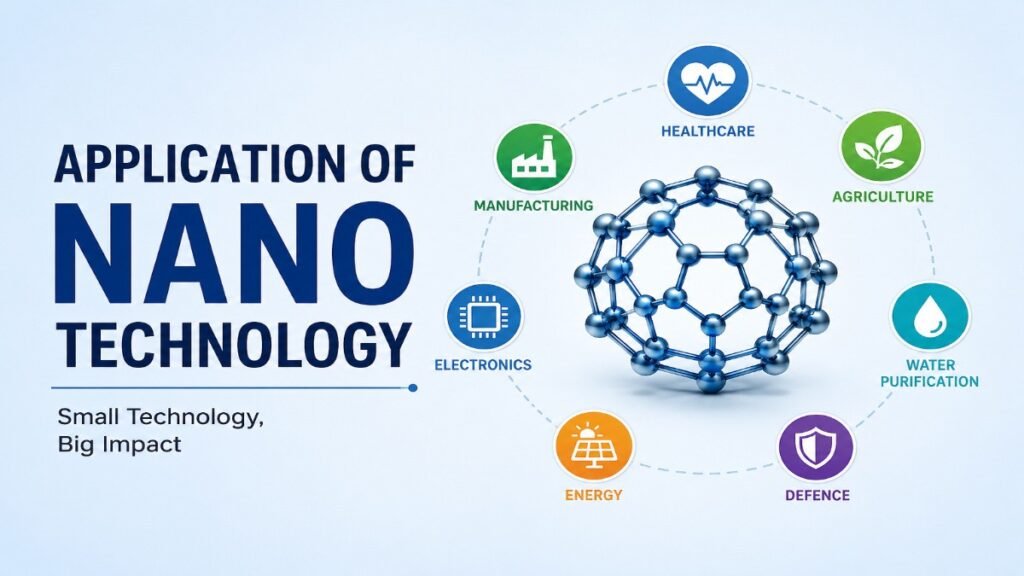
The Application of Nano Technology has emerged as one of the most important enabling technologies of the 21st century because it supports innovation in diverse fields such as healthcare, agriculture, energy, electronics, water purification, defence, manufacturing and environmental protection. By manipulating matter at the atomic and molecular level, nanotechnology enables the development of products that are lighter, stronger, smarter and more efficient than conventional materials.
The use of Nano Technology is playing an increasingly important role in promoting Atmanirbhar Bharat, improving industrial competitiveness and addressing key developmental challenges through cost-effective and sustainable solutions. In India, government initiatives such as the Nano Science and Technology Mission (NSTM) and growing investments in research and innovation are accelerating the adoption of nanotechnology across strategic sectors.
As emerging technologies such as Artificial Intelligence (AI), Internet of Things (IoT), biotechnology, quantum computing and advanced manufacturing continue to evolve, the Application of Nano Technology is becoming a foundational technology that supports the Fourth Industrial Revolution (Industry 4.0) and the transition towards a knowledge-based economy.
These Nano Technology Notes provide a comprehensive understanding of the concept, characteristics and significance of nanotechnology, making the topic highly relevant for Nano Technology for BPSC, BPSC Mains and other competitive examinations.
Master Science & Technology. Maximize Your BPSC Mains Score.
Enroll in the BPSC Science & Tech Course Today
Master Science & Technology for BPSC Mains GS Paper-2 with 75+ exam-oriented topics, 6 structured lessons, and downloadable PDF notes—all in one course.
✔ 75+ Exam-Oriented Topics • ✔ 6 Comprehensive Lessons • ✔ Downloadable PDF Notes • ✔ Updated for 72nd BPSC Mains
2. Key Features of Nanotechnology
Manipulation at the Nanoscale
The Application of Nano Technology involves designing and controlling materials at an extremely small scale of 1–100 nanometres, where they exhibit unique physical, chemical and biological properties that are not observed in their bulk form. At this scale, even minor changes in particle size can significantly alter the behaviour and performance of materials.
Enhanced Material Properties
Nanomaterials possess greater strength, higher electrical and thermal conductivity, improved chemical reactivity, enhanced optical properties and better durability compared to conventional materials. These unique characteristics enable the use of Nano Technology in developing high-performance products for industries such as healthcare, electronics, energy and manufacturing.
Multi-sectoral Applications
One of the defining features of the Application of Nano Technology is its broad applicability across multiple sectors. It has transformative applications in healthcare, agriculture, energy, electronics, defence, environmental protection, water purification, construction, textiles, food processing, manufacturing and space research, making it a truly interdisciplinary technology.
Improves Efficiency and Sustainability
The Application of Nano Technology enables the development of products that are lighter, stronger, more energy-efficient and environmentally friendly. Nano-based materials reduce resource consumption, improve energy efficiency, minimise waste generation and lower greenhouse gas emissions, thereby supporting sustainable development and India’s commitment towards Net Zero emissions by 2070.
Foundation of Future Technologies
Nanotechnology serves as an enabling technology for several emerging fields, including Artificial Intelligence (AI), Biotechnology, Internet of Things (IoT), Quantum Computing, Robotics and Advanced Materials. Its ability to enhance material performance makes it indispensable for next-generation technological innovations.
The unique features of nanotechnology make it one of the most transformative technologies of the modern era. By enabling innovations across diverse sectors, the Application of Nano Technology is strengthening industrial competitiveness, promoting sustainable development and accelerating scientific progress. These Nano Technology Notes are highly relevant for Nano Technology for BPSC, BPSC Mains and other competitive examinations.
Experience the Quality Before You Enroll
Download Free Sample Notes (PDF)
Download a free sample of our BPSC Mains Science & Technology Notes and experience the structured, exam-oriented content before enrolling. Explore the presentation, answer-writing approach, and overall quality of the complete course.
✔ Free Download • ✔ Exam-Oriented Notes • ✔ Updated Content • ✔ Structured for BPSC Mains
3. Applications of Nanotechnology
Healthcare and Medicine
The Application of Nano Technology has revolutionised healthcare by enabling targeted drug delivery, early disease diagnosis, regenerative medicine, medical imaging and advanced medical implants. Nanoparticles can deliver medicines directly to diseased cells, particularly cancer cells, thereby improving treatment effectiveness while minimising damage to healthy tissues and reducing side effects.
Nanotechnology is also being used in biosensors, wound dressings, antimicrobial coatings and tissue engineering, leading to faster diagnosis and improved patient care. According to the World Health Organization (WHO), cancer accounts for nearly 10 million deaths annually, making nano-based targeted therapies increasingly significant in modern medicine.
Example: The mRNA COVID-19 vaccines developed by Pfizer-BioNTech and Moderna use Lipid Nanoparticles (LNPs) to safely deliver genetic material into human cells, demonstrating one of the most successful large-scale applications of Nano Technology in healthcare.
Agriculture
The Application of Nano Technology is promoting precision agriculture by improving the efficiency of fertilisers, pesticides and soil nutrients while reducing input costs and environmental pollution. Nano-fertilisers and nano-pesticides release nutrients in a controlled manner, increasing nutrient-use efficiency, reducing chemical losses and enhancing crop productivity.
Nanotechnology also supports soil health monitoring, plant disease detection and smart delivery of micronutrients, thereby contributing to sustainable agriculture and food security. Since agriculture supports the livelihood of over 45% of India’s workforce, the use of Nano Technology can significantly improve farm productivity and farmers’ income.
Example: IFFCO Nano Urea, launched in 2021, is the world’s first commercially available liquid nano urea. According to IFFCO, a 500 ml bottle of Nano Urea can effectively replace one conventional 45 kg bag of urea, reducing fertiliser consumption, transportation costs and environmental pollution while improving nutrient-use efficiency.
Water Purification and Wastewater Treatment
The Application of Nano Technology is playing a vital role in ensuring safe drinking water and sustainable water management. Nanomaterials such as carbon nanotubes, nano-membranes and metal oxide nanoparticles can efficiently remove arsenic, fluoride, heavy metals, bacteria, viruses and other toxic pollutants from contaminated water.
These technologies provide faster filtration, higher purification efficiency and lower energy consumption than conventional methods. Nanotechnology is particularly significant for India, where many regions face challenges related to groundwater contamination and water scarcity. It also supports the treatment and recycling of industrial wastewater, contributing to the objectives of the Jal Jeevan Mission and Sustainable Development Goal (SDG) 6 – Clean Water and Sanitation.
Example: TERI (The Energy and Resources Institute) has developed nanotechnology-based water purification systems capable of removing arsenic, fluoride and microbial contaminants, providing safe drinking water to rural and remote communities.
Energy Sector
The Application of Nano Technology is transforming the energy sector by improving the efficiency, storage, generation and conservation of energy. Nanomaterials are used in high-efficiency solar cells, lithium-ion batteries, fuel cells, hydrogen production and supercapacitors, enabling better energy conversion and longer battery life. They also improve the performance of Electric Vehicles (EVs) by reducing charging time and increasing energy density.
As India aims to achieve Net Zero emissions by 2070 and expand renewable energy capacity, the use of Nano Technology is becoming an important enabler of clean and sustainable energy solutions.
Example: Silicon nanomaterials are increasingly used in the anodes of next-generation lithium-ion batteries, significantly increasing battery capacity and reducing charging time for Electric Vehicles (EVs) and renewable energy storage systems.
Manufacturing and Industrial Development
The Application of Nano Technology is significantly enhancing manufacturing efficiency, product quality and industrial competitiveness by enabling the development of lightweight, stronger, corrosion-resistant and wear-resistant materials. Nanomaterials improve the durability and performance of automobiles, aircraft, machinery, electronics and consumer goods while reducing maintenance costs and energy consumption.
Nano-coatings protect industrial equipment from corrosion, heat and abrasion, thereby extending their service life. As India promotes Industry 4.0, Make in India and Atmanirbhar Bharat, the use of Nano Technology is emerging as a key driver of advanced manufacturing.
Example: Nano-coated cutting tools are widely used in the automobile and aerospace industries. These coatings increase tool life, improve machining precision and reduce production costs by minimising wear and friction.
The Application of Nano Technology is transforming sectors such as healthcare, agriculture, water management, energy and manufacturing by providing innovative, efficient and sustainable solutions. As research and commercial adoption continue to expand, the use of Nano Technology will play a crucial role in strengthening India’s technological capabilities and achieving sustainable development. These Nano Technology Notes are highly relevant for Nano Technology for BPSC, BPSC Mains and other competitive examinations.
Electronics and Semiconductor Industry
The Application of Nano Technology has enabled the miniaturisation of electronic devices, making them smaller, faster, more energy-efficient and highly powerful. It is extensively used in the production of advanced semiconductor chips, nanoelectronics, flexible displays, sensors, memory devices and high-performance processors. The technology has become indispensable for emerging fields such as Artificial Intelligence (AI), 5G communication, Internet of Things (IoT) and Quantum Computing.
With the launch of the India Semiconductor Mission, the use of Nano Technology will play a crucial role in strengthening India’s semiconductor manufacturing ecosystem and reducing dependence on imported chips.
Example: TSMC (Taiwan Semiconductor Manufacturing Company) manufactures 3-nanometre (3 nm) semiconductor chips, one of the world’s most advanced chip technologies, using nanotechnology. These chips power high-end smartphones, AI processors and next-generation computing devices.
Environmental Protection
The Application of Nano Technology is playing a crucial role in addressing environmental challenges through air pollution control, wastewater treatment, soil remediation, oil spill cleanup and environmental monitoring. Nanomaterials possess a large surface area and high adsorption capacity, enabling them to efficiently remove toxic pollutants such as heavy metals, industrial chemicals, pesticides and greenhouse gases.
They are also used in advanced air filters and pollution sensors to continuously monitor environmental quality. By improving resource efficiency and reducing pollution, the use of Nano Technology supports India’s Net Zero target by 2070 and the achievement of the Sustainable Development Goals (SDGs).
Example: Nano-adsorbents containing iron oxide nanoparticles are widely used to remove arsenic and other heavy metals from contaminated groundwater, providing a cost-effective solution for safe drinking water in arsenic-affected regions.
Defence and Internal Security
The Application of Nano Technology has become a strategic technology for enhancing national security, soldier protection, surveillance and defence equipment. It is used to develop lightweight bulletproof jackets, advanced body armour, stealth coatings, high-performance explosives, chemical and biological sensors and military drones.
The use of Nano Technology improves the strength, durability and mobility of defence equipment while reducing its weight, thereby increasing the operational effectiveness of security forces. It also supports India’s goal of defence indigenisation under Atmanirbhar Bharat.
Example: DRDO has developed nanotechnology-based lightweight bulletproof jackets using advanced nanocomposite materials. These jackets provide enhanced ballistic protection while significantly reducing weight, improving the mobility and safety of Indian soldiers.
Food Industry
The Application of Nano Technology is improving food safety, food processing, packaging and storage, thereby reducing food losses and enhancing nutritional quality. Nanomaterials are used to develop smart food packaging that can detect spoilage, microbial contamination and changes in temperature or humidity.
Nano-encapsulation technology improves the delivery and absorption of vitamins, minerals and other nutrients, resulting in the development of functional and fortified foods. This is particularly important for India, where post-harvest losses account for around 5–16% of agricultural production, making improved food preservation essential for ensuring food security.
Example: Silver nanoparticle-based antimicrobial food packaging inhibits the growth of bacteria and fungi, thereby extending the shelf life of perishable food items such as milk, meat, fruits and vegetables.
Textile Industry
The Application of Nano Technology has transformed the textile industry by enabling the production of antibacterial, stain-resistant, water-repellent, wrinkle-free, self-cleaning and UV-protective fabrics. Nanoparticles improve fabric durability without affecting comfort or breathability, making textiles more functional and suitable for healthcare, defence, sports and industrial applications.
The technology has also created opportunities for smart textiles capable of monitoring body temperature, heart rate and other health parameters through embedded nanosensors.
Example: Silver nanoparticle-coated textiles are extensively used in hospital bedsheets, surgical gowns, face masks and healthcare uniforms because of their strong antimicrobial properties, which help reduce hospital-acquired infections.
The Application of Nano Technology is rapidly expanding into advanced sectors such as electronics, environmental protection, defence, food processing and textiles. The growing use of Nano Technology is improving efficiency, sustainability and innovation while strengthening India’s technological capabilities. These Nano Technology Notes are highly relevant for Nano Technology for BPSC, BPSC Mains and other competitive examinations.
Construction and Infrastructure
The Application of Nano Technology is transforming the construction sector by improving the strength, durability, sustainability and lifespan of buildings and infrastructure. Nanomaterials such as nano-silica, titanium dioxide (TiO₂) and carbon nanotubes are used to produce stronger concrete, corrosion-resistant steel, self-cleaning surfaces and energy-efficient buildings. These materials reduce maintenance costs, improve resistance to cracks and weathering, and enhance the structural performance of bridges, roads, tunnels and high-rise buildings.
Nanotechnology also supports green construction by lowering cement consumption and reducing carbon emissions, making infrastructure more sustainable.
Example: Nano-silica is increasingly used in high-performance concrete for bridges, highways and metro projects to enhance compressive strength, reduce permeability and increase the service life of infrastructure.
Space Research
The Application of Nano Technology has become an essential component of modern space missions by enabling the development of lightweight spacecraft, high-performance satellites, advanced sensors, thermal protection systems and radiation-resistant materials. Since every kilogram launched into space significantly increases mission costs, nanomaterials help reduce spacecraft weight while improving strength, durability and fuel efficiency.
Nanotechnology also enhances the performance of satellite electronics, solar panels and communication systems, making space missions more reliable and cost-effective. The use of Nano Technology is increasingly supporting India’s ambitions in space exploration through advanced materials and miniaturised components.
Example: ISRO uses carbon nanocomposites and other advanced nanomaterials in satellites and launch vehicles to develop lightweight structural components with high strength and thermal resistance, improving payload capacity and mission efficiency.
Prepare Smarter. Study Better. Ace BPSC Mains.
BPSC Mains GS Paper 1 & 2 Complete Course
Access comprehensive BPSC Mains Notes for GS Paper 1 & 2, covering 378+ topics across 24 PDF lessons, with dedicated Bihar coverage, practice questions and downloadable study material.
✓ GS Paper 1 & 2 • ✓ 378+ Topics • ✓ 24 PDF Lessons • ✓ Bihar-Specific Coverage • ✓ Downloadable Notes
4. Government Initiatives for Nanotechnology in India
Nano Science and Technology Mission (NSTM), 2007
- Launched by the Department of Science and Technology (DST) with an outlay of ₹1,000 crore to promote research, human resource development, infrastructure creation and commercialisation of nanotechnology.
- It has significantly strengthened India’s nanotechnology research ecosystem and accelerated the Application of Nano Technology across strategic sectors.
Mission on Nano Science and Technology (DST)
- Implemented through premier institutions such as IITs, IISc, CSIR laboratories and Central Universities.
- Supports advanced research in nanomaterials for applications in healthcare, agriculture, energy, water purification and electronics, promoting the use of Nano Technology for national development.
National Centre for Nanoscience and Nanotechnology (NCNN), IIT Bombay
- One of India’s premier nanotechnology research centres.
- Engaged in developing nanomaterials and devices for biomedical applications, clean energy, sensors and environmental protection.
- Also supports industry collaboration and start-up innovation in nanotechnology.
Nano-based Agricultural Initiatives
- The Government has promoted the Application of Nano Technology in agriculture through nano-fertilisers and nano-agrochemicals to improve nutrient-use efficiency and reduce excessive chemical fertiliser consumption.
- IFFCO Nano Urea, approved by the Government of India, has emerged as a major step towards sustainable agriculture and balanced fertiliser use.
National Quantum Mission (NQM), 2023
- Although primarily focused on quantum technologies, the mission promotes nanofabrication facilities and advanced materials research, which are essential for the development of quantum devices, nanoelectronics and next-generation semiconductors.
Government initiatives have played a significant role in strengthening the Application of Nano Technology by promoting research, innovation, infrastructure and commercialisation. Continued policy support and investment will further accelerate the use of Nano Technology and strengthen India’s position as a global hub for advanced materials and emerging technologies. These Nano Technology Notes are highly relevant for Nano Technology for BPSC, BPSC Mains and other competitive examinations.
5. Challenges Associated with Nanotechnology
High Cost of Research and Commercialisation
- The Application of Nano Technology requires sophisticated laboratories, advanced fabrication facilities, expensive equipment and highly skilled researchers.
- The high cost of research, product development and commercialisation makes it difficult for start-ups and Micro, Small and Medium Enterprises (MSMEs) to adopt nanotechnology on a large scale.
- This remains a major constraint in expanding the use of Nano Technology across industries.
Health and Environmental Risks
- The long-term effects of nanoparticles on human health and the environment are not yet fully understood.
- Due to their extremely small size, nanoparticles can enter living cells, tissues and ecosystems, raising concerns regarding toxicity, bioaccumulation and potential long-term ecological impacts.
- Therefore, extensive safety assessments are essential before large-scale commercial applications.
Lack of a Comprehensive Regulatory Framework
- India, like many other countries, still lacks a comprehensive regulatory framework governing the production, use, labelling, disposal and risk assessment of nanomaterials.
- The absence of uniform standards creates concerns regarding consumer safety, worker protection and environmental sustainability.
Limited Commercialisation and Industry Adoption
- Despite significant scientific research, the commercial adoption of nanotechnology remains relatively limited.
- Weak industry–academia collaboration, inadequate funding and challenges in technology transfer often prevent laboratory innovations from reaching the market.
- Expanding the Application of Nano Technology requires stronger collaboration between research institutions and industries.
Import Dependence and Skill Gap
- India continues to depend on imported high-end nanomaterials, fabrication equipment and characterisation tools.
- In addition, there is a shortage of trained professionals with expertise in nanoscience, nanomanufacturing and advanced material engineering.
- Strengthening indigenous capabilities is essential for promoting the use of Nano Technology under Atmanirbhar Bharat.
6. Way Forward
- Strengthen Research and Innovation: Increase investment in nanotechnology research through DST, CSIR, IITs, IISc and start-ups to develop indigenous technologies and expand the Application of Nano Technology.
- Promote Commercialisation: Foster stronger industry–academia collaboration to accelerate the conversion of laboratory research into market-ready products and encourage wider industrial adoption.
- Develop a Robust Regulatory Framework: Establish comprehensive guidelines for the safe production, use, disposal and risk assessment of nanomaterials to protect human health and the environment.
- Enhance Skill Development: Expand specialised training programmes in nanotechnology through universities, research institutions and skill development missions to create a future-ready workforce.
- Promote Indigenous Manufacturing: Encourage the use of Nano Technology under Atmanirbhar Bharat and Make in India to reduce import dependence, strengthen domestic manufacturing and enhance India’s global competitiveness.
7. Conclusion
The Application of Nano Technology has emerged as one of the most transformative technological advancements of the 21st century, with applications spanning healthcare, agriculture, energy, electronics, manufacturing, defence, environmental protection, construction and space research.
By enabling innovative, efficient and sustainable solutions, the use of Nano Technology has the potential to accelerate Atmanirbhar Bharat, strengthen industrial competitiveness, improve public health and address critical developmental challenges.
However, realising the full potential of the Application of Nano Technology requires sustained investment in research, indigenous innovation, robust regulatory mechanisms, skilled human resources and responsible adoption. With continued policy support and technological advancement, nanotechnology can become a key driver of Viksit Bharat 2047, sustainable economic growth and global technological leadership. These Nano Technology Notes provide a comprehensive understanding of the concept, applications, challenges and future prospects of nanotechnology, making them highly relevant for Nano Technology for BPSC, BPSC Mains and other competitive examinations.
Learn More from the Department of Science and Technology (DST):
Readers interested in the Application of Nano Technology, government initiatives, the Nano Science and Technology Mission (NSTM), nanotechnology research and innovation in India can visit the official website of the Department of Science and Technology (DST), Government of India.
BPSC Mains Practice Questions
Q1. “Nanotechnology is emerging as a transformative technology with applications across multiple sectors.” Discuss the Application of Nano Technology in healthcare, agriculture, energy, manufacturing and environmental protection.
Q2. Examine the major government initiatives promoting the Application of Nano Technology in India. Discuss the role of the Nano Science and Technology Mission (NSTM) and other initiatives in strengthening research, innovation and industrial development.
Q3. Analyse the major challenges associated with the wider use of Nano Technology in India. Suggest suitable measures to promote safe, sustainable and indigenous development of nanotechnology.