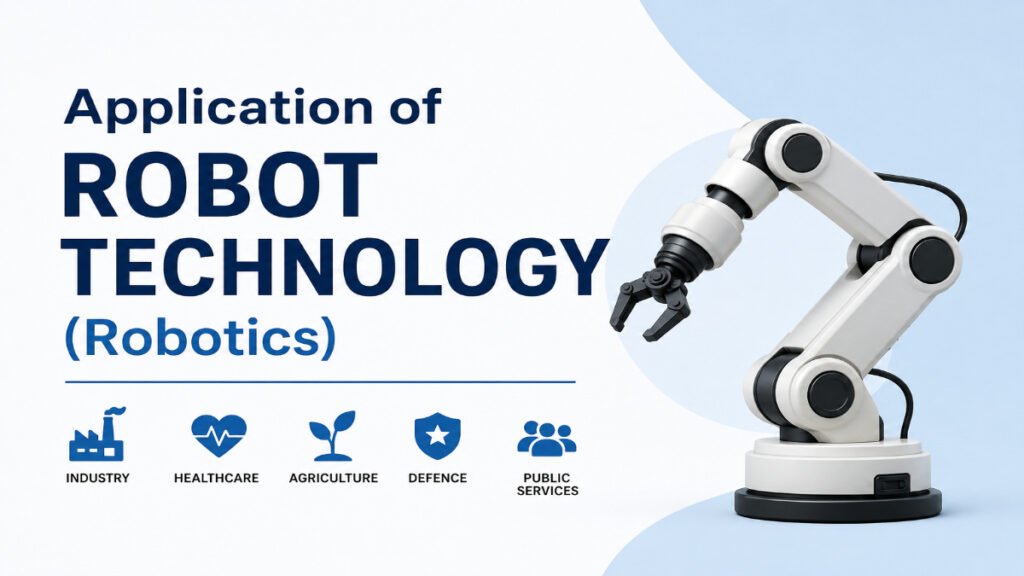
1. Robot Technology (Robotics): Meaning / Definition
Robot Technology (Robotics) is a branch of science and engineering that deals with the design, development, programming, operation and application of robots to perform tasks either autonomously or with human assistance. A robot is a programmable machine capable of sensing its surroundings, processing information and carrying out physical actions with precision and consistency.
The Application of Robot Technology integrates multiple disciplines, including mechanical engineering, electronics, computer science, Artificial Intelligence (AI) and sensor technology, to create intelligent machines that can assist, augment or replace human effort in repetitive, hazardous or high-precision tasks.
In the era of the Fourth Industrial Revolution (Industry 4.0), the use of Robot Technology has expanded far beyond manufacturing to sectors such as healthcare, agriculture, defence, logistics, disaster management, space exploration and public services. Robots improve productivity, accuracy, safety and operational efficiency while reducing human exposure to dangerous environments.
India’s Robotics ecosystem is gradually expanding through government initiatives such as the National Mission on Interdisciplinary Cyber-Physical Systems (NM-ICPS), growing start-up innovation and increasing industrial automation. According to the World Robotics Report 2022, India ranked 10th globally in annual industrial robot installations, reflecting the country’s growing adoption of robotic technologies while highlighting the need for greater indigenous research, skilled manpower and affordable robotic solutions.
As emerging technologies such as Artificial Intelligence (AI), Internet of Things (IoT), Machine Learning (ML), 5G and Cloud Computing continue to evolve, the Application of Robot Technology is becoming a key driver of digital transformation, smart manufacturing and economic growth. It is expected to play a crucial role in achieving the objectives of Make in India, Atmanirbhar Bharat and Viksit Bharat 2047.
These Nano Technology Notes provide a comprehensive understanding of the concept, working and significance of Robotics, making the topic highly relevant for Robotics for BPSC, BPSC Mains and other competitive examinations.
Master Science & Technology. Maximize Your BPSC Mains Score.
Enroll in the BPSC Science & Tech Course Today
Master Science & Technology for BPSC Mains GS Paper-2 with 75+ exam-oriented topics, 6 structured lessons, and downloadable PDF notes—all in one course.
✔ 75+ Exam-Oriented Topics • ✔ 6 Comprehensive Lessons • ✔ Downloadable PDF Notes • ✔ Updated for 72nd BPSC Mains
2. Laws of Robotics
The Three Laws of Robotics were proposed by science fiction writer Isaac Asimov in 1942 as an ethical framework to govern the behaviour of intelligent robots and ensure safe human-robot interaction. Although these laws are fictional and not legally binding, they have significantly influenced discussions on Artificial Intelligence (AI), Robotics, autonomous systems and the responsible Application of Robot Technology.
First Law
A robot must not harm a human being or, through inaction, allow a human being to come to harm. his law gives the highest priority to human safety and serves as the ethical foundation for the use of Robot Technology, especially in sectors such as healthcare, defence and public services.
Second Law
A robot must obey the orders given by human beings except where such orders would conflict with the First Law. This law ensures that robots function under human control while preventing them from carrying out commands that could endanger human life.
Third Law
A robot must protect its own existence as long as such protection does not conflict with the First or Second Law. This law enables robots to preserve their operational capability, provided that doing so does not compromise human safety or violate legitimate human instructions.
Although Asimov’s Three Laws are fictional, they continue to influence global debates on AI ethics, autonomous robots, responsible innovation and the regulation of intelligent machines. As the Application of Robot Technology expands across healthcare, defence, manufacturing and public administration, these ethical principles remain relevant in shaping discussions on the safe and responsible development of Robotics.
Prepare Smarter. Study Better. Ace BPSC Mains.
BPSC Mains GS Paper 1 & 2 Complete Course
Access comprehensive BPSC Mains Notes for GS Paper 1 & 2, covering 378+ topics across 24 PDF lessons, with dedicated Bihar coverage, practice questions and downloadable study material.
✓ GS Paper 1 & 2 • ✓ 378+ Topics • ✓ 24 PDF Lessons • ✓ Bihar-Specific Coverage • ✓ Downloadable Notes
3. Government Initiatives for Robotics in India
National Mission on Interdisciplinary Cyber-Physical Systems (NM-ICPS)
- Launched in 2018, NM-ICPS promotes research and innovation in emerging technologies such as Robotics, Artificial Intelligence (AI), Internet of Things (IoT) and autonomous systems.
- It aims to strengthen India’s technological capabilities and accelerate the Application of Robot Technology across strategic sectors.
ARTPARK (AI & Robotics Technology Park), Bengaluru
- Established under NM-ICPS at IISc Bengaluru.
- Develops AI and Robotics solutions for sectors such as healthcare, agriculture, mobility and smart cities, while supporting innovation and start-ups.
National Strategy for Robotics (Draft)
- Aims to make India a global leader in Robotics by 2030.
- Focuses on indigenous manufacturing, innovation, start-up ecosystem and the development of a skilled workforce to promote the use of Robot Technology.
ISRO’s Vyommitra
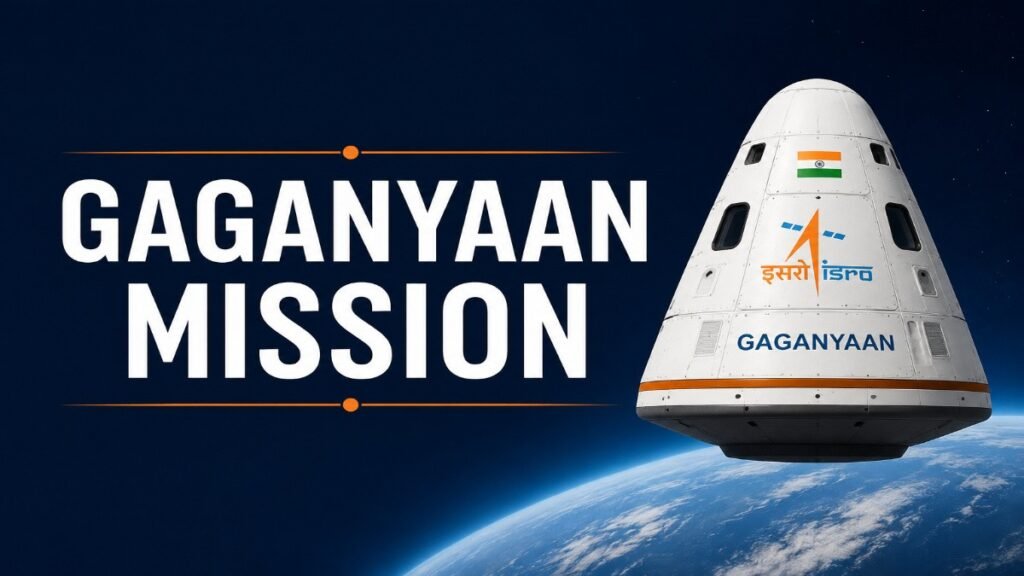
- Vyommitra is a humanoid robot developed by ISRO for the Gaganyaan Mission.
- It is designed to simulate human functions, monitor spacecraft systems and support future human spaceflight missions.
FutureSkills Prime
- A MeitY initiative that provides industry-relevant training in emerging technologies, including Robotics, Artificial Intelligence (AI), Cybersecurity and Blockchain.
- It aims to build a future-ready workforce capable of supporting Industry 4.0.
Atal Innovation Mission (AIM)
- Through Atal Tinkering Labs (ATLs), students receive hands-on exposure to Robotics, coding, Artificial Intelligence (AI) and other emerging technologies.
- The initiative promotes innovation and scientific temper from the school level.
Government initiatives are creating a strong foundation for the Application of Robot Technology in India by promoting research, innovation, skill development and indigenous manufacturing. These programmes are expected to strengthen India’s Robotics ecosystem and contribute significantly to Atmanirbhar Bharat, Industry 4.0 and Viksit Bharat 2047. These notes are highly relevant for Robotics for BPSC, BPSC Mains and other competitive examinations.
Experience the Quality Before You Enroll
Download Free Sample Notes (PDF)
Download a free sample of our BPSC Mains Science & Technology Notes and experience the structured, exam-oriented content before enrolling. Explore the presentation, answer-writing approach, and overall quality of the complete course.
✔ Free Download • ✔ Exam-Oriented Notes • ✔ Updated Content • ✔ Structured for BPSC Mains
4. Applications of Robotics
Manufacturing and Industrial Automation
The Application of Robot Technology has transformed manufacturing by enabling industrial automation across production processes. Industrial robots are widely used for welding, painting, assembly, machine tending, quality inspection, packaging and material handling, allowing industries to operate with greater speed, precision and consistency.
Unlike manual labour, robots can work continuously with minimal errors, thereby improving productivity, reducing wastage, lowering production costs and ensuring workplace safety by undertaking hazardous tasks. The use of Robot Technology has become a key component of Industry 4.0, where robots work alongside Artificial Intelligence (AI), Internet of Things (IoT) and automation to create smart factories.
Example: Maruti Suzuki, Tata Motors and Mahindra & Mahindra use robotic arms in their automobile manufacturing plants for welding, painting and assembling vehicle components, resulting in improved efficiency and product quality.
Healthcare
The Application of Robot Technology is revolutionising healthcare by improving the precision, safety and efficiency of medical procedures. Robot-assisted surgery enables doctors to perform minimally invasive operations with greater accuracy, reducing blood loss, post-operative pain and recovery time.
Robotics is also used in rehabilitation through robotic exoskeletons, telemedicine, hospital automation and patient care, particularly for elderly and differently-abled individuals. During infectious disease outbreaks, robots help minimise direct contact between healthcare workers and patients.
Example: The Da Vinci Surgical System is widely used across the world, including in leading Indian hospitals such as AIIMS, Apollo Hospitals and Medanta, for performing complex minimally invasive surgeries with high precision.
Agriculture
The Application of Robot Technology is promoting precision agriculture by automating labour-intensive farming activities such as sowing, transplanting, spraying pesticides, harvesting, weeding and crop monitoring.
Equipped with sensors, cameras and Artificial Intelligence (AI), agricultural robots can identify diseased plants, apply fertilisers only where needed and optimise the use of water and pesticides. This increases crop productivity, reduces input costs, addresses labour shortages and promotes environmentally sustainable farming.
Example: TartanSense, an Indian agritech start-up, has developed AI-powered precision spraying robots that selectively spray pesticides only on infected plants, reducing chemical usage while improving crop yields.
Defence and Internal Security
The Application of Robot Technology plays a crucial role in strengthening national security by undertaking dangerous missions that would otherwise expose security personnel to significant risks. Robots are deployed for bomb detection and disposal, surveillance, border patrolling, reconnaissance, mine detection and counter-terrorism operations.
Unmanned Ground Vehicles (UGVs) and robotic systems improve operational efficiency while reducing casualties in hostile and inaccessible environments.
Example: DAKSHA, developed by DRDO, is an advanced bomb disposal robot capable of detecting, handling and neutralising Improvised Explosive Devices (IEDs). It is extensively used by the Indian Armed Forces and security agencies.
Space Exploration
The Application of Robot Technology is indispensable for space missions because it enables exploration of environments that are inaccessible or extremely dangerous for humans. Space robots are used for planetary exploration, satellite servicing, scientific experiments, sample collection and astronaut assistance.
They can function in extreme temperatures, radiation and low-gravity conditions, significantly reducing mission risks and costs while expanding scientific knowledge.
Example: Vyommitra, developed by ISRO, is India’s first space-faring humanoid robot designed for the Gaganyaan Mission. It will simulate human functions, monitor spacecraft conditions and support astronauts during future human spaceflight missions.
The Application of Robot Technology is transforming manufacturing, healthcare, agriculture, defence and space exploration by improving efficiency, precision and safety. As Robotics continues to evolve with advances in Artificial Intelligence (AI) and automation, its adoption is expected to accelerate India’s technological progress and strengthen Industry 4.0. These notes are highly relevant for Robotics for BPSC, BPSC Mains and other competitive examinations.
Disaster Management
The Application of Robot Technology has become an important tool in disaster preparedness, search and rescue, firefighting and emergency response. Robots can operate in hazardous environments such as collapsed buildings, earthquake-hit areas, flooded regions, mines and chemical or nuclear accident sites, where human intervention is difficult or life-threatening.
Equipped with cameras, sensors, thermal imaging systems and communication devices, robots help locate survivors, assess structural damage, deliver emergency supplies and support rescue teams, thereby improving the speed and effectiveness of disaster response.
Example: During the 2023 Turkey–Syria earthquake, snake robots and other rescue robots were deployed to search for survivors trapped beneath collapsed buildings, enabling rescue teams to access narrow spaces that were inaccessible to humans.
Logistics and Warehousing
The Application of Robot Technology has transformed the logistics sector by automating inventory management, sorting, packaging, loading, unloading and transportation of goods. Autonomous Mobile Robots (AMRs) and robotic arms improve operational efficiency by reducing human errors, accelerating order processing and ensuring faster deliveries.
With the rapid growth of e-commerce and digital supply chains, warehouse automation has become essential for handling large volumes of goods while lowering operational costs.
Example: Amazon operates more than 7.5 lakh warehouse robots globally to move inventory, assist workers in order fulfilment and optimise warehouse operations, significantly reducing delivery time.
Education and Research
The Application of Robot Technology has emerged as an effective tool for promoting STEM (Science, Technology, Engineering and Mathematics) education, innovation and research. Educational robots provide hands-on learning experiences that enhance students’ problem-solving, programming and critical thinking skills.
Robotics laboratories in schools and universities encourage innovation and prepare students for emerging technologies such as Artificial Intelligence (AI), Internet of Things (IoT) and automation.
Example: e-Yantra, an initiative of IIT Bombay funded by the Ministry of Education, promotes Robotics education by establishing robotics laboratories, conducting competitions and training engineering students across India.
Smart Cities and Public Services
The Application of Robot Technology is playing a growing role in improving urban governance and public service delivery. Robots are increasingly being used for sewer cleaning, waste collection, public surveillance, infrastructure inspection, traffic monitoring and citizen assistance, thereby enhancing efficiency, safety and service quality.
By undertaking hazardous and repetitive tasks, the use of Robot Technology also helps reduce occupational risks for sanitation workers and contributes to the objectives of the Smart Cities Mission.
Example: Bandicoot, developed by the Indian start-up Genrobotics, is a robotic scavenger deployed in several Indian cities to clean sewer lines and manholes, helping eliminate the practice of manual scavenging while improving worker safety.
Environmental Protection
The Application of Robot Technology contributes significantly to environmental conservation through waste management, pollution monitoring, ocean cleaning, wildlife conservation and environmental data collection. Autonomous robots can continuously monitor ecosystems, detect pollution levels, remove waste from water bodies and collect scientific data from remote or hazardous environments.
The use of Robot Technology supports sustainable development by improving the efficiency of environmental monitoring and conservation programmes.
Example: WasteShark, an autonomous aquatic robot, collects floating plastic waste, algae and other pollutants from rivers, lakes and ports, helping reduce water pollution and protect aquatic ecosystems.
The Application of Robot Technology is rapidly expanding beyond industrial automation into disaster management, logistics, education, smart cities and environmental protection. The growing adoption of Robotics is improving efficiency, safety and sustainability while supporting India’s digital transformation and Industry 4.0. These notes are highly relevant for Robotics for BPSC, BPSC Mains and other competitive examinations.
5. Challenges Associated with Robotics
High Cost of Adoption
- The Application of Robot Technology requires substantial investment in the installation, maintenance and upgradation of robotic systems.
- The high cost of robots, sensors and automation technologies makes them unaffordable for many MSMEs and small farmers in developing countries like India.
- Example: Many Indian MSMEs continue to rely on manual labour due to the high cost of industrial robots.
Job Displacement and Skill Gap
- The increasing use of Robot Technology to automate repetitive tasks may reduce employment opportunities for low-skilled workers while simultaneously increasing the demand for highly skilled professionals.
- This creates an urgent need for large-scale reskilling and upskilling of the workforce.
- Example: According to Goldman Sachs (2023), AI and automation could affect nearly 300 million jobs globally.
Ethical and Legal Issues
- The widespread Application of Robot Technology raises concerns regarding accountability, decision-making, autonomous weapons and patient safety, particularly in sectors such as defence and healthcare.
- Example: The global debate over Lethal Autonomous Weapon Systems (LAWS) at the United Nations highlights the ethical challenges posed by AI-powered military robots.
Cybersecurity Risks
- Connected Robotics systems are vulnerable to hacking, malware attacks and unauthorised control, which can disrupt critical infrastructure and compromise sensitive data.
- As robots become increasingly connected through Artificial Intelligence (AI), Internet of Things (IoT) and cloud computing, cybersecurity has become a major concern.
- Example: The WannaCry ransomware attack (2017) affected several industrial systems worldwide, demonstrating the cybersecurity risks associated with connected technologies.
Safety Concerns
- Malfunctioning robots or software failures can cause serious accidents, especially in industrial workplaces where humans and robots operate together.
- Establishing robust safety standards is essential for the responsible use of Robot Technology.
- Example: In 2015, a worker at a Volkswagen factory in Germany was killed in an accident involving an industrial robot.
Dependence on Foreign Technology
- India continues to depend significantly on imported robotic components, sensors, controllers and advanced software, increasing costs and strategic dependence.
- Strengthening indigenous manufacturing is essential for expanding the Application of Robot Technology under Atmanirbhar Bharat.
- Example: Most high-end industrial robots used in India are imported from companies such as ABB (Switzerland), FANUC (Japan) and KUKA (Germany).
6. Way Forward
- Promote Indigenous Robotics: Strengthen Make in India and Atmanirbhar Bharat by encouraging domestic manufacturing of robots, sensors and robotic components to reduce import dependence.
- Increase Investment in Research and Development (R&D): Expand funding through institutions such as IITs, IISc, DRDO, ISRO and start-ups to develop affordable and India-specific robotic solutions.
- Develop a Skilled Workforce: Integrate Artificial Intelligence (AI), Robotics, coding and automation into school and higher education curricula while expanding programmes such as FutureSkills Prime to prepare a future-ready workforce.
- Establish a Robust Regulatory Framework: Formulate comprehensive laws and standards governing robot safety, cybersecurity, data privacy, liability and the ethical use of autonomous systems.
- Promote Human–Robot Collaboration: Encourage the adoption of Collaborative Robots (Cobots) that assist workers rather than replace them, ensuring inclusive technological growth and higher productivity.
- Expand Robotics in Public Services: Increase the Application of Robot Technology in healthcare, agriculture, disaster management, sanitation and defence to improve governance, service delivery and public safety.
7. Conclusion
The Application of Robot Technology is emerging as one of the most transformative technologies of the Fourth Industrial Revolution (Industry 4.0). By improving productivity, precision, efficiency and safety, Robotics is reshaping manufacturing, healthcare, agriculture, defence, logistics, public services and everyday life.
For India, the growing use of Robot Technology offers immense opportunities to accelerate Atmanirbhar Bharat, modernise key sectors, strengthen global competitiveness and achieve the vision of Viksit Bharat 2047.
However, the widespread adoption of robotics must be supported by ethical governance, robust cybersecurity, indigenous innovation, skill development and inclusive policies to address concerns related to employment, privacy and safety. With sustained investment in research, domestic manufacturing and human capital, the Application of Robot Technology can become a major driver of India’s technological and economic transformation. These notes are highly relevant for Robotics for BPSC, BPSC Mains and other competitive examinations.
Learn More from the Ministry of Electronics and Information Technology (MeitY):
Readers interested in the Application of Robot Technology, Robotics, Artificial Intelligence, automation, Industry 4.0 and government initiatives can visit the official website of the Ministry of Electronics and Information Technology (MeitY), Government of India. The portal provides authentic information on emerging technologies, digital innovation, research programmes and national initiatives supporting the use of Robot Technology.
BPSC Mains Practice Questions
Q1. “Robotics is a key driver of the Fourth Industrial Revolution (Industry 4.0).” Discuss the Application of Robot Technology in manufacturing, healthcare, agriculture, defence and public service delivery.
Q2. Examine the major government initiatives promoting Robotics in India. Evaluate their role in strengthening indigenous innovation, automation and technological self-reliance under Atmanirbhar Bharat.
Q3. Analyse the major challenges associated with the use of Robot Technology in India, including ethical, legal, cybersecurity and employment concerns. Suggest suitable measures for the responsible and inclusive adoption of Robotics.