1. Introduction
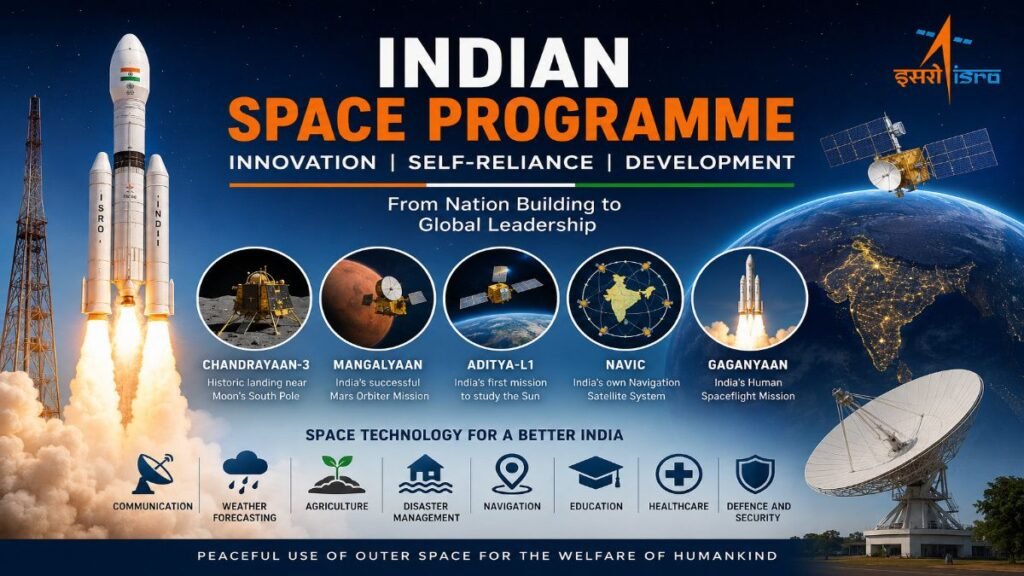
Over the past six decades, India has evolved from launching basic communication and remote sensing satellites to undertaking complex missions in human spaceflight, planetary exploration, advanced Earth observation and space infrastructure. Building on the success of missions such as Chandrayaan-3, Aditya-L1 and SPADEX, the Upcoming Projects of ISRO aim to strengthen India’s scientific capabilities, strategic interests and commercial presence in the global space sector.
These Upcoming Projects of ISRO include human spaceflight (Gaganyaan), Earth observation (NISAR), planetary exploration (Chandrayaan-4, Venus Orbiter Mission and Mars Orbiter Mission-2), space astronomy (AstroSat-2) and the establishment of the Bharatiya Antariksha Station. Collectively, these Upcoming ISRO Missions will enhance India’s technological self-reliance, promote international collaboration and contribute to the vision of Viksit Bharat 2047.
Master Science & Technology. Maximize Your BPSC Mains Score.
Enroll in the BPSC Science & Tech Course Today
Master Science & Technology for BPSC Mains GS Paper-2 with 75+ exam-oriented topics, 6 structured lessons, and downloadable PDF notes—all in one course.
✔ 75+ Exam-Oriented Topics • ✔ 6 Comprehensive Lessons • ✔ Downloadable PDF Notes • ✔ Updated for 72nd BPSC Mains
2. Upcoming Human Spaceflight and Space Infrastructure Missions
India’s human spaceflight programme represents the next major phase of its space journey, moving beyond satellite launches to crewed missions, orbital docking and the establishment of an indigenous space station. These Upcoming Projects of ISRO will strengthen India’s capabilities in human spaceflight, space research and long-duration missions while reducing dependence on foreign space agencies.
Gaganyaan-1 (First Uncrewed Mission)
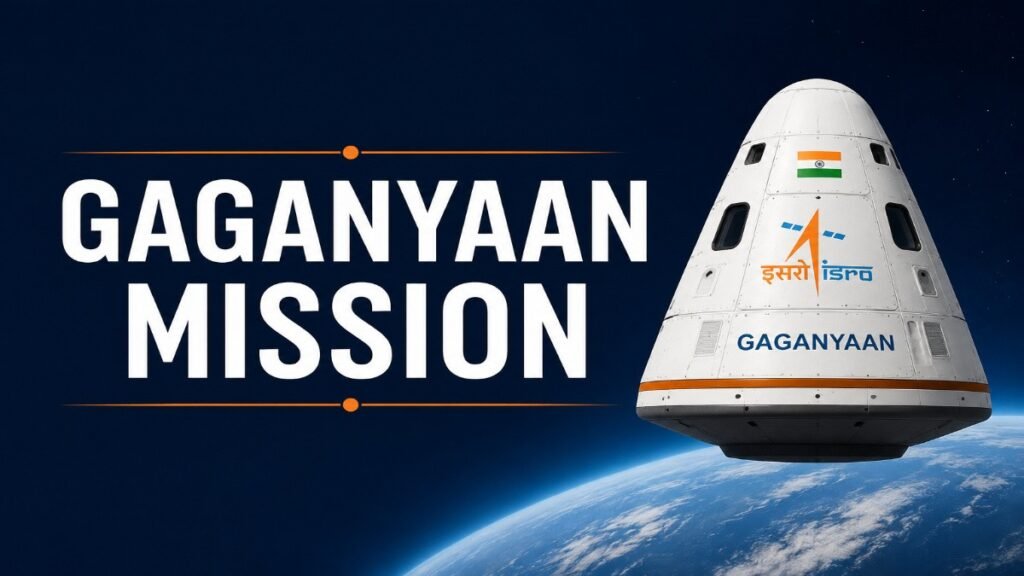
Expected Launch in the year 2026 (following completion of ongoing qualification tests). Gaganyaan-1 (G1) will be the first uncrewed test flight of India’s Human Spaceflight Programme. The mission is a crucial step before sending Indian astronauts into space. The mission will carry the Crew Module, Service Module and the humanoid robot Vyommitra to validate critical technologies such as:
- Human-rated launch vehicle (HLVM3)
- Crew Module performance
- Environmental Control and Life Support System (ECLSS)
- Re-entry and splashdown
- Crew recovery procedures
Gaganyaan-2 (Second Uncrewed Mission)
Expected Launch after the successful completion of Gaganyaan-1 (2026–27). Gaganyaan-2 will be the second uncrewed validation mission. The mission aims to ensure that every critical system performs flawlessly before astronauts are onboard. It will further test the reliability and safety of all crew systems under actual spaceflight conditions, including:
- Life-support systems
- Crew escape system
- Orbital operations
- Mission control and recovery mechanisms
Gaganyaan-3 (First Crewed Mission)
Expected Launch targeted after completion of the two uncrewed missions (currently around 2027, subject to mission readiness). Gaganyaan-3 will be India’s first human spaceflight mission, carrying three Indian astronauts (Gaganyatris) into Low Earth Orbit (LEO) at an altitude of about 400 km for nearly three days, followed by a safe splashdown in the Indian Ocean. The successful completion of this mission will make India the fourth country after the United States, Russia and China to independently develop and execute a human spaceflight mission using indigenous technology.
SPADEX (Space Docking Experiment)
SPADEX Successfully demonstrated in 2025 is India’s first mission to demonstrate orbital rendezvous and autonomous docking between two spacecraft. Docking technology is a prerequisite for advanced space missions because it enables spacecraft to join together while orbiting the Earth. The technology will be essential for:
- Bharatiya Antariksha Station
- In-orbit satellite servicing
- Spacecraft refuelling
- Deep-space exploration missions
- Future lunar missions
With the successful docking demonstration, India became the fourth country after the United States, Russia and China to achieve indigenous space docking capability.
Bharatiya Antariksha Station (BAS)
First Module Targeted for 2028 and Fully Operational target for 2035. The Bharatiya Antariksha Station (BAS) will be India’s first independently operated space station in Low Earth Orbit (LEO). The planned station will consist of five modules and provide a permanent platform for Indian astronauts to conduct long-duration scientific experiments in a microgravity environment. Major objectives include:
- Microgravity research
- Space medicine and life sciences
- Material science experiments
- Robotics and in-orbit technologies
- Preparation for future lunar and interplanetary missions
The station will mark India’s transition from short-duration human missions to continuous human presence in space, significantly strengthening its long-term space exploration programme.
These missions collectively demonstrate India’s emergence as a major human spacefaring nation with indigenous capabilities spanning crewed missions, orbital docking and permanent space infrastructure. The Future Missions of ISRO therefore represent a major expansion of India’s human spaceflight and space infrastructure capabilities.
Prepare Smarter. Study Better. Ace BPSC Mains.
BPSC Mains GS Paper 1 & 2 Complete Course
Access comprehensive BPSC Mains Notes for GS Paper 1 & 2, covering 378+ topics across 24 PDF lessons, with dedicated Bihar coverage, practice questions and downloadable study material.
✓ GS Paper 1 & 2 • ✓ 378+ Topics • ✓ 24 PDF Lessons • ✓ Bihar-Specific Coverage • ✓ Downloadable Notes
3. Upcoming Planetary Exploration and Scientific Missions
Building on the success of Chandrayaan-3, Aditya-L1 and Mangalyaan, ISRO is preparing several advanced scientific and planetary missions to strengthen India’s capabilities in Earth observation, lunar exploration, planetary science and space astronomy. These Upcoming Projects of ISRO will enhance scientific research, international collaboration and technological innovation.
NISAR (NASA–ISRO Synthetic Aperture Radar)
The NASA-ISRO Synthetic Aperture Radar (NISAR) is a joint Earth observation mission developed by NASA and ISRO. It is the world’s first dual-frequency Synthetic Aperture Radar (SAR) satellite, carrying both L-band (NASA) and S-band (ISRO) radars. Its major objectives are:
- Monitoring earthquakes, landslides and volcanic activity.
- Tracking glaciers and polar ice sheets.
- Measuring forest biomass and carbon storage.
- Monitoring agricultural lands and crop health.
- Improving disaster management and climate change studies.
The mission will provide high-resolution global observations every 12 days, making it one of the most advanced Earth observation satellites ever developed.
Chandrayaan-4
Expected Launch in the year 2027, the Chandrayaan-4 will be India’s first lunar sample return mission, aimed at collecting samples from the Moon’s surface and bringing them safely back to Earth for scientific analysis. The mission will consist of four major modules:
- Transfer Module
- Lander Module
- Ascender Module
- Re-entry Module
Successful completion of this mission will place India among the select group of countries capable of returning extraterrestrial samples to Earth, significantly advancing lunar science and technologies required for future human lunar missions.
Venus Orbiter Mission (Shukrayaan-1)
Expected Launch is Planned in the coming years (tentatively 2028). The Venus Orbiter Mission, popularly known as Shukrayaan-1, is India’s first mission to Venus. Understanding why Venus evolved so differently from Earth despite having similar size and composition will provide valuable insights into planetary evolution and climate science.
The spacecraft will study:
- Venusian atmosphere
- Surface geology
- Atmospheric chemistry
- Greenhouse effect and climate evolution
Mars Orbiter Mission-2 (Mangalyaan-2)
Following the success of Mars Orbiter Mission (Mangalyaan-1), ISRO is planning Mangalyaan-2, which is expected to be a more advanced orbiter carrying improved scientific instruments. The mission will further strengthen India’s position among the leading spacefaring nations engaged in Mars exploration. The mission aims to:
- Study the Martian atmosphere and climate.
- Analyse surface mineralogy.
- Investigate the possibility of water-related processes.
- Improve India’s deep-space communication and interplanetary mission capabilities.
LUPEX (Lunar Polar Exploration Mission)
Status: Joint mission of ISRO and JAXA (Japan); under development. LUPEX is a collaborative mission between ISRO and the Japan Aerospace Exploration Agency (JAXA) to explore the Moon’s south polar region, where significant deposits of water ice are believed to exist. The mission will contribute significantly to future lunar resource utilisation and international lunar exploration efforts. The mission aims to:
- Detect and analyse lunar water ice.
- Study the lunar surface and subsurface.
- Demonstrate advanced rover technologies.
- Support future long-duration human presence on the Moon.
AstroSat-2
AstroSat-2 is the successor to India’s first space observatory, AstroSat. It will carry next-generation scientific instruments to study:
- Black holes
- Neutron stars
- Galaxies
- High-energy cosmic events
- Stellar evolution
The mission will strengthen India’s capabilities in astronomy and astrophysics while supporting collaborative research with the global scientific community.
These Upcoming ISRO Missions demonstrate ISRO’s expanding focus beyond Earth-orbiting satellites towards advanced planetary exploration, Earth system science and frontier scientific research, reinforcing India’s growing leadership in global space exploration. The ISRO Upcoming Space Missions will therefore play an important role in expanding India’s scientific and technological capabilities.
4. Conclusion
ISRO’s Upcoming Projects of ISRO reflect India’s transition from a space-capable nation to a leading global space power. By advancing human spaceflight, planetary exploration, Earth observation and space infrastructure, these projects will strengthen scientific research, technological self-reliance, national security and international cooperation. They will also play a vital role in achieving the vision of Atmanirbhar Bharat and Viksit Bharat 2047, while enhancing India’s contribution to the global space economy.
BPSC Mains Practice Question
“India’s Upcoming Projects of ISRO reflect a shift from conventional satellite missions towards human spaceflight, planetary exploration and permanent space infrastructure.” Discuss the major upcoming missions of ISRO and examine their significance for India’s scientific, strategic and economic ambitions.
Learn More About Upcoming Projects of ISRO
For the latest official information on Upcoming Projects of ISRO, including Gaganyaan, Chandrayaan-4, Venus Orbiter Mission and other planned missions, visit the Indian Space Research Organisation (ISRO) official website: ISRO – Upcoming Missions