1. Introduction and Mission Profile
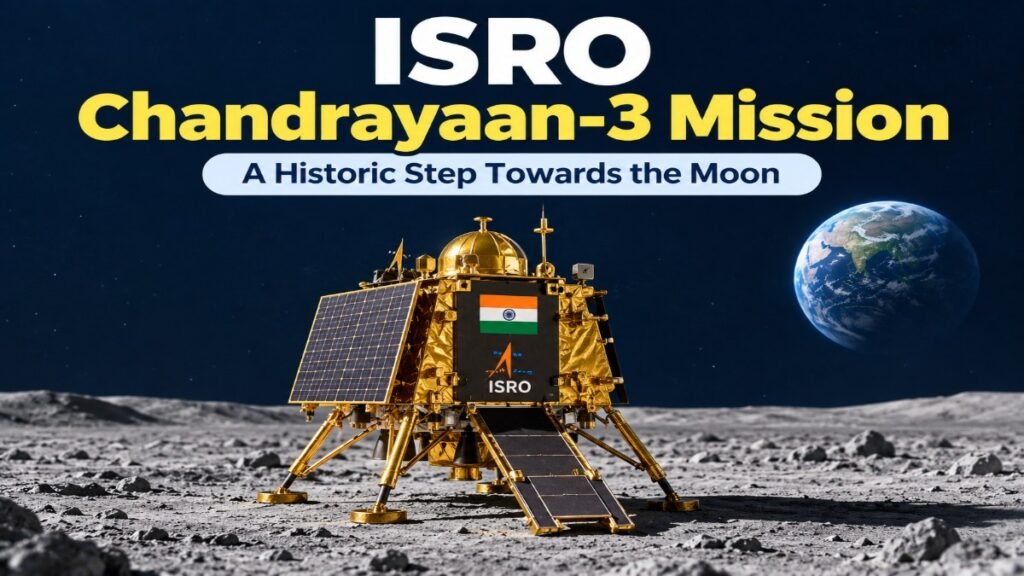
ISRO Chandrayaan-3 is India’s third lunar exploration mission, developed by the Indian Space Research Organisation (ISRO) as a follow-up to Chandrayaan-2. The Chandrayaan-3 Mission was primarily designed to demonstrate India’s capability to achieve a safe and soft landing on the Moon, operate a rover on the lunar surface and conduct scientific experiments. It incorporated several improvements based on the lessons learned from the Chandrayaan-2 mission.
The mission was launched on 14 July 2023 aboard the LVM3-M4 launch vehicle from the Satish Dhawan Space Centre (SDSC), Sriharikota, and successfully achieved a soft landing on 23 August 2023 near the Moon’s South Polar region. The landing site was subsequently named ‘Shiv Shakti Point’ by the Government of India, while 23 August is celebrated annually as the National Space Day to commemorate this historic achievement. ISRO Chandrayaan-3 comprised three major components:
- Propulsion Module – carried the spacecraft from Earth to the Moon’s orbit.
- Vikram Lander – performed the soft landing on the lunar surface.
- Pragyan Rover – explored the landing site and carried out scientific investigations.
The Chandrayaan-3 Mission had three primary objectives:
- To demonstrate a safe and soft landing on the Moon.
- To demonstrate the roving capability of the Pragyan Rover.
- To conduct in-situ scientific experiments on the lunar surface.
The successful completion of ISRO Chandrayaan-3 made India the first country to successfully land a spacecraft near the Moon’s South Pole and the fourth country, after the Soviet Union (USSR), the United States and China, to achieve a controlled soft landing on the Moon. The mission significantly enhanced India’s stature in global space exploration and laid the foundation for future missions such as Chandrayaan-4, LUPEX and long-term lunar exploration.
Master Science & Technology. Maximize Your BPSC Mains Score.
Enroll in the BPSC Science & Tech Course Today
Master Science & Technology for BPSC Mains GS Paper-2 with 75+ exam-oriented topics, 6 structured lessons, and downloadable PDF notes—all in one course.
✔ 75+ Exam-Oriented Topics • ✔ 6 Comprehensive Lessons • ✔ Downloadable PDF Notes • ✔ Updated for 72nd BPSC Mains
2. Major Scientific Findings and Achievements
ISRO Chandrayaan-3 was a landmark mission that not only demonstrated India’s capability for a safe lunar landing but also generated valuable scientific data about the Moon’s south polar region. The Vikram Lander and Pragyan Rover successfully conducted several experiments, enhancing our understanding of the Moon’s surface, environment and composition.
Successful Soft Landing and Rover Operations
On 23 August 2023, the Vikram Lander successfully achieved a soft landing near the Moon’s South Pole, making India the first country to accomplish this feat. Shortly after landing, the Pragyan Rover rolled out from the lander and travelled about 100 metres, carrying out scientific investigations and transmitting valuable data back to Earth.
Detection of Elements on the Lunar Surface
One of the most significant achievements of the Chandrayaan-3 Mission was the first-ever in-situ detection of Sulphur near the Moon’s south polar region by the Laser-Induced Breakdown Spectroscope (LIBS) onboard the Pragyan Rover. In addition, the rover confirmed the presence of several other elements. These findings provide important clues about the Moon’s geological history and the composition of its surface.
Study of Lunar Environment
The Vikram Lander conducted experiments to understand the physical conditions prevailing on the Moon. It measured the temperature profile beneath the lunar surface, revealing significant temperature variations between the surface and the subsurface. It also studied the plasma environment near the lunar surface and recorded local seismic activity, improving scientific understanding of the Moon’s internal and surface processes.
SHAPE Experiment
Even after separating from the lander, the Propulsion Module continued to operate in lunar orbit using the SHAPE (Spectro-polarimetry of Habitable Planet Earth) payload. The experiment studied Earth from lunar orbit to understand how a habitable planet appears from space. The data generated is expected to support future research in the search for Earth-like exoplanets.
Major Achievements of ISRO Chandrayaan-3
- First country to achieve a soft landing near the Moon’s South Pole.
- Fourth nation after the USSR, USA and China to successfully perform a soft lunar landing.
- Demonstrated India’s capability in precision landing and rover operations.
- Successfully completed all three primary mission objectives.
- Validated several technologies that will support future missions such as Chandrayaan-4, LUPEX and future human lunar exploration.
The success of ISRO Chandrayaan-3 established India as a major contributor to global lunar exploration and demonstrated the maturity of its indigenous space technology.
Prepare Smarter. Study Better. Ace BPSC Mains.
BPSC Mains GS Paper 1 & 2 Complete Course
Access comprehensive BPSC Mains Notes for GS Paper 1 & 2, covering 378+ topics across 24 PDF lessons, with dedicated Bihar coverage, practice questions and downloadable study material.
✓ GS Paper 1 & 2 • ✓ 378+ Topics • ✓ 24 PDF Lessons • ✓ Bihar-Specific Coverage • ✓ Downloadable Notes
3. Significance of ISRO Chandrayaan-3
The successful execution of ISRO Chandrayaan-3 represents a major milestone in India’s space programme. Beyond achieving a historic lunar landing, the mission has strengthened India’s scientific capabilities, technological expertise and global standing in space exploration.
Scientific Significance
- ISRO Chandrayaan-3 provided valuable data on the Moon’s south polar region, one of the least explored areas of the lunar surface.
- The detection of sulphur and other elements has improved understanding of the Moon’s geological evolution and mineral composition.
- Data on surface temperature, plasma environment and seismic activity will support future lunar research and the search for water ice.
- The findings will contribute to planning future human and robotic missions to the Moon.
Technological Significance
- The Chandrayaan-3 Mission demonstrated India’s capability to achieve safe and precise soft landing on a planetary body.
- Successfully validated indigenous technologies related to landing, rover mobility, navigation and autonomous operations.
- Strengthened ISRO’s expertise in complex space missions, providing a strong foundation for future projects such as Chandrayaan-4, LUPEX, the Gaganyaan Mission and the Bharatiya Antariksha Station.
Strategic and Economic Significance
- Established India as the first nation to land near the Moon’s South Pole and the fourth country to achieve a successful soft landing on the Moon.
- Enhanced India’s credibility as a reliable and cost-effective space power, increasing opportunities for international collaboration and commercial launch services.
- Boosted the growth of India’s space startups, private industries and advanced manufacturing under the Indian Space Policy, 2023, IN-SPACe and Atmanirbhar Bharat initiatives.
- Encouraged investment in frontier technologies such as robotics, artificial intelligence, sensors and advanced materials.
National and Global Impact
- Inspired millions of students and researchers to pursue careers in Science, Technology, Engineering and Mathematics (STEM).
- Strengthened India’s soft power by showcasing its scientific and technological capabilities on the global stage.
- Reinforced India’s vision of becoming a leading space-faring nation while contributing to peaceful exploration and sustainable use of outer space.
ISRO Chandrayaan-3 is not merely a successful lunar mission but a symbol of India’s growing scientific excellence, technological self-reliance and global leadership in space exploration. The Chandrayaan-3 Mission has laid a strong foundation for future planetary exploration.
4. Conclusion
ISRO Chandrayaan-3 marks a historic achievement in India’s space journey by demonstrating safe lunar landing, rover operations and in-situ scientific research. The Chandrayaan-3 Mission has strengthened India’s technological capabilities, scientific knowledge and global standing in space exploration. Its success has also created a strong foundation for future lunar missions, human spaceflight and planetary exploration. Overall, ISRO Chandrayaan-3 represents India’s growing self-reliance, innovation and ambition to become a leading global space-faring nation.
BPSC Mains Practice Question
“Chandrayaan-3 has marked a significant milestone in India’s journey towards becoming a leading space-faring nation.” Discuss its major scientific and technological achievements and examine its significance for India’s future space exploration.
Learn More About Chandrayaan-3
For official information on the Chandrayaan-3 mission, its objectives, scientific experiments and achievements, visit the Indian Space Research Organisation (ISRO) official website: https://www.isro.gov.in/Chandrayaan3_Details.html