1. Rare Earth Metals (Rare Earth Elements): Meaning
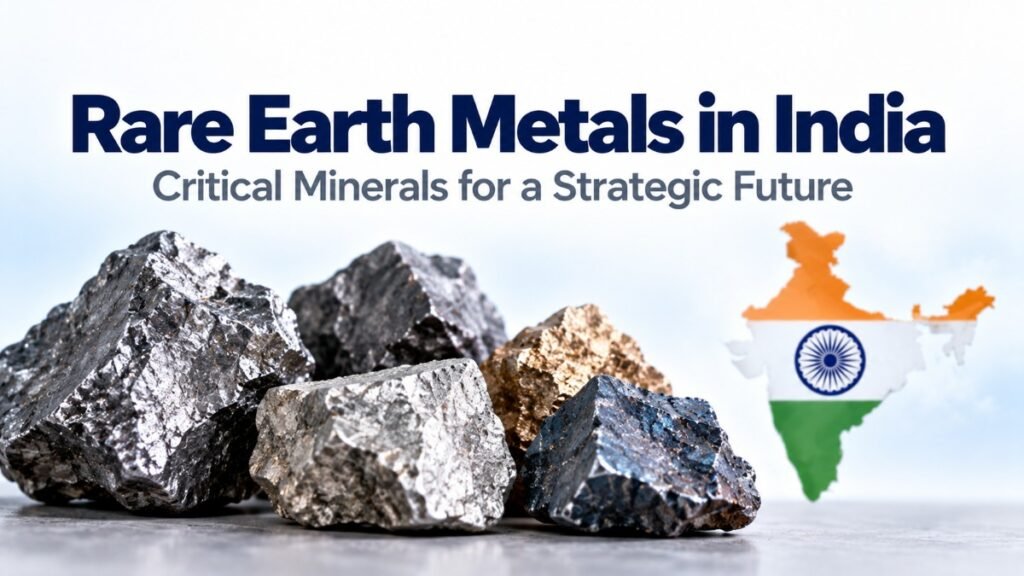
Rare Earth Metals (REMs) or Rare Earth Elements (REEs) are a group of 17 metallic elements, comprising the 15 lanthanides along with scandium and yttrium, which possess unique magnetic, luminescent, and electrochemical properties. These properties make them indispensable for manufacturing advanced technologies used in modern industries. Although called “rare,” these elements are not necessarily scarce in the Earth’s crust; rather, they are found in low concentrations and are difficult and expensive to extract and process economically.
Rare Earth Metals in India are considered critical minerals because they are essential for semiconductors, electric vehicles (EVs), wind turbines, smartphones, defence equipment, satellites, medical devices, and clean energy technologies. Owing to their strategic importance and limited global supply chains, they have become crucial for economic growth, energy transition, and national security.
Rare Earth Elements in India are therefore strategically important for India’s technological and economic development. Their growing Rare Earth Metals Importance makes them an important topic for understanding India’s critical mineral security, clean energy transition, advanced manufacturing, and national security. These aspects are also important for Rare Earth Metals Notes prepared for BPSC and UPSC examination.
Master Science & Technology. Maximize Your BPSC Mains Score.
Enroll in the BPSC Science & Tech Course Today
Master Science & Technology for BPSC Mains GS Paper-2 with 75+ exam-oriented topics, 6 structured lessons, and downloadable PDF notes—all in one course.
✔ 75+ Exam-Oriented Topics • ✔ 6 Comprehensive Lessons • ✔ Downloadable PDF Notes • ✔ Updated for 72nd BPSC Mains
2. Applications of Rare Earth Metals
Electronics and Semiconductor Industry
Rare earth metals are essential for manufacturing smartphones, computers, semiconductors, LED displays, hard disk drives, optical fibres, and communication equipment. Their excellent magnetic and electrical properties enable the production of compact, high-performance, and energy-efficient electronic devices, making them indispensable for the digital economy.
Example: Neodymium (Nd) is used to manufacture powerful permanent magnets found in smartphones, computer hard drives, and semiconductor manufacturing equipment. The Rare Earth Metals Importance in advanced electronics is therefore closely linked with the growth of the digital economy and high-technology manufacturing.
Electric Vehicles (EVs) and Automobile Industry
Rare earth metals play a crucial role in the automobile industry, particularly in electric vehicles (EVs), by improving the efficiency of electric motors, batteries, regenerative braking systems, and power steering. Their use enhances vehicle performance, reduces energy consumption, and supports the transition towards clean mobility.
Example: Neodymium-Iron-Boron (NdFeB) magnets, made using Neodymium and Dysprosium, are widely used in the high-performance electric motors of Tesla and several other electric vehicles. This application highlights the growing Rare Earth Metals Importance for the global transition towards electric mobility.
Renewable Energy
Rare earth metals are vital for the production of wind turbines, solar power systems, and other renewable energy technologies. Permanent magnets made from rare earth elements improve the efficiency and reliability of wind turbines, enabling higher electricity generation while reducing maintenance requirements. They are therefore essential for achieving global clean energy and climate goals.
Example: Modern offshore wind turbines use Neodymium and Dysprosium-based permanent magnets to generate electricity efficiently with minimal maintenance.
Defence and Aerospace
Rare earth metals are indispensable for modern defence technologies such as fighter aircraft, missiles, radar systems, submarines, satellites, lasers, and electronic warfare equipment. Their unique magnetic and heat-resistant properties enhance the performance, precision, and reliability of advanced military platforms, making them strategically important for national security.
Example: The F-35 Lightning II fighter aircraft uses several hundred kilograms of rare earth elements in its radar, sensors, electronic warfare systems, and high-performance permanent magnets. This demonstrates the Rare Earth Metals Importance for advanced defence and aerospace technologies.
Healthcare and Medical Devices
Rare earth metals have revolutionized healthcare by improving the performance of MRI scanners, CT scanners, X-ray machines, medical lasers, and advanced diagnostic equipment. They also play an important role in medical imaging, cancer diagnosis, and targeted therapies, leading to more accurate diagnosis and better patient outcomes.
Example: Gadolinium (Gd) is widely used as a contrast agent in Magnetic Resonance Imaging (MRI) to produce clearer and more detailed images of internal organs.
Space and Emerging Technologies
Rare earth metals are critical for satellites, spacecraft, robotics, Artificial Intelligence (AI), quantum technologies, advanced communication systems, and hydrogen energy technologies. Their exceptional magnetic, optical, and thermal properties enable the development of high-performance components required for next-generation technologies and space exploration.
Example: ISRO uses rare earth-based materials in satellite communication systems, onboard electronics, and space sensors due to their high thermal stability and reliability under extreme space conditions. This highlights the growing importance of Rare Earth Elements in India for space technology and other emerging technologies.
Prepare Smarter. Study Better. Ace BPSC Mains.
BPSC Mains GS Paper 1 & 2 Complete Course
Access comprehensive BPSC Mains Notes for GS Paper 1 & 2, covering 378+ topics across 24 PDF lessons, with dedicated Bihar coverage, practice questions and downloadable study material.
✓ GS Paper 1 & 2 • ✓ 378+ Topics • ✓ 24 PDF Lessons • ✓ Bihar-Specific Coverage • ✓ Downloadable Notes
3. Status of Rare Earth Sector in India
- India possesses about 6% of the world’s rare earth reserves, but contributes only around 1% of global rare earth production.
- India is heavily dependent on China for rare earth metals and processed rare earth products. During 2018–19, nearly 92% (by value) and 97% (by quantity) of India’s rare earth imports came from China.
- Exploration of rare earth minerals is carried out mainly by the Geological Survey of India (GSI), Atomic Minerals Directorate (AMD), and the Ministry of Mines.
- Mining and processing of rare earth-bearing monazite beach sand is largely undertaken by IREL (India) Limited, a Public Sector Undertaking under the Department of Atomic Energy (DAE).
- India’s rare earth industry is concentrated mainly in upstream activities (mining and production of rare earth oxides), while high-value downstream activities such as refining, magnet manufacturing, and advanced products remain limited.
The Rare Earth Metals in India sector therefore has significant strategic importance, particularly for reducing import dependence and developing domestic high-value manufacturing. Rare Earth Metals Notes for BPSC and UPSC should focus on India’s resource base, production capacity, import dependence, and value-chain challenges.
4. Government Initiatives
- National Critical Mineral Mission (NCMM): Launched to strengthen the exploration, mining, processing, recycling, and strategic security of critical minerals, including rare earth elements, to support India’s clean energy and technology sectors.
- MMDR Amendment Act, 2021: Amended the Mines and Minerals (Development and Regulation) Act, 1957 to improve ease of doing business, boost mineral production, and encourage greater private sector participation in mining.
- Deep Ocean Mission: Promotes the exploration of polymetallic nodules and seabed minerals, which may contain valuable rare earth and other critical minerals.
- IREL (India) Limited: The Government has strengthened the role of IREL in the exploration, mining, processing, and production of rare earth elements and associated strategic minerals.
- Proposal for an ‘India Rare Earths Mission’: The Confederation of Indian Industry (CII) has proposed the establishment of an India Rare Earths Mission, on the lines of the India Semiconductor Mission, to promote private sector participation, diversify supply chains, and develop a complete domestic rare earth value chain.
These initiatives are aimed at strengthening Rare Earth Elements in India, reducing supply-chain vulnerabilities, and promoting domestic exploration, processing, and manufacturing.
5. Challenges Associated with Rare Earth Metals
- China’s Dominance: China controls a major share of the global mining, processing, and refining of rare earth elements, making countries like India vulnerable to supply disruptions and geopolitical tensions.
- Limited Processing and Value Addition: India largely exports rare earth oxides while importing high-value products such as permanent magnets, alloys, and advanced components, resulting in limited domestic value addition.
- Restricted Private Sector Participation: Mining of rare earth-bearing monazite has traditionally remained under government control, limiting private investment and slowing the development of the sector.
- Environmental Concerns: Mining and processing of rare earth minerals generate radioactive waste, toxic chemicals, and environmental pollution, requiring strict environmental safeguards and sustainable mining practices.
- Weak Supply Chain and Technology Gap: India lacks advanced refining technologies, processing facilities, and manufacturing capabilities for rare earth-based products, leading to heavy dependence on imports for strategic industries.
These challenges highlight the Rare Earth Metals Importance for India’s economic, technological, and strategic security. Addressing them is essential for strengthening the domestic Rare Earth Metals in India value chain and reducing external dependence.
6. Conclusion
India should adopt a comprehensive strategy to build a self-reliant rare earth ecosystem by encouraging private sector participation, expanding domestic exploration and processing capacity, and promoting value-added manufacturing of permanent magnets and other high-tech products. Diversifying import sources through partnerships such as the Quad, strengthening strategic reserves, promoting recycling of rare earth elements, and establishing an India Rare Earths Mission will enhance supply chain resilience. These measures will not only reduce dependence on China but also support Atmanirbhar Bharat, make in India, clean energy transition, and Viksit Bharat 2047, while strengthening India’s technological and strategic capabilities.
Rare Earth Metals will remain strategically important for India’s technological development, defence preparedness, clean energy transition, and advanced manufacturing. Strengthening domestic capabilities will help India build a more resilient and self-reliant critical mineral ecosystem.
BPSC Mains Practice Questions
- What are Rare Earth Metals? Discuss their major applications and examine the challenges faced by India in developing a self-reliant rare earth ecosystem.
- Rare Earth Metals are critical for India’s technological and strategic security. Discuss the status of the rare earth sector in India and evaluate the major government initiatives to strengthen the sector.
Learn More About Rare Earth Metals
For official information on critical minerals, rare earth elements, mineral exploration, and India’s mineral resources, visit the Ministry of Mines, Government of India: Ministry of Mines – Critical Minerals. The Ministry provides official information on India’s critical mineral strategy, exploration, mining, processing, and initiatives related to rare earth elements.