1. Introduction
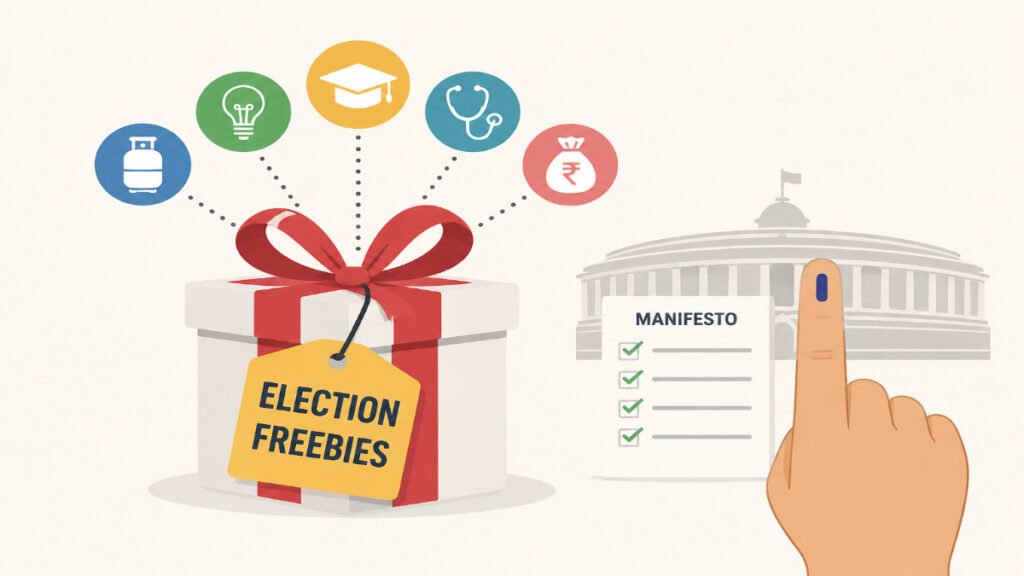
Election freebies refer to promises made by political parties in their election manifestos to provide goods, services, cash transfers or subsidies free of cost or at highly subsidised rates with the objective of attracting voters. These may include promises such as free electricity, free water, loan waivers, cash transfers, free laptops, smartphones, scooters, public transport or household appliances. The debate over Election freebies in India has become an important issue involving electoral politics, public welfare and fiscal sustainability.
There is no legal or constitutional definition of the term “election freebies” in India. It is primarily a political, economic and judicial concept, and its interpretation has evolved through Supreme Court judgments, Election Commission guidelines and public policy debates. The issue of Freebies in Indian elections therefore continues to generate debate over the appropriate balance between electoral promises, welfare obligations and fiscal responsibility.
It is important to distinguish welfare schemes from election freebies. Welfare measures are generally designed to fulfil the objectives of the Directive Principles of State Policy (DPSPs) by improving education, healthcare, nutrition, employment and social security for disadvantaged sections of society. In contrast, election freebies are often criticised as short-term populist promises that may not always be linked to long-term socio-economic development or fiscal sustainability. However, the distinction is often subjective and remains a matter of public and judicial debate.
Welfare Schemes vs Election Freebies
| Welfare Schemes | Election Freebies |
|---|---|
| Aim at long-term socio-economic development and inclusive growth. | Primarily intended to attract voters during elections. |
| Based on constitutional principles, particularly the Directive Principles of State Policy (Part IV). | Generally announced in election manifestos without a constitutional mandate. |
| Focus on improving human capital through education, healthcare, nutrition and social security. | Often involve distribution of consumer goods, cash or highly subsidised services. |
| Usually targeted towards vulnerable and disadvantaged sections. | May be universal or targeted depending on electoral strategy. |
| Examples: PM-KISAN, Ayushman Bharat, PM POSHAN, MGNREGA, ICDS, National Food Security Act. | Examples: Free electricity, free laptops, free smartphones, farm loan waivers, free scooters, free household appliances, universal cash transfers. |
The distinction between election freebies and genuine welfare measures is particularly important while examining Election freebies in India, as well as the broader debate surrounding Freebies in Indian elections.
Master Current Affairs. Ace BPSC Mains.
BPSC Mains Current Affairs & International Relations Course
Master GS Paper-I (Section-II) with 116 exam-oriented topics, 5 structured lessons and downloadable PDF notes—all in one comprehensive course.
✔ 116 Exam-Oriented Topics • ✔ 5 Comprehensive Lessons • ✔ Downloadable PDF Notes • ✔ Updated for 72nd BPSC Mains
Why in News?
- The issue of election freebies has gained prominence due to the ongoing proceedings before the Supreme Court on regulating promises of freebies made in election manifestos. The debate over Election freebies in India has intensified as political parties increasingly use welfare-oriented promises during elections.
- The Election Commission of India (ECI) continues to enforce guidelines on election manifestos framed pursuant to the Supreme Court’s judgment in S. Subramaniam Balaji v. State of Tamil Nadu (2013).
- The Reserve Bank of India (RBI) has cautioned that excessive unfunded freebies by States can crowd out capital expenditure, weaken fiscal sustainability and adversely affect long-term economic growth. This has added an important economic dimension to the debate surrounding Freebies in Indian elections.
- The debate has intensified because many recent State Assembly elections witnessed competing promises of cash transfers, free electricity, free transport and loan waivers, raising concerns regarding fiscal responsibility and electoral fairness.
Thus, the issue of election freebies involves a broader debate over the balance between legitimate welfare measures, fiscal prudence and electoral competition in Election freebies in India.
Prepare Smarter. Study Better. Ace BPSC Mains.
BPSC Mains GS Paper 1 & 2 Complete Course
Access comprehensive BPSC Mains Notes for GS Paper 1 & 2, covering 378+ topics across 24 PDF lessons, with dedicated Bihar coverage, practice questions and downloadable study material.
✓ GS Paper 1 & 2 • ✓ 378+ Topics • ✓ 24 PDF Lessons • ✓ Bihar-Specific Coverage • ✓ Downloadable Notes
2. Types of Election Freebies
- Direct Cash Transfers: Monetary assistance promised to specific groups or all voters, such as monthly allowances, unemployment allowances, financial assistance to women or youth, and direct income support. Such promises are among the most visible forms of election freebies and have become increasingly prominent in Election freebies in India.
- Consumer Goods: Distribution of durable household goods free of cost or at highly subsidised rates. Examples include laptops, smartphones, tablets, television sets, mixers, grinders, fans, sewing machines, bicycles and scooters. These forms of Freebies in Indian elections directly provide material benefits to voters.
- Free or Subsidised Utilities: Promises relating to free electricity, free water supply, subsidised LPG cylinders, free internet or free Wi-Fi, which reduce household expenditure but may increase the fiscal burden on governments.
- Loan Waivers: Waiver of agricultural loans, education loans or loans of small borrowers announced before elections. Farm loan waivers are among the most debated forms of election freebies due to their fiscal implications.
- Free Public Services: Provision of free public transport, free healthcare, free education, free coaching, free pilgrimage or free insurance announced through election manifestos. The Election Commission notes that the classification of such promises depends on whether they primarily serve welfare objectives or electoral considerations.
- Housing and Asset Distribution: Promises to provide free land, houses, cattle, gold coins or other productive assets to targeted beneficiaries such as landless labourers, women or economically weaker sections.
- Tax and Fee Concessions: Commitments to waive or reduce electricity dues, water charges, property tax, education fees or other government charges for particular categories of citizens.
The different forms of Election freebies in India show that such promises can range from direct financial assistance and consumer goods to public services and subsidies. Therefore, the debate on Freebies in Indian elections also requires examining the purpose, beneficiaries, fiscal cost and long-term impact of each promise.
3. Constitutional, Legal and Institutional Framework
Constitutional Framework
- Article 38: Directs the State to promote the welfare of the people by securing a social order based on justice—social, economic and political.
- Article 39(b) & (c): Requires the State to ensure equitable distribution of material resources and prevent concentration of wealth, forming the constitutional basis for many welfare schemes.
- Article 41: Directs the State to provide public assistance in cases of unemployment, old age, sickness and disability within its economic capacity.
- Article 43: Directs the State to secure a living wage and decent standard of life for workers.
- Article 282: Empowers the Union and States to make grants for any public purpose, even if the subject does not fall within their legislative competence. This provision is often cited while defending welfare expenditure.
- Article 324: Vests the Election Commission of India (ECI) with the power to conduct free and fair elections, forming the constitutional basis for issuing guidelines on election manifestos.
Legal Framework
- There is no specific law in India regulating or defining election freebies.
- Section 123 of the Representation of the People Act, 1951, which defines “corrupt practices”, does not treat promises made in election manifestos as corrupt practices.
- In S. Subramaniam Balaji v. State of Tamil Nadu (2013), the Supreme Court held that promises made in election manifestos cannot be treated as corrupt practices under the existing law, while acknowledging that freebies can influence voters and affect the level playing field. The Court directed the Election Commission to frame guidelines for election manifestos and also observed that Parliament may enact a law on the subject if considered necessary.
- Petitions challenging the growing culture of election freebies, including Ashwini Kumar Upadhyay v. Union of India, are presently under consideration before the Supreme Court, and the issue continues to evolve judicially.
Institutional Framework
- Election Commission of India (ECI): In compliance with the Supreme Court’s directions, the ECI incorporated Guidelines on Election Manifestos under Part VIII of the Model Code of Conduct (MCC).
- Manifesto Guidelines: Political parties should ensure that manifestos:
- Do not violate constitutional ideals and the Model Code of Conduct.
- Avoid promises that may unduly influence voters.
- Clearly explain the rationale behind promises.
- Broadly indicate the financial implications and sources of funding.
- Make only those promises that are realistically implementable.
- Reserve Bank of India (RBI): The RBI has repeatedly cautioned that non-merit or unfunded freebies can weaken fiscal sustainability by increasing subsidy burdens, reducing capital expenditure and raising public debt.
The constitutional and institutional framework is therefore important for understanding the debate around Election freebies in India. While the Constitution permits governments to undertake welfare measures, the regulation of Freebies in Indian elections must also consider fiscal sustainability, electoral fairness and transparency.
4. Significance and Arguments in Favour of Election Freebies
Promotion of Social Justice and Inclusive Development
Election promises that provide free or subsidised essential services can help reduce socio-economic inequalities and improve the living standards of vulnerable sections. The Directive Principles of State Policy (Articles 38, 39 and 41) require the State to promote social welfare and provide assistance to disadvantaged citizens.
Therefore, schemes aimed at food security, healthcare, education or livelihood support are often viewed as instruments of constitutional welfare rather than mere political giveaways. For example, the National Food Security Act (NFSA), 2013 covers up to 75% of the rural population and 50% of the urban population, providing subsidised food grains, while also guaranteeing nutrition support through ICDS and PM POSHAN (Mid-Day Meal).
Poverty Alleviation and Human Development
Supporters argue that many so-called freebies act as investments in human development by reducing household expenditure on essential needs. Free or subsidised education, healthcare, food, housing and public transport improve access to basic services, particularly for economically weaker sections.
Schemes such as Ayushman Bharat PM-JAY, PM-KISAN, PM Awas Yojana and MGNREGA have contributed to improving social security and reducing multidimensional poverty. The Election Commission itself recognises that promises relating to welfare measures cannot be objected to merely because they involve government expenditure, as they are rooted in the Directive Principles of State Policy.
Fulfilling the Constitutional Vision of a Welfare State
India is constitutionally committed to functioning as a welfare state, where governments are expected to provide basic public goods and social protection. The Election Commission’s Manifesto Guidelines, framed pursuant to the S. Subramaniam Balaji (2013) judgment, explicitly acknowledge that political parties may promise welfare measures because the Constitution enjoins the State to pursue them.
Consequently, every pre-election welfare promise cannot automatically be categorised as an undesirable freebie. The real concern is whether such promises are fiscally sustainable and intended for genuine public welfare.
Addressing Market Failures and Supporting Vulnerable Groups
Many welfare-oriented benefits are justified because markets often fail to provide affordable healthcare, quality education or social protection to the poor. Subsidies and targeted assistance help bridge these gaps and enable inclusive growth.
Examples include free textbooks, bicycles for girl students, old-age pensions, maternity benefits and subsidised food grains. Such measures improve school enrolment, nutritional outcomes and labour productivity, generating long-term socio-economic benefits that outweigh their immediate fiscal cost.
Stimulating Consumption and Economic Activity
Targeted income support and subsidies can increase disposable income among low-income households, thereby boosting consumption demand and supporting local economic activity. During periods of economic distress, welfare transfers also act as automatic stabilisers by sustaining purchasing power.
For instance, free food grain under the Pradhan Mantri Garib Kalyan Anna Yojana (PMGKAY) protected millions of vulnerable households during and after the COVID-19 pandemic by ensuring food security and reducing out-of-pocket expenditure. Such interventions can contribute to economic resilience when implemented in a fiscally responsible manner.
Strengthening Democratic Accountability
Election manifestos provide voters with an opportunity to evaluate competing policy visions. Welfare promises can enhance democratic accountability by compelling political parties to address public concerns such as unemployment, education, healthcare, women’s empowerment and rural distress.
The Election Commission requires parties to explain the rationale and financial implications of manifesto promises, thereby promoting transparency and informed voter choice rather than prohibiting welfare commitments altogether.
Thus, while election freebies can raise concerns about electoral populism, Election freebies in India may also overlap with legitimate welfare measures. The key issue in the debate over Freebies in Indian elections is whether a particular promise promotes genuine public welfare and human development or merely creates an unsustainable fiscal burden.
5. Challenges and Criticism of Election Freebies
Fiscal Burden and Rising Public Debt
One of the strongest criticisms of election freebies is their adverse impact on the fiscal health of governments. Free electricity, loan waivers, cash transfers and subsidies substantially increase revenue expenditure, leaving fewer resources for productive capital investment. The RBI’s State Finances: A Study of Budgets (2024) emphasises the need for fiscal prudence and recommends a transparent, time-bound debt consolidation strategy for States.
It warns that excessive subsidy expenditure and off-budget liabilities can weaken long-term fiscal sustainability. The Fifteenth Finance Commission has also recommended that States adhere to prudent borrowing limits and fiscal discipline.
Crowding Out Developmental Expenditure
Large expenditure on election freebies often reduces the fiscal space available for capital expenditure on infrastructure, education, healthcare, irrigation and industrial development. Since capital expenditure generates long-term economic growth and employment, excessive spending on recurring subsidies may lower the quality of public expenditure.
The RBI has repeatedly highlighted that States should prioritise growth-enhancing capital spending while rationalising subsidies. For example, the 2023–24 RBI State Finances Report noted a sharp increase in capital outlay by States and stressed that this momentum should not be undermined by unsustainable welfare commitments.
Distortion of Electoral Democracy
Critics argue that excessive promises of freebies may influence voter behaviour and undermine the principle of free and fair elections. In S. Subramaniam Balaji v. State of Tamil Nadu (2013), the Supreme Court observed that although promises in election manifestos do not amount to corrupt practices under the Representation of the People Act, they can influence voters and disturb the level playing field among political parties.
Consequently, the Court directed the Election Commission to frame guidelines on election manifestos, which are now incorporated in the Model Code of Conduct.
Populism and Moral Hazard
Freebies in Indian elections are often criticised for encouraging short-term populism instead of long-term development-oriented policymaking. Political parties may compete by offering increasingly expensive promises that are financially unsustainable. Such practices can create a moral hazard, where beneficiaries begin to expect continuous government support instead of relying on productive employment or entrepreneurship.
Farm loan waivers, repeated electricity subsidies and unconditional cash transfers are frequently cited as examples that may weaken financial discipline and reduce incentives for structural reforms.
Inter-generational Equity and Taxpayer Burden
Many election freebies are financed through government borrowing, shifting the repayment burden to future taxpayers. Persistent fiscal deficits increase public debt, interest payments and debt-servicing obligations, thereby reducing resources available for future generations.
During recent hearings, the Supreme Court questioned whether governments running large fiscal deficits should continue announcing extensive freebies, observing that such practices may ultimately hamper long-term national development.
Lack of Transparency and Accountability
Political parties are generally not required to present a detailed financial roadmap for implementing every manifesto promise. Although the Election Commission’s Manifesto Guidelines require parties to indicate the rationale, financial implications and means of funding, these guidelines are advisory in nature and lack statutory backing.
Consequently, voters often find it difficult to assess the fiscal viability and long-term consequences of manifesto promises before casting their votes.
The concerns surrounding Election freebies in India therefore relate not merely to government expenditure but also to the quality of public spending, fiscal sustainability, electoral fairness and accountability. A balanced approach to Freebies in Indian elections requires distinguishing productive welfare expenditure from fiscally unsustainable promises.
6. International Experience
Nordic Countries: Welfare with Fiscal Responsibility
The Nordic countries (Sweden, Norway, Denmark, Finland and Iceland) are often cited as examples of successful welfare states. These countries provide universal access to free or highly subsidised healthcare, education, unemployment benefits, child allowances and old-age pensions. However, these benefits are not election freebies but part of a long-term welfare model financed through high taxation, strong fiscal discipline and transparent public finance. The welfare system is based on need rather than electoral promises, and governments maintain high levels of public accountability. This demonstrates that generous social welfare can coexist with sound fiscal management when backed by sustainable revenue sources.
Latin America: Cash Transfers with Mixed Outcomes
Several Latin American countries have implemented Conditional Cash Transfer (CCT) programmes to reduce poverty and improve human development. Prominent examples include Brazil’s Bolsa Família and Mexico’s Progresa (later Oportunidades/Prospera), where financial assistance is linked to conditions such as children’s school attendance and health check-ups. According to the OECD, these programmes have significantly reduced poverty and improved education and health outcomes. However, poorly designed or unconditional subsidies in some countries have also reduced incentives for formal employment and increased fiscal pressure. The international experience suggests that welfare programmes are more effective when they are targeted, conditional and integrated with employment and skill development policies.
Lessons for India
The international experience indicates that the debate is not about welfare versus freebies, but about fiscal sustainability, targeting and accountability. Countries with successful welfare systems finance social protection through stable revenue sources, transparent budgeting and robust institutions, while ensuring that welfare expenditure contributes to human capital development. For India, the priority should be to distinguish productive welfare spending from unsustainable electoral populism, strengthen outcome-based social programmes and ensure that election promises are accompanied by credible estimates of their fiscal implications.
The international experience provides useful lessons for Election freebies in India, particularly in distinguishing sustainable welfare programmes from Freebies in Indian elections that may create long-term fiscal liabilities.
7. Government, RBI, Finance Commission and Expert Views
Election Commission of India (ECI)
The Election Commission of India (ECI) has maintained that while election manifestos are an essential part of democratic elections, political parties should exercise responsibility in making promises. Following the Supreme Court’s judgment in S. Subramaniam Balaji v. State of Tamil Nadu (2013), the ECI incorporated Part VIII (Election Manifestos) into the Model Code of Conduct (MCC).
These guidelines require political parties to clearly explain the rationale, financial implications and sources of funding for manifesto promises. However, since the Model Code of Conduct is non-statutory, the ECI cannot reject or invalidate manifesto promises solely because they contain freebies. The Commission has repeatedly stated that any stricter regulation would require legislative intervention by Parliament.
Reserve Bank of India (RBI)
The Reserve Bank of India, particularly in its State Finances: A Study of Budgets reports, has consistently cautioned against the growing trend of unfunded or non-merit freebies. According to the RBI, excessive expenditure on such schemes increases revenue expenditure, widens fiscal deficits, raises public debt, and reduces the fiscal space available for productive capital expenditure such as roads, irrigation, education and healthcare.
The RBI has stressed that States should maintain fiscal prudence under the Fiscal Responsibility and Budget Management (FRBM) framework and prioritise growth-enhancing public investment over unsustainable subsidy commitments.
Finance Commission
The Fifteenth Finance Commission (2021–26) did not recommend a ban on welfare expenditure but strongly emphasised fiscal sustainability, debt management and responsible public finances. It recommended that both the Union and the States adhere to FRBM targets, improve the quality of public expenditure and avoid excessive borrowing.
The Commission highlighted that long-term fiscal stability is essential for sustaining development expenditure and protecting macroeconomic stability. These recommendations are particularly relevant in the context of rising expenditure on Election freebies in India.
Economic Survey and Expert Opinion
The Economic Survey has consistently argued that well-targeted welfare expenditure can improve human capital and inclusive growth, whereas poorly targeted and fiscally unsustainable subsidies can reduce economic efficiency.
Economists generally distinguish between merit subsidies (education, healthcare, nutrition, skill development) that generate long-term social returns and non-merit subsidies that primarily support consumption without creating productive assets. Many experts therefore advocate an outcome-based approach, where welfare schemes should be evaluated on the basis of measurable improvements in poverty reduction, education, health and employment rather than their political appeal.
The views of the ECI, RBI and Finance Commission show that the debate over Freebies in Indian elections is not simply about whether governments should provide welfare. It is about ensuring transparency, fiscal sustainability, responsible public expenditure and electoral fairness while allowing genuine welfare measures to continue.
8. Bihar Perspective
Bihar has emerged as an important case study in the national debate on election freebies versus welfare measures, as recent Assembly elections witnessed intense competition among political parties through promises of cash assistance, free electricity, employment and social welfare. Given Bihar’s status as one of India’s fiscally constrained states, the challenge lies in balancing welfare commitments with fiscal sustainability.
Recent Election Promises in Bihar
During the 2025 Bihar Assembly Elections, political parties announced several welfare and freebie-oriented promises to attract different sections of voters:
- The NDA promised 125 units of free electricity for domestic consumers, expansion of women-centric welfare programmes and continued support for existing social security schemes.
- The Mahagathbandhan (RJD-led alliance) announced a ₹30,000 annual cash transfer for women, employment generation measures, unemployment assistance and enhanced social welfare programmes.
- Just before the 2025 Bihar Assembly Elections, the NDA Government launched the Mukhyamantri Mahila Rozgar Yojana (MMRY) under which ₹10,000 was transferred through Direct Benefit Transfer (DBT) to eligible women beneficiaries as seed capital for self-employment. According to official announcements, the scheme initially benefited 21 lakh women (₹2,100 crore transferred), and was later expanded to cover 75 lakh women, making it one of the most significant welfare measures in the election period. The scheme became a major subject of political debate, with the Opposition alleging that it functioned as an election freebie, while the Government defended it as an employment-oriented welfare programme aimed at promoting women’s entrepreneurship and livelihood generation.
Bihar’s Welfare Model
Bihar has historically implemented several welfare-oriented schemes that are generally viewed as development-oriented welfare measures rather than election freebies because they focus on improving human capital and social inclusion. Examples include:
- Mukhyamantri Balika Cycle Yojana, which significantly improved girls’ enrolment and retention in secondary education.
- Mukhyamantri Kanya Utthan Yojana, providing financial assistance for girls’ education and empowerment.
- Jeevika (Bihar Rural Livelihoods Project), which has mobilised over 1.3 crore rural women into Self-Help Groups (SHGs), strengthening women’s financial inclusion and livelihoods.
- Reservation of 50% seats for women in Panchayati Raj Institutions, enhancing women’s political participation.
Challenges for Bihar
Despite the need for social welfare, Bihar faces significant fiscal and developmental constraints.
- Bihar continues to be one of India’s lowest per capita income states, limiting its fiscal capacity to finance large-scale recurring subsidies.
- The state faces persistent challenges of high unemployment, out-migration, low industrialisation and dependence on central transfers.
- Large-scale unfunded electoral promises may reduce the fiscal space available for education, healthcare, irrigation, infrastructure and industrial development, which are crucial for Bihar’s long-term growth.
- Therefore, Bihar needs to strike a balance between targeted welfare for vulnerable groups and fiscal responsibility, ensuring that welfare spending creates productive human capital rather than unsustainable recurring liabilities.
The Bihar experience highlights the wider challenge of Election freebies in India: welfare support can address genuine socio-economic needs, but Freebies in Indian elections must be evaluated in terms of their fiscal sustainability, developmental outcomes and long-term impact on public finances.
9. Way Forward
- Enact a comprehensive law to distinguish genuine welfare schemes from unsustainable election freebies, as suggested by the Supreme Court in S. Subramaniam Balaji v. State of Tamil Nadu (2013).
- Make fiscal impact disclosure mandatory by requiring political parties to specify the estimated cost, funding sources and implementation strategy for every major manifesto promise.
- Strengthen the Election Commission’s powers by providing statutory backing to the Manifesto Guidelines under the Model Code of Conduct for greater transparency and accountability.
- Prioritise merit-based welfare expenditure on education, healthcare, nutrition, skill development and infrastructure over non-productive consumption subsidies, in line with the Directive Principles of State Policy.
- Ensure fiscal discipline by adhering to the FRBM framework, maintaining sustainable debt levels and avoiding unfunded recurring liabilities, as repeatedly emphasised by the RBI and the Finance Commission.
- Promote targeted and outcome-based welfare schemes using Direct Benefit Transfer (DBT), Aadhaar authentication and regular social audits to improve efficiency and reduce leakages.
- Create an Independent Fiscal Council to evaluate the long-term fiscal sustainability of major election promises before implementation, enabling informed public debate.
- Increase voter awareness regarding the long-term fiscal implications of election promises so that electoral choices are based on governance performance rather than short-term inducements.
A balanced approach to Election freebies in India should therefore focus on distinguishing genuine welfare from fiscally unsustainable populism. The objective should not be to eliminate welfare expenditure, but to ensure that Freebies in Indian elections are accompanied by transparency, credible funding plans, fiscal responsibility and measurable developmental outcomes.
Experience the Quality Before You Enroll
Download Free Sample Notes (PDF)
Download a free sample of our BPSC Mains Current Affairs Notes and experience the structured, exam-oriented content before enrolling. Explore the presentation, answer-writing approach, and overall quality of the complete course.
✔ Free Download • ✔ Exam-Oriented Notes • ✔ Updated Content • ✔ Structured for BPSC Mains
BPSC Mains Practice Questions
Q1. Differentiate between welfare schemes and election freebies. Discuss the constitutional basis of welfare measures in India.
Q2. Critically examine the constitutional, legal and economic issues associated with election freebies in India. What role has the Election Commission of India played in regulating election manifestos?
Q3. ‘The debate on election freebies is essentially a debate between the welfare state and fiscal responsibility.’ In the light of recent Supreme Court observations, RBI concerns and Election Commission guidelines, critically analyse this statement. Suggest suitable reforms to ensure a balance between social welfare and fiscal prudence.
Learn More from the Election Commission of India
Readers interested in election freebies, Election freebies in India, Freebies in Indian elections, election manifestos, Model Code of Conduct, manifesto guidelines, electoral reforms and the regulation of political party promises can visit the official website of the Election Commission of India. The portal provides authentic information on election-related guidelines, political parties, election laws, Model Code of Conduct and other measures concerning free and fair elections.