1. Introduction
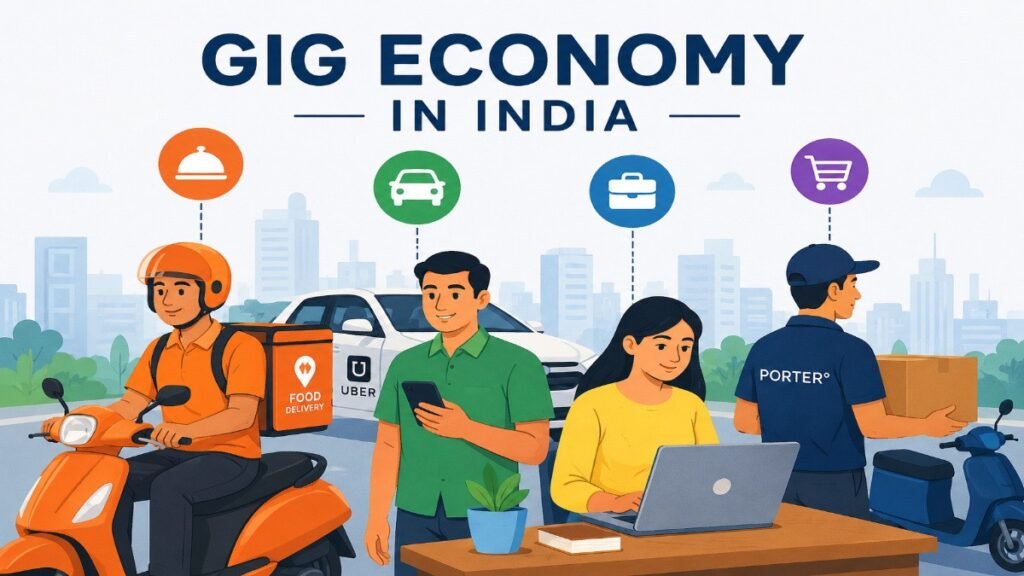
The Gig Economy in India refers to a labour market where individuals work on a temporary, flexible or task-based basis instead of having a traditional employer-employee relationship. Workers are engaged for specific assignments or services and are generally paid per task, project or delivery. Most gig work in India is facilitated through digital platforms such as ride-hailing, food delivery, e-commerce logistics, home services and online freelancing. The Code on Social Security, 2020 provides, for the first time in India, legal definitions of Gig Worker and Platform Worker.
- Gig Worker: A person who performs work or participates in a work arrangement outside the traditional employer-employee relationship.
- Platform Worker: A person engaged in work through an online platform that connects service providers with customers for payment.
According to NITI Aayog’s report “India’s Booming Gig and Platform Economy” (2022):
- India had 77 lakh (7.7 million) gig workers in 2020–21.
- The number is projected to reach 2.35 crore (23.5 million) by 2029–30.
- Gig workers are expected to constitute about 4.1% of India’s total workforce by 2029–30.
The Gig economy in India is therefore emerging as an important component of the country’s changing labour market, while the growing number of Gig Workers has also created new questions regarding social security and labour protection.
Master Current Affairs. Ace BPSC Mains.
BPSC Mains Current Affairs & International Relations Course
Master GS Paper-I (Section-II) with 116 exam-oriented topics, 5 structured lessons and downloadable PDF notes—all in one comprehensive course.
✔ 116 Exam-Oriented Topics • ✔ 5 Comprehensive Lessons • ✔ Downloadable PDF Notes • ✔ Updated for 72nd BPSC Mains
Why in News?
- The Union Budget 2025–26 announced social security measures for gig and platform workers, including identity cards, registration on the e-Shram portal, and healthcare coverage under Ayushman Bharat PM-JAY.
- The Code on Social Security, 2020 came into force on 21 November 2025, formally recognizing Gig Workers and Platform Workers and enabling welfare measures such as life and disability cover, accident insurance, health and maternity benefits, and old-age protection.
- The Ministry of Labour & Employment launched the Aggregator Module on the e-Shram Portal in December 2024 to facilitate the registration of platform aggregators and Gig Workers. Major platforms such as Uber, Ola, Swiggy, Zomato, Blinkit, Rapido, Amazon, Urban Company, Zepto, Porter and Ecom Express have been onboarded.
- The Government has proposed the creation of a Social Security Fund under the Code on Social Security, 2020 to finance welfare schemes for gig and platform workers.
The recent policy measures highlight the growing importance of the Gig economy in India and the need to provide social security and labour protection to its rapidly expanding workforce.
2. Features, Growth and Drivers of the Gig Economy
Features of the Gig Economy
The Gig economy in India is characterised by short-term, task-based and flexible employment arrangements rather than permanent jobs. Work is generally assigned through digital platforms or mobile applications, where workers are paid on a per task, per ride, per delivery or per project basis. Most Gig Workers function as independent contractors instead of regular employees and therefore do not enjoy conventional employment benefits such as provident fund, gratuity or paid leave. The sector relies heavily on technology, GPS, digital payments, customer ratings and algorithm-based allocation of work, making it an important component of India’s digital economy.
Growth of the Gig Economy in India
India has emerged as one of the fastest-growing gig economy markets in the world due to rapid digitalisation and increasing platform-based services. According to NITI Aayog’s report India’s Booming Gig and Platform Economy (2022), India had 77 lakh (7.7 million) gig workers in 2020–21, and this number is projected to increase to 2.35 crore (23.5 million) by 2029–30. Gig workers are expected to account for 6.7% of the non-agricultural workforce and 4.1% of the total workforce by 2029–30.
At present, nearly 47% of gig workers are engaged in medium-skilled jobs, 22% in high-skilled jobs, and 31% in low-skilled jobs. Recent government data also indicates a 55% increase in the number of gig workers between FY 2020–21 and FY 2024–25, highlighting the rapid expansion of the sector.
Drivers of the Gig Economy
The rapid expansion of the Gig economy in India has been driven by several structural and technological factors. Increasing smartphone penetration, affordable internet connectivity, widespread adoption of UPI-based digital payments, growth of e-commerce and quick-commerce platforms, and rising consumer demand for on-demand services have significantly accelerated platform-based employment. Businesses increasingly prefer gig workers because they provide operational flexibility and lower labour costs, while workers are attracted by flexible working hours and multiple income opportunities.
Government initiatives such as Digital India, Startup India, Skill India and the growing digital infrastructure have further supported the expansion of platform-based work. The Gig economy in India today spans diverse sectors including ride-hailing, food delivery, logistics, home services, healthcare, education, consulting, information technology and freelancing.
Prepare Smarter. Study Better. Ace BPSC Mains.
BPSC Mains GS Paper 1 & 2 Complete Course
Access comprehensive BPSC Mains Notes for GS Paper 1 & 2, covering 378+ topics across 24 PDF lessons, with dedicated Bihar coverage, practice questions and downloadable study material.
✓ GS Paper 1 & 2 • ✓ 378+ Topics • ✓ 24 PDF Lessons • ✓ Bihar-Specific Coverage • ✓ Downloadable Notes
3. Significance of the Gig Economy
Employment Generation
- The Gig economy in India has emerged as one of India’s fastest-growing sources of employment, particularly for youth, women and migrant workers.
- According to NITI Aayog, the number of gig workers is projected to increase from 77 lakh (2020–21) to 2.35 crore by 2029–30.
- It creates low-entry-barrier employment opportunities for workers with varying skill levels.
- Examples: Uber, Ola, Zomato, Swiggy, Blinkit, Zepto, Porter and Urban Company.
Promotes Labour Market Flexibility
- Allows Gig Workers to choose working hours, location and number of assignments, improving work-life flexibility.
- Enables individuals to pursue multiple income sources simultaneously.
- Helps companies hire workers according to seasonal or demand-based requirements, reducing fixed labour costs.
- Particularly beneficial for students, homemakers, retired persons and freelancers.
Supports the Digital Economy
- Gig work is driven by digital platforms, smartphones, GPS technology, AI-based algorithms and UPI-enabled digital payments.
- Supports the rapid growth of e-commerce, quick commerce and app-based service delivery.
- Strengthens flagship initiatives such as Digital India, Startup India and the digital public infrastructure ecosystem.
- Examples: Amazon, Flipkart, Blinkit, Zepto, BigBasket and Urban Company.
Boosts Entrepreneurship and Innovation
- Encourages self-employment instead of dependence on traditional salaried jobs.
- Enables professionals to offer specialised services independently in sectors such as IT, consulting, design, education and healthcare.
- Provides startups with access to skilled professionals without maintaining a permanent workforce.
- Encourages innovation through platform-based business models.
Increases Female Workforce Participation
- Flexible working arrangements enable greater participation of women who may be unable to undertake regular full-time employment.
- Creates opportunities for home-based digital work, freelancing, online tutoring and professional consulting.
- Supports the Government’s objective of improving the Female Labour Force Participation Rate (FLFPR).
- Examples: Online teaching, content writing, graphic designing and telemedicine services.
Enhances Economic Growth
- Expands the services sector by improving productivity and labour market efficiency.
- Increases household income and consumption, thereby contributing to GDP growth.
- Supports India’s demographic dividend by productively engaging a large young workforce.
- According to NITI Aayog, gig workers are expected to constitute 6.7% of India’s non-agricultural workforce and 4.1% of the total workforce by 2029–30.
The growing Gig economy in India therefore has the potential to generate employment, support entrepreneurship and strengthen India’s digital economy, provided that adequate social security and labour protections are extended to Gig Workers.
4. Challenges Associated with the Gig Economy in India
Lack of Social Security
- Most Gig Workers do not receive traditional employment benefits such as Provident Fund (PF), Employees’ State Insurance (ESI), gratuity, paid leave or pension.
- Although the Code on Social Security, 2020 legally recognises gig and platform workers, effective implementation of welfare schemes remains a challenge.
- The Government has proposed a Social Security Fund and registration through the e-Shram Portal, but universal coverage is still evolving.
Income Insecurity and Absence of Minimum Wage
- Earnings fluctuate depending on demand, incentives, customer ratings and platform algorithms.
- Workers are generally paid on a per-task or per-delivery basis, resulting in unstable monthly income.
- There is no statutory minimum wage specifically applicable to most gig workers.
- High fuel prices and maintenance costs further reduce net earnings of delivery partners and drivers.
Algorithmic Control and Job Insecurity
- Digital platforms allocate work through AI-based algorithms, over which workers have little control.
- Frequent changes in incentive structures, commissions and customer-rating systems directly affect workers’ income.
- Accounts may be suspended or deactivated without adequate grievance redressal mechanisms.
- NHRC has recommended reviewing arbitrary rating systems and ensuring greater transparency.
Poor Working Conditions
- Gig workers often work long hours without guaranteed weekly holidays or paid leave.
- According to discussions highlighted by the NHRC, over 83% of app-based drivers work more than 10 hours a day, increasing physical and mental stress.
- Delivery workers face occupational risks such as road accidents, adverse weather conditions and health hazards.
- Most workers bear the cost of fuel, vehicles, mobile phones and internet connectivity themselves.
Limited Legal Protection and Collective Bargaining
- Gig workers are generally treated as independent contractors rather than employees.
- This limits their access to labour rights relating to dismissal, collective bargaining and dispute resolution.
- Trade union representation and collective negotiations remain weak in the platform economy.
- The absence of a clear employer–employee relationship creates regulatory ambiguity.
Gender and Digital Inclusion Challenges
- Women gig workers face concerns related to workplace safety, harassment, irregular working hours and limited access to childcare.
- Digital literacy gaps, unequal access to smartphones and internet connectivity restrict participation from rural areas.
- NHRC has recommended maternity benefits, crèche facilities, dedicated grievance mechanisms and gender-sensitive workplace policies for women gig workers.
These challenges show that the rapid expansion of the Gig economy in India needs to be accompanied by stronger social security, income protection and labour safeguards for every Gig Worker.
5. Government Initiatives
Code on Social Security, 2020
- First law in India to legally define Gig Worker, Platform Worker and Aggregator.
- Section 114 empowers the Central Government to frame social security schemes for gig and platform workers.
- Provides for benefits relating to: Life and disability cover, Accident insurance, Health and maternity benefits, Old-age protection, Crèche facilities, Establishes a Social Security Fund for financing welfare schemes.
- Provides for the constitution of a National Social Security Board for gig and platform workers.
e-Shram Portal
- Launched on 26 August 2021 by the Ministry of Labour & Employment.
- Creates a National Database of Unorganised Workers (NDUW), including gig and platform workers.
- Each registered worker receives a 12-digit Universal Account Number (UAN) linked with Aadhaar.
- Enables portability of welfare benefits and integration with Central and State Government schemes.
- As of November 2025, over 31.38 crore unorganised workers, including over 5.09 lakh gig and platform workers, had been registered.
Union Budget 2025–26 Initiatives
- Announced identity cards for gig and platform workers.
- Registration of platform workers on the e-Shram Portal.
- Extension of Ayushman Bharat–Pradhan Mantri Jan Arogya Yojana (AB-PMJAY) health insurance coverage.
- Expected to benefit around 1 crore gig workers across India.
- Marks the first comprehensive social security initiative specifically targeted at platform workers.
Aggregator Module on e-Shram
- Launched by the Ministry of Labour & Employment to facilitate registration of platform aggregators and workers.
- Enables digital onboarding of aggregators and verification of workers.
- Promotes better implementation of welfare schemes through data integration.
- Several major aggregators have been onboarded, including Uber, Ola, Zomato, Swiggy, Blinkit, Rapido, Amazon, Urban Company, Zepto and Porter.
Social Security and Welfare Measures
- The Government is developing a comprehensive social security framework through consultation with States/UTs, aggregators, worker associations and knowledge partners.
- Special nationwide registration drives have been conducted to increase registration of platform workers.
- e-Shram has been integrated with multiple welfare schemes to improve benefit delivery.
- Interoperability has been established between e-Shram and AB-PMJAY for seamless healthcare benefits.
Patna Gig Worker AC Lounges (Bihar Initiative)
- The Bihar Government, through Patna Smart City Limited (PSCL), inaugurated two 24×7 air-conditioned lounges for gig and platform workers in June 2026.
- The lounges are located near Gandhi Maidan and Income Tax Golambar, two of Patna’s busiest commercial areas.
- Bihar became the third state in India, after Tamil Nadu and Karnataka, to establish dedicated rest facilities for gig workers.
- Each lounge has a seating capacity of around 15 workers at a time.
- The lounges provide air-conditioned seating, drinking water, mobile charging points, CCTV surveillance, security arrangements and rest facilities for delivery partners and cab drivers.
- The initiative primarily benefits workers associated with platforms such as Zomato, Swiggy, Blinkit, Zepto, Uber and Ola.
- The project aims to protect gig workers from extreme heat, rainfall and fatigue, while improving their health, safety and working conditions.
- The initiative reflects Bihar’s commitment to strengthening the urban welfare infrastructure for the rapidly growing Gig economy in India workforce.
6. Way Forward
- Implement the Code on Social Security, 2020 in letter and spirit to ensure universal social security coverage for gig and platform workers.
- Operationalise the Social Security Fund with timely contributions from aggregators and governments to finance welfare schemes.
- Achieve universal registration on the e-Shram Portal through continuous awareness campaigns and integration with all digital labour platforms.
- Strengthen grievance redressal mechanisms by establishing helplines and facilitation centres as envisaged under the Code on Social Security, 2020.
- Ensure transparency in algorithm-based work allocation by promoting fair rating systems, transparent incentive structures and accountability of digital platforms.
- Expand access to health insurance, accident insurance, pension and maternity benefits for all gig workers through convergence with existing government welfare schemes.
- Promote skill development and reskilling through platform-led and outcome-based training to improve productivity and career progression of gig workers.
- Improve financial inclusion by facilitating access to affordable credit, insurance products and digital financial services specifically designed for gig workers.
- Strengthen data collection and official labour statistics by separately enumerating gig and platform workers in national surveys for evidence-based policymaking.
- Encourage State Governments to adopt welfare initiatives similar to Patna’s Gig Worker AC Lounges to improve working conditions and urban social infrastructure for platform workers.
A comprehensive approach to the Gig economy in India, combining social security, skill development, financial inclusion and better working conditions, will be essential to ensure that the growing number of Gig Workers benefit from India’s digital and economic transformation.
Experience the Quality Before You Enroll
Download Free Sample Notes (PDF)
Download a free sample of our BPSC Mains Current Affairs Notes and experience the structured, exam-oriented content before enrolling. Explore the presentation, answer-writing approach, and overall quality of the complete course.
✔ Free Download • ✔ Exam-Oriented Notes • ✔ Updated Content • ✔ Structured for BPSC Mains
BPSC Mains Practice Questions
Q1. What is the Gig Economy? Discuss its major features and significance for employment generation and India’s digital economy.
Q2. Despite creating new employment opportunities, the Gig Economy in India raises concerns regarding social security and labour rights. Critically examine the challenges faced by gig and platform workers in India. Discuss the recent government initiatives and suggest measures for building an inclusive and sustainable gig economy.
Learn More from the Ministry of Labour & Employment, Government of India
Readers interested in the Gig economy in India, Gig Workers, platform workers, social security, e-Shram registration, labour rights, welfare schemes and government initiatives for the platform economy can visit the official website of the Ministry of Labour & Employment, Government of India. The portal provides authentic information on labour policies, social security measures, e-Shram, employment initiatives and government programmes aimed at improving the welfare and working conditions of India’s growing gig workforce.