1. Introduction and Concept of Nuclear Energy
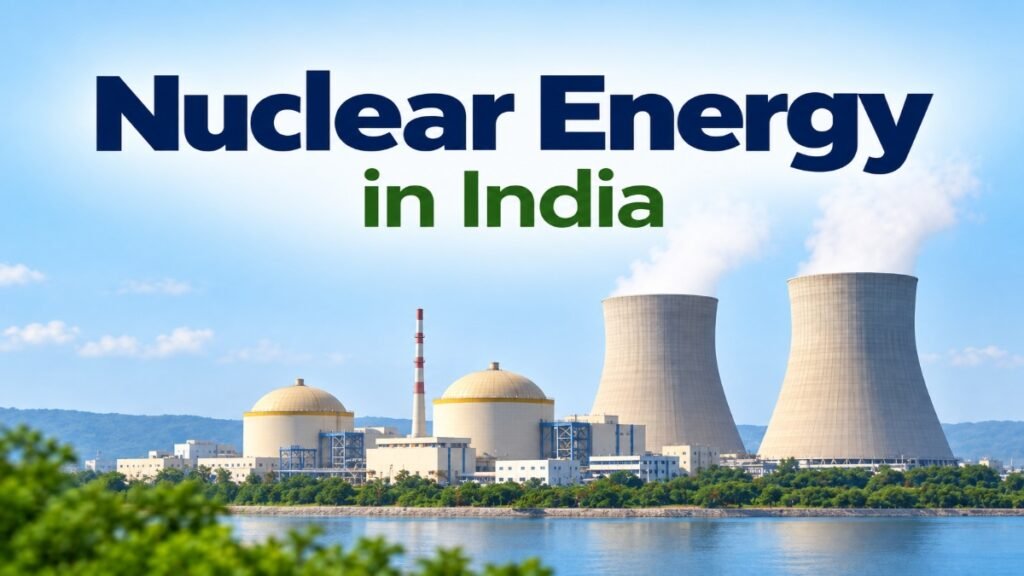
Nuclear Energy in India refers to the use of nuclear reactions to generate electricity and support India’s long-term energy security. Nuclear energy is the energy released from the nucleus (core) of an atom through nuclear reactions. It is one of the most energy-dense sources of power, capable of producing a large amount of electricity from a relatively small quantity of fuel. Nuclear Energy in India has emerged as an important component of the global clean energy transition because it provides low-carbon, reliable, and continuous (base-load) electricity, complementing intermittent renewable sources such as solar and wind.
As the world’s fastest-growing major economy, India’s electricity demand is projected to increase significantly due to rapid industrialisation, urbanisation, digitalisation, and rising living standards. Meeting this demand while reducing dependence on fossil fuels makes Nuclear Energy in India strategically important. India possesses limited reserves of uranium but has one of the world’s largest thorium resources, accounting for nearly one-fourth of global thorium reserves. This unique resource base forms the foundation of India’s long-term nuclear energy strategy envisioned by Dr. Homi Jehangir Bhabha through the Three-Stage Nuclear Power Programme.
Nuclear Energy is Harnessed through Two Processes
Nuclear Fission
- Nuclear fission is the process in which the nucleus of a heavy atom, such as Uranium-235 or Plutonium-239, splits into smaller nuclei after being struck by a neutron.
- This process releases a large amount of heat along with additional neutrons, creating a controlled chain reaction.
- The heat produced is used to generate steam, which drives turbines to produce electricity.
- All commercial nuclear power plants in India currently operate using nuclear fission technology.
Nuclear Fusion
- Nuclear fusion is the process in which two light atomic nuclei combine to form a heavier nucleus, releasing enormous amounts of energy.
- Fusion powers the Sun and other stars and has the potential to provide virtually unlimited, clean energy with minimal radioactive waste.
- However, controlled fusion technology is still under development globally and is not yet commercially available for electricity generation.
Relevance of Nuclear Energy in India
- It strengthens energy security by reducing dependence on imported fossil fuels.
- It supports India’s commitment to achieve Net Zero emissions by 2070 by providing low-carbon electricity.
- It supplies reliable 24×7 base-load power, which complements renewable energy sources.
- It promotes Atmanirbhar Bharat through indigenous reactor technology, fuel cycle development, and utilisation of India’s vast thorium reserves.
- It contributes to sustainable economic growth while balancing the objectives of energy affordability, energy accessibility, and environmental protection.
Master Science & Technology. Maximize Your BPSC Mains Score.
Enroll in the BPSC Science & Tech Course Today
Master Science & Technology for BPSC Mains GS Paper-2 with 75+ exam-oriented topics, 6 structured lessons, and downloadable PDF notes—all in one course.
✔ 75+ Exam-Oriented Topics • ✔ 6 Comprehensive Lessons • ✔ Downloadable PDF Notes • ✔ Updated for 72nd BPSC Mains
2. Status of Nuclear Energy in India
- Nuclear Energy in India is an important component of India’s diversified energy mix, though its contribution to total electricity generation remains modest compared to coal, hydro, and renewable energy.
- As of 2025, India has 24 operational nuclear reactors with a total installed capacity of approximately 8,780 MW (8.78 GW).
- India has 8 nuclear power stations located in Tamil Nadu, Maharashtra, Rajasthan, Gujarat, Uttar Pradesh, Karnataka, Haryana, and Andhra Pradesh.
- India is rapidly expanding Nuclear Energy in India, with 8 reactors (about 6,600 MW) under construction and several more approved by the Government.
- Nuclear power contributes around 3% of India’s total electricity generation and about 1.8% of the country’s installed electricity generation capacity.
Major Nuclear Power Plants in India
- Tarapur Atomic Power Station (Maharashtra) – India’s first nuclear power plant.
- Rajasthan Atomic Power Station (Rajasthan).
- Madras Atomic Power Station, Kalpakkam (Tamil Nadu).
- Narora Atomic Power Station (Uttar Pradesh).
- Kakrapar Atomic Power Station (Gujarat).
- Kaiga Generating Station (Karnataka).
- Kudankulam Nuclear Power Plant (Tamil Nadu) – India’s largest nuclear power station, developed with Russian cooperation.
- Gorakhpur Haryana Anu Vidyut Pariyojana (Haryana) – under construction.
Nuclear Power in India has developed through a combination of indigenous reactor technology and international civil nuclear cooperation. The expansion of Nuclear Power Plants in India is aimed at increasing reliable low-carbon electricity generation while supporting India’s long-term energy security.
Nuclear Energy Notes: For UPSC and BPSC preparation, the status of Nuclear Energy in India, major reactors, installed capacity, and the geographical distribution of Nuclear Power Plants in India are important areas for both Prelims and Mains.
Prepare Smarter. Study Better. Ace BPSC Mains.
BPSC Mains GS Paper 1 & 2 Complete Course
Access comprehensive BPSC Mains Notes for GS Paper 1 & 2, covering 378+ topics across 24 PDF lessons, with dedicated Bihar coverage, practice questions and downloadable study material.
✓ GS Paper 1 & 2 • ✓ 378+ Topics • ✓ 24 PDF Lessons • ✓ Bihar-Specific Coverage • ✓ Downloadable Notes
3. Importance of Nuclear Energy for India
Ensuring Energy Security
India’s electricity demand is increasing rapidly due to industrialisation, urbanisation, electric mobility, digital infrastructure, and rising living standards. At the same time, the country imports a significant proportion of its crude oil, natural gas, and coking coal, making it vulnerable to global price fluctuations and supply disruptions. Nuclear Energy in India diversifies India’s energy basket by reducing dependence on imported fossil fuels and providing a stable domestic source of electricity. It therefore plays a crucial role in strengthening India’s long-term energy security.
Supporting India’s Climate Commitments
Nuclear Energy in India is one of the clean energy options because nuclear power emits negligible greenhouse gases during operation. Expanding nuclear energy will help India reduce the carbon intensity of its economy while meeting its growing electricity demand. It complements India’s commitments under the Paris Agreement, the target of achieving Net Zero emissions by 2070, and the objective of creating a low-carbon energy system under Viksit Bharat 2047.
Providing Reliable Baseload Power
Unlike solar and wind energy, which depend on weather conditions and daylight, Nuclear Power in India can provide continuous electricity throughout the year. This reliable base-load power enhances grid stability and ensures a continuous electricity supply for industries, transport systems, hospitals, defence establishments, and urban centres. Nuclear Energy in India therefore acts as an ideal complement to India’s rapidly expanding renewable energy capacity.
Driving Economic Growth and Industrial Development
Sustained economic growth requires an uninterrupted supply of affordable electricity. Nuclear Energy in India supports energy-intensive sectors such as steel, aluminium, cement, chemicals, fertilisers, semiconductor manufacturing, and data centres. Expansion of the nuclear sector also generates employment in engineering, manufacturing, construction, research, and high-technology industries, while promoting indigenous manufacturing under the Make in India and Atmanirbhar Bharat initiatives.
Promoting Strategic and Technological Self-Reliance
India has developed indigenous expertise in reactor design, heavy water production, nuclear fuel fabrication, reactor operation, and waste management despite decades of international technology restrictions. Indigenous 700 MW Pressurised Heavy Water Reactors (PHWRs), the development of Fast Breeder Reactors (FBRs), and ongoing research on Small Modular Reactors (SMRs) demonstrate India’s growing technological capabilities. These achievements strengthen strategic autonomy and reduce dependence on foreign technology.
Harnessing India’s Vast Thorium Resources
India possesses nearly one-fourth of the world’s known thorium reserves, mainly found along the coastal regions of Kerala, Tamil Nadu, Andhra Pradesh, and Odisha. Although thorium cannot be used directly as reactor fuel, it can be converted into Uranium-233, a valuable nuclear fuel. The successful implementation of the third stage of India’s nuclear programme would enable the country to utilise this abundant domestic resource for centuries, ensuring long-term energy security and reducing dependence on imported uranium.
Enabling Future Clean Energy Applications
Nuclear Energy in India has applications beyond electricity generation. Advanced nuclear reactors can support the production of green hydrogen, seawater desalination, district heating, and industrial process heat for sectors that are difficult to decarbonise. Small Modular Reactors (SMRs) also offer the potential to replace ageing coal-fired power plants and provide reliable electricity to remote regions, thereby contributing to India’s long-term clean energy transition.
Nuclear Energy Benefits therefore extend beyond electricity generation to energy security, industrial development, technological self-reliance and India’s long-term climate objectives. For UPSC and BPSC preparation, these Nuclear Energy Benefits are important dimensions for analysing the strategic significance of Nuclear Energy in India.
4. Challenges in Expansion of Nuclear Energy
High Capital Cost and Long Gestation Period
Nuclear Energy in India requires substantial upfront investment and nuclear power projects typically take 8–15 years from planning to commercial operation due to complex regulatory approvals, safety requirements, and construction challenges. Although nuclear plants have relatively low operating costs and long service lives, the high initial capital requirement often delays project execution and increases the cost of electricity. Cost overruns witnessed in several international nuclear projects have also made investors cautious.
Nuclear Safety and Risk of Accidents
Although modern nuclear reactors incorporate multiple safety systems, the possibility of severe accidents cannot be completely eliminated. Incidents such as the Chernobyl disaster (Ukraine, 1986) and the Fukushima Daiichi accident (Japan, 2011) demonstrated that reactor failures can have long-lasting environmental, health, and economic consequences. These events have increased global concerns regarding reactor safety, emergency preparedness, and disaster management. In India, the Atomic Energy Regulatory Board (AERB) enforces stringent safety standards, and no major nuclear accident has occurred in commercial nuclear power plants.
Radioactive Waste Management
Spent nuclear fuel remains radioactive for thousands of years and requires safe handling, transportation, reprocessing, and long-term disposal. Developing secure storage facilities and geological repositories is technically challenging and expensive. Although India follows a closed nuclear fuel cycle, which reprocesses spent fuel to recover usable materials and reduces waste volume, safe disposal of high-level radioactive waste remains a long-term responsibility.
Nuclear Fuel Constraints
India possesses limited high-grade uranium reserves, making it dependent on imports from countries such as Kazakhstan, Canada, Australia, Russia, and Uzbekistan to meet part of its fuel requirements. While international civil nuclear agreements have improved fuel availability, long-term energy security depends on expanding domestic uranium mining and successfully implementing the thorium-based third stage of the nuclear programme.
Slow Progress of the Three-Stage Nuclear Programme
India’s long-term nuclear strategy is based on utilising its abundant thorium reserves through a three-stage programme. However, the commercial deployment of Fast Breeder Reactors (FBRs) and thorium-based reactors has progressed more slowly than originally envisioned because of technological complexity, prolonged testing, and high development costs. This has delayed the large-scale utilisation of India’s vast thorium resources.
Civil Liability Issues
The Civil Liability for Nuclear Damage Act, 2010 provides compensation to victims in the event of a nuclear accident and allows the operator a limited right of recourse against suppliers under specified conditions. Several foreign reactor manufacturers have expressed concerns regarding these liability provisions, which has slowed the pace of international nuclear collaborations and private investment in the sector.
Public Opposition and Land Acquisition
Many proposed nuclear projects have faced resistance from local communities due to concerns over radiation exposure, displacement, environmental impacts, and livelihood loss. Protests have been witnessed at projects such as Kudankulam (Tamil Nadu) and Jaitapur (Maharashtra). Delays arising from land acquisition disputes, environmental clearances, and public consultations often increase project costs and postpone commissioning.
Environmental and Ecological Concerns
Nuclear power plants require large quantities of water for cooling, making site selection dependent on reliable water sources. Thermal discharge into nearby water bodies must be carefully regulated to minimise ecological impacts. Additionally, extreme weather events, rising sea levels, earthquakes, and cyclones associated with climate change necessitate robust reactor design and site-specific disaster preparedness measures.
Limited Private Sector Participation
The Atomic Energy Act, 1962, restricts the ownership and operation of nuclear power plants primarily to government entities. Consequently, the private sector has only a limited role in manufacturing equipment and providing engineering services. This limits competition, reduces access to private capital, and slows capacity expansion. However, the Government has recently initiated steps to increase private sector participation, particularly in the development of Small Modular Reactors (SMRs).
International Technology and Geopolitical Constraints
Despite the India–US Civil Nuclear Agreement (2008) and the waiver granted by the Nuclear Suppliers Group (NSG), India continues to face restrictions in accessing certain advanced nuclear technologies because it is not a member of the NSG. Geopolitical tensions, export control regimes, and disruptions in global supply chains can also affect the availability of nuclear fuel, reactor components, and advanced technologies.
Shortage of Skilled Human Resources
The expansion of Nuclear Energy in India requires a large pool of highly trained scientists, engineers, technicians, radiation safety experts, and regulatory professionals. Strengthening institutions involved in nuclear education, research, and skill development is essential to support future reactor construction, operation, and maintenance.
For UPSC and BPSC aspirants, these challenges provide important dimensions for analysing Nuclear Energy in India, particularly in questions related to energy security, climate change, technology, safety and sustainable development. Nuclear Energy Notes should therefore cover both the potential and limitations of India’s nuclear programme.
5. Government Initiatives and Future Roadmap
Three-Stage Nuclear Power Programme
India’s long-term nuclear strategy, conceived by Dr. Homi J. Bhabha, aims to achieve energy security by optimally utilising the country’s limited uranium reserves and abundant thorium resources. The programme progresses from Pressurised Heavy Water Reactors (PHWRs) using natural uranium to Fast Breeder Reactors (FBRs) and finally to thorium-based reactors using Uranium-233. This indigenous strategy is unique to India and is designed to provide sustainable Nuclear Energy in India for the long term.
Expansion of Indigenous 700 MW PHWR Fleet
The Government has adopted the 700 MW Pressurised Heavy Water Reactor (PHWR) as the standard design for future nuclear expansion. The successful commissioning of Kakrapar Atomic Power Station Units 3 and 4 has demonstrated India’s indigenous capability in reactor design and construction.
To accelerate capacity addition, the Government has approved fleet-mode construction of multiple 700 MW PHWRs. This approach reduces construction time, lowers costs through standardisation, and promotes indigenous manufacturing under the Atmanirbhar Bharat initiative.
Development of Bharat Small Modular Reactor (BSMR)
Recognising the global shift towards flexible and safer nuclear technologies, India is developing the Bharat Small Modular Reactor (BSMR). These reactors are expected to:
- Supply reliable electricity to industries and remote regions.
- Replace ageing coal-fired thermal power plants.
- Support production of clean hydrogen and industrial process heat.
- Reduce construction time and capital investment compared to conventional large reactors.
The Government is also exploring wider participation of the private sector and public sector enterprises in the development and deployment of SMRs.
Fast Breeder Reactor and Thorium Development
The 500 MW Prototype Fast Breeder Reactor (PFBR) at Kalpakkam, Tamil Nadu, developed by BHAVINI, is a major milestone in India’s second-stage nuclear programme. Once fully operational, it will produce more fissile material than it consumes, thereby improving fuel efficiency.
Simultaneously, the Bhabha Atomic Research Centre (BARC) continues research on the Advanced Heavy Water Reactor (AHWR), designed to utilise thorium as the primary fuel. India also operates the KAMINI reactor at Kalpakkam, the world’s only reactor fuelled by Uranium-233, demonstrating the country’s progress in thorium research.
Strengthening Nuclear Infrastructure and Capacity Expansion
The Government has approved construction of several new nuclear reactors across states such as Rajasthan, Haryana, Karnataka, Gujarat, Madhya Pradesh, and Tamil Nadu.
The Nuclear Power Corporation of India Limited (NPCIL) has entered into partnerships with major Public Sector Undertakings such as NTPC Limited and Indian Oil Corporation Limited (IOCL) to accelerate nuclear power deployment, improve financing, and expand technical collaboration.
International Civil Nuclear Cooperation
Following the India–US Civil Nuclear Agreement (2008) and the NSG waiver, India has significantly expanded international cooperation in the peaceful use of nuclear energy. Key developments include:
- Russia’s collaboration in the Kudankulam Nuclear Power Project.
- Ongoing cooperation with France for the proposed Jaitapur Nuclear Power Project, expected to become one of the world’s largest nuclear power parks.
- Civil nuclear agreements with countries including Australia, Canada, Kazakhstan, and Uzbekistan for the supply of uranium fuel.
- Active cooperation with the International Atomic Energy Agency (IAEA) in nuclear safety, safeguards, and technical capacity building.
Nuclear Energy Mission and Policy Reforms
Recognising Nuclear Energy in India as a key pillar of India’s clean energy transition, the Government has announced a Nuclear Energy Mission to accelerate research, innovation, and deployment of advanced nuclear technologies. Recent policy initiatives focus on:
- Accelerating reactor construction through streamlined approvals.
- Promoting indigenous manufacturing of nuclear equipment.
- Encouraging research in advanced fuels and reactor technologies.
- Expanding domestic uranium exploration and mining.
- Enhancing private sector participation in non-strategic segments of the nuclear value chain, particularly for SMRs and component manufacturing.
Nuclear Energy for Net Zero and Viksit Bharat 2047
Nuclear Energy in India has become an integral component of India’s long-term energy strategy to achieve Net Zero emissions by 2070 while ensuring energy security and economic growth. It complements renewable energy by providing reliable base-load electricity and supports emerging sectors such as green hydrogen, electric mobility, data centres, semiconductor manufacturing, and artificial intelligence infrastructure.
The Government envisions Nuclear Energy in India as an essential contributor to Viksit Bharat 2047, enabling sustainable industrialisation, technological self-reliance, and a resilient low-carbon economy.
The Future of Nuclear Energy in India will depend on the successful expansion of indigenous reactor capacity, development of SMRs, progress in the three-stage nuclear programme, and continued investment in nuclear research and infrastructure. For UPSC and BPSC aspirants, these developments are important components of Nuclear Energy Notes.
6. Conclusion
Nuclear Energy in India has emerged as a strategic pillar of India’s long-term energy security, clean energy transition, and sustainable economic development. While renewable energy will remain the backbone of India’s future energy mix, Nuclear Energy in India is indispensable for providing reliable 24×7 low-carbon base-load electricity required for a rapidly growing economy.
Going forward, India must accelerate indigenous reactor construction, operationalise the three-stage nuclear programme, expand Small Modular Reactors (SMRs), harness its vast thorium reserves, and strengthen nuclear safety and waste management systems. Greater investment in research, skilled manpower, and international cooperation will further enhance the sector’s growth.
A balanced expansion of Nuclear Energy in India, alongside renewable sources and energy efficiency, will be crucial for achieving Net Zero emissions by 2070, ensuring energy independence, and realising the vision of Viksit Bharat 2047.
Nuclear Energy Benefits therefore need to be assessed alongside issues of safety, cost, waste management, technology and public participation. The Future of Nuclear Energy in India will depend on how effectively India balances these opportunities and challenges while building a secure, affordable and low-carbon energy system.
BPSC Mains Practice Questions
- “Nuclear energy is indispensable for India’s transition towards a low-carbon and energy-secure economy.” Examine the significance of Nuclear Energy in India in meeting rising electricity demand, ensuring energy security, supporting Net Zero 2070, and complementing renewable energy. Also discuss the major challenges associated with its expansion.
- India’s Three-Stage Nuclear Power Programme represents a long-term strategy for achieving energy security through the optimal utilisation of uranium and thorium resources. Explain the three stages of the programme and critically examine the progress, technological challenges, and future prospects of India’s nuclear energy programme.
- “The expansion of Nuclear Energy in India requires a balance between technological ambition, economic viability, public confidence, and environmental safety.” Discuss the challenges relating to nuclear safety, radioactive waste management, civil liability, high capital costs, land acquisition, private sector participation, and international cooperation. Suggest a suitable roadmap for the Future of Nuclear Energy in India.
Learn More About Nuclear Energy in India
For official information on Nuclear Energy in India, nuclear power projects, nuclear reactors, nuclear safety, and India’s nuclear energy programme, visit the Department of Atomic Energy (DAE), Government of India official website: Department of Atomic Energy – Government of India