1. Introduction
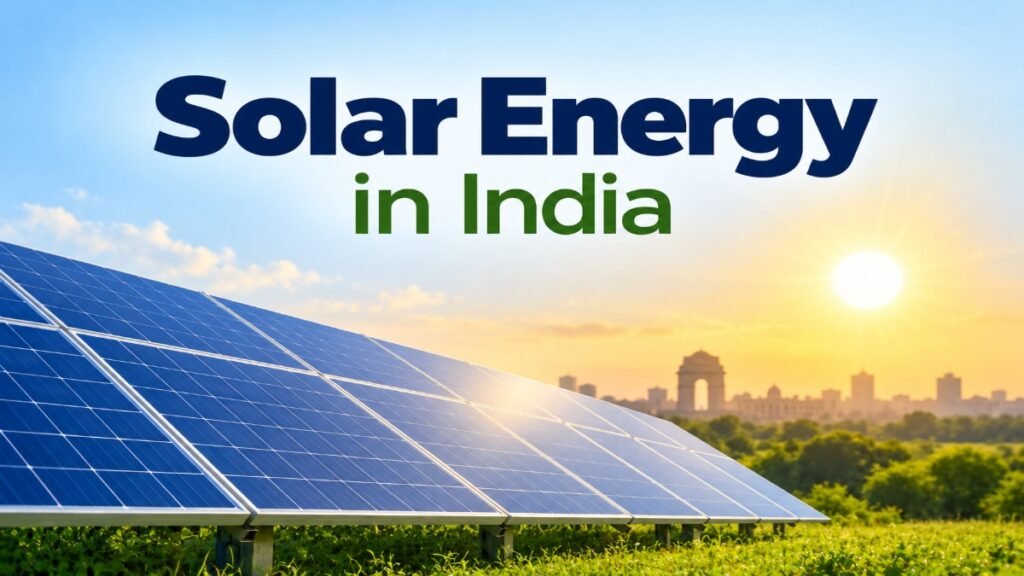
Solar Energy in India is the energy obtained from the Sun’s radiation and converted into usable forms such as electricity and heat through technologies like Solar Photovoltaic (PV) and Concentrated Solar Power (CSP). It is a clean, renewable, and inexhaustible source of energy that plays a crucial role in reducing greenhouse gas emissions and ensuring long-term energy security.
India is naturally endowed with abundant solar resources. According to the Ministry of New and Renewable Energy (MNRE), the country receives nearly 5,000 trillion kWh of solar energy annually, with most regions receiving 4–7 kWh of solar radiation per square metre per day and 250–300 sunny days every year. The National Institute of Solar Energy (NISE) has estimated India’s technical solar potential at around 748 GW, making it one of the most promising countries for solar power generation. This Solar Energy Potential in India provides a strong foundation for expanding Solar Power in India.
Recognising this immense potential, Solar Energy in India has become the backbone of India’s clean energy transition. As of 30 June 2026, India has installed 162.15 GW of solar power capacity, making solar the largest contributor to the country’s renewable energy capacity. Solar Power Capacity in India is expected to grow further and play a central role in achieving India’s targets of 500 GW non-fossil fuel-based electricity capacity by 2030, around 50% cumulative installed electric power capacity from non-fossil sources by 2030, and Net Zero emissions by 2070. These commitments make Solar Energy in India a cornerstone of India’s future energy policy.
Master Science & Technology. Maximize Your BPSC Mains Score.
Enroll in the BPSC Science & Tech Course Today
Master Science & Technology for BPSC Mains GS Paper-2 with 75+ exam-oriented topics, 6 structured lessons, and downloadable PDF notes—all in one course.
✔ 75+ Exam-Oriented Topics • ✔ 6 Comprehensive Lessons • ✔ Downloadable PDF Notes • ✔ Updated for 72nd BPSC Mains
2. Solar Energy Potential in India
Solar Radiation in India
- Solar Energy in India receives approximately 5,000 trillion kWh of solar energy every year, making solar one of the country’s most abundant renewable energy resources.
- Most parts of the country receive 4–7 kWh of solar radiation per square metre per day, which is sufficient for efficient electricity generation through solar photovoltaic systems. This highlights the significant Solar Energy Potential in India.
- India experiences nearly 250–300 sunny days annually, providing favourable conditions for year-round Solar Power in India generation.
- According to the National Institute of Solar Energy (NISE), the country’s estimated technical Solar Power Capacity in India potential is around 748 GW, based on the utilisation of nearly 3% of wasteland.
Geographical Advantage
- India’s location between the Tropic of Cancer and the Equator provides high solar insolation throughout the year, making it one of the most suitable countries for harnessing Solar Energy in India.
- The country possesses vast stretches of arid and semi-arid land that are ideal for establishing large utility-scale solar parks.
- Desert regions of Rajasthan and Gujarat, along with plateau regions of Madhya Pradesh, Maharashtra, Andhra Pradesh and Karnataka, offer excellent conditions for large-scale solar projects.
- India’s favourable climatic conditions significantly reduce seasonal variations in solar energy generation compared to many temperate countries.
State-wise Solar Potential
- Rajasthan possesses the highest estimated solar potential in India, with about 142 GW, owing to its vast desert landscape and high solar irradiation.
- Jammu & Kashmir (including Ladakh) has an estimated potential of around 111 GW, supported by high solar radiation and clear atmospheric conditions.
- Maharashtra and Madhya Pradesh have estimated solar potentials of about 64 GW and 62 GW, respectively, making them important destinations for future solar investments.
- States such as Andhra Pradesh, Gujarat, Karnataka and Tamil Nadu have also emerged as major contributors to India’s installed solar capacity because of favourable policies and infrastructure.
India’s Global Position
- Solar Power in India has emerged as one of the world’s leading solar energy producers through rapid expansion of solar power infrastructure.
- According to the Ministry of New and Renewable Energy (MNRE), India’s installed Solar Power Capacity in India reached 162.15 GW as on 30 June 2026, accounting for nearly 56% of the country’s total renewable energy capacity.
- India is a founding member of the International Solar Alliance (ISA), which promotes global cooperation in solar energy deployment among sunshine-rich countries.
Future Growth Potential
- Despite remarkable progress, only a fraction of India’s estimated 748 GW technical solar potential has been utilised, indicating enormous scope for future expansion of Solar Energy in India.
- Government initiatives such as PM Surya Ghar: Muft Bijli Yojana, PM-KUSUM, Solar Park Scheme, and the PLI Scheme for Solar PV Modules are expected to accelerate Solar Power in India capacity addition.
- Emerging technologies such as floating solar plants, agrivoltaics, bifacial solar modules, Battery Energy Storage Systems (BESS), and green hydrogen are likely to further enhance the utilisation of India’s Solar Energy Potential in India.
- Continued investment in domestic manufacturing, transmission infrastructure, and energy storage will enable India to maximise its solar energy potential while strengthening energy security and supporting its Net Zero 2070 commitment.
These points are particularly important for Solar Energy UPSC preparation and can also serve as concise Solar Energy Notes for BPSC and other competitive examinations.
Prepare Smarter. Study Better. Ace BPSC Mains.
BPSC Mains GS Paper 1 & 2 Complete Course
Access comprehensive BPSC Mains Notes for GS Paper 1 & 2, covering 378+ topics across 24 PDF lessons, with dedicated Bihar coverage, practice questions and downloadable study material.
✓ GS Paper 1 & 2 • ✓ 378+ Topics • ✓ 24 PDF Lessons • ✓ Bihar-Specific Coverage • ✓ Downloadable Notes
3. Types of Solar Energy Technologies
Solar Photovoltaic (PV) Technology
- Solar Energy in India is primarily harnessed through Solar Photovoltaic (PV) technology, which converts sunlight directly into electricity using solar cells.
- It is the most widely used solar technology in India due to its high efficiency, declining costs, and ease of installation, making it central to the expansion of Solar Power in India.
- It is used in utility-scale solar parks, rooftop solar systems, street lighting, irrigation pumps, and household electricity generation.
- Solar PV accounts for the overwhelming majority of India’s installed solar power capacity and therefore forms the backbone of Solar Energy in India.
Concentrated Solar Power (CSP)
- Concentrated Solar Power (CSP) uses mirrors to concentrate sunlight and produce heat, which is then used to generate electricity.
- Unlike Solar PV, CSP can store heat for a limited period, enabling electricity generation even after sunset.
- Due to high investment costs and water requirements, CSP has seen limited deployment in India compared to Solar PV.
- The development of CSP remains relevant for diversifying Solar Energy in India and expanding India’s long-term solar technology options.
Rooftop Solar Systems
- Rooftop solar systems are installed on residential, commercial, industrial, and institutional buildings to generate electricity for local consumption.
- They reduce electricity bills, lower transmission losses, and promote decentralised power generation.
- The PM Surya Ghar: Muft Bijli Yojana has significantly accelerated the adoption of rooftop solar across the country.
- Rooftop solar is an important component of Solar Power in India, particularly for increasing decentralised Solar Power Capacity in India.
Floating Solar Power Plants
- Floating solar plants are installed on reservoirs, lakes, dams, and other water bodies instead of land.
- They help conserve land resources, reduce water evaporation, and improve the efficiency of solar panels due to the cooling effect of water.
- India is increasingly promoting floating solar projects on reservoirs managed by NTPC, NHPC, and state utilities.
- Floating solar can help utilise India’s large water resources while expanding Solar Energy in India without placing additional pressure on available land.
Agrivoltaics (Solar Farming)
- Agrivoltaics combines agriculture with solar power generation by installing solar panels above or alongside agricultural land.
- It enables farmers to generate electricity while continuing crop cultivation on the same land.
- This approach increases farmers’ income, improves land-use efficiency, and supports sustainable agriculture.
- Agrivoltaics can therefore contribute to the future Solar Energy Potential in India, particularly in agricultural regions.
Emerging Solar Technologies
- India is promoting advanced solar technologies such as bifacial solar panels, perovskite solar cells, thin-film solar cells, and Building Integrated Photovoltaics (BIPV).
- These technologies aim to improve energy efficiency, reduce production costs, and enhance domestic manufacturing under the Make in India initiative.
- Continued research and innovation are expected to make next-generation solar technologies more commercially viable in the coming years.
- Adoption of these technologies can further strengthen Solar Energy in India, increase Solar Power Capacity in India, and support India’s long-term clean energy transition.
These technologies form an important part of Solar Energy UPSC preparation and provide useful Solar Energy Notes for understanding India’s transition towards large-scale solar power.
4. Current Status of Solar Energy in India (Latest MNRE Data)
- As per the Ministry of New and Renewable Energy (MNRE), India’s installed solar power capacity reached 162.15 GW as on 30 June 2026, making solar the largest source of renewable energy in the country. This rapid expansion highlights the growing importance of Solar Energy in India.
- Solar Power Capacity in India accounts for nearly 56% of India’s total installed renewable energy capacity, reflecting the dominant role of solar power in India’s clean energy transition.
- Solar Power in India has emerged as the third-largest solar power producer in the world and continues to be one of the fastest-growing solar markets globally.
- Rajasthan is the leading solar power-producing state, followed by Gujarat, Karnataka, Tamil Nadu, and Maharashtra.
- The Bhadla Solar Park (Rajasthan), with a capacity of about 2.25 GW, is among the largest operational solar parks in the world.
- The Khavda Renewable Energy Park (Gujarat) is under development and is expected to become the world’s largest renewable energy park, with a planned capacity of 30 GW, of which solar will constitute a major share.
- Rooftop solar adoption has accelerated significantly following the launch of the PM Surya Ghar: Muft Bijli Yojana, which aims to install rooftop solar systems in 1 crore households.
- India is rapidly expanding domestic manufacturing of solar cells, photovoltaic modules, and related components under the Production Linked Incentive (PLI) Scheme to reduce dependence on imports and strengthen Solar Power in India.
- To ensure reliable utilisation of solar power, the Government is promoting Battery Energy Storage Systems (BESS), Green Energy Corridors, and smart grid infrastructure.
The rapid growth in Solar Power Capacity in India, combined with India’s large Solar Energy Potential in India, makes Solar Energy in India a crucial topic for Solar Energy UPSC preparation and Solar Energy Notes for BPSC/UPSC examinations.
5. Advantages of Solar Energy
Clean and Environment-friendly Energy
- Solar Energy in India generates electricity without emitting greenhouse gases or air pollutants during operation, making it one of the cleanest energy sources.
- It contributes significantly to reducing carbon emissions and improving air quality, thereby supporting India’s commitments under the Paris Agreement and Net Zero by 2070.
- According to the International Energy Agency (IEA), solar PV has become one of the most effective technologies for decarbonising the power sector.
- The expansion of Solar Power in India therefore directly supports India’s transition towards a cleaner and lower-carbon energy system.
Energy Security
- Solar Energy in India reduces India’s dependence on imported fossil fuels such as crude oil, coal, and natural gas, thereby enhancing national energy security.
- India imports nearly 85% of its crude oil requirement, making diversification towards domestic renewable energy strategically important.
- Expansion of Solar Power in India strengthens long-term energy independence and protects the economy from fluctuations in global fuel prices.
- India’s vast Solar Energy Potential in India provides an opportunity to increase domestic energy generation and reduce import dependence.
Economic Growth and Employment
- The rapid expansion of Solar Energy in India has attracted substantial domestic and foreign investments while creating employment in manufacturing, installation, operation, and maintenance.
- Government initiatives such as the PLI Scheme for Solar PV Modules and PM Surya Ghar are promoting domestic manufacturing under the Make in India initiative.
- According to the International Renewable Energy Agency (IRENA), the renewable energy sector supports millions of jobs globally, with solar PV accounting for the largest share.
- Growth in Solar Power Capacity in India can further stimulate investment, manufacturing, innovation, and employment opportunities.
Rural Development and Agricultural Growth
- Solar Power in India improves electricity access in rural and remote areas through decentralised generation systems.
- The PM-KUSUM Scheme promotes solar-powered irrigation pumps, reducing farmers’ dependence on diesel and lowering irrigation costs.
- Solar energy also creates additional income opportunities for farmers through agrivoltaics and decentralised solar power generation.
- Thus, Solar Energy in India can contribute to rural development while strengthening India’s agricultural energy security.
Cost-effective and Sustainable Energy Source
- The cost of solar electricity has declined sharply over the past decade due to technological advancements, economies of scale, and supportive government policies.
- Solar power plants have relatively low operation and maintenance costs compared to conventional thermal power plants.
- Since sunlight is freely available, Solar Energy in India offers a sustainable long-term solution to meet India’s growing electricity demand.
- The continued decline in technology costs can help accelerate Solar Power Capacity in India.
Supports Climate Change Mitigation
- Solar Energy in India plays a vital role in reducing dependence on fossil fuel-based electricity generation, thereby lowering greenhouse gas emissions.
- It is expected to contribute significantly towards India’s target of achieving 500 GW non-fossil fuel-based electricity capacity by 2030.
- Large-scale deployment of Solar Power in India supports global efforts to limit the rise in average global temperature under the Paris Climate Agreement.
- India’s abundant Solar Energy Potential in India, combined with supportive policies and technological development, makes solar energy an important instrument for achieving long-term climate goals.
These advantages make Solar Energy in India an important area for Solar Energy UPSC preparation. The economic, environmental and energy-security dimensions are also essential components of comprehensive Solar Energy Notes for BPSC and UPSC examinations.
6. Government Initiatives for Solar Energy
Jawaharlal Nehru National Solar Mission (JNNSM) – 2010
- The Jawaharlal Nehru National Solar Mission (JNNSM) was launched in 2010 as a major initiative to promote Solar Energy in India.
- It aimed to promote large-scale development of solar power, reduce the cost of solar energy, and establish India as a global leader in solar energy.
- The mission played an important role in creating the policy and institutional framework for the expansion of Solar Power in India.
- JNNSM laid the foundation for the rapid increase in Solar Power Capacity in India.
PM Surya Ghar: Muft Bijli Yojana (2024)
- The PM Surya Ghar: Muft Bijli Yojana was launched in 2024 to promote rooftop solar installations among households.
- The scheme aims to install rooftop solar systems in 1 crore households and provide financial assistance to eligible households.
- It promotes decentralised Solar Energy in India and helps households generate their own electricity.
- The scheme is expected to increase Solar Power in India while reducing household electricity expenditure.
PM-KUSUM
- The PM-KUSUM Scheme promotes the use of solar energy in the agricultural sector.
- It supports the installation of solar pumps and decentralised solar power plants for farmers.
- The scheme reduces farmers’ dependence on diesel for irrigation and promotes clean and reliable energy.
- PM-KUSUM helps utilise India’s Solar Energy Potential in India for agricultural development and rural energy security.
Solar Park Scheme
- The Solar Park Scheme promotes the development of large-scale solar parks with common infrastructure and facilities.
- It facilitates faster development of solar projects by providing land and supporting infrastructure.
- Large solar parks contribute significantly to increasing Solar Power Capacity in India.
- The scheme has supported the development of major solar projects across different states.
Grid Connected Rooftop Solar Programme (Phase-II)
- The Grid Connected Rooftop Solar Programme (Phase-II) promotes rooftop solar systems connected to the electricity grid.
- It provides financial assistance and incentives to encourage rooftop solar adoption.
- Rooftop solar reduces transmission losses and enables consumers to generate electricity locally.
- It is an important component of decentralised Solar Energy in India.
PLI Scheme for High Efficiency Solar PV Modules
- The Production Linked Incentive (PLI) Scheme promotes domestic manufacturing of high-efficiency solar PV modules.
- It aims to strengthen India’s solar manufacturing ecosystem and reduce dependence on imported solar components.
- The scheme supports domestic production of solar cells, modules and related components.
- Strengthening domestic manufacturing is essential for the sustainable expansion of Solar Power in India and Solar Power Capacity in India.
Approved List of Models and Manufacturers (ALMM)
- The Approved List of Models and Manufacturers (ALMM) is aimed at ensuring the quality and reliability of solar PV modules used in government-supported projects.
- Only approved models and manufacturers meeting specified standards are eligible for certain government and grid-connected projects.
- ALMM supports quality assurance and promotes a more reliable domestic solar manufacturing ecosystem.
- It therefore contributes to the long-term development of Solar Energy in India.
International Solar Alliance (ISA)
- The International Solar Alliance (ISA) was launched jointly by India and France in 2015 to promote greater deployment of solar energy globally.
- Its objective is to facilitate cooperation among solar-rich countries, mobilise investment, promote technology transfer, and accelerate solar deployment.
- India plays an important role in promoting international cooperation through the ISA.
- The initiative strengthens India’s global leadership in Solar Power in India and solar energy diplomacy.
One Sun, One World, One Grid (OSOWOG)
- One Sun, One World, One Grid (OSOWOG) is an initiative promoted by India to develop interconnected electricity grids across regions and countries.
- It seeks to enable the transfer of renewable electricity across geographical regions based on the availability of sunlight and demand.
- OSOWOG can improve the utilisation of solar resources and support global clean-energy integration.
- The initiative reflects India’s broader vision of expanding Solar Energy in India and promoting international cooperation in renewable energy.
These government initiatives have created a supportive policy framework for expanding Solar Power in India, increasing Solar Power Capacity in India, and utilising the country’s Solar Energy Potential in India. They are important areas for Solar Energy UPSC preparation and should be included in comprehensive Solar Energy Notes for BPSC and UPSC examinations.
7. Challenges in Solar Energy Development
High Initial Investment
- The development of large-scale solar projects requires substantial initial investment in land, solar modules, inverters, transmission infrastructure, and other equipment.
- Although the cost of solar electricity has declined significantly, the high upfront cost can remain a barrier, particularly for small consumers and distributed projects.
- Financing constraints can slow the expansion of Solar Energy in India, especially in regions where access to affordable capital is limited.
Intermittent Nature of Solar Energy
- Solar power generation depends on sunlight and therefore varies with day-night cycles, weather conditions, and seasonal changes.
- Solar plants cannot generate electricity continuously, creating challenges for maintaining a reliable electricity supply.
- The intermittent nature of solar power increases the need for flexible generation, energy storage, and better grid management.
- Managing this intermittency is an important challenge for expanding Solar Power in India.
Limited Energy Storage Infrastructure
- Large-scale deployment of solar energy requires adequate energy storage systems to store surplus electricity generated during periods of high solar radiation.
- India’s storage infrastructure is still developing, particularly for long-duration energy storage.
- High battery costs and dependence on critical minerals can increase the overall cost of solar projects.
- Expanding storage capacity is therefore essential for efficiently utilising India’s Solar Energy Potential in India.
Land Acquisition and Environmental Concerns
- Large solar parks require considerable amounts of land, which can create conflicts with agriculture, grazing areas, forests, and other land uses.
- Poorly planned solar projects may affect local ecosystems and biodiversity.
- Land acquisition and environmental concerns can delay projects and increase their costs.
- Therefore, sustainable land-use planning is necessary for the future expansion of Solar Energy in India.
Grid Integration Challenges
- Rapid growth in solar generation requires adequate transmission and distribution infrastructure to transfer electricity from solar-rich regions to demand centres.
- Many solar projects are located in areas such as Rajasthan and Gujarat, while major electricity demand exists across different parts of the country.
- Grid congestion, transmission constraints, and fluctuations in solar generation can create difficulties in integrating large quantities of solar power.
- Strengthening transmission networks and smart-grid infrastructure is essential for increasing Solar Power Capacity in India.
Dependence on Imported Components
- India’s solar industry has historically depended significantly on imports for several critical components and raw materials.
- Dependence on external supply chains can expose the domestic solar sector to international price fluctuations, trade restrictions, and supply disruptions.
- Although initiatives such as the PLI Scheme are promoting domestic manufacturing, further development of the complete solar manufacturing ecosystem is required.
- Reducing import dependence is important for the long-term growth of Solar Power in India.
Operation and Maintenance Issues
- Solar plants require regular cleaning, inspection, monitoring, and maintenance to maintain efficient power generation.
- Dust accumulation on solar panels can reduce their efficiency, particularly in arid and semi-arid regions.
- Extreme weather conditions and equipment degradation can also affect the performance and lifespan of solar installations.
- Developing efficient operation and maintenance systems is therefore necessary to sustain the growth of Solar Energy in India.
Solar Panel Waste Management
- The rapid expansion of solar installations will generate increasing quantities of end-of-life solar panels in the coming decades.
- Solar panels contain materials such as glass, aluminium, silicon, and other components that require appropriate recycling and disposal.
- Inadequate recycling infrastructure can create environmental and resource-recovery challenges.
- Developing a circular economy for solar equipment is essential for ensuring the long-term sustainability of Solar Energy in India.
These challenges need to be addressed to fully utilise the Solar Energy Potential in India and achieve sustained growth in Solar Power Capacity in India. Understanding these issues is important for Solar Energy UPSC preparation and comprehensive Solar Energy Notes for BPSC and UPSC examinations.
8. Way Forward
Expand Domestic Manufacturing
- India should further strengthen domestic manufacturing of solar cells, photovoltaic modules, inverters, and other components to reduce dependence on imports.
- The PLI Scheme should be effectively implemented to develop an integrated domestic solar manufacturing ecosystem.
- Strengthening domestic manufacturing will improve supply-chain resilience and support the long-term expansion of Solar Energy in India.
Promote Energy Storage
- Greater investment is required in Battery Energy Storage Systems (BESS) and other storage technologies to address the intermittent nature of solar power.
- Affordable and efficient storage solutions can enable surplus solar electricity generated during the daytime to be used during periods of low or no sunlight.
- Expansion of storage infrastructure will improve the reliability of Solar Power in India and facilitate higher Solar Power Capacity in India.
Strengthen Grid Infrastructure
- India needs to strengthen transmission and distribution networks to efficiently integrate increasing quantities of solar electricity into the national grid.
- Green Energy Corridors, smart grids, and advanced forecasting systems should be expanded to manage fluctuations in solar generation.
- Better grid infrastructure will help utilise India’s Solar Energy Potential in India more efficiently.
Promote Rooftop and Decentralised Solar
- Greater emphasis should be placed on rooftop solar systems, decentralised solar plants, and community-based solar projects.
- Schemes such as PM Surya Ghar: Muft Bijli Yojana should be implemented effectively to increase household-level solar adoption.
- Decentralised Solar Energy in India can reduce transmission losses, improve energy access, and empower consumers to generate their own electricity.
Encourage Innovation and Research
- Greater investment in research and development is required for high-efficiency solar cells, advanced storage technologies, floating solar, agrivoltaics, and next-generation photovoltaic technologies.
- Collaboration among government institutions, universities, research organisations, and private companies should be strengthened.
- Technological innovation can reduce costs and improve the efficiency and reliability of Solar Power in India.
Develop a Circular Solar Economy
- India should develop a comprehensive ecosystem for the recycling, reuse, and safe disposal of solar panels and other solar equipment.
- Recycling can recover valuable materials and reduce the environmental impact of increasing solar panel waste.
- A circular economy approach will make the long-term expansion of Solar Energy in India more sustainable.
Enhance Private Sector Participation
- Greater participation of private companies should be encouraged through stable policies, transparent regulations, easier financing, and predictable investment conditions.
- Public-private partnerships can support the development of large solar parks, rooftop systems, storage infrastructure, and domestic manufacturing.
- Increased private investment can accelerate the growth of Solar Power Capacity in India.
Build Skilled Human Resources
- India needs a skilled workforce for solar manufacturing, installation, operation, maintenance, research, and recycling.
- Skill-development programmes should be expanded to create trained technicians, engineers, and other professionals for the growing renewable energy sector.
- Building human-resource capacity will support the sustainable expansion of Solar Energy in India and create additional employment opportunities.
A coordinated approach involving domestic manufacturing, energy storage, grid modernisation, decentralised generation, technological innovation, recycling, private investment, and skill development is essential to realise India’s Solar Energy Potential in India. These measures can strengthen Solar Power in India, accelerate Solar Power Capacity in India, and remain important areas for Solar Energy UPSC and Solar Energy Notes preparation.
9. Conclusion
Solar Energy in India has emerged as a key pillar of India’s renewable energy transition due to the country’s abundant solar radiation, declining technology costs, and supportive government policies. The rapid growth of Solar Power Capacity in India reflects India’s increasing focus on clean energy, energy security, and climate change mitigation.
India’s large Solar Energy Potential in India provides significant opportunities for economic growth, employment generation, rural development, and reduction of dependence on fossil fuels. Initiatives such as PM Surya Ghar, PM-KUSUM, the Solar Park Scheme, PLI Scheme, and the International Solar Alliance have further strengthened the development of Solar Power in India.
However, challenges related to intermittency, energy storage, land requirements, grid integration, imported components, and solar panel waste need to be addressed. Strengthening domestic manufacturing, expanding energy storage, modernising grid infrastructure, promoting rooftop solar, encouraging innovation, and developing a circular solar economy can ensure sustainable growth.
Overall, Solar Energy in India can play a crucial role in meeting India’s rising energy demand while supporting its long-term climate and clean-energy objectives. The topic is highly relevant for Solar Energy UPSC preparation and should form an important part of Solar Energy Notes for BPSC and UPSC examinations.
BPSC Mains Practice Questions
- “Solar energy has emerged as a cornerstone of India’s clean energy transition, but its large-scale expansion presents significant technological, economic and environmental challenges.” Discuss the potential and challenges of Solar Energy in India.
- Examine the role of government initiatives such as PM Surya Ghar, PM-KUSUM, Solar Park Scheme and the PLI Scheme in accelerating solar energy development in India. Suggest measures to make India’s solar transition more sustainable and resilient.
External Link
This official MNRE page provides information on India’s solar energy programmes, policies, schemes and development, making it suitable as an external reference for the article. Official Source: Ministry of New and Renewable Energy (MNRE) – Solar Energy