1. Introduction
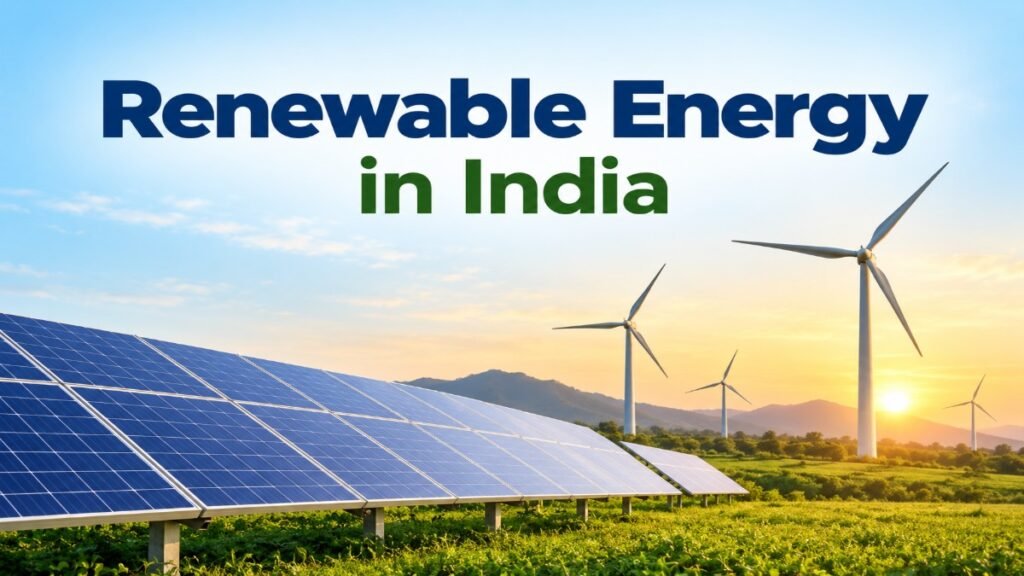
Renewable Energy in India refers to the development and use of energy obtained from natural resources that are replenished continuously or within a short period, making them virtually inexhaustible on a human timescale. Major Renewable Energy Sources in India include solar, wind, hydropower, biomass, geothermal, ocean energy, and green hydrogen (produced using renewable electricity). Unlike fossil fuels, renewable energy generates little or no greenhouse gas emissions, making it a key pillar of sustainable development and climate change mitigation.
India’s rapidly growing economy and population have significantly increased the demand for energy. However, dependence on coal, oil, and natural gas poses challenges such as energy insecurity, import dependence, air pollution, and greenhouse gas emissions. Therefore, Renewable Energy in India has become central to India’s strategy for achieving energy security, clean energy transition, and sustainable economic growth.
Recognising its importance, India became the first country in the world to establish a dedicated Ministry of Non-Conventional Energy Sources in 1992, now known as the Ministry of New and Renewable Energy (MNRE). Today, India is among the global leaders in renewable energy and has committed to achieving 500 GW of non-fossil fuel-based electricity capacity by 2030, meeting around 50% of its cumulative electric power installed capacity from non-fossil fuel sources by 2030, and achieving Net Zero emissions by 2070. These commitments make Renewable Energy in India a cornerstone of India’s future energy policy.
Master Science & Technology. Maximize Your BPSC Mains Score.
Enroll in the BPSC Science & Tech Course Today
Master Science & Technology for BPSC Mains GS Paper-2 with 75+ exam-oriented topics, 6 structured lessons, and downloadable PDF notes—all in one course.
✔ 75+ Exam-Oriented Topics • ✔ 6 Comprehensive Lessons • ✔ Downloadable PDF Notes • ✔ Updated for 72nd BPSC Mains
2. Renewable Energy Resources in India
Solar Energy
- Solar energy is harnessed from sunlight using Solar Photovoltaic (PV) panels and Concentrated Solar Power (CSP) technologies.
- India receives 4–7 kWh/m²/day of solar radiation, with nearly 300 sunny days annually, making it one of the world’s most suitable countries for solar power generation.
- Rajasthan, Gujarat, Karnataka, Tamil Nadu, and Maharashtra are the leading solar energy-producing states.
- India has emerged as the 3rd largest producer of solar power globally and solar energy constitutes the largest share of India’s renewable energy capacity.
- Major applications include utility-scale solar parks, rooftop solar systems, solar pumps, street lighting, and solar-powered irrigation.
Wind Energy
- Wind energy converts the kinetic energy of moving air into electricity using wind turbines.
- India possesses an estimated offshore wind potential of about 70 GW along the coasts of Gujarat and Tamil Nadu.
- Tamil Nadu, Gujarat, Karnataka, Maharashtra, and Rajasthan account for the majority of installed wind power capacity.
- India ranks among the top five countries in installed wind power capacity globally.
- Wind energy complements solar energy by generating higher output during monsoon and night-time hours.
Hydropower (Large & Small Hydro)
- Hydropower generates electricity from the energy of flowing or falling water.
- It is classified into Large Hydro Projects (>25 MW) and Small Hydro Projects (≤25 MW).
- Hydropower is the largest source of renewable electricity after solar in India’s power mix and provides valuable grid stability.
- Major hydropower-producing states include Himachal Pradesh, Uttarakhand, Arunachal Pradesh, Sikkim, and Jammu & Kashmir.
- Pumped Storage Hydropower Projects (PSPs) are increasingly being promoted for renewable energy storage.
Bioenergy (Biomass, Biogas & Waste-to-Energy)
- Bioenergy is produced from agricultural residues, forest waste, animal dung, municipal solid waste, and industrial organic waste.
- Major technologies include Biomass Power, Bagasse Cogeneration, Biogas, Compressed Biogas (CBG), and Waste-to-Energy (WtE) plants.
- Punjab, Haryana, Uttar Pradesh, Maharashtra, Karnataka, and Tamil Nadu possess significant biomass potential.
- Bioenergy supports rural employment, improves waste management, and reduces dependence on fossil fuels.
- Government initiatives such as the National Bioenergy Programme and SATAT Scheme promote biofuel and compressed biogas production.
Ocean Energy (Tidal & Wave Energy)
- Ocean energy includes tidal, wave, ocean thermal, and tidal current energy.
- India has promising tidal energy potential in the Gulf of Khambhat, Gulf of Kutch, and the Sundarbans.
- Wave energy potential exists along the western and southern coastlines.
- Although commercial deployment is limited, ocean energy remains an important future Renewable Energy Source in India.
Geothermal Energy
- Geothermal energy utilises heat stored beneath the Earth’s surface to generate electricity and provide direct heating.
- India has identified nearly 350 geothermal sites across the country.
- Major geothermal regions include Puga Valley (Ladakh), Manikaran (Himachal Pradesh), Tapovan (Uttarakhand), Rajgir (Bihar), and Surajkund (Jharkhand).
- At present, geothermal energy in India remains at the research and pilot project stage.
Green Hydrogen (Emerging Renewable Fuel)
- Green hydrogen is produced by electrolysis of water using electricity generated from renewable energy sources.
- It is considered a clean fuel for sectors that are difficult to decarbonise, such as steel, fertilisers, refineries, shipping, and heavy transport.
- India launched the National Green Hydrogen Mission (2023) to become a global hub for green hydrogen production and exports.
- Green hydrogen is expected to play a crucial role in achieving Net Zero emissions by 2070 and strengthening India’s long-term energy security.
Prepare Smarter. Study Better. Ace BPSC Mains.
BPSC Mains GS Paper 1 & 2 Complete Course
Access comprehensive BPSC Mains Notes for GS Paper 1 & 2, covering 378+ topics across 24 PDF lessons, with dedicated Bihar coverage, practice questions and downloadable study material.
✓ GS Paper 1 & 2 • ✓ 378+ Topics • ✓ 24 PDF Lessons • ✓ Bihar-Specific Coverage • ✓ Downloadable Notes
3. Current Status of Renewable Energy in India (Latest MNRE Data)
Solar Energy
- Installed Capacity: 162.15 GW (as on 30 June 2026), accounting for nearly 56% of India’s total renewable energy capacity.
- India added 11.89 GW of new solar capacity during April–June 2026, indicating the fastest growth among all renewable sources.
- Ground-mounted Solar: 121.25 GW
- Rooftop Solar: 30.11 GW
- Rajasthan, Gujarat, Karnataka, Tamil Nadu and Maharashtra are the leading solar power-producing states.
- India has emerged as the 3rd largest solar power producer globally and is among the fastest-growing solar markets.
Wind Energy
- Installed Capacity: 57.44 GW (as on 30 June 2026).
- Wind energy is the second-largest renewable energy source in India after solar.
- India added 1.35 GW of new wind capacity during April–June 2026.
- Gujarat, Tamil Nadu, Karnataka, Maharashtra and Rajasthan account for the majority of wind installations.
- India ranks among the top five countries in global wind power capacity.
Hydropower
- Large Hydropower Capacity: 52.06 GW.
- Small Hydropower Capacity: 5.18 GW.
- Total Hydropower Capacity: about 57.25 GW (June 2026).
- Pumped Storage Projects (PSPs) contribute about 7.43 GW, playing a crucial role in balancing intermittent solar and wind power.
- Himachal Pradesh, Uttarakhand, Arunachal Pradesh, Sikkim and Jammu & Kashmir possess the largest untapped hydropower potential.
Bioenergy
- Bagasse Cogeneration: 9.82 GW
- Biomass (Non-Bagasse): 1.05 GW
- Waste-to-Energy: 0.88 GW (including off-grid projects)
- Total Bioenergy Capacity: about 11.8 GW.
- India has promoted bioenergy through the National Bioenergy Programme, SATAT Scheme, and ethanol blending initiatives.
- Agricultural states such as Uttar Pradesh, Maharashtra, Punjab, Karnataka and Tamil Nadu have significant biomass potential.
Ocean Energy
- India possesses an estimated 12–13 GW tidal energy potential, mainly in the Gulf of Khambhat, Gulf of Kutch, and the Sundarbans.
- Wave energy potential is estimated at around 40 GW along the western coastline.
- At present, ocean energy remains at the research and demonstration stage, with no commercial power projects commissioned by MNRE.
Geothermal Energy
- India has identified nearly 350 geothermal sites with an estimated potential of around 10 GW.
- Major geothermal provinces include Puga (Ladakh), Manikaran (Himachal Pradesh), Tapovan (Uttarakhand), Rajgir (Bihar) and Surajkund (Jharkhand).
- Commercial geothermal power generation has not yet commenced, and the sector is currently limited to pilot studies and resource assessment.
Green Hydrogen
- The National Green Hydrogen Mission was launched in 2023 with a financial outlay of ₹19,744 crore.
- India aims to produce at least 5 million metric tonnes (MMT) of Green Hydrogen annually by 2030, with the possibility of scaling up further.
- The mission is expected to attract investments of over ₹8 lakh crore, create more than 6 lakh jobs, and reduce fossil fuel imports significantly.
- Green hydrogen is expected to decarbonise sectors such as fertilisers, refineries, steel, shipping and heavy transport, making it a key component of India’s Net Zero strategy.
4. Importance of Renewable Energy
Energy Security
- Renewable Energy in India reduces India’s dependence on imported crude oil, natural gas, and coal, thereby enhancing energy independence.
- It diversifies the country’s energy mix and minimises risks associated with fluctuations in global fuel prices.
- Renewable Energy Sources in India promote decentralised power generation through rooftop solar, solar pumps, and mini-grids, ensuring electricity access in remote and rural areas.
Environmental and Climate Benefits
- Renewable energy produces little or no greenhouse gas emissions during operation, helping combat climate change and supporting Clean Energy in India.
- renewable energy in India reduces air pollution caused by fossil fuels, leading to improved public health.
- Renewable Energy in India supports India’s commitments under the Paris Agreement, Panchamrit Goals, and the target of Net Zero emissions by 2070.
Economic Growth and Employment
- The growing India Renewable Energy Sector attracts large-scale domestic and foreign investment in clean energy infrastructure.
- renewable energy in India creates employment opportunities in manufacturing, installation, operation, maintenance, and research.
- Renewable energy can reduce long-term electricity generation costs due to declining prices of solar and wind technologies.
- It promotes indigenous manufacturing under initiatives such as Make in India and the PLI Scheme for Solar PV Modules.
Rural Development and Sustainable Development
- Renewable Energy in India provides reliable electricity for agriculture, irrigation, healthcare, education, and rural enterprises.
- It promotes sustainable agriculture through solar pumps and biomass-based energy systems.
- renewable energy in India supports achievement of the Sustainable Development Goals (SDGs), particularly SDG 7 (Affordable and Clean Energy), SDG 13 (Climate Action), and SDG 9 (Industry, Innovation and Infrastructure).
Technological Advancement and Energy Transition
- Renewable Energy promotes innovation in battery energy storage systems (BESS), smart grids, green hydrogen, electric mobility, offshore wind, and digital energy management.
- It encourages adoption of advanced technologies such as Artificial Intelligence (AI), Internet of Things (IoT), and smart metering for efficient energy management.
- Renewable Energy in India strengthens India’s transition from a fossil fuel-based economy to a clean, low-carbon, and sustainable energy system.
5. Government Initiatives for Renewable Energy in India
Solar Energy
National Solar Mission (NSM) – 2010
- Flagship mission under the National Action Plan on Climate Change (NAPCC).
- Objective: Make India a global leader in solar energy through large-scale deployment.
- Focuses on utility-scale solar parks, rooftop solar, domestic manufacturing, and research & development.
- Instrumental in increasing India’s solar capacity from 2.82 GW (2014) to over 162 GW (June 2026).
- The National Solar Mission is a major pillar of Renewable Energy in India and has significantly strengthened Renewable Energy Sources in India.
PM Surya Ghar: Muft Bijli Yojana (2024)
- World’s largest rooftop solar programme for households.
- Target: 1 crore households with rooftop solar systems.
- Provides Central Financial Assistance (CFA) directly to beneficiaries.
- Aims to provide up to 300 units of free electricity per month to eligible households.
- Promotes domestic solar manufacturing, employment generation, and distributed renewable energy.
- The scheme is an important step towards expanding Clean Energy in India at the household level.
PM-KUSUM Scheme (2019)
- Promotes solarisation of the agriculture sector.
- Target: 34,800 MW additional solar capacity by March 2026.
- Total Central Financial Support: ₹34,422 crore.
- Enhances farmers’ income while reducing dependence on diesel pumps.
- PM-KUSUM strengthens Renewable Energy in India by connecting solar energy with agriculture and rural development.
- Three major components:
Component A: 10,000 MW decentralised solar power plants.
Component B: Installation of 14 lakh standalone solar pumps.
Component C: Solarisation of 35 lakh existing grid-connected agricultural pumps.
Solar Parks Scheme
- Provides land and transmission infrastructure for utility-scale solar projects.
- Encourages private investment and reduces project implementation time.
- Several ultra-mega solar parks have been developed in Rajasthan, Gujarat, Madhya Pradesh and Karnataka.
PLI Scheme for High Efficiency Solar PV Modules
- Promotes domestic manufacturing of solar PV modules.
- Reduces dependence on imported solar equipment.
- Supports the Make in India initiative and strengthens the solar manufacturing value chain.
- This initiative is important for the long-term growth of the India Renewable Energy Sector.
Wind Energy
National Wind-Solar Hybrid Policy (2018)
- Promotes hybrid projects combining solar and wind energy.
- Improves grid stability and efficient utilisation of transmission infrastructure.
- Reduces variability associated with standalone renewable projects.
- Wind-solar hybrid projects strengthen the reliability of Renewable Energy in India.
Repowering Policy for Wind Power Projects
- Encourages replacement of old, low-capacity wind turbines with modern, high-efficiency turbines.
- Aims to increase electricity generation without acquiring additional land.
Offshore Wind Energy Programme
- India has notified the Strategy for Establishment of Offshore Wind Energy Projects.
- Viability Gap Funding (VGF) has been introduced to support offshore wind projects.
- Initial commercial projects are planned along the coasts of Gujarat and Tamil Nadu.
- Offshore wind represents an important emerging opportunity for Renewable Energy Sources in India.
Hydropower
Small Hydro Power (SHP) Programme
- Promotes hydroelectric projects up to 25 MW.
- Focuses on supplying clean electricity to remote and hilly regions.
- Financial assistance is provided by MNRE for project development.
Pumped Storage Projects (PSPs)
- Encouraged to store excess solar and wind energy.
- Improve grid flexibility and ensure reliable electricity supply during peak demand.
- Considered a key technology for India’s Renewable Energy transition.
Bioenergy
National Bioenergy Programme
- Umbrella programme implemented by MNRE.
- Supports:
- Biomass Power Projects
- Bagasse Cogeneration
- Biogas Plants
- Waste-to-Energy Projects
- Promotes efficient utilisation of agricultural residues and organic waste.
- Contributes to rural employment, waste management and Clean Energy in India generation.
SATAT Initiative
- Sustainable Alternative Towards Affordable Transportation (SATAT).
- Promotes production of Compressed Biogas (CBG) from agricultural residue, cattle dung and municipal waste.
- Supports clean transport fuel and additional income for farmers.
National Policy on Biofuels
- Encourages ethanol blending, biodiesel and advanced biofuels.
- Supports the Ethanol Blended Petrol (EBP) Programme to reduce crude oil imports and carbon emissions.
Green Hydrogen
National Green Hydrogen Mission (2023)
- Total financial outlay: ₹19,744 crore.
- Target: Produce at least 5 Million Metric Tonnes (MMT) of Green Hydrogen annually by 2030.
- Expected to attract over ₹8 lakh crore in investments and create more than 6 lakh jobs.
- Includes:
- SIGHT Programme (Strategic Interventions for Green Hydrogen Transition)
- Green Hydrogen Hubs
- Pilot projects in steel, mobility and shipping
- Research & Development
- Skill development
- Aims to make India a global hub for production, utilisation and export of Green Hydrogen.
- Green hydrogen is expected to become an important component of Renewable Energy in India and the country’s transition towards Clean Energy in India.
Cross-sector Renewable Energy Initiatives
- Ministry of New and Renewable Energy (MNRE) – Nodal ministry for renewable energy development in India.
- International Solar Alliance (ISA) – India-led global initiative to promote solar energy adoption among sunshine-rich countries.
- Green Energy Corridor Project – Strengthens interstate and intrastate transmission infrastructure for evacuation of renewable power.
- Renewable Purchase Obligation (RPO) & Renewable Consumption Obligation (RCO) – Mandate procurement and consumption of renewable energy by designated entities.
- Green Open Access Rules, 2022 – Simplify procurement of renewable electricity for commercial and industrial consumers.
- Green Term Ahead Market (GTAM) – Facilitates trading of renewable electricity through power exchanges.
- New Solar Power Scheme under PM JANMAN – Provides solar electrification to Particularly Vulnerable Tribal Group (PVTG) habitations and villages.
These initiatives collectively strengthen the India Renewable Energy Sector by promoting solar, wind, hydropower, bioenergy and green hydrogen. They also expand Renewable Energy Capacity in India while supporting the country’s broader transition towards Clean Energy in India.
6. Challenges in Renewable Energy Development
Intermittency and Energy Storage
- Solar and wind energy are weather-dependent, resulting in fluctuating power generation.
- Absence of affordable large-scale Battery Energy Storage Systems (BESS) limits reliable round-the-clock electricity supply.
- Integration of intermittent renewable energy requires flexible generation and storage infrastructure.
- Expanding Renewable Energy Capacity in India therefore requires adequate storage solutions to ensure reliable and continuous power supply.
Grid Integration and Transmission Infrastructure
- Rapid growth in Renewable Energy in India requires expansion of transmission networks and smart grids.
- Renewable energy-rich states often face inadequate transmission capacity, leading to power curtailment.
- Timely completion of Green Energy Corridors remains crucial for efficient power evacuation.
- Strong transmission infrastructure is essential for effectively integrating Renewable Energy Sources in India into the national electricity grid.
Land Acquisition and Environmental Concerns
- Utility-scale solar parks and wind farms require vast land areas, creating conflicts with agriculture and local communities.
- Renewable energy projects may impact forests, grasslands, wetlands, and wildlife habitats if not properly planned.
- Delays in land acquisition and environmental clearances increase project costs and implementation time.
- Sustainable land-use planning is therefore important for expanding Clean Energy in India without creating new environmental pressures.
Financial and Investment Challenges
- Renewable energy projects require high initial capital investment despite low operating costs.
- Financial stress of power distribution companies (DISCOMs) often delays payments to renewable energy developers.
- Access to affordable long-term financing remains a challenge, especially for emerging technologies.
- Sustained investment is essential for scaling up the India Renewable Energy Sector and achieving India’s ambitious renewable energy targets.
Dependence on Imported Components
- India continues to rely heavily on imports of solar cells, wafers, battery materials, and critical minerals such as lithium, cobalt, and rare earth elements.
- Global supply chain disruptions can affect project costs and timely implementation.
- Strengthening domestic manufacturing remains essential for achieving energy security and self-reliance.
- Reducing import dependence is particularly important for sustaining the rapid expansion of Renewable Energy Capacity in India.
Policy and Regulatory Challenges
- Frequent policy changes, regulatory uncertainties, and delays in approvals affect investor confidence.
- Variations in renewable energy policies across states create implementation challenges.
- Delays in signing Power Purchase Agreements (PPAs) and tariff-related disputes hinder project execution.
- Stable and predictable policies are necessary for the long-term development of Renewable Energy in India.
Technological and Skilled Manpower Constraints
- Advanced technologies such as offshore wind, green hydrogen, battery storage, and smart grids require continuous research and innovation.
- Limited domestic manufacturing capacity for advanced renewable energy equipment increases dependence on foreign technology.
- Shortage of skilled manpower in installation, operation, maintenance, and research affects the pace of renewable energy expansion.
- Addressing these constraints will be critical for strengthening the India Renewable Energy Sector and accelerating India’s transition towards Clean Energy in India.
7. Conclusion
Renewable Energy in India has emerged as a cornerstone of India’s strategy to achieve energy security, sustainable development, and climate resilience. With abundant renewable resources, strong policy support, and rapid technological advancements, India has become one of the global leaders in clean energy deployment. The country’s ambitious commitments of 500 GW non-fossil fuel-based electricity capacity by 2030 and Net Zero emissions by 2070 reflect its determination to transition towards a low-carbon economy.
Going forward, strengthening domestic manufacturing, expanding energy storage systems, modernising the power grid, promoting green hydrogen, and ensuring stable policy implementation will be crucial for accelerating renewable energy adoption. A balanced approach that combines technological innovation, private sector participation, and community involvement will enable India to achieve its clean energy goals while fostering inclusive economic growth and environmental sustainability.
The continued expansion of Renewable Energy in India will also strengthen the India Renewable Energy Sector, increase Renewable Energy Capacity in India, and support the transition towards Clean Energy in India. Therefore, effective utilisation of diverse Renewable Energy Sources in India will remain essential for India’s long-term energy security and sustainable development.
BPSC Mains Practice Questions
- Discuss the major renewable energy sources in India. Examine the role of solar, wind, hydropower and bioenergy in India’s energy transition.
- Examine the importance of renewable energy in achieving India’s energy security, sustainable development and climate goals. What are the major challenges in expanding renewable energy capacity in India?
- Discuss the major government initiatives for promoting renewable energy in India. Explain the significance of the National Green Hydrogen Mission, PM Surya Ghar Yojana, PM-KUSUM and Green Energy Corridor.
Learn More About Renewable Energy in India
For official information on India’s renewable energy policies, programmes, schemes, and developments, visit the Ministry of New and Renewable Energy (MNRE), Government of India: Ministry of New and Renewable Energy (MNRE)