1. Introduction
A Defence Industrial Corridor (DIC) is a dedicated industrial ecosystem established to promote the manufacturing, research, development, testing and export of defence equipment by bringing together defence industries, research institutions, MSMEs, start-ups and government agencies in a defined geographical region.
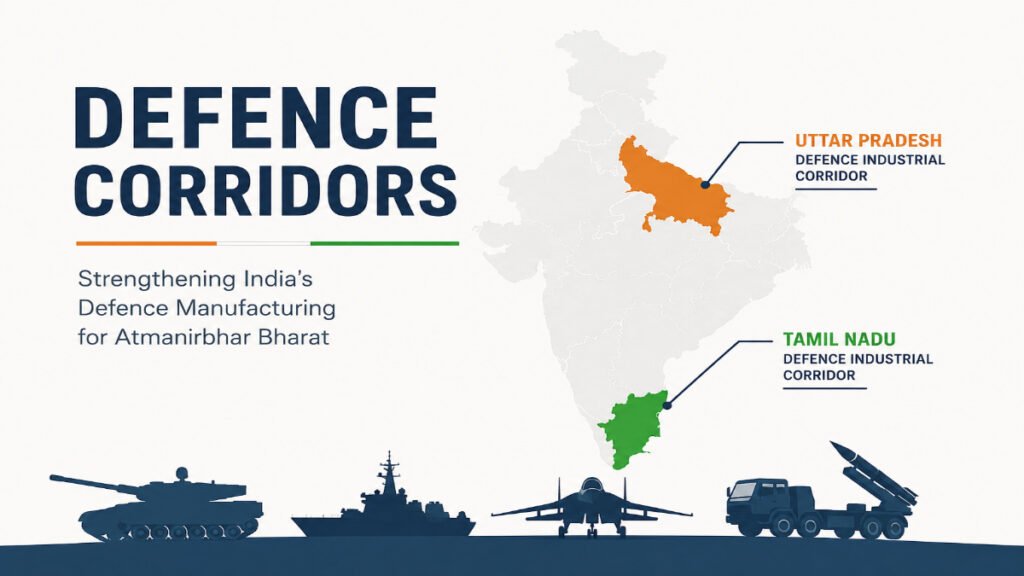
The Government of India announced the establishment of two Defence Corridors in 2018—one in Uttar Pradesh and the other in Tamil Nadu—to strengthen indigenous defence manufacturing under the Atmanirbhar Bharat and Make in India initiatives. These Defence Corridors in India aim to reduce India’s dependence on defence imports, attract domestic and foreign investment, generate employment and develop an integrated defence manufacturing supply chain.
Objectives of Defence Corridors
- Promote indigenous design, development and production of defence equipment.
- Create a robust ecosystem involving DPSUs, DRDO, private industries, MSMEs and start-ups.
- Attract domestic and foreign investment in the defence sector.
- Generate skilled employment and promote regional industrial development.
- Enhance defence exports and position India as a global defence manufacturing hub.
- Strengthen national security by reducing dependence on imported military equipment.
The establishment of Defence Corridors represents a major step towards building a self-reliant defence manufacturing ecosystem in India. These Defence Corridors in India are expected to strengthen indigenous production, promote innovation and position the country as a global hub for defence manufacturing. These Defence Corridor Notes for BPSC provide a comprehensive understanding of the concept, objectives and significance of defence corridors and are highly useful for BPSC Mains and other competitive examinations.
Master Science & Technology. Maximize Your BPSC Mains Score.
Enroll in the BPSC Science & Tech Course Today
Master Science & Technology for BPSC Mains GS Paper-2 with 75+ exam-oriented topics, 6 structured lessons, and downloadable PDF notes—all in one course.
✔ 75+ Exam-Oriented Topics • ✔ 6 Comprehensive Lessons • ✔ Downloadable PDF Notes • ✔ Updated for 72nd BPSC Mains
2. Defence Corridors in India
(a) Uttar Pradesh Defence Industrial Corridor (UPDIC)
The Uttar Pradesh Defence Industrial Corridor (UPDIC) was launched in 2018 to develop North India as a major hub for defence manufacturing. It comprises six nodes—Lucknow, Kanpur, Jhansi, Agra, Aligarh and Chitrakoot—strategically selected to leverage the state’s industrial base, connectivity and skilled workforce. The UPDIC is one of the two major Defence Corridors in India established to strengthen indigenous defence production.
Key Features
- Focuses on the production of small arms, ammunition, armoured vehicles, aerospace components, defence electronics and precision engineering.
- Has attracted investments from DPSUs, DRDO, MSMEs, start-ups and major private companies.
- Supported by the BrahMos Aerospace Integration and Testing Facility at Lucknow, which will manufacture the BrahMos supersonic cruise missile.
- Aims to create an integrated defence manufacturing ecosystem through strong industry–academia collaboration.
(b) Tamil Nadu Defence Industrial Corridor (TNDIC)
The Tamil Nadu Defence Industrial Corridor (TNDIC) was also launched in 2018 and consists of five nodes—Chennai, Hosur, Coimbatore, Salem and Tiruchirappalli. The corridor builds upon Tamil Nadu’s strong base in automobile manufacturing, aerospace, electronics and precision engineering, making it another key pillar among the Defence Corridors in India.
Key Features
- Specialises in aerospace systems, defence electronics, missile components, avionics and advanced manufacturing technologies.
- Hosts major defence establishments such as Hindustan Aeronautics Limited (HAL), Heavy Vehicles Factory (HVF), Ordnance Clothing Factory, DRDO laboratories and Bharat Electronics Limited (BEL), providing a strong industrial ecosystem.
- Supports the participation of MSMEs and start-ups in defence production and innovation.
- Enhances India’s capability in manufacturing high-value defence equipment and integrating into global defence supply chains.
While the Uttar Pradesh Defence Industrial Corridor is emerging as a hub for missiles, ammunition and land systems, the Tamil Nadu Defence Industrial Corridor has developed strengths in aerospace, electronics and advanced engineering, making the two Defence Corridors complementary pillars of India’s defence manufacturing ecosystem. These Defence Corridor Notes for BPSC are important for understanding the geographical distribution, industrial specialisation and strategic significance of Defence Corridors in India.
Experience the Quality Before You Enroll
Download Free Sample Notes (PDF)
Download a free sample of our BPSC Mains Science & Technology Notes and experience the structured, exam-oriented content before enrolling. Explore the presentation, answer-writing approach, and overall quality of the complete course.
✔ Free Download • ✔ Exam-Oriented Notes • ✔ Updated Content • ✔ Structured for BPSC Mains
3. Significance of Defence Corridors
Strengthening Defence Indigenisation
- Promotes indigenous design, development and manufacturing of defence equipment under Atmanirbhar Bharat.
- Reduces dependence on defence imports and strengthens strategic autonomy.
- Supports the implementation of the Positive Indigenisation Lists issued by the Ministry of Defence.
Promoting Investment and Industrial Growth
- Defence Corridors attract investment from DPSUs, private companies, MSMEs, start-ups and foreign firms.
- Encourage technology transfer, innovation and the development of an integrated defence manufacturing ecosystem.
- The two Defence Corridors in India have together attracted investment proposals exceeding ₹30,000 crore.
Employment Generation and Regional Development
- Creates large-scale direct and indirect employment for engineers, technicians and skilled workers.
- Promotes industrialisation in backward regions such as Bundelkhand (Uttar Pradesh).
- Improves infrastructure, logistics and ancillary industries around corridor nodes.
Boosting Defence Exports
- Enhances India’s capacity to manufacture globally competitive defence equipment.
- Supports the Government’s target of making India a major defence exporting nation.
- India’s defence exports reached a record ₹23,622 crore in FY 2024–25, reflecting the growing strength of indigenous manufacturing.
Strengthening National Security
- Ensures timely availability of critical defence equipment during conflicts and emergencies.
- Reduces vulnerability to global supply-chain disruptions and geopolitical uncertainties.
- Supports the Armed Forces with faster maintenance, repair and modernisation of defence systems.
Promoting Innovation and Technology Development
- Encourages collaboration among DRDO, academia, industry and start-ups.
- Accelerates the development of emerging technologies such as Artificial Intelligence (AI), drones, robotics, electronic warfare and advanced materials.
- Strengthens India’s long-term technological competitiveness in the global defence sector.
The Defence Corridors are playing a transformative role in strengthening India’s indigenous defence manufacturing ecosystem by promoting investment, innovation, employment and exports. The rapid development of Defence Corridors in India is expected to enhance strategic autonomy, boost economic growth and position India as a global defence manufacturing hub. These Defence Corridor Notes for BPSC are highly relevant for understanding the strategic and economic significance of defence corridors for BPSC Mains and other competitive examinations.
Prepare Smarter. Study Better. Ace BPSC Mains.
BPSC Mains GS Paper 1 & 2 Complete Course
Access comprehensive BPSC Mains Notes for GS Paper 1 & 2, covering 378+ topics across 24 PDF lessons, with dedicated Bihar coverage, practice questions and downloadable study material.
✓ GS Paper 1 & 2 • ✓ 378+ Topics • ✓ 24 PDF Lessons • ✓ Bihar-Specific Coverage • ✓ Downloadable Notes
4. Challenges
Challenges
- Slow Project Implementation: Delays in land acquisition, infrastructure development and regulatory approvals have affected the pace of Defence Corridors development.
- Technology Dependence: India continues to depend on imports for critical technologies such as jet engines, semiconductor chips, advanced sensors and propulsion systems, limiting complete self-reliance in defence manufacturing.
- Limited Private Investment: High capital requirements and long gestation periods discourage greater participation by private industries and MSMEs in Defence Corridors in India.
- Skill and R&D Gaps: Shortage of highly skilled manpower and relatively low investment in defence research limit innovation and technological advancement.
- Global Competition: Indian defence manufacturers face stiff competition from established exporters such as the USA, France, Russia, Israel and China, making continuous innovation and cost competitiveness essential.
5. Way Forward
- Develop world-class infrastructure and improve connectivity within defence corridor nodes.
- Increase investment in R&D, particularly in emerging technologies such as Artificial Intelligence (AI), drones, semiconductors, quantum technologies and electronic warfare.
- Encourage greater participation of private industries, MSMEs, start-ups and foreign technology partners through policy support and ease of doing business.
- Strengthen collaboration among DRDO, DPSUs, academia and industry to accelerate indigenous innovation and technology transfer.
- Promote export-oriented manufacturing by integrating Indian firms into global defence supply chains and expanding defence partnerships with friendly nations.
Addressing these challenges is essential for unlocking the full potential of Defence Corridors and strengthening India’s indigenous defence manufacturing ecosystem. By improving infrastructure, enhancing research and development, encouraging private sector participation and promoting exports, Defence Corridors in India can play a decisive role in achieving Atmanirbhar Bharat and positioning India as a leading global defence manufacturing hub. These Defence Corridor Notes for BPSC provide a comprehensive understanding of the challenges and future roadmap, making the topic highly relevant for BPSC Mains and other competitive examinations.
6. Conclusion
Defence Corridors are emerging as the backbone of India’s defence manufacturing ecosystem. By fostering indigenous production, innovation and exports, the Defence Corridors in India are strengthening self-reliance in defence manufacturing while reducing dependence on imported military equipment. They are also creating a robust ecosystem involving DRDO, DPSUs, private industries, MSMEs, start-ups and academia, thereby enhancing India’s technological capabilities and industrial competitiveness.
With sustained policy support, greater private sector participation, increased investment in research and development, and stronger integration into global defence supply chains, Defence Corridors will play a pivotal role in achieving Atmanirbhar Bharat, strengthening national security and realising the vision of Viksit Bharat 2047. These Defence Corridor Notes for BPSC provide a comprehensive understanding of the concept, significance and future potential of Defence Corridors in India, making the topic highly relevant for BPSC Mains and other competitive examinations.
Learn More from the Ministry of Defence:
Readers interested in learning more about Defence Corridors, the Uttar Pradesh Defence Industrial Corridor (UPDIC), Tamil Nadu Defence Industrial Corridor (TNDIC), defence manufacturing, investment opportunities and the Government’s initiatives to promote Defence Corridors in India can visit the Defence Investment Portal of the Ministry of Defence, Government of India. The portal provides authentic information on defence industrial policies, corridor development, investment opportunities and indigenous defence manufacturing.
BPSC Mains Practice Questions
Q1. Discuss the significance of Defence Corridors in promoting indigenous defence manufacturing in India. How do the Defence Corridors in India contribute to Atmanirbhar Bharat, defence exports and national security?
Q2. Examine the objectives, major features and challenges of the Defence Corridors in India. Suggest suitable measures to strengthen their role in making India a global defence manufacturing hub.