1. Introduction
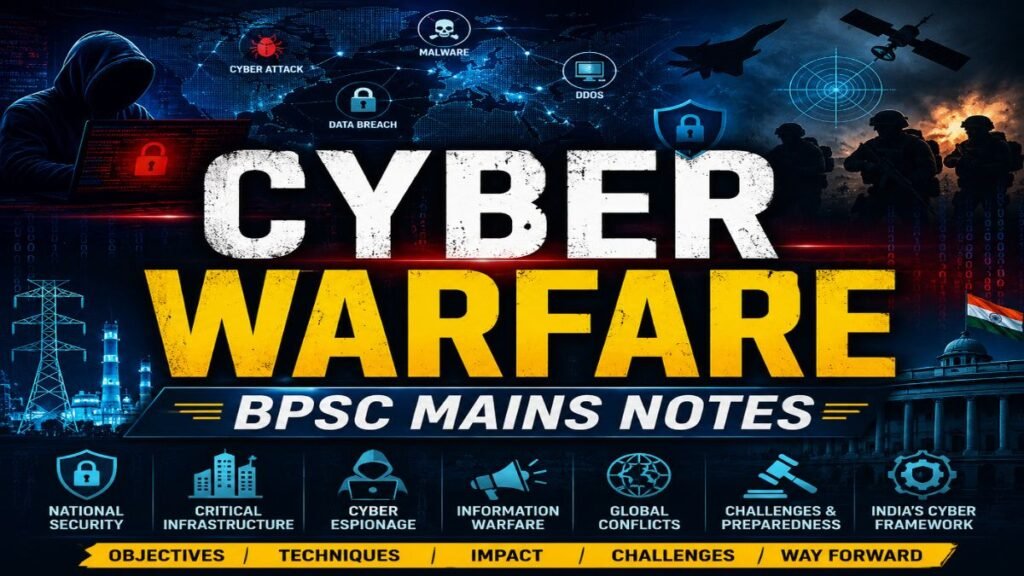
Cyber warfare refers to the use of cyberspace by a nation or state-sponsored groups to attack, disrupt, damage or gain strategic advantage over another country. Unlike conventional warfare, it targets computer networks, communication systems, satellites and critical infrastructure through digital means.
With rapid digitisation, cyberspace has become the fifth domain of warfare (after land, sea, air and space), as recognised by NATO in 2016. Recent conflicts such as the Russia–Ukraine War and the Israel–Hamas conflict have demonstrated that cyber-attacks are now an integral part of modern cyber war, making cybersecurity a crucial component of national security.
Key Features of Cyber Warfare
- Primarily conducted by nation-states or state-sponsored groups.
- Targets critical infrastructure such as power grids, banking, defence, healthcare and communication networks.
- Low-cost but high-impact, capable of causing widespread disruption.
- Difficult to attribute, allowing attackers to conceal their identity.
- Forms a key component of hybrid warfare, alongside conventional military operations and information warfare.
The growing significance of cyber warfare has transformed cyberspace into a strategic battlefield where digital attacks can influence military operations, economic stability and national security without the use of conventional weapons. These Cyber Warfare BPSC Notes provide a comprehensive understanding of the concept, features and evolving nature of modern cyber war, making the topic highly relevant for BPSC Mains and other competitive examinations.
Master Science & Technology. Maximize Your BPSC Mains Score.
Enroll in the BPSC Science & Tech Course Today
Master Science & Technology for BPSC Mains GS Paper-2 with 75+ exam-oriented topics, 6 structured lessons, and downloadable PDF notes—all in one course.
✔ 75+ Exam-Oriented Topics • ✔ 6 Comprehensive Lessons • ✔ Downloadable PDF Notes • ✔ Updated for 72nd BPSC Mains
2. Evolution of Cyber Warfare
- Early Phase (1980s–1990s): Cyber-attacks were largely limited to hacking, computer viruses and website defacement by individuals or small groups, with minimal strategic impact. During this period, cyber warfare was still in its infancy and had limited implications for national security.
- Rise of State-Sponsored Operations (2000s): Nations began using cyber tools for espionage and strategic purposes. The 2007 cyber-attacks on Estonia, targeting government and banking networks, marked one of the first large-scale cyber war attacks against a nation.
- Weaponisation of Cyberspace (2010s): Cyber-attacks evolved into offensive military tools. The Stuxnet malware (2010), which targeted Iran’s nuclear programme, demonstrated that malware could cause physical destruction of critical infrastructure.
- Cyber as Part of Hybrid Warfare: Modern conflicts integrate cyber-attacks with conventional military operations, economic sanctions and disinformation campaigns. The Russia–Ukraine War is a leading example of this approach, highlighting the growing role of cyber warfare in modern conflicts.
- Emergence of AI-Driven Cyber Threats: Artificial Intelligence (AI), automation, deepfakes and machine learning are enabling faster, more sophisticated cyber-attacks while also strengthening cyber defence capabilities.
- Future Trends: Technologies such as Quantum Computing, 5G/6G networks, Internet of Things (IoT), cloud computing and satellite-based communication are expanding both cyber vulnerabilities and defence capabilities, making cyber warfare a central pillar of national security.
The evolution of cyber warfare clearly shows its transformation from isolated hacking incidents to a powerful strategic instrument used by nations during peace as well as conflict. These developments form an important part of Cyber Warfare BPSC Notes, helping aspirants understand how modern cyber war has become an integral component of hybrid warfare and national security.
3. Objectives of Cyber Warfare
- Gain Military Advantage: Disrupt enemy command-and-control systems, communication networks, air defence and logistics to weaken military operations during conflicts. This is one of the primary objectives of modern cyber warfare.
- Target Critical Infrastructure: Attack essential services such as power grids, banking systems, transportation, healthcare, oil and gas pipelines and telecommunications to paralyse a nation’s functioning.
- Cyber Espionage: Steal sensitive military, diplomatic, scientific and strategic information to gain intelligence without physical infiltration. Cyber espionage has become a crucial aspect of contemporary cyber war.
- Economic Disruption: Cause financial losses by targeting stock exchanges, payment systems, industries and supply chains, thereby weakening the opponent’s economy.
- Information and Psychological Warfare: Spread misinformation, deepfakes and propaganda through digital platforms to influence public opinion, create panic and reduce trust in government institutions.
- Political and Strategic Influence: Interfere in elections, government decision-making and diplomatic processes to advance geopolitical interests without direct military confrontation.
The objectives of cyber warfare extend far beyond damaging computer systems. Modern cyber operations seek to achieve military, economic, political and psychological advantages while avoiding conventional armed conflict. These objectives are an important component of Cyber Warfare BPSC Notes and help explain why cyber war has become a critical instrument of statecraft and national security in the 21st century.
Prepare Smarter. Study Better. Ace BPSC Mains.
BPSC Mains GS Paper 1 & 2 Complete Course
Access comprehensive BPSC Mains Notes for GS Paper 1 & 2, covering 378+ topics across 24 PDF lessons, with dedicated Bihar coverage, practice questions and downloadable study material.
✓ GS Paper 1 & 2 • ✓ 378+ Topics • ✓ 24 PDF Lessons • ✓ Bihar-Specific Coverage • ✓ Downloadable Notes
4. Major Components/Techniques of Cyber Warfare
Malware Attacks
- Malware (malicious software) is designed to damage, disrupt or gain unauthorised access to computer systems.
- Used to destroy data, disable military networks or sabotage critical infrastructure.
- Example: The Stuxnet malware (2010) targeted Iran’s Natanz nuclear facility, damaging nearly 1,000 uranium centrifuges without direct military action.
Distributed Denial-of-Service (DDoS) Attacks
- Attackers flood a website or server with massive internet traffic, making it inaccessible to legitimate users.
- Frequently used to disrupt government portals, banking services and media websites during conflicts.
- Example: During the Russia–Ukraine War (2022), Ukrainian government websites and banking networks were repeatedly targeted through DDoS attacks before the Russian military offensive.
Ransomware Attacks
- Attackers encrypt a victim’s data and demand payment to restore access.
- Increasingly used by state-backed hacker groups to create economic disruption.
- Example: The Colonial Pipeline attack (USA, 2021) disrupted fuel supplies across the U.S. East Coast, demonstrating how cyber warfare can affect critical infrastructure.
Supply Chain Attacks
- Instead of attacking the main target directly, hackers compromise trusted software, hardware or service providers to infiltrate multiple organisations.
- Such attacks can spread rapidly across governments and businesses.
- Example: The SolarWinds attack (2020) compromised thousands of organisations, including several U.S. government agencies, through a software update.
Zero-Day Exploits
- These attacks exploit previously unknown software vulnerabilities before developers release security patches.
- They are difficult to detect and are often used in sophisticated state-sponsored cyber war operations.
- Example: The Pegasus spyware, developed by Israel’s NSO Group, exploited zero-click vulnerabilities in smartphones to conduct covert surveillance.
Critical Infrastructure Attacks
- Cyber-attacks targeting electricity grids, water supply, oil and gas facilities, transportation systems and healthcare services.
- Their objective is to disrupt essential public services and reduce civilian morale.
- Example: In December 2015, hackers linked to Russia disrupted Ukraine’s power grid, causing electricity outages for nearly 230,000 people. Similar attacks continued during the Russia–Ukraine conflict.
Satellite and Communication Network Attacks
- Modern militaries rely heavily on satellites for communication, navigation, surveillance and missile guidance.
- Disrupting these systems can significantly weaken military coordination.
- Example: Just before the Russian invasion of Ukraine (2022), the Viasat KA-SAT satellite network was attacked, disrupting military and civilian communications across Ukraine and parts of Europe.
Artificial Intelligence (AI)-Enabled Cyber Attacks
- AI enables attackers to automate hacking, identify vulnerabilities faster, create sophisticated phishing campaigns and evade security systems.
- It is also used to generate convincing fake audio, video and text.
- Example: During the Russia–Ukraine War and the Israel–Hamas conflict, AI-generated fake videos and manipulated images circulated on social media to spread misinformation and influence public perception.
Information Warfare and Deepfakes
- Cyber warfare increasingly involves manipulating information rather than only attacking computer systems.
- Deepfakes, fake news and coordinated social media campaigns are used to create confusion, undermine trust and influence political or military outcomes.
- Example: In March 2022, a deepfake video falsely showing Ukrainian President Volodymyr Zelenskyy urging soldiers to surrender was circulated online as part of an information warfare campaign.
These techniques demonstrate that cyber warfare is no longer confined to hacking computer systems but has evolved into a multidimensional form of cyber war targeting military assets, critical infrastructure, economies and public perception. Understanding these methods is essential for Cyber Warfare BPSC Notes, as they are frequently asked in BPSC Mains and other competitive examinations.
5. Cyber Warfare in Recent Global Conflicts
The nature of warfare has undergone a profound transformation in the 21st century, with cyber warfare emerging as a key instrument of military strategy. Modern conflicts are no longer fought solely on land, sea, air and space; cyberspace has become an equally important battlefield. Nations increasingly use cyber-attacks to disrupt enemy communications, disable critical infrastructure, gather intelligence, spread misinformation and weaken public morale before or alongside conventional military operations. These developments clearly illustrate the expanding role of cyber war in contemporary international conflicts.
The Russia–Ukraine War (2022–present) is regarded as the most prominent example of modern cyber warfare. In the hours preceding Russia’s military invasion, the Viasat KA-SAT satellite network was targeted, disrupting military communications in Ukraine and affecting internet services across several European countries. Russian hacker groups also deployed WhisperGate and Industroyer2 malware against Ukrainian government institutions and energy infrastructure. In response, Ukraine established the IT Army of Ukraine, a volunteer cyber force that conducted cyber operations against Russian government agencies, banks and media platforms. This conflict demonstrated how cyber-attacks can complement conventional warfare and influence battlefield outcomes.
The Israel–Hamas conflict (2023–present) and the broader Israel–Iran cyber rivalry have highlighted the growing role of cyber operations in hybrid warfare. Both sides witnessed extensive cyber-attacks on government websites, financial institutions, communication systems and media platforms. Cyber campaigns were accompanied by AI-generated deepfakes, fake emergency alerts and misinformation on social media aimed at influencing public opinion and creating panic. Meanwhile, Israel and Iran have continued targeting each other’s critical infrastructure, including ports, fuel distribution systems, water treatment facilities and transportation networks, making cyberspace a persistent arena of strategic competition even outside conventional wars.
Cyber warfare has also become a significant feature of strategic competition in the Indo-Pacific region. China has been repeatedly accused of conducting cyber espionage against Taiwan’s government networks, defence establishments and semiconductor industry while simultaneously targeting communication infrastructure and undersea internet cables. India has also experienced cyber threats from state-sponsored groups, particularly during periods of heightened tensions with neighbouring countries.
Attempts to probe India’s power grids, government networks, financial institutions and critical infrastructure underscore the need for robust cyber resilience. These global experiences clearly indicate that future conflicts will increasingly be shaped by the ability of nations to defend and dominate cyberspace alongside conventional military capabilities. These developments are an important part of Cyber Warfare BPSC Notes and are highly relevant for understanding the evolving nature of cyber war in the 21st century.
6. Impact of Cyber Warfare
On National Security
- Disrupts military communication, command-and-control systems, reducing operational effectiveness during conflicts.
- Compromises classified defence and intelligence information through cyber espionage.
- Example: The Viasat satellite attack (2022) disrupted military communications during the Russia–Ukraine War.
On Critical Infrastructure
- Cyber warfare targets power grids, water supply, oil and gas pipelines, transportation, healthcare and telecom networks, affecting essential services.
- Example: Ukraine’s power grid attacks (2015 & 2022) caused large-scale electricity outages.
On Economy
- Causes financial losses through attacks on banks, stock exchanges, payment systems and industries.
- Disrupts supply chains and investor confidence.
- Example: The Colonial Pipeline ransomware attack (USA, 2021) disrupted fuel supply across the U.S. East Coast.
On Society and Public Confidence
- Spreads fake news, deepfakes and propaganda, creating panic and eroding trust in governments and institutions.
- Can influence elections and polarise societies.
- Example: Deepfake videos during the Russia–Ukraine War and the Israel–Hamas conflict.
On International Relations
- Increases geopolitical tensions and may trigger retaliatory cyber or military responses.
- Attribution challenges make diplomatic resolution difficult.
- Promotes a global cyber war arms race among nations.
On National Development
- Diverts significant financial resources towards cybersecurity and cyber defence.
- Affects digital governance, e-commerce, Digital India initiatives and investor confidence in the digital economy.
The impact of cyber warfare extends far beyond the digital domain, affecting national security, economic stability, governance, international relations and public confidence. As nations become increasingly dependent on digital infrastructure, protecting cyberspace has become a strategic necessity. These dimensions of cyber war are an important component of Cyber Warfare BPSC Notes and are highly relevant for BPSC Mains and other competitive examinations.
7. India’s Cyber Security Architecture and Preparedness
India has adopted a multi-layered institutional framework to strengthen cyber resilience, protect critical infrastructure and enhance national cyber defence. With rapid digitalisation under initiatives such as Digital India, UPI and the Smart Cities Mission, cybersecurity has become an integral part of national security. Strengthening this institutional framework is essential to counter the growing threats posed by cyber warfare.
Indian Computer Emergency Response Team (CERT-In)
- National agency under the Ministry of Electronics and Information Technology (MeitY) for responding to cybersecurity incidents.
- Issues security advisories, coordinates incident response and conducts cyber drills.
- In 2024–25, CERT-In strengthened collaboration with government agencies and private organisations to counter ransomware and phishing attacks.
National Critical Information Infrastructure Protection Centre (NCIIPC)
- Functions under the National Technical Research Organisation (NTRO).
- Protects critical sectors such as power, banking, telecom, transport, energy, space and strategic government infrastructure from cyber warfare attacks.
Defence Cyber Agency (DCA)
- Established in 2019 under the Headquarters Integrated Defence Staff.
- Coordinates cyber operations of the Army, Navy and Air Force and develops offensive and defensive cyber capabilities.
- Supports India’s preparedness against cyber war threats during military conflicts.
National Cyber Security Coordinator (NCSC)
- Functions under the National Security Council Secretariat (NSCS).
- Coordinates cybersecurity policies among ministries, intelligence agencies and security organisations to ensure a unified national response.
Indian Cyber Crime Coordination Centre (I4C)
- Established under the Ministry of Home Affairs (MHA).
- Coordinates efforts to combat cybercrime, build capacity among law enforcement agencies and enhance cyber awareness.
- Operates the National Cyber Crime Reporting Portal and the 1930 Cyber Helpline for reporting online financial fraud.
National Cyber Coordination Centre (NCCC)
- Serves as India’s cyber threat intelligence platform.
- Monitors internet traffic metadata to identify potential cyber threats and enables early warning and coordinated response.
Other Important Initiatives
- Cyber Surakshit Bharat Programme to improve cybersecurity awareness and capacity in government departments.
- Cyber Swachhta Kendra (Botnet Cleaning and Malware Analysis Centre) to help users detect and remove malware from devices.
- Regular national cyber security exercises involving government departments, critical infrastructure operators and defence agencies to test preparedness.
India’s multi-layered cyber security architecture reflects the country’s commitment to building a resilient digital ecosystem capable of addressing the challenges of modern cyber warfare. By strengthening institutions, enhancing inter-agency coordination and improving cyber resilience, India is better prepared to respond to emerging cyber war threats. These institutional mechanisms form an important part of Cyber Warfare BPSC Notes and are highly relevant for BPSC Mains and other competitive examinations.
8. Challenges Before India
Growing Sophistication of Cyber Threats
Cyber attacks are becoming more complex with the use of Artificial Intelligence (AI), machine learning, ransomware, deepfakes and zero-day exploits. State-sponsored hacker groups possess advanced capabilities to launch large-scale attacks on critical infrastructure, making detection and attribution increasingly difficult. These evolving threats have made cyber warfare far more sophisticated than traditional forms of cyber attacks.
Vulnerability of Critical Infrastructure
India’s rapid digitalisation has increased the exposure of power grids, banking systems, telecom networks, transportation, healthcare, satellites and digital payment platforms to cyber attacks. A successful attack on these sectors could disrupt essential services and pose serious national security risks, making them prime targets during a cyber war.
Shortage of Skilled Cybersecurity Professionals
Despite being a global IT hub, India faces a significant shortage of trained cybersecurity experts. The increasing demand for cyber professionals in government, defence and private sectors often exceeds the available skilled workforce, affecting the country’s preparedness against cyber warfare.
Dependence on Foreign Technology
India continues to rely heavily on imported hardware, software, semiconductors and networking equipment. Such dependence increases the risk of supply-chain attacks, hidden vulnerabilities and strategic dependence on foreign technology providers.
Misinformation and Information Warfare
The widespread use of social media, AI-generated deepfakes and coordinated disinformation campaigns poses a serious challenge to democratic institutions and national security. During conflicts, adversaries increasingly use information warfare to influence public opinion, spread panic and weaken trust in government. This has become an important dimension of modern cyber warfare.
Inadequate International Legal Framework
Cyberspace lacks a universally accepted legal framework governing state behaviour during cyber conflicts. Difficulties in identifying the source of attacks (the attribution problem) and the absence of binding international norms often delay accountability and coordinated global responses.
These challenges highlight that India’s preparedness against cyber warfare requires not only stronger technological capabilities but also robust legal frameworks, skilled manpower, indigenous technologies and international cooperation. Addressing these issues is essential to strengthen national cyber resilience and effectively respond to emerging cyber war threats. These topics form an important part of Cyber Warfare BPSC Notes and are highly relevant for BPSC Mains and other competitive examinations.
9. Conclusion
Cyber warfare has emerged as a defining feature of 21st-century conflicts, where digital attacks can significantly influence military operations, economic stability and national security without the use of conventional weapons. The recent conflicts in Ukraine, West Asia and the Indo-Pacific demonstrate that cyber capabilities are now an integral component of modern cyber war and strategic competition.
For India, strengthening cybersecurity requires a comprehensive approach involving robust legal frameworks, indigenous technologies, skilled manpower, AI-driven cyber defence, protection of critical infrastructure and enhanced international cooperation. As India advances towards the vision of Viksit Bharat 2047, building a secure, resilient and self-reliant cyber ecosystem will be essential to safeguard its sovereignty, economic growth and national interests in the digital age. These Cyber Warfare BPSC Notes provide a comprehensive understanding of the evolving nature of cyber warfare, its strategic implications and India’s preparedness, making the topic highly relevant for BPSC Mains and other competitive examinations.
Learn More from CERT-In:
Readers interested in understanding Cyber Warfare, cyber threats, cybersecurity advisories, incident response mechanisms and India’s cyber defence framework can visit the official website of the Indian Computer Emergency Response Team (CERT-In). The portal provides authentic information on cyber security alerts, vulnerability notes, best practices, incident reporting and national initiatives to strengthen India’s resilience against cyber war and other cyber threats.
BPSC Mains Practice Questions
Q1. “Cyber warfare has emerged as the fifth dimension of modern warfare.” Discuss the objectives, major techniques and impact of Cyber Warfare on national security, critical infrastructure and international relations with suitable examples.
Q2. Examine the emerging challenges posed by Cyber Warfare to India. Discuss India’s cyber security architecture and suggest measures to strengthen the country’s cyber resilience in the era of digital governance and hybrid warfare.
Q3. Analyse the role of Cyber Warfare in recent global conflicts such as the Russia–Ukraine War and the Israel–Hamas conflict. What lessons should India learn to strengthen its preparedness against future cyber war threats?