1. Introduction and Mission Profile
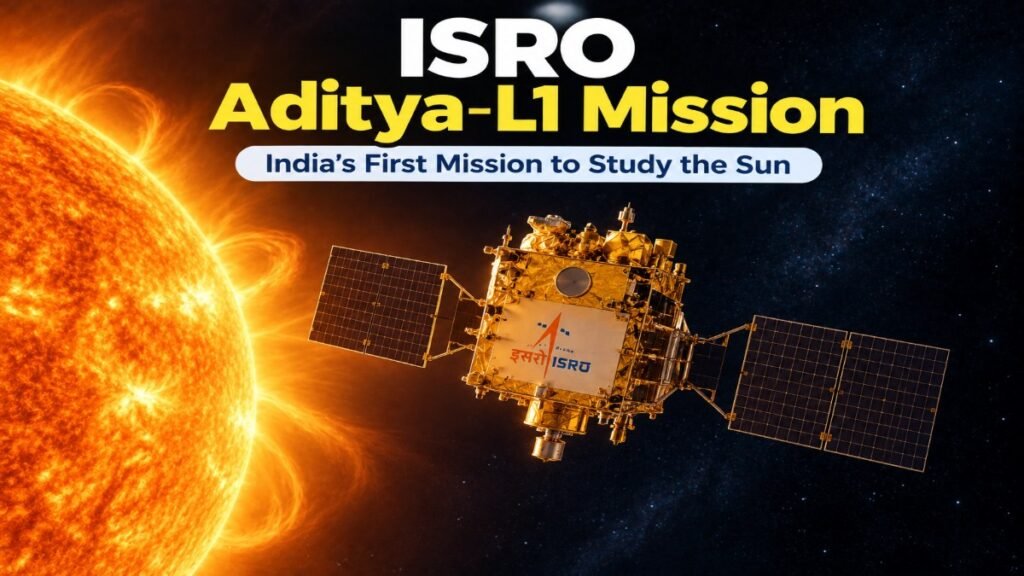
Aditya-L1 Mission is India’s first dedicated space-based mission to study the Sun, developed by the Indian Space Research Organisation (ISRO). The mission aims to enhance our understanding of the Sun’s atmosphere, solar activities and their impact on space weather, which directly affects satellites, communication systems and technological infrastructure on Earth.
The spacecraft was successfully launched on 2 September 2023 aboard the PSLV-C57 launch vehicle from the Satish Dhawan Space Centre (SDSC), Sriharikota. After a journey of about 126 days, it was successfully placed in a Halo Orbit around the Sun-Earth Lagrange Point-1 (L1) on 6 January 2024, approximately 1.5 million km from the Earth.
Master Science & Technology. Maximize Your BPSC Mains Score.
Enroll in the BPSC Science & Tech Course Today
Master Science & Technology for BPSC Mains GS Paper-2 with 75+ exam-oriented topics, 6 structured lessons, and downloadable PDF notes—all in one course.
✔ 75+ Exam-Oriented Topics • ✔ 6 Comprehensive Lessons • ✔ Downloadable PDF Notes • ✔ Updated for 72nd BPSC Mains
The Lagrange Point-1 (L1) is a unique location between the Earth and the Sun where the gravitational forces of the two bodies balance each other. A spacecraft positioned in a Halo Orbit around L1 can continuously observe the Sun without being obstructed by the Earth or experiencing eclipses, enabling uninterrupted monitoring of solar activities in real time.
Aditya-L1 carries seven scientific payloads, of which four are designed to remotely observe the photosphere, chromosphere and corona (the outermost layer of the Sun), while the remaining three study solar wind, energetic particles, plasma and magnetic fields in the space surrounding the spacecraft. Together, these payloads provide comprehensive information on the Sun’s behaviour and its influence on the interplanetary environment.
Major Objectives of Aditya-L1 Mission
- Study the photosphere, chromosphere and corona of the Sun.
- Understand the heating mechanism of the solar corona.
- Investigate solar flares and Coronal Mass Ejections (CMEs).
- Study the origin, composition and dynamics of solar wind.
- Observe the plasma environment and magnetic fields near L1.
- Improve the understanding and prediction of space weather.
Aditya-L1 Mission is a landmark mission in India’s space programme, marking the country’s entry into advanced solar research and strengthening its capabilities in space science and deep-space exploration.
2. Major Scientific Achievements and Significance
- Continuous Observation of the Sun: Positioned at the Sun–Earth Lagrange Point-1 (L1), about 1.5 million km from Earth, the Aditya-L1 Solar Mission can continuously monitor the Sun 24×7 without interruptions caused by eclipses or Earth’s shadow, enabling real-time observation of solar activities.
- Understanding Solar Phenomena: The ISRO Aditya-L1 Mission studies the solar corona, solar flares and Coronal Mass Ejections (CMEs), helping scientists solve long-standing mysteries such as why the Sun’s corona is nearly 200 times hotter than its surface.
- Improving Space Weather Forecasting: The Aditya-L1 Mission provides crucial data on solar wind, plasma and magnetic fields, improving the prediction of space weather events that can disrupt satellites, GPS/NavIC navigation, radio communication, power grids and aviation systems.
- Supporting Future Space Missions: Real-time monitoring of solar radiation and energetic particles helps protect spacecraft and astronauts from harmful solar storms. The mission will support future programmes such as Gaganyaan, Bharatiya Antariksha Station and other deep-space missions.
- Strengthening India’s Space Science Capabilities: The Aditya-L1 Solar Mission has made India one of the few countries with a dedicated solar observatory, joining nations such as the United States, Europe and Japan in advanced solar research. The scientific data generated will contribute to global studies on solar physics and climate science.
- Technological Milestone: Successfully placing a spacecraft in a Halo Orbit around L1 demonstrated ISRO’s advanced deep-space navigation and mission management capabilities, paving the way for more ambitious interplanetary and space science missions.
Prepare Smarter. Study Better. Ace BPSC Mains.
BPSC Mains GS Paper 1 & 2 Complete Course
Access comprehensive BPSC Mains Notes for GS Paper 1 & 2, covering 378+ topics across 24 PDF lessons, with dedicated Bihar coverage, practice questions and downloadable study material.
✓ GS Paper 1 & 2 • ✓ 378+ Topics • ✓ 24 PDF Lessons • ✓ Bihar-Specific Coverage • ✓ Downloadable Notes
3. Importance of Aditya-L1 Mission
- Advancing Solar Science: Aditya-L1 Mission is India’s first dedicated solar observatory, enabling indigenous research on the Sun’s atmosphere, solar magnetic fields and space weather. The mission will generate long-term scientific data, reducing dependence on foreign space agencies and strengthening India’s capabilities in solar physics.
- Enhancing National Infrastructure Security: Accurate forecasting of space weather helps protect critical infrastructure such as communication satellites, GPS/NavIC services, power grids, aviation systems and communication networks from disruptions caused by solar storms and Coronal Mass Ejections (CMEs).
- Supporting Future Human Spaceflight: Data generated by the ISRO Aditya-L1 Mission will help assess the effects of solar radiation and energetic particles on spacecraft and astronauts. This will improve mission planning and safety for future programmes such as Gaganyaan, the Bharatiya Antariksha Station and future lunar exploration missions.
- Strengthening India’s Global Position in Space Research: With the Aditya-L1 Solar Mission, India has joined a select group of countries with dedicated solar observation missions, enhancing its reputation as a major space-faring nation and creating new opportunities for international scientific collaboration.
- Promoting Technological Innovation and Self-Reliance: The mission has advanced India’s expertise in deep-space navigation, spacecraft autonomy, payload development and mission operations, supporting the objectives of Atmanirbhar Bharat, Indian Space Policy 2023 and the growth of the domestic space ecosystem.
- Contributing to Viksit Bharat 2047: Aditya-L1 Mission represents a significant step towards building a knowledge-driven economy by promoting scientific research, technological innovation and human resource development. The mission reinforces India’s commitment to peaceful space exploration while laying the foundation for future deep-space and interplanetary missions.
4. Conclusion
The Aditya-L1 Mission marks a major milestone in India’s space science programme by providing continuous observations of the Sun and valuable insights into solar activity and space weather. Its success has strengthened India’s capabilities in solar research, deep-space navigation and advanced scientific missions. By supporting future human spaceflight, protecting critical infrastructure and promoting indigenous technology, Aditya-L1 Mission contributes significantly to India’s scientific self-reliance and its aspiration to become a leading global space power.
BPSC Mains Practice Question
“The Aditya-L1 Mission marks India’s entry into advanced solar research and has implications beyond scientific exploration.” Discuss the major scientific achievements of the mission and examine its significance for India’s national infrastructure, future space missions and technological self-reliance.
Learn More About Aditya-L1 Mission
For official information on the Aditya-L1 Mission, its objectives, scientific payloads and mission updates, visit the Indian Space Research Organisation (ISRO) official website: https://www.isro.gov.in/Aditya_L1.html