1. Introduction
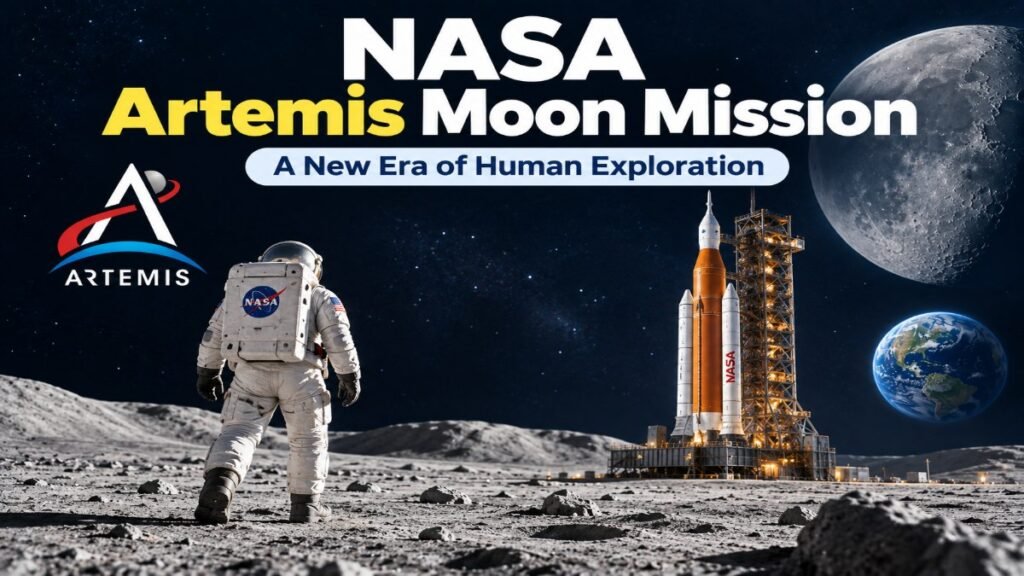
The Artemis Mission is NASA’s flagship human lunar exploration programme aimed at returning astronauts to the Moon after the Apollo missions and establishing a sustainable long-term human presence on and around the Moon. It serves as a stepping stone for future human missions to Mars and deep-space exploration.
Named after Artemis, the Greek goddess of the Moon and twin sister of Apollo, the Artemis Program symbolizes a new era of space exploration with a focus on international collaboration, advanced technologies, and commercial partnerships. Unlike the Apollo programme, which primarily focused on short-duration lunar landings, the Artemis Moon Mission seeks to develop permanent infrastructure such as the Lunar Gateway, enable resource utilization on the Moon, and support continuous scientific research.
Key Facts
- Lead Agency: National Aeronautics and Space Administration (NASA), USA.
- Programme Announced: 2017 (under the U.S. Space Policy Directive-1).
- First Mission: Artemis I (uncrewed), successfully launched in November 2022.
- Primary Goal: Land the first woman and the first person of colour on the Moon and establish a sustainable human presence.
- Long-term Vision: Use the Moon as a testing ground for future human missions to Mars.
Master Science & Technology. Maximize Your BPSC Mains Score.
Enroll in the BPSC Science & Tech Course Today
Master Science & Technology for BPSC Mains GS Paper-2 with 75+ exam-oriented topics, 6 structured lessons, and downloadable PDF notes—all in one course.
✔ 75+ Exam-Oriented Topics • ✔ 6 Comprehensive Lessons • ✔ Downloadable PDF Notes • ✔ Updated for 72nd BPSC Mains
2. Evolution of the Artemis Programme
- The Apollo Programme (1961–1972) successfully landed 12 astronauts on the Moon through six lunar landing missions, but human lunar exploration ended with Apollo 17 (1972) due to high costs and shifting priorities.
- To revive deep-space exploration, the U.S. Space Policy Directive-1 (2017) directed NASA to lead a sustainable programme for returning humans to the Moon, leading to the launch of the Artemis Programme.
- In 2020, NASA introduced the Artemis Accords, a set of non-binding principles for peaceful, transparent, and responsible exploration of the Moon, Mars, and other celestial bodies. As of 2026, 60+ countries have signed the Accords, including India (2023).
- The Artemis Program has evolved into a global collaborative programme, with major contributions from international partners such as the European Space Agency (ESA), Japan Aerospace Exploration Agency (JAXA), Canadian Space Agency (CSA), and several private companies like SpaceX and Blue Origin.
Prepare Smarter. Study Better. Ace BPSC Mains.
BPSC Mains GS Paper 1 & 2 Complete Course
Access comprehensive BPSC Mains Notes for GS Paper 1 & 2, covering 378+ topics across 24 PDF lessons, with dedicated Bihar coverage, practice questions and downloadable study material.
✓ GS Paper 1 & 2 • ✓ 378+ Topics • ✓ 24 PDF Lessons • ✓ Bihar-Specific Coverage • ✓ Downloadable Notes
3. Objectives of the Artemis Programme
- Establish a sustainable human presence on the Moon by developing long-term infrastructure for scientific research, technology demonstration, and future habitation, unlike the short-duration Apollo missions.
- Advance scientific exploration by studying the Moon’s geology, water ice deposits at the south pole, and lunar environment to understand the evolution of the Earth–Moon system and the Solar System.
- Utilise lunar resources (In-Situ Resource Utilisation – ISRU) such as water ice for producing drinking water, oxygen, and rocket fuel, thereby reducing the cost of future deep-space missions.
- Prepare for human missions to Mars by using the Moon as a testing ground for life-support systems, habitats, robotics, and other technologies required for long-duration space travel.
- Promote international and commercial collaboration by encouraging participation of partner countries and private space companies, fostering innovation and expanding the global space economy.
4. Major Components of the Artemis Programme
Space Launch System (SLS)
The Space Launch System (SLS) is NASA’s most powerful rocket, designed to carry astronauts, cargo, and heavy spacecraft beyond Earth’s orbit. It serves as the primary launch vehicle for Artemis Mission and is capable of supporting future missions to the Moon and Mars. Artemis I (2022) marked the first successful flight of the SLS.
Orion Spacecraft
The Orion spacecraft is the crew vehicle developed to transport astronauts from Earth to lunar orbit and safely return them. It consists of a Crew Module for astronauts and a Service Module, supplied by the European Space Agency (ESA), which provides propulsion, power, oxygen, and water during the mission.
Lunar Gateway
The Lunar Gateway is a small space station planned in orbit around the Moon. It will function as a staging point for lunar landings, scientific experiments, astronaut accommodation, and logistics support. It is being jointly developed by NASA, ESA, JAXA, CSA, and other international partners.
Human Landing System (HLS)
The Human Landing System (HLS) is designed to transport astronauts from the Lunar Gateway to the Moon’s surface and back. NASA selected SpaceX’s Starship as the first HLS for Artemis III, while additional landing systems are being developed to ensure long-term sustainability and competition.
Exploration Spacesuits and Lunar Surface Systems
NASA is developing next-generation Artemis spacesuits (AxEMU) for enhanced mobility, safety, and extended exploration on the lunar surface, particularly near the Moon’s south pole. The programme also includes lunar rovers, power systems, communication networks, and surface habitats to support prolonged human presence.
5. Artemis Missions: Progress So Far
- Artemis I (16 November – 11 December 2022): The first uncrewed Artemis mission successfully tested the Space Launch System (SLS) and Orion spacecraft. Orion completed a 25.5-day mission, travelled about 2.25 million km, orbited the Moon, and safely splashed down in the Pacific Ocean.
- Artemis II (April 2026): The first crewed Artemis mission carried four astronauts on a lunar flyby without landing on the Moon. The mission successfully validated Orion’s life-support systems, deep-space operations, and crew performance, marking the first human journey beyond low Earth orbit since Apollo 17 (1972).
- Artemis III (Target: 2027): Under NASA’s revised architecture, this mission is planned as a crewed demonstration mission in low Earth orbit to test rendezvous and docking with commercial lunar landers (SpaceX and/or Blue Origin). The experience gained will support future lunar landing missions.
- Artemis IV (Target: 2028): Planned to become the first Artemis Mission to land astronauts near the Moon’s South Pole, while also beginning the deployment of the Lunar Gateway and expanding long-duration lunar exploration.
- Long-term Vision: NASA plans annual Artemis missions after 2028 to establish a sustainable human presence on the Moon, develop a lunar economy, and prepare for future human missions to Mars.
6. Significance of the Artemis Programme
Scientific Significance
The Artemis Moon Mission will enable detailed exploration of the Moon’s South Pole, where permanently shadowed craters contain water ice. Scientific studies of lunar rocks, soil, and ice will provide insights into the formation and evolution of the Earth–Moon system and the early Solar System.
Technological Significance
The NASA Artemis Program is driving the development of advanced space technologies, including heavy-lift launch vehicles, reusable lunar landers, next-generation spacesuits, autonomous systems, and deep-space communication. These technologies will support future long-duration missions beyond the Moon.
Economic Significance
The programme is expected to accelerate the global space economy by encouraging private sector participation in launch services, spacecraft development, lunar logistics, communication, and resource utilization. It is creating new opportunities for innovation, investment, and high-skilled employment.
Strategic and Geopolitical Significance
The NASA Artemis Mission strengthens the United States’ leadership in space exploration while promoting international cooperation through the Artemis Accords. At the same time, it has intensified global competition in lunar exploration, particularly with countries pursuing independent Moon programmes.
Significance for Future Human Exploration
The Moon will serve as a testing ground for technologies, habitats, and life-support systems required for long-duration human missions to Mars. The experience gained through the Artemis Mission will reduce the risks associated with future deep-space exploration.
7. Challenges and Criticisms
- Mission Delays: The Artemis Mission has faced repeated delays due to technical challenges, safety reviews, and the development of critical systems such as the Human Landing System (HLS) and next-generation spacesuits.
- High Cost: The programme involves enormous expenditure on the Space Launch System (SLS), Orion spacecraft, Lunar Gateway, and associated infrastructure, raising concerns about its long-term financial sustainability.
- Technological and Environmental Challenges: Long-duration human missions must overcome challenges such as space radiation, extreme lunar temperatures, lunar dust, communication constraints, and reliable life-support systems.
- Dependence on Commercial Partners: Key mission components, particularly the lunar lander, are being developed by private companies such as SpaceX and Blue Origin. Delays or technical issues faced by these partners can directly affect mission timelines.
- Geopolitical and Legal Concerns: While the Artemis Accords promote peaceful exploration, some countries have expressed concerns regarding space resource utilization, governance of lunar activities, and the absence of a universally accepted legal framework for exploiting extraterrestrial resources.
8. Relevance for India
- Strengthening India–US Space Cooperation: India became the 27th signatory to the Artemis Accords in June 2023, reinforcing cooperation with the United States in peaceful space exploration, scientific research, interoperability, and responsible use of outer space.
- Opportunities for ISRO: Collaboration under the Artemis Program can benefit India’s future programmes such as Gaganyaan, Chandrayaan, the Bharatiya Antariksha Station (BAS), and proposed lunar exploration missions through technology exchange, scientific cooperation, and capacity building.
- Boost to India’s Space Industry: The programme opens opportunities for Indian private space companies and startups to participate in the global space supply chain in areas such as satellite technology, robotics, navigation, communication systems, and space manufacturing.
- Scientific and Strategic Importance: The Artemis Moon Mission will generate valuable scientific data on the Moon’s South Pole, complementing discoveries made by Chandrayaan-3. India’s participation also enhances its role as a responsible and emerging global space power.
- Support for India’s Long-term Space Vision: The knowledge and international partnerships developed through the NASA Artemis Mission are expected to support India’s long-term objectives of human spaceflight, lunar exploration, deep-space missions, and eventual participation in Mars exploration.
9. Future Prospects of the Artemis Mission
- The Artemis Mission aims to establish a sustainable human presence on the Moon through permanent infrastructure, regular crewed missions, and long-duration scientific research. The NASA Artemis Program is expected to play a major role in achieving this long-term objective.
- It is expected to lay the foundation for a lunar economy, including resource utilization, commercial space activities, and international research stations. These developments are important Artemis Program Notes for understanding the economic and strategic dimensions of lunar exploration.
- The experience gained from the Artemis Mission will be crucial for human missions to Mars, helping validate technologies required for deep-space exploration. The NASA Artemis Mission will therefore serve as an important technological stepping stone towards future interplanetary missions. These developments also form important Artemis Program Notes for BPSC and UPSC preparation.
- With growing participation of partner countries and private companies, the Artemis Mission is likely to become the largest international collaborative programme for human space exploration in the coming decades. Such international cooperation and commercial participation are also important Artemis Program Notes for understanding the future of global space exploration.
10. Conclusion
The Artemis Mission represents a major shift in human space exploration from short-duration lunar visits towards a sustainable human presence on and around the Moon. Through the Artemis Program, NASA aims to advance scientific research, develop new space technologies, strengthen international cooperation and prepare for future human missions to Mars. The NASA Artemis Program therefore has significance not only for lunar exploration but also for the future of the global space economy and humanity’s long-term presence beyond Earth.
BPSC Mains Practice Questions
1. “The Artemis Mission represents a shift from short-duration lunar exploration towards establishing a sustainable human presence on and around the Moon.” Discuss the major objectives, components and significance of the Artemis Mission.
2. “The Artemis Mission is not merely a lunar exploration programme but a stepping stone towards future human missions to Mars.” Examine the opportunities and challenges associated with the programme and discuss its relevance for India.
Learn More About the Artemis Mission
For authentic and updated information on the Artemis Mission, including Artemis missions, lunar exploration, Gateway, Moon-to-Mars objectives and future human exploration, visit the official NASA website: NASA Artemis Program – Moon to Mars