1. Introduction
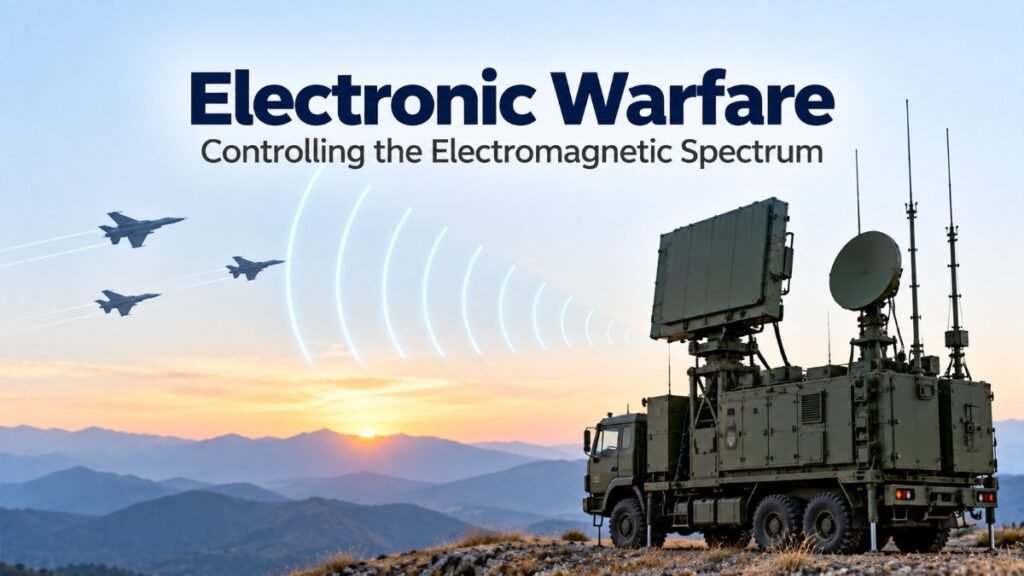
Electronic Warfare (EW) refers to the military use of the electromagnetic spectrum (EMS) to detect, deceive, disrupt, or deny the enemy’s electronic systems while protecting one’s own communication and surveillance networks. It involves the use of radio waves, radar signals, infrared, microwave, GPS, and other electromagnetic frequencies to gain a tactical or strategic advantage during military operations.
In modern warfare, advanced weapons, aircraft, missiles, drones, satellites, and communication systems rely heavily on the electromagnetic spectrum. Therefore, controlling this spectrum has become as important as controlling land, sea, air, and cyberspace. A nation that dominates the electromagnetic environment can significantly reduce the enemy’s operational capability without direct physical engagement. Electronic Warfare systems therefore play a critical role in modern military operations.
Unlike Cyber Warfare, which targets computer networks and digital data, Electronic Warfare targets the electromagnetic signals that enable communication, navigation, surveillance, and weapon guidance. In practice, both are often used together as part of hybrid warfare. These concepts are important for understanding Electronic Warfare Notes from a BPSC and UPSC examination perspective.
Importance of Electronic Warfare
- Enables real-time intelligence gathering by intercepting enemy radar and communication signals.
- Disrupts enemy communication, radar, GPS, and drone operations through jamming and deception.
- Protects friendly military assets from enemy electronic attacks.
- Enhances the effectiveness of air defence, precision-guided weapons, and unmanned systems.
- Acts as a force multiplier, allowing militaries to achieve operational superiority with minimal physical confrontation.
The growing importance of Electronic Warfare in India is linked to the increasing use of network-centric warfare, drones, precision-guided weapons, satellites, and advanced communication systems.
Master Science & Technology. Maximize Your BPSC Mains Score.
Enroll in the BPSC Science & Tech Course Today
Master Science & Technology for BPSC Mains GS Paper-2 with 75+ exam-oriented topics, 6 structured lessons, and downloadable PDF notes—all in one course.
✔ 75+ Exam-Oriented Topics • ✔ 6 Comprehensive Lessons • ✔ Downloadable PDF Notes • ✔ Updated for 72nd BPSC Mains
2. Major Techniques of Electronic Warfare
It is broadly classified into three components: Electronic Support (ES), Electronic Attack (EA), and Electronic Protection (EP). Together, they help a military detect enemy activities, disrupt adversary systems, and safeguard its own electronic assets. This framework is also described as Electronic Support Attack and Protection, and forms the core of modern Electronic Warfare systems.
(i) Electronic Support (ES)
Electronic Support involves detecting, intercepting, locating, and analysing enemy electromagnetic emissions such as radar and communication signals. It provides real-time intelligence on enemy positions, movements, and capabilities, enabling informed battlefield decisions.
Example: During the Russia–Ukraine War, both sides continuously intercepted radio communications and radar emissions to locate enemy artillery and command posts, improving the accuracy of counter-attacks.
(ii) Electronic Attack (EA)
Electronic Attack aims to degrade, disrupt, deceive, or destroy enemy electronic systems through techniques such as radar jamming, GPS spoofing, communication interference, and anti-radiation missiles. It can render enemy aircraft, drones, missiles, and air-defence systems ineffective without physically destroying them.
Examples:
- In the Russia–Ukraine War, extensive GPS jamming disrupted drone navigation and precision-guided weapons.
- During the Israel–Iran confrontation (2024–25), electronic jamming and spoofing were widely used to counter drones and guided missiles.
- During Operation Sindoor (2025), India reportedly employed electronic warfare systems to suppress enemy radar and communication networks while neutralising drone threats.
(iii) Electronic Protection (EP)
Electronic Protection comprises measures taken to secure friendly communication, radar, navigation, and weapon systems from enemy electronic attacks. It includes frequency hopping, signal encryption, anti-jamming technologies, electromagnetic shielding, and secure communication networks, ensuring uninterrupted military operations even in a contested electromagnetic environment.
Example: Modern fighter aircraft such as the Rafale and LCA Tejas Mk-1A are equipped with advanced electronic warfare suites that detect hostile radar signals, issue threat warnings, and deploy electronic countermeasures to enhance aircraft survivability.
Prepare Smarter. Study Better. Ace BPSC Mains.
BPSC Mains GS Paper 1 & 2 Complete Course
Access comprehensive BPSC Mains Notes for GS Paper 1 & 2, covering 378+ topics across 24 PDF lessons, with dedicated Bihar coverage, practice questions and downloadable study material.
✓ GS Paper 1 & 2 • ✓ 378+ Topics • ✓ 24 PDF Lessons • ✓ Bihar-Specific Coverage • ✓ Downloadable Notes
3. Electronic Warfare in Recent Global Conflicts
Recent conflicts have demonstrated that Electronic Warfare (EW) has become indispensable in modern military operations. Control over the electromagnetic spectrum is now as critical as superiority in land, air, sea, and cyberspace. The following conflicts provide important examples for Electronic Warfare Notes and demonstrate the growing operational importance of Electronic Warfare systems.
Russia–Ukraine War (2022–Present)
- Widely regarded as the largest electronic warfare battlefield since World War II.
- Russia deployed advanced EW systems such as Krasukha-4, Zhitel, Tirada-2, and Borisoglebsk-2 to jam Ukrainian radars, GPS signals, and military communications.
- Both sides extensively used GPS jamming and spoofing to disrupt drones, precision-guided missiles, and navigation systems.
- Russia has also targeted Starlink satellite communications, attempting to disrupt Ukrainian drone operations through electronic jamming.
Israel–Hamas Conflict (2023–Present)
- Israel employed sophisticated electronic warfare to support the Iron Dome and other air-defence systems against rockets and drones.
- Electronic intelligence (ELINT) was extensively used to detect militant communications and locate launch sites.
- Both sides attempted to interfere with drone control links and communication networks, highlighting the growing importance of EW in urban warfare.
Israel–Iran Conflict (2024–25)
- Both countries relied heavily on GPS jamming, spoofing, and electronic countermeasures to defend against drones and missile attacks.
- Electronic warfare was used to degrade enemy navigation systems and protect strategic installations.
- The conflict demonstrated how electromagnetic spectrum dominance is increasingly essential for missile defence and unmanned systems.
India–Pakistan: Operation Sindoor (2025)
- During Operation Sindoor, India integrated electronic warfare with precision air strikes and air-defence operations.
- Electronic warfare systems were reportedly used to jam enemy communication links, suppress radar systems, and neutralise hostile drones, improving the effectiveness and survivability of Indian aircraft.
- The operation highlighted India’s growing emphasis on network-centric and spectrum-centric warfare.
The experience of Operation Sindoor is particularly relevant to Electronic Warfare in India, demonstrating the increasing importance of indigenous Electronic Warfare systems for integrated military operations.
Armenia–Azerbaijan (Nagorno-Karabakh Conflict)
- Azerbaijan successfully integrated electronic warfare with armed drones to suppress Armenian air-defence radars.
- Radar jamming enabled drones such as the Bayraktar TB2 to destroy tanks, artillery, and missile systems with high precision.
- The conflict established a new model of drone-centric electronic warfare.
China–Taiwan Tensions
- China frequently employs electronic warfare aircraft and naval platforms to jam radar, GPS, and communication systems during military exercises around Taiwan.
- The People’s Liberation Army (PLA) considers electromagnetic spectrum dominance a core element of its “Intelligentised Warfare” doctrine.
- These activities are intended to test Taiwan’s air-defence and communication resilience.
Red Sea Crisis (2023–Present)
- During attacks by Houthi rebels on commercial shipping, coalition naval forces relied extensively on electronic warfare to detect, jam, and intercept drones and anti-ship missiles.
- Electronic countermeasures played a crucial role in protecting international maritime trade routes.
These conflicts demonstrate that Electronic Support Attack and Protection is no longer limited to specialised military operations. It has become an integral part of modern multi-domain warfare, where control and protection of the electromagnetic spectrum can directly influence the outcome of military operations.
4. India’s Electronic Warfare Capabilities and Way Forward
India has significantly strengthened its electronic warfare (EW) capabilities to address emerging threats from network-centric warfare, drones, precision-guided weapons, and electronic attacks. Under the vision of Aatmanirbhar Bharat, the country is increasingly developing indigenous EW systems and integrating them across the Army, Navy, and Air Force.
India’s Capabilities
- DRDO-developed EW Systems: Indigenous systems such as Samyukta (Army), Himshakti (mountain warfare), and Shakti (Navy) provide capabilities for communication interception, radar surveillance, electronic jamming, and signal intelligence. These DRDO Electronic Warfare systems strengthen India’s ability to operate effectively in a contested electromagnetic environment.
- Advanced Airborne EW Suites: Modern combat aircraft, including the Rafale, LCA Tejas Mk-1A, and Su-30 MKI, are equipped with advanced electronic warfare suites capable of detecting enemy radars, issuing threat warnings, and deploying electronic countermeasures.
- Anti-Drone Technologies: DRDO has developed indigenous Counter-Unmanned Aircraft Systems (C-UAS) capable of detecting, tracking, jamming, and neutralising hostile drones, an increasingly important capability in view of recent conflicts. These capabilities are an important part of Electronic Warfare in India.
- Integration with Network-Centric Warfare: Electronic warfare capabilities are being integrated with satellites, drones, airborne early warning systems (AEW&C), missile defence, and secure communication networks, enabling real-time battlefield awareness and faster decision-making.
Way Forward
- Accelerate indigenous development of AI-enabled electronic systems, advanced radar technologies, and next-generation communication networks.
- Strengthen joint electronic warfare capabilities among the Army, Navy, Air Force, Defence Cyber Agency, and Defence Space Agency for integrated multi-domain operations.
- Invest in quantum-resistant communication, spectrum management, and resilient satellite navigation systems to counter future electronic threats.
- Expand research, skilled manpower, and collaboration between DRDO, ISRO, academia, private industry, and start-ups to achieve technological self-reliance.
Strengthening indigenous Electronic Warfare systems and expanding DRDO Electronic Warfare systems will be essential for maintaining spectrum dominance and ensuring India’s preparedness for future conflicts.
5. Conclusion
Electronic Warfare has become an indispensable component of modern warfare, as control over the electromagnetic spectrum directly influences communication, navigation, surveillance, weapon guidance, and battlefield operations. The integration of Electronic Support, Electronic Attack and Electronic Protection enables militaries to detect threats, disrupt adversary systems, and protect their own electronic assets.
For India, strengthening indigenous Electronic Warfare in India capabilities is essential to address emerging threats from drones, precision-guided weapons, cyber-electromagnetic attacks, and network-centric warfare. Continued development of DRDO Electronic Warfare systems, AI-enabled technologies, resilient communication networks, and skilled manpower will help India achieve greater technological self-reliance and maintain operational superiority in an increasingly contested electromagnetic environment.
BPSC Mains Practice Question
“Electronic Warfare has emerged as a critical component of modern multi-domain warfare.” Discuss the significance of Electronic Support, Electronic Attack and Electronic Protection in contemporary conflicts. Also examine India’s Electronic Warfare capabilities and suggest measures to strengthen them.
Learn More About Electronic Warfare
For official information on Electronic Warfare, indigenous EW technologies, and defence electronics research and development, visit the Defence Research and Development Organisation (DRDO) official website: DRDO – Official Website