1. Introduction
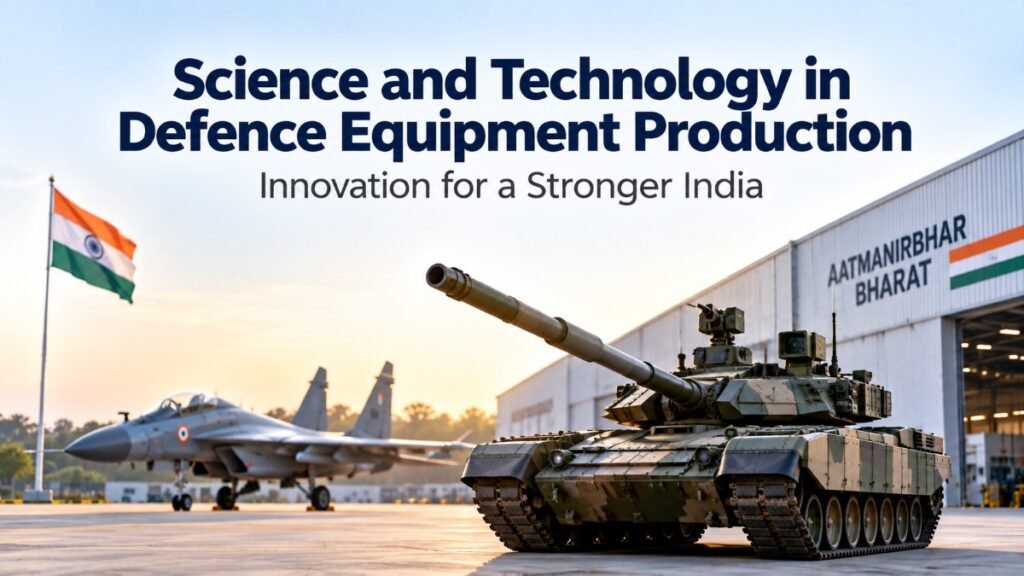
Science and Technology in Defence Equipment Production refers to the application of advanced technologies such as Artificial Intelligence (AI), Robotics, Aerospace Engineering, Advanced Materials, Electronics, Cyber Technology, Space Technology, and Additive Manufacturing (3D Printing) in the design, development, production, and maintenance of modern defence equipment. These technologies have transformed defence manufacturing from conventional weapons to smart, network-centric, and autonomous systems.
India has traditionally been one of the world’s largest importers of defence equipment. However, in recent years, the focus has shifted towards indigenous research, development, and manufacturing under initiatives such as Atmanirbhar Bharat, Make in India, and Defence Acquisition Procedure (DAP) 2020. The objective is to reduce import dependence, strengthen national security, promote technological self-reliance, and position India as a global defence manufacturing hub. This shift has given greater importance to Science and technology in defence, particularly in developing critical technologies and strengthening domestic capabilities.
With continuous advancements in science and technology, India has successfully developed several indigenous defence platforms such as the LCA Tejas, INS Vikrant, Agni and Akash missile systems, BrahMos supersonic cruise missile, Pinaka rocket system, and AI-enabled drones, demonstrating significant progress towards Indigenous defence manufacturing. The growing Defence equipment production in India also reflects the country’s increasing ability to convert scientific research and technological innovation into operational defence capabilities.
Master Science & Technology. Maximize Your BPSC Mains Score.
Enroll in the BPSC Science & Tech Course Today
Master Science & Technology for BPSC Mains GS Paper-2 with 75+ exam-oriented topics, 6 structured lessons, and downloadable PDF notes—all in one course.
✔ 75+ Exam-Oriented Topics • ✔ 6 Comprehensive Lessons • ✔ Downloadable PDF Notes • ✔ Updated for 72nd BPSC Mains
2. Role of Science and Technology in Defence Equipment Production
Advanced Missile and Weapon Systems
Science and technology have enabled India to develop advanced indigenous weapon systems with high accuracy and greater deterrence. Systems such as Agni (ballistic missile), BrahMos (supersonic cruise missile), Akash (surface-to-air missile), Pinaka (multi-barrel rocket launcher), and the recently tested AD-1 interceptor missile under the Ballistic Missile Defence (BMD) programme have significantly strengthened India’s defence preparedness.
These developments demonstrate the importance of Science and technology in defence and contribute significantly to Defence equipment production in India. Indigenous development of advanced weapon systems also strengthens Indigenous defence manufacturing and reduces dependence on foreign suppliers.
Aerospace and Aviation Technologies
Advanced aerospace technologies have transformed India’s aircraft manufacturing capabilities. Indigenous platforms such as the LCA Tejas, Light Combat Helicopter (Prachand), Light Utility Helicopter (LUH), and the upcoming Advanced Medium Combat Aircraft (AMCA) demonstrate India’s growing expertise in aeronautics. India is also developing indigenous Unmanned Aerial Vehicles (UAVs) such as TAPAS-BH-201 for surveillance and reconnaissance missions.
The development of these platforms highlights the role of Science and technology in defence in building sophisticated aerospace capabilities and strengthening the India defence manufacturing ecosystem.
Naval Defence Technologies
Science and technology have enhanced India’s maritime capabilities through indigenous warship and submarine construction. The INS Vikrant, India’s first indigenously built aircraft carrier, and the Arihant-class nuclear-powered ballistic missile submarines (SSBNs) have strengthened India’s maritime security. Technologies such as sonars, advanced radars, autonomous underwater vehicles (AUVs), and anti-submarine warfare systems further improve naval operations.
Such capabilities represent significant progress in Indigenous defence manufacturing and demonstrate how Defence technology and Atmanirbhar Bharat can contribute to India’s strategic autonomy.
Artificial Intelligence (AI), Robotics and Autonomous Systems
AI and robotics are revolutionising defence production by enabling autonomous drones, swarm drones, robotic surveillance vehicles, intelligent target recognition, predictive maintenance, and battlefield decision support systems. These technologies reduce risks to soldiers while improving operational efficiency and precision in modern warfare.
The integration of AI, robotics, and autonomous systems is strengthening Defence equipment production in India while creating new opportunities for the India defence manufacturing ecosystem.
Advanced Electronics, Communication and Cyber Technologies
Modern defence equipment relies heavily on AESA radars, electronic warfare systems, encrypted communication networks, Battlefield Management Systems (BMS), satellite communication, and cyber defence technologies. These systems facilitate network-centric warfare, allowing seamless coordination among the Army, Navy, and Air Force.
Advanced electronics and secure communication technologies are therefore essential elements of Science and technology in defence, particularly for developing sophisticated and interconnected defence platforms.
Space and Advanced Manufacturing Technologies
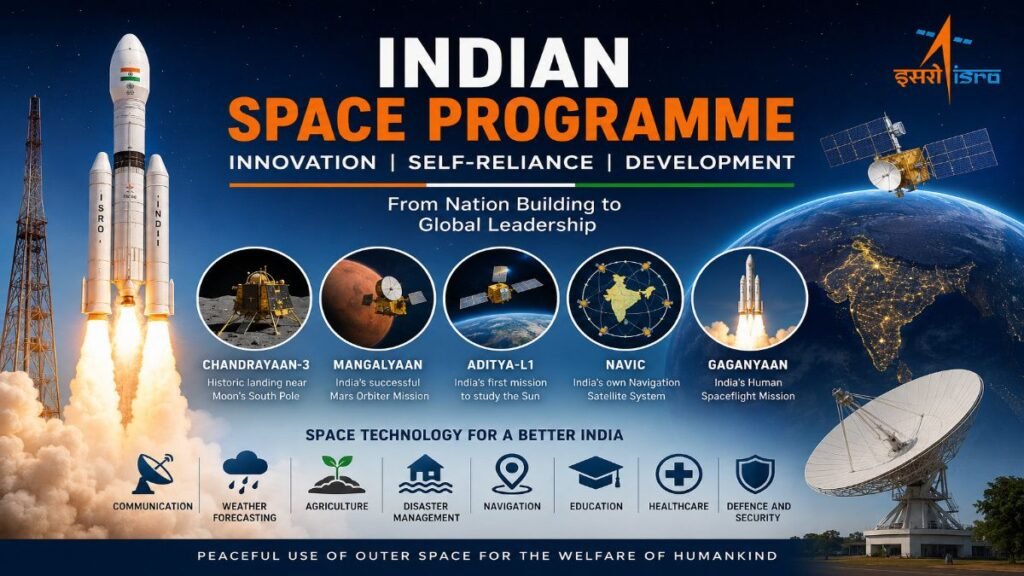
Space technology plays a crucial role in defence through military satellites, NAVIC navigation, satellite communication, and intelligence gathering. At the same time, advanced manufacturing techniques such as 3D Printing (Additive Manufacturing), advanced composite materials, nanotechnology, and indigenous semiconductor-based electronics have reduced production time, improved equipment quality, and enhanced self-reliance in defence manufacturing.
These technologies strengthen Defence technology and Atmanirbhar Bharat by enabling domestic development of critical technologies and supporting a more capable India defence manufacturing ecosystem.
Prepare Smarter. Study Better. Ace BPSC Mains.
BPSC Mains GS Paper 1 & 2 Complete Course
Access comprehensive BPSC Mains Notes for GS Paper 1 & 2, covering 378+ topics across 24 PDF lessons, with dedicated Bihar coverage, practice questions and downloadable study material.
✓ GS Paper 1 & 2 • ✓ 378+ Topics • ✓ 24 PDF Lessons • ✓ Bihar-Specific Coverage • ✓ Downloadable Notes
3. Government Initiatives and Current Status
- Atmanirbhar Bharat in Defence: The Government has prioritised indigenous design, development, and manufacturing to reduce import dependence. In FY 2024–25, India’s defence production reached a record ₹1.54 lakh crore, reflecting the growing strength of the domestic defence industry. This progress demonstrates the increasing importance of Defence technology and Atmanirbhar Bharat in strengthening India’s strategic autonomy.
- Defence Acquisition Procedure (DAP), 2020: DAP 2020 gives the highest priority to ‘Buy (Indian–IDDM)’ (Indigenously Designed, Developed and Manufactured) equipment, encourages domestic production, and promotes participation of MSMEs, start-ups, and the private sector. It provides an important policy framework for Defence equipment production in India and supports Indigenous defence manufacturing.
- Positive Indigenisation Lists: The Ministry of Defence has notified five Positive Indigenisation Lists covering over 5,500 defence items, including weapons, sensors, radars, ammunition, and components, which are to be procured only from domestic manufacturers. By 2025, more than 3,000 items had already been indigenised. These measures strengthen Science and technology in defence by encouraging domestic development of critical technologies.
- iDEX (Innovations for Defence Excellence): Launched in 2018, iDEX supports start-ups, MSMEs, innovators, and academia in developing cutting-edge defence technologies such as AI, robotics, drones, cyber security, autonomous systems, and space technologies, strengthening India’s defence innovation ecosystem. It has become an important pillar of the India defence manufacturing ecosystem.
- Defence Industrial Corridors: India has established two Defence Industrial Corridors in Uttar Pradesh and Tamil Nadu to promote defence manufacturing, attract investments, create employment, and develop an integrated defence industrial ecosystem. These corridors support Defence equipment production in India by bringing manufacturers, suppliers, research institutions, and other stakeholders into a connected industrial ecosystem.
- SRIJAN Portal and Technology Development Fund (TDF): The SRIJAN Portal facilitates the indigenisation of imported defence components, while the Technology Development Fund (TDF) supports industries and research institutions in developing indigenous defence technologies. Together, they accelerate self-reliance in critical defence equipment and strengthen Indigenous defence manufacturing.
- Rising Defence Exports: India’s defence exports have increased from ₹686 crore in 2013–14 to a record ₹23,622 crore in FY 2024–25, a 34-fold increase. Indian defence products are now exported to over 100 countries, with major exports including BrahMos missiles, ALH Dhruv, Akash systems, radars, patrol vessels, and artillery systems. The growth of exports indicates the expanding capabilities of India’s India defence manufacturing ecosystem and its growing role in the global defence market.
4. Challenges and Way Forward
Challenges
- Dependence on Critical Technologies: India still imports key technologies such as aircraft engines, semiconductor chips, aero-engines, advanced sensors, and jet propulsion systems, limiting complete self-reliance. Strengthening Science and technology in defence is therefore essential for developing critical technologies domestically.
- Low Investment in Defence R&D: India’s defence R&D expenditure remains modest compared to major military powers like the United States and China, slowing the development of cutting-edge technologies. Greater investment is necessary to strengthen Defence equipment production in India and accelerate technological innovation.
- Limited Private Sector Participation: Although private companies are playing an increasing role, Defence Public Sector Undertakings (DPSUs) still dominate defence manufacturing, limiting competition and innovation. Greater participation of private companies, MSMEs, and start-ups is essential for a stronger India defence manufacturing ecosystem.
- Technology Transfer Constraints: Foreign defence collaborations often involve limited transfer of critical technologies (ToT), restricting India’s capability to independently manufacture advanced weapon systems. Developing indigenous capabilities through Indigenous defence manufacturing can reduce this technological dependence.
- Global Competition in Defence Exports: Indian defence products face stiff competition from established exporters such as the United States, Russia, France, China, and Israel, requiring continuous improvements in quality, cost competitiveness, and after-sales support.
Way Forward
- Increase Investment in R&D: Enhance funding for DRDO, academia, start-ups, and private industries to develop indigenous technologies in AI, quantum computing, robotics, hypersonic weapons, and semiconductor manufacturing. This will further strengthen Defence technology and Atmanirbhar Bharat.
- Strengthen Public-Private Partnerships (PPP): Encourage greater participation of MSMEs, start-ups, and private defence manufacturers through initiatives like iDEX, Technology Development Fund (TDF), and Defence Industrial Corridors. Such partnerships can create a more innovative and competitive India defence manufacturing ecosystem.
- Focus on Critical Indigenous Technologies: Prioritise the development of indigenous aero-engines, advanced materials, electronic warfare systems, semiconductor chips, and propulsion technologies to reduce strategic dependence on imports. This is central to achieving Indigenous defence manufacturing and technological self-reliance.
- Expand Defence Exports: Improve product quality, certification, maintenance support, and defence diplomacy to achieve the Government’s long-term vision of making India a leading global exporter of defence equipment. A strong export-oriented approach can further expand Defence equipment production in India.
- Promote Industry–Academia Collaboration: Strengthen collaboration among DRDO, ISRO, IITs, universities, defence industries, and start-ups to accelerate innovation and commercialisation of advanced defence technologies. Such collaboration will strengthen Science and technology in defence and support the long-term objectives of Defence technology and Atmanirbhar Bharat.
5. Conclusion
Science and technology have become the backbone of modern defence equipment production, enabling India to develop advanced indigenous platforms and reduce dependence on foreign imports. Initiatives such as Atmanirbhar Bharat, DAP 2020, iDEX, and Defence Industrial Corridors have significantly strengthened the country’s defence manufacturing ecosystem. With sustained investment in research and development, emerging technologies, and private sector participation, India is well-positioned to achieve its vision of becoming a self-reliant defence manufacturing hub and a leading global exporter of defence equipment while ensuring national security and strategic autonomy.
BPSC Mains Practice Question
“Science and technology has become the backbone of modern defence equipment production.” Discuss the role of emerging technologies in strengthening India’s defence manufacturing capabilities. Also examine the major challenges to achieving self-reliance in defence production under the framework of Atmanirbhar Bharat.
Learn More About Science and Technology in Defence Equipment Production
For official information on defence production, indigenous defence manufacturing, and technological self-reliance, visit the Ministry of Defence, Government of India official website: Ministry of Defence – Government of India