1. Introduction
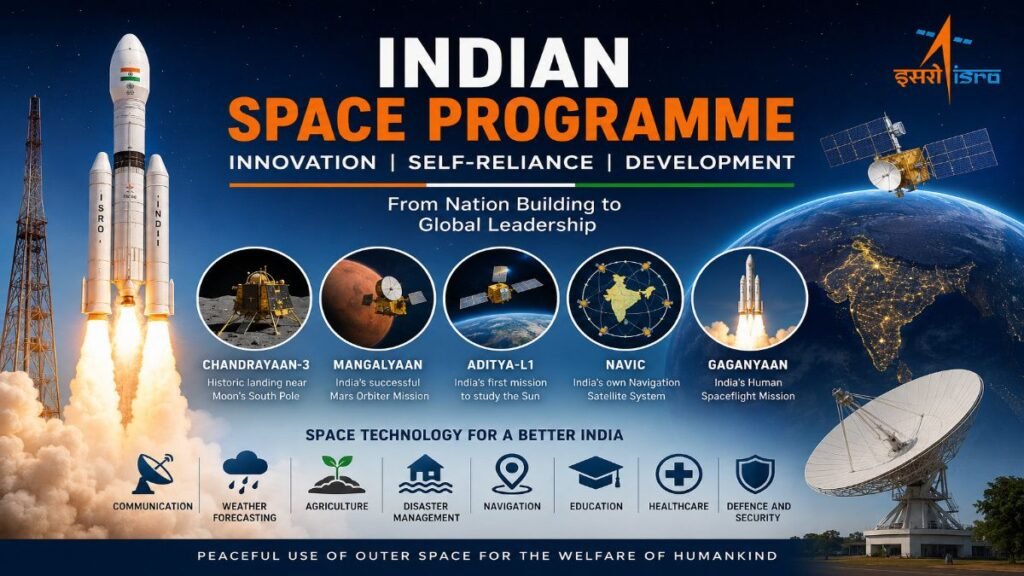
The Indian Space Programme is one of the world’s most successful and development-oriented space programmes. It is led by the Indian Space Research Organisation (ISRO) under the Department of Space (DoS). Unlike many countries that initially focused on military or prestige-driven space missions, India adopted a unique approach by using space technology as a tool for socio-economic development. The Indian Space Program has therefore evolved with a strong focus on national development and public welfare.
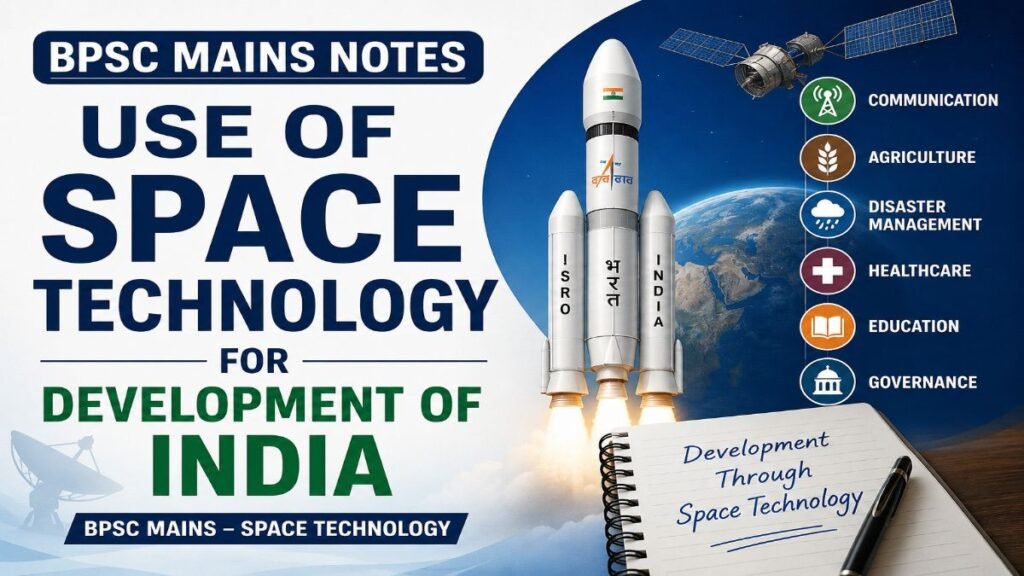
The programme is characterized by the Characteristics of Indian Space Programme, including its emphasis on the peaceful use of outer space, cost-effective innovation, self-reliance, and people-centric applications. Over the years, it has significantly contributed to communication, agriculture, disaster management, navigation, weather forecasting, education, healthcare, and national security, making it an essential component of India’s development strategy.
Master Science & Technology. Maximize Your BPSC Mains Score.
Enroll in the BPSC Science & Tech Course Today
Master Science & Technology for BPSC Mains GS Paper-2 with 75+ exam-oriented topics, 6 structured lessons, and downloadable PDF notes—all in one course.
✔ 75+ Exam-Oriented Topics • ✔ 6 Comprehensive Lessons • ✔ Downloadable PDF Notes • ✔ Updated for 72nd BPSC Mains
2. Objectives of the Indian Space Programme
The Indian Space Programme aims to harness space technology for national development while promoting scientific research, technological self-reliance, and peaceful exploration of outer space. Its major objectives are:
- To develop indigenous capabilities in satellite technology, launch vehicles, and space applications.
- To use space technology for communication, navigation, weather forecasting, disaster management, agriculture, and resource mapping.
- To promote scientific research, space exploration, and innovation through planetary and astronomical missions.
- To strengthen national security through satellite-based communication, surveillance, and navigation.
- To encourage education, capacity building, and scientific temperament through space research and outreach programmes.
- To enhance India’s presence in the global space economy through commercial launches, international cooperation, and private sector participation.
Prepare Smarter. Study Better. Ace BPSC Mains.
BPSC Mains GS Paper 1 & 2 Complete Course
Access comprehensive BPSC Mains Notes for GS Paper 1 & 2, covering 378+ topics across 24 PDF lessons, with dedicated Bihar coverage, practice questions and downloadable study material.
✓ GS Paper 1 & 2 • ✓ 378+ Topics • ✓ 24 PDF Lessons • ✓ Bihar-Specific Coverage • ✓ Downloadable Notes
3. Key Characteristics of the Indian Space Programme
Development-Oriented Programme
The Indian Space Program is primarily designed to support socio-economic development. Space technology is extensively used in communication, agriculture, disaster management, weather forecasting, education, healthcare, and natural resource management, directly benefiting millions of people.
Peaceful Use of Outer Space
India has consistently advocated the peaceful exploration and use of outer space in accordance with international law. The programme focuses on civilian applications while strengthening strategic capabilities for national security.
Cost-Effective and Efficient Missions
ISRO is globally recognized for executing high-quality space missions at comparatively low costs. Missions such as Mangalyaan and Chandrayaan-3 have demonstrated India’s ability to achieve complex objectives with remarkable cost efficiency.
Self-Reliance in Space Technology
A major characteristic of the programme is the development of indigenous technologies, including satellites, launch vehicles, cryogenic engines, navigation systems, and space applications. This has reduced dependence on foreign technology and strengthened Atmanirbhar Bharat.
Strong Societal Applications
Unlike many space programmes that focus mainly on exploration, India’s programme is closely linked with public welfare. Satellite technology supports rural development, digital connectivity, fisheries, environmental monitoring, and governance.
Commercial Orientation
With the establishment of NSIL, IN-SPACe, and the opening of the space sector to private companies, India has emerged as an important player in the global commercial space market through satellite launches, space services, and innovation.
International Cooperation
India actively collaborates with global space agencies and provides satellite launch services to several countries. It also undertakes joint missions and shares satellite-based services with neighbouring nations, enhancing its role in space diplomacy.
Focus on Innovation and Future Technologies
The programme continues to invest in advanced technologies such as reusable launch vehicles, human spaceflight, artificial intelligence, robotics, and deep-space exploration, ensuring long-term technological leadership.
4. Major Applications of the Indian Space Programme
The Indian Space Program has significantly contributed to national development by providing satellite-based services across multiple sectors. These applications have improved governance, economic growth, public welfare, and strategic capabilities.
Communication and Broadcasting
Communication satellites of the INSAT and GSAT series provide television broadcasting, mobile communication, internet connectivity, DTH services, telecommunication, telemedicine, tele-education, and disaster warning services. They have helped bridge the digital divide by connecting remote and rural areas with the rest of the country.
Agriculture and Resource Management
Remote sensing satellites support crop acreage estimation, crop health monitoring, soil moisture assessment, irrigation planning, drought monitoring, and yield forecasting. They also help in mapping mineral resources, groundwater, forests, and marine resources, enabling efficient utilization of natural resources.
Weather Forecasting and Climate Monitoring
Meteorological satellites such as INSAT-3D and INSAT-3DR continuously monitor atmospheric conditions, cloud movement, rainfall, cyclones, and monsoon systems. Accurate weather forecasting supports agriculture, aviation, shipping, fisheries, and disaster preparedness.
Disaster Management
Space technology plays a vital role in disaster risk reduction by providing early warning of cyclones, floods, droughts, forest fires, landslides, and tsunamis. Satellite imagery assists in disaster mapping, damage assessment, rescue operations, and rehabilitation planning, thereby minimizing loss of life and property.
Navigation and Transportation
India’s indigenous navigation system NavIC provides accurate positioning and timing services for road transport, railways, aviation, maritime navigation, fleet management, and emergency response. It also enhances strategic capabilities by supporting defence operations and secure navigation.
Environmental Monitoring
Satellite data is widely used to monitor forests, biodiversity, glaciers, wetlands, coastal ecosystems, desertification, air pollution, and climate change. It supports environmental conservation, sustainable development, and evidence-based policymaking.
Education and Healthcare
Space technology facilitates tele-education and telemedicine, enabling quality education and specialized healthcare services to reach remote and underserved regions. Satellite communication has improved digital learning, teacher training, and medical consultation across the country.
Defence and National Security
Space assets strengthen India’s defence preparedness through secure communication, surveillance, border monitoring, reconnaissance, intelligence gathering, and maritime security. Satellites such as GSAT-7, RISAT, and EMISAT enhance the operational capabilities of the armed forces.
Governance and Urban Planning
Remote sensing and Geographic Information Systems (GIS) support land records management, urban planning, infrastructure development, Smart Cities Mission, watershed management, and monitoring of government projects. Satellite-based information enables better planning and efficient delivery of public services.
Scientific Research and Space Exploration
Scientific missions such as AstroSat, Chandrayaan, Mangalyaan, Aditya-L1, and XPoSat have expanded India’s capabilities in astronomy, planetary science, solar studies, and space research. These missions have enhanced India’s scientific reputation at the global level.
5. Major Milestones in the Evolution of the Indian Space Programme
The Indian Space Programme Evolution has taken place steadily over the past six decades through continuous technological innovation, institutional development, and successful space missions. Its major milestones are discussed below.
Foundation Phase (1962–1975)
The foundation of India’s space programme was laid with the establishment of the Indian National Committee for Space Research (INCOSPAR) in 1962 under the leadership of Dr. Vikram Sarabhai. In 1963, India’s first sounding rocket was launched from the Thumba Equatorial Rocket Launching Station (TERLS) in Kerala. The Indian Space Research Organisation (ISRO) was established on 15 August 1969, followed by the creation of the Department of Space (DoS) and the Space Commission in 1972. India entered the space age with the launch of its first satellite, Aryabhata, on 19 April 1975 with Soviet assistance.
Development of Indigenous Launch Vehicles (1975–1995)
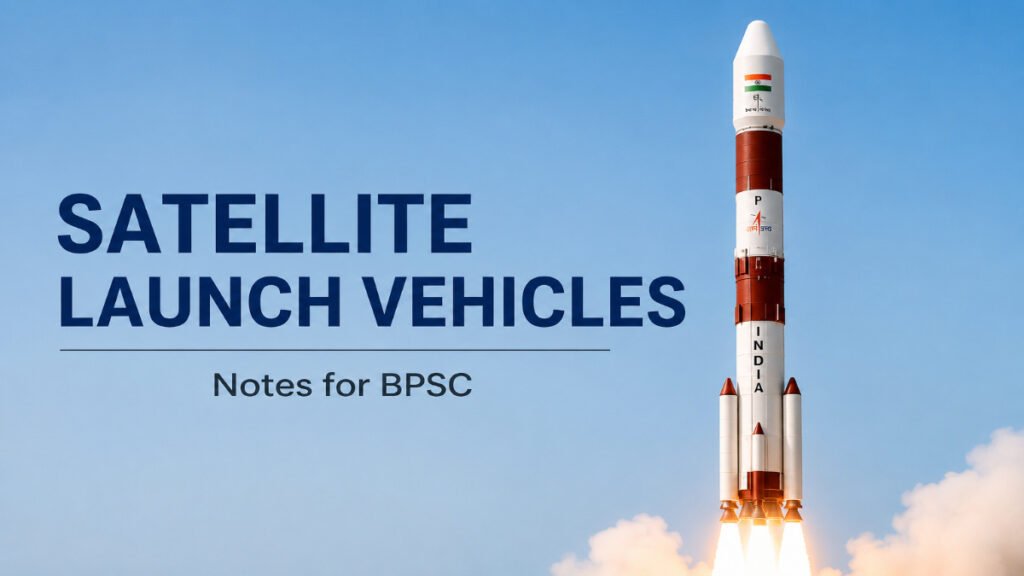
The next major milestone was the development of indigenous launch vehicle technology. In 1980, the SLV-3 successfully launched the Rohini Satellite (RS-1), making India the sixth country capable of launching satellites using its own rocket. ISRO subsequently developed the ASLV, followed by the highly successful Polar Satellite Launch Vehicle (PSLV), which completed its first successful mission in 1994. During this period, India also established the INSAT communication satellite system and the Indian Remote Sensing (IRS) satellite programme, laying the foundation for satellite-based development.
Expansion and Global Recognition (1995–2015)
From the mid-1990s onwards, India emerged as a globally recognized space power. The PSLV gained international recognition for its reliability and became ISRO’s workhorse launch vehicle. India successfully developed the Geosynchronous Satellite Launch Vehicle (GSLV) and later mastered indigenous cryogenic engine technology, despite international technology denial. The launch of Chandrayaan-1 (2008) resulted in the discovery of water molecules on the Moon, while the Mars Orbiter Mission (Mangalyaan) successfully entered Mars orbit in 2014, making India the first country to reach Mars in its maiden attempt and the first Asian nation to do so.
Technological Leadership and New Space Era (2015–Present)
In recent years, India’s space programme has entered a new era of technological leadership and commercial expansion. AstroSat (2015) became India’s first dedicated space observatory, while NavIC provided India with an indigenous regional navigation system. The Government opened the space sector to private participation in 2020, leading to the establishment of IN-SPACe and the strengthening of NSIL. Chandrayaan-3 (2023) achieved a historic soft landing near the Moon’s south pole, making India the first country to land in that region.
Aditya-L1 (2023) became India’s first solar mission, while SpaDeX (2024) successfully demonstrated autonomous space docking technology. India is now preparing for the Gaganyaan Human Spaceflight Mission, the proposed Bharatiya Antariksh Station by 2035, and future missions such as Shukrayaan-1, Chandrayaan-4, and Mangalyaan-2, reflecting its ambition to become a leading global space power.
6. Recent Developments and Emerging Trends
India’s space programme is undergoing rapid transformation with greater emphasis on advanced technologies, private sector participation, commercialisation, and human spaceflight. These developments are expected to strengthen India’s position in the global space economy.
Space Sector Reforms and Private Participation
The Government of India opened the space sector to private participation in 2020, ending ISRO’s monopoly in several commercial activities. The establishment of IN-SPACe as an independent regulator and NewSpace India Limited (NSIL) as the commercial arm of the Department of Space has encouraged private companies and start-ups to participate in satellite manufacturing, launch vehicle development, and space-based services. The Indian Space Policy, 2023 further defined the roles of ISRO, NSIL, IN-SPACe, and private industries, creating a robust ecosystem for innovation and commercialization.
Growth of India’s Space Start-up Ecosystem
India has witnessed rapid growth in space start-ups working in launch vehicles, satellite manufacturing, Earth observation, geospatial services, and propulsion systems. Companies such as Skyroot Aerospace, Agnikul Cosmos, Pixxel, Dhruva Space, and Bellatrix Aerospace are contributing to technological innovation and expanding India’s commercial space capabilities. Their participation is expected to increase India’s share in the rapidly growing global space economy.
Human Spaceflight Programme
The Gaganyaan Mission is India’s first human spaceflight programme aimed at sending Indian astronauts (Gagannauts) into Low Earth Orbit (LEO) using the LVM3 launch vehicle. It will make India one of the few countries with independent human spaceflight capability. India is also planning to establish the Bharatiya Antariksh Station by 2035, marking a significant step towards long-term human presence in space.
Advanced Space Exploration Missions
Following the success of Chandrayaan-3 and Aditya-L1, ISRO is focusing on more ambitious missions. Planned projects include Shukrayaan-1 for Venus exploration, Chandrayaan-4 for lunar sample return technologies, Mangalyaan-2 for advanced Mars exploration, and the NISAR Mission, a joint Earth observation mission with NASA. ISRO is also developing technologies such as Reusable Launch Vehicles (RLV), Semi-Cryogenic Engines, and Space Docking Technology (SpaDeX) to support future deep-space and human missions.
7. Conclusion
The Indian Space Program is distinguished by its development-oriented approach, cost-effective innovation, peaceful use of outer space, and strong emphasis on self-reliance. Over the past six decades, it has evolved from launching sounding rockets to undertaking complex missions such as Chandrayaan-3, Mangalyaan, and Aditya-L1, establishing India as a leading space-faring nation.
Beyond scientific achievements, the programme has made significant contributions to communication, agriculture, disaster management, weather forecasting, navigation, governance, education, healthcare, and national security. Recent reforms, increased private sector participation, and ambitious missions like Gaganyaan and the proposed Bharatiya Antariksh Station indicate India’s transition towards becoming a major global space power. By continuing to invest in innovation, sustainability, and international cooperation, India’s space programme will remain a key driver of technological advancement, economic growth, and national development.
BPSC Mains Practice Questions
- “The Indian Space Programme has evolved from a development-oriented programme into a major instrument of India’s technological, strategic and economic transformation.” Discuss the major characteristics, applications and milestones of this evolution.
- India’s space programme combines cost-effective innovation, self-reliance and societal applications with growing commercial and strategic ambitions. Examine the recent developments in India’s space sector and discuss the opportunities and challenges ahead.
Learn More About the Indian Space Programme
For authentic and detailed information on the Indian Space Programme, its objectives, major missions, applications, and achievements, refer to the official Indian Space Research Organisation (ISRO) website. Learn more about the Indian Space Programme – ISRO