1. Introduction
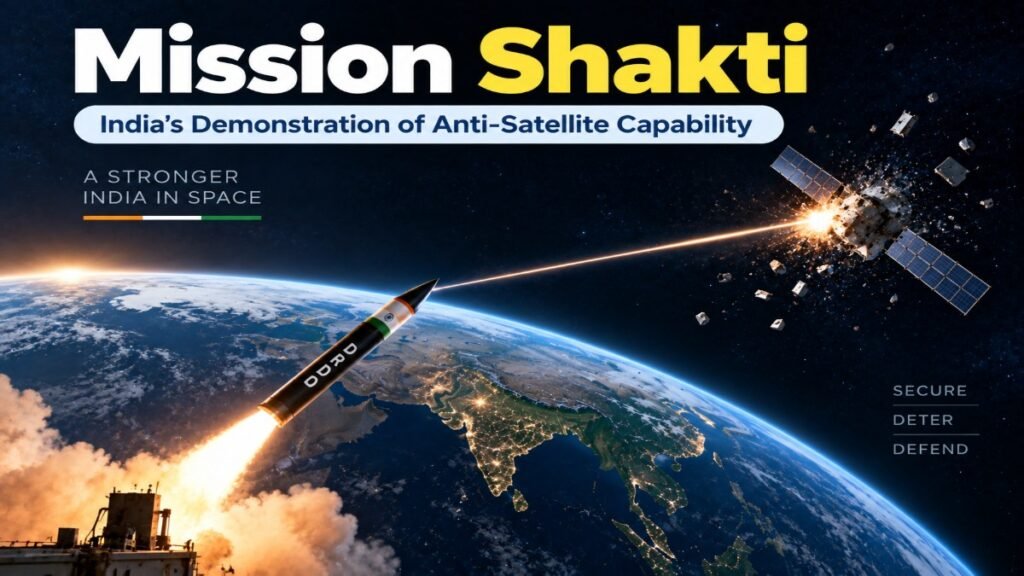
Mission Shakti was India’s first successful Anti-Satellite (ASAT) missile test, conducted on 27 March 2019 by the Defence Research and Development Organisation (DRDO) in collaboration with the Indian Space Research Organisation (ISRO). During the mission, India successfully destroyed one of its own satellites, Microsat-R, in Low Earth Orbit (LEO) at an altitude of about 300 km using a direct-ascent, kinetic-kill ASAT missile. The Mission Shakti ASAT Test demonstrated India’s ability to intercept a satellite in space using an Anti-Satellite Missile.
An Anti-Satellite (ASAT) weapon is designed to detect, track, and destroy or disable enemy satellites, thereby reducing an adversary’s capabilities in communication, navigation, surveillance, reconnaissance, and missile guidance. The development of such Anti-Satellite Weapons has become an important element of modern space security.
The successful demonstration of Mission Shakti made India the fourth country after the United States, Russia, and China to possess proven ASAT capability. The test showcased India’s advanced missile guidance, tracking, and interception technologies while strengthening its space security capabilities. It marked a significant milestone in the development of India ASAT Capability and India’s strategic preparedness in outer space.
Master Science & Technology. Maximize Your BPSC Mains Score.
Enroll in the BPSC Science & Tech Course Today
Master Science & Technology for BPSC Mains GS Paper-2 with 75+ exam-oriented topics, 6 structured lessons, and downloadable PDF notes—all in one course.
✔ 75+ Exam-Oriented Topics • ✔ 6 Comprehensive Lessons • ✔ Downloadable PDF Notes • ✔ Updated for 72nd BPSC Mains
2. Need for Mission Shakti
- Protection of Critical Space Assets: India increasingly depends on satellites for communication, navigation (NavIC), weather forecasting, disaster management, remote sensing, and military operations. Protecting these assets is essential for national security and economic development. Mission Shakti was therefore an important step towards strengthening India’s ability to protect its space infrastructure.
- Space as the Fourth Domain of Warfare: Along with land, sea, and air, outer space has emerged as a fourth domain of warfare. Modern armed forces rely heavily on satellites for intelligence, surveillance, reconnaissance (ISR), secure communication, and precision-guided operations. The development of Anti-Satellite Weapons has consequently become an important aspect of modern defence preparedness.
- Credible Deterrence: The demonstration of ASAT capability provides India with a credible deterrent against adversaries that possess counter-space capabilities, thereby strengthening national security. The India ASAT Capability demonstrated through Mission Shakti provides an additional strategic option in the event of threats to India’s space assets.
- Rapidly Changing Global Security Environment: With countries such as the United States, Russia, and China developing advanced counter-space technologies, India needed to develop indigenous capabilities to safeguard its strategic interests and maintain technological parity. The Mission Shakti ASAT Test demonstrated India’s ability to develop and deploy such advanced technologies.
- Support for India’s Defence Preparedness: Mission Shakti complements India’s Ballistic Missile Defence (BMD) programme by demonstrating advanced capabilities in tracking, guidance, and hit-to-kill interception, which are relevant for missile defence and space security.
Prepare Smarter. Study Better. Ace BPSC Mains.
BPSC Mains GS Paper 1 & 2 Complete Course
Access comprehensive BPSC Mains Notes for GS Paper 1 & 2, covering 378+ topics across 24 PDF lessons, with dedicated Bihar coverage, practice questions and downloadable study material.
✓ GS Paper 1 & 2 • ✓ 378+ Topics • ✓ 24 PDF Lessons • ✓ Bihar-Specific Coverage • ✓ Downloadable Notes
3. Significance of Mission Shakti
- Strengthened National Security: Mission Shakti enhanced India’s capability to protect its space-based assets and act as a credible deterrent against hostile actions targeting Indian satellites. It strengthened the country’s overall strategic preparedness.
- Major Technological Achievement: Successfully intercepting a satellite moving at nearly 7.8 km/s demonstrated India’s advanced capabilities in missile guidance, tracking, precision targeting, and hit-to-kill technology, placing it among a select group of space powers. The success of the Anti-Satellite Missile test reflected India’s growing technological capabilities.
- Boost to India’s Global Standing: By becoming the fourth country to demonstrate ASAT capability, India strengthened its position as a responsible space power and gained greater strategic relevance in discussions on global space governance and security. The Mission Shakti Notes are therefore important for understanding India’s emergence as a major space and defence power.
- Support to India’s Space and Defence Ecosystem: The technologies developed under Mission Shakti complement India’s Ballistic Missile Defence (BMD) programme and contribute to the development of advanced missile, radar, sensor, and space surveillance systems. These capabilities also support the broader development of India ASAT Capability.
- Strategic Deterrence: The mission enhanced India’s ability to deter potential adversaries from targeting its space infrastructure, thereby improving the resilience of military and civilian satellite-based services during conflicts. It demonstrated that Anti-Satellite Weapons can form part of a country’s broader strategic deterrence capabilities.
4. Challenges and Concerns
- Generation of Space Debris: The destruction of a satellite creates debris that may threaten operational satellites and spacecraft. Although Mission Shakti was conducted at a relatively low altitude (~300 km) to ensure that most debris would re-enter the Earth’s atmosphere within a short period, concerns regarding orbital debris remain.
- Risk of Kessler Syndrome: Large-scale generation of space debris can trigger the Kessler Syndrome, where collisions between debris create more debris, increasing the likelihood of further collisions and making certain orbital regions unsafe for future missions.
- Militarization of Outer Space: The development of ASAT weapons may accelerate the militarization and potential weaponization of outer space, leading to a counter-space arms race among nations. The proliferation of Anti-Satellite Weapons could further increase strategic tensions.
- Limitations of ASAT Weapons: Modern military operations often rely on multiple satellites, allied satellite networks, and alternative technologies such as cyber operations, electronic warfare, and signal jamming. Therefore, ASAT capability alone cannot completely neutralize an adversary’s space-based infrastructure.
- Need for Global Governance: The absence of a comprehensive international legal framework regulating counter-space weapons highlights the need for stronger global cooperation to ensure the peaceful, safe, and sustainable use of outer space. The Mission Shakti ASAT Test also underlined the importance of developing responsible international norms for space security.
5. International Legal Framework
The Outer Space Treaty (1967) forms the cornerstone of international space law and mandates that outer space shall be used exclusively for peaceful purposes. It prohibits the placement of nuclear weapons or other weapons of mass destruction (WMDs) in orbit or on celestial bodies. However, the treaty does not prohibit conventional Anti-Satellite (ASAT) weapons, and therefore Mission Shakti did not violate any international treaty or legal obligation.
At the same time, the growing development of counter-space capabilities has intensified global concerns over space debris, militarization of outer space, and the absence of legally binding rules governing ASAT testing. Consequently, there is increasing international support for strengthening global norms, transparency measures, and confidence-building mechanisms to ensure the long-term sustainability, safety, and peaceful use of outer space. The India ASAT Capability demonstrated through Mission Shakti therefore also highlights the need for responsible behaviour and stronger international governance of Anti-Satellite Weapons.
6. Way Forward
- Adopt Responsible Counter-space Practices: India should maintain ASAT capability as a credible deterrent while exercising restraint and ensuring that future activities minimize the creation of space debris.
- Strengthen Space Situational Awareness (SSA): Expanding initiatives such as Project NETRA and improving space surveillance capabilities will help detect, track, and protect Indian space assets from potential threats.
- Promote International Cooperation: India should actively support global efforts through the United Nations and other multilateral forums to develop transparent and responsible norms for space security and the sustainable use of outer space.
- Develop Non-Destructive Counter-space Technologies: Greater emphasis should be placed on technologies such as electronic warfare, cyber defence, satellite hardening, and signal jamming, which can reduce dependence on kinetic Anti-Satellite Weapons and minimize space debris.
- Enhance Indigenous Space Security Capabilities: Continued investment in advanced missile defence, satellite protection systems, reusable launch technologies, and next-generation space infrastructure will strengthen India’s long-term strategic and technological capabilities. The experience gained through the Mission Shakti ASAT Test should be used to further strengthen India’s defensive space capabilities.
7. Conclusion
Mission Shakti marked a significant milestone in India’s journey towards becoming a major space power by demonstrating credible ASAT capabilities. While the mission strengthened national security and technological self-reliance, the risks associated with space debris and militarization cannot be ignored. India must therefore combine strategic preparedness with responsible space behaviour, international cooperation and non-destructive technologies to ensure a secure, sustainable and peaceful outer space environment.
BPSC Mains Practice Question
Q. “Mission Shakti demonstrated India’s technological capability in space security but also raised concerns about the militarisation and sustainability of outer space.” Discuss the significance and challenges of Mission Shakti and suggest a suitable way forward for India.
Learn More About Mission Shakti
For official information on Mission Shakti, India’s ASAT capability, the Anti-Satellite (ASAT) missile test and its technological significance, visit the Defence Research and Development Organisation (DRDO) official website: https://www.drdo.gov.in/drdo/node/2087