1. Introduction and Key Features
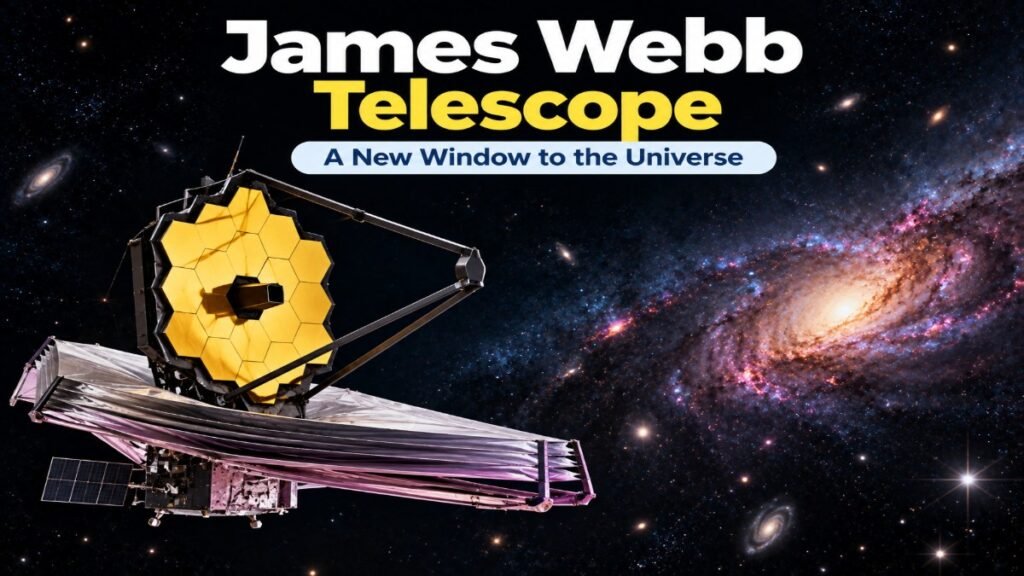
The James Webb Telescope is the world’s largest and most powerful space telescope, developed through a collaboration between the National Aeronautics and Space Administration (NASA), the European Space Agency (ESA), and the Canadian Space Agency (CSA). It was successfully launched on 25 December 2021 aboard an Ariane 5 rocket from Kourou, French Guiana, and began full scientific operations in July 2022. The James Webb Space Telescope represents a major advancement in modern space astronomy.
James Webb Telescope is the successor to the Hubble Space Telescope, designed primarily to observe the universe in the infrared spectrum. This enables it to detect extremely faint and distant celestial objects, allowing scientists to study the universe as it existed over 13 billion years ago, shortly after the Big Bang.
The telescope operates from the Sun–Earth L2 Lagrange Point (L2), located about 1.5 million km from Earth. This location provides a stable thermal environment, uninterrupted observation of deep space, and minimal interference from the Earth and the Sun, making it ideal for infrared astronomy. The James Webb Space Telescope uses this unique location to observe distant cosmic objects with high sensitivity.
Key Facts
- Launch Date: 25 December 2021
- Space Agencies: NASA, ESA and CSA
- Location: Sun–Earth L2 Lagrange Point (1.5 million km from Earth)
- Primary Observation: Infrared radiation (0.6–28.5 micrometres)
- Primary Mirror Diameter: 6.5 metres (largest mirror ever deployed in space)
- Scientific Operations Began: July 2022
Master Science & Technology. Maximize Your BPSC Mains Score.
Enroll in the BPSC Science & Tech Course Today
Master Science & Technology for BPSC Mains GS Paper-2 with 75+ exam-oriented topics, 6 structured lessons, and downloadable PDF notes—all in one course.
✔ 75+ Exam-Oriented Topics • ✔ 6 Comprehensive Lessons • ✔ Downloadable PDF Notes • ✔ Updated for 72nd BPSC Mains
2. Objectives and Significance
- Study the Early Universe: The James Webb Telescope is designed to observe the first stars and galaxies formed after the Big Bang, helping scientists understand the origin and evolution of the Universe.
- Understand Galaxy and Star Formation: Its powerful infrared instruments can penetrate cosmic dust clouds, enabling detailed study of the formation and evolution of galaxies, stars, and planetary systems. The James Webb Space Telescope provides scientists with observations that were difficult to obtain using earlier space telescopes.
- Explore Exoplanets: The telescope analyses the atmospheres of exoplanets to detect gases such as water vapour, carbon dioxide, and methane, providing clues about planetary environments and the possibility of habitability.
- Major Scientific Discoveries: Since becoming operational in July 2022, JWST has captured the deepest and highest-resolution infrared images of the Universe, identified some of the earliest known galaxies, studied the birth of stars, and provided unprecedented insights into black holes and distant cosmic structures.
- Advancement of Astronomy: The James Webb Telescope is expected to revolutionize astronomy by answering fundamental questions about the origin of the Universe, the evolution of galaxies, and the formation of planetary systems, making it one of the most significant scientific missions of the 21st century.
Prepare Smarter. Study Better. Ace BPSC Mains.
BPSC Mains GS Paper 1 & 2 Complete Course
Access comprehensive BPSC Mains Notes for GS Paper 1 & 2, covering 378+ topics across 24 PDF lessons, with dedicated Bihar coverage, practice questions and downloadable study material.
✓ GS Paper 1 & 2 • ✓ 378+ Topics • ✓ 24 PDF Lessons • ✓ Bihar-Specific Coverage • ✓ Downloadable Notes
3. Conclusion
The James Webb Telescope marks a new era in space astronomy by enabling scientists to explore the earliest stages of the Universe, study the formation of stars and galaxies, and investigate the atmospheres of distant exoplanets with unprecedented precision. Its discoveries are expected to significantly enhance our understanding of the origin, evolution, and future of the Universe, making the James Webb Space Telescope one of the most important scientific missions in the history of space exploration.
BPSC Mains Practice Question
Q. The James Webb Telescope has opened a new window into the early Universe. Discuss its major features, scientific objectives and significance in advancing our understanding of the origin and evolution of the Universe.
Learn More About James Webb Telescope
For official information on the James Webb Telescope, its mission, scientific objectives, discoveries and latest observations, visit the National Aeronautics and Space Administration (NASA) official website: https://science.nasa.gov/mission/webb/