1. Introduction
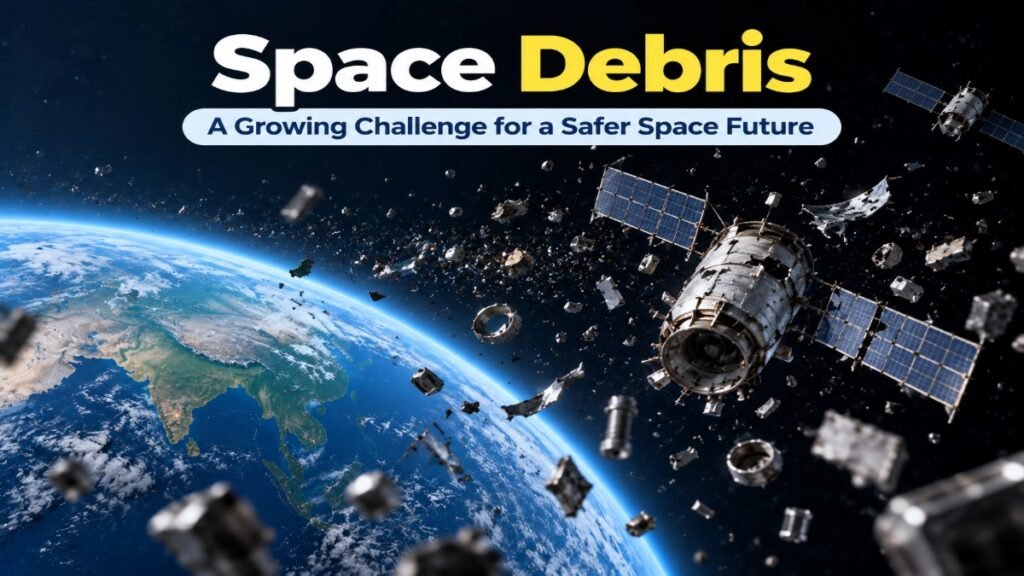
Space Debris (also known as space junk or orbital debris) refers to non-functional human-made objects orbiting the Earth that no longer serve any useful purpose. It includes defunct satellites, spent rocket stages, mission-related objects, and fragments generated from collisions, explosions, or anti-satellite (ASAT) tests. The growing Space Debris issue has become an important challenge for the safe and sustainable use of outer space.
The rapid growth in satellite launches, particularly large commercial satellite constellations in Low Earth Orbit (LEO), has significantly increased the amount of Space Debris. Even tiny debris fragments travel at speeds of about 7–8 km per second (≈28,000 km/h), making them capable of severely damaging operational satellites and spacecraft.
Key Facts
- More than 40,000 space objects are currently tracked by global space surveillance networks, of which over 11,000 are active satellites; the remainder are mostly debris.
- It is estimated that over 1.2 million debris objects larger than 1 cm and more than 50,000 objects larger than 10 cm are orbiting the Earth.
- Most Space Debris is concentrated in Low Earth Orbit (LEO), making it the most congested and collision-prone region for space activities.
Master Science & Technology. Maximize Your BPSC Mains Score.
Enroll in the BPSC Science & Tech Course Today
Master Science & Technology for BPSC Mains GS Paper-2 with 75+ exam-oriented topics, 6 structured lessons, and downloadable PDF notes—all in one course.
✔ 75+ Exam-Oriented Topics • ✔ 6 Comprehensive Lessons • ✔ Downloadable PDF Notes • ✔ Updated for 72nd BPSC Mains
2. Sources and Causes of Space Debris
- Defunct Satellites: Satellites that have completed their operational life or have become non-functional remain in orbit, contributing significantly to the growing amount of Space Debris.
- Spent Rocket Stages: Upper stages of launch vehicles and other mission-related hardware left in orbit after satellite deployment become long-term sources of Orbital Debris.
- Collisions and Explosions: Accidental collisions between satellites or explosions caused by leftover fuel and batteries create thousands of debris fragments. For example, the 2009 Iridium–Cosmos collision generated over 2,000 trackable debris pieces.
- Anti-Satellite (ASAT) Tests: Destruction of satellites during ASAT tests produces a large number of high-speed debris fragments. Such tests have been conducted by countries including China (2007), India (Mission Shakti, 2019), Russia (2021), and the United States (1985 & 2008).
- Rapid Increase in Satellite Launches: The emergence of private space companies and mega-constellations for communication and internet services has led to an unprecedented rise in satellite launches, increasing the risk of congestion and future Space Debris generation in Earth’s orbit.
Prepare Smarter. Study Better. Ace BPSC Mains.
BPSC Mains GS Paper 1 & 2 Complete Course
Access comprehensive BPSC Mains Notes for GS Paper 1 & 2, covering 378+ topics across 24 PDF lessons, with dedicated Bihar coverage, practice questions and downloadable study material.
✓ GS Paper 1 & 2 • ✓ 378+ Topics • ✓ 24 PDF Lessons • ✓ Bihar-Specific Coverage • ✓ Downloadable Notes
3. Threats and Challenges of Space Debris
Threat to Operational Satellites
Space Debris poses a serious collision risk to operational satellites used for communication, navigation, weather forecasting, and Earth observation. Even a small debris fragment travelling at orbital velocity (about 7–8 km/s) can severely damage or completely disable a satellite.
Kessler Syndrome
The Kessler Syndrome, proposed by NASA scientist Donald J. Kessler (1978), is a scenario in which collisions between space objects generate more debris, triggering a chain reaction of further collisions. This could make certain orbital regions unusable for future space missions and further aggravate the Space Debris issue.
Risk to Human Space Missions
Space Debris threatens astronauts aboard the International Space Station (ISS) and future human missions such as NASA’s Artemis Programme, China’s Tiangong Space Station, and India’s Gaganyaan Mission. Space agencies often perform collision avoidance manoeuvres (CAMs) to protect crewed spacecraft.
Threat from Re-entry Debris
Large debris that survives atmospheric re-entry can fall back to Earth, posing risks to people, infrastructure, aircraft, and marine ecosystems. Although most debris burns up in the atmosphere, heavier components may reach the Earth’s surface.
Challenges to Future Space Activities
The rapid increase in Space Debris has made Space Situational Awareness (SSA) and Space Traffic Management (STM) increasingly complex. Congestion in valuable orbital regions, especially Low Earth Orbit (LEO), can reduce the availability of safe orbital slots and increase operational costs for future space missions.
4. Measures to Mitigate Space Debris
India’s Initiatives
- IS4OM (System for Safe and Sustainable Space Operations Management): Established by ISRO in 2022, IS4OM continuously monitors space objects, assesses collision risks, and supports safe operation of Indian space assets. It is an important component of India’s Space Debris Mitigation efforts.
- Project NETRA: It is ISRO’s Space Situational Awareness (SSA) programme that uses a network of telescopes and radars to detect, track, and predict the movement of Orbital Debris and other objects that may threaten Indian satellites.
- Collision Avoidance Manoeuvres (CAMs): ISRO regularly performs orbital adjustments of operational satellites whenever there is a significant risk of collision with Space Debris, thereby enhancing mission safety.
- Debris Mitigation Practices: ISRO follows international debris mitigation guidelines by passivating spent rocket stages, de-orbiting satellites at the end of their mission wherever feasible, and designing missions to minimize debris generation. These measures contribute to India’s broader Space Debris Mitigation strategy.
Global Initiatives
- Inter-Agency Space Debris Coordination Committee (IADC): Established in 1993, the IADC brings together major space agencies to develop technical guidelines and promote international cooperation for Space Debris Mitigation.
- UN Committee on the Peaceful Uses of Outer Space (UN-COPUOS): It has formulated the Space Debris Mitigation Guidelines and the Guidelines for the Long-term Sustainability of Outer Space Activities, encouraging responsible behaviour in space.
- European Space Agency (ESA) – Zero Debris Charter: ESA has adopted the Zero Debris Charter, aiming to significantly reduce the creation of new space debris by 2030 through sustainable mission design and responsible end-of-life disposal.
- Active Debris Removal (ADR): Space agencies and private companies are developing technologies such as robotic arms, harpoons, nets, and drag sails to capture and safely remove large defunct satellites and rocket bodies from orbit.
5. International Legal Framework
- Outer Space Treaty (1967): It is the foundation of international space law. The treaty declares outer space as the province of all humankind, prohibits national appropriation of celestial bodies, and mandates the peaceful use of outer space.
- Rescue Agreement (1968): It requires countries to provide assistance to astronauts in distress and ensure the safe return of astronauts and space objects to the launching state.
- Liability Convention (1972): It holds the launching state absolutely liable for damage caused by its space objects on Earth or to aircraft, and liable for damage caused in outer space if fault is established.
- Registration Convention (1975): It requires countries to maintain and share a national registry of space objects launched into Earth orbit, thereby improving transparency and tracking of space activities.
- Moon Agreement (1979): It seeks to regulate the exploration and use of the Moon and other celestial bodies for peaceful purposes. India is a signatory to all five UN space treaties but has not ratified the Moon Agreement, while it has ratified the other four treaties. These international legal instruments provide a framework for responsible space activities, although dedicated global rules for Space Debris Mitigation remain an important requirement.
6. Way Forward
- Strengthen Space Situational Awareness (SSA): Expand global networks of radars, telescopes, and tracking systems to improve real-time monitoring of space objects and enable timely collision avoidance.
- Develop an International Space Traffic Management (STM) Framework: Establish globally accepted rules for satellite operations, orbital slot allocation, and debris management to ensure safe and sustainable use of outer space. Effective Space Traffic Management will become increasingly important as satellite numbers continue to rise.
- Adopt Sustainable Space Practices: Promote reusable launch vehicles, responsible satellite design, passivation of rocket stages, and mandatory de-orbiting of satellites after the completion of their operational life. Such practices should form the foundation of effective Space Debris Mitigation.
- Promote Active Debris Removal (ADR): Encourage the development of innovative technologies to capture and safely remove large debris objects from orbit through international cooperation and private sector participation.
- Strengthen International Cooperation: Countries should work through platforms such as the United Nations, IADC, and other multilateral forums to develop legally binding global norms for debris mitigation and ensure the long-term sustainability of outer space activities. Better Space Traffic Management and international cooperation are essential to address the growing Space Debris issue.
7. Conclusion
Space Debris is emerging as a major challenge to the safe, sustainable and peaceful use of outer space. Effective Space Debris Mitigation, stronger Space Situational Awareness, responsible satellite operations and international cooperation are essential to prevent further orbital congestion. For India, strengthening indigenous capabilities and Space Traffic Management will be crucial for protecting space assets and ensuring sustainable growth of its space programme.
BPSC Mains Practice Question
Q. “Space Debris has transformed the challenge of space exploration from merely reaching orbit to sustainably managing orbit.” Discuss the causes and consequences of Space Debris and critically examine India’s initiatives and the need for a robust global framework for Space Debris Mitigation.
Learn More About Space Debris
For official information on Space Debris, space object tracking, collision avoidance and India’s efforts for safe and sustainable space operations, visit the Indian Space Research Organisation (ISRO) official website: https://www.isro.gov.in/Space_Situational_Awareness.html