1. Introduction
A Ballistic Missile Defence (BMD) system, also known as an Anti-Ballistic Missile (ABM) system, is an integrated defence mechanism designed to detect, track, and destroy incoming ballistic missiles before they reach their intended targets. As ballistic missiles can carry conventional as well as nuclear warheads and travel at very high speeds, an effective BMD system is crucial for safeguarding strategic assets and population centres.
India initiated its Anti-Ballistic Missile Development Programme in 1999 under the leadership of the Defence Research and Development Organisation (DRDO), following the lessons of the Kargil War and the evolving missile capabilities of neighbouring countries. The programme aims to develop an indigenous, multi-layered missile shield capable of intercepting hostile ballistic missiles at different stages of their flight.
The programme strengthens India’s defence preparedness by complementing its ‘No First Use (NFU)’ nuclear doctrine, enhancing second-strike capability, and reducing dependence on imported missile defence technologies. With continuous advancements in interceptor missiles, long-range radars, and command-and-control systems, India is steadily moving towards establishing a robust indigenous ballistic missile defence architecture.
Master Science & Technology. Maximize Your BPSC Mains Score.
Enroll in the BPSC Science & Tech Course Today
Master Science & Technology for BPSC Mains GS Paper-2 with 75+ exam-oriented topics, 6 structured lessons, and downloadable PDF notes—all in one course.
✔ 75+ Exam-Oriented Topics • ✔ 6 Comprehensive Lessons • ✔ Downloadable PDF Notes • ✔ Updated for 72nd BPSC Mains
2. Ballistic Missile and Ballistic Missile Defence (BMD): Concept
What is a Ballistic Missile?
A ballistic missile is a guided missile that follows a ballistic trajectory after its initial powered flight. Once the propulsion phase ends, the missile travels mainly under the influence of gravity and aerodynamic forces until it reaches the target.
Advantages of Ballistic Missiles
- Long-range capability: Ballistic missiles travel through the upper atmosphere or outer space, experiencing minimal air resistance, enabling ranges from hundreds to thousands of kilometres. This makes an anti-ballistic missile development programme important for countering long-range missile threats.
- High speed: They can travel at supersonic or hypersonic speeds, making interception highly challenging.
- Fuel efficient: Propulsion is required mainly during the initial boost phase, while the remaining flight relies on gravity.
- High payload capacity: They can carry conventional, nuclear, chemical, or biological warheads due to their greater payload capability.
- MIRV capability: Advanced ballistic missiles can carry Multiple Independently Targetable Re-entry Vehicles (MIRVs), allowing a single missile to strike multiple targets simultaneously.
What is a Ballistic Missile Defence (BMD) System?
A Ballistic Missile Defence (BMD) system is an integrated network designed to detect, track, intercept, and destroy incoming ballistic missiles before they reach their targets. Unlike offensive missile systems, BMD serves as a defensive shield against missile attacks.
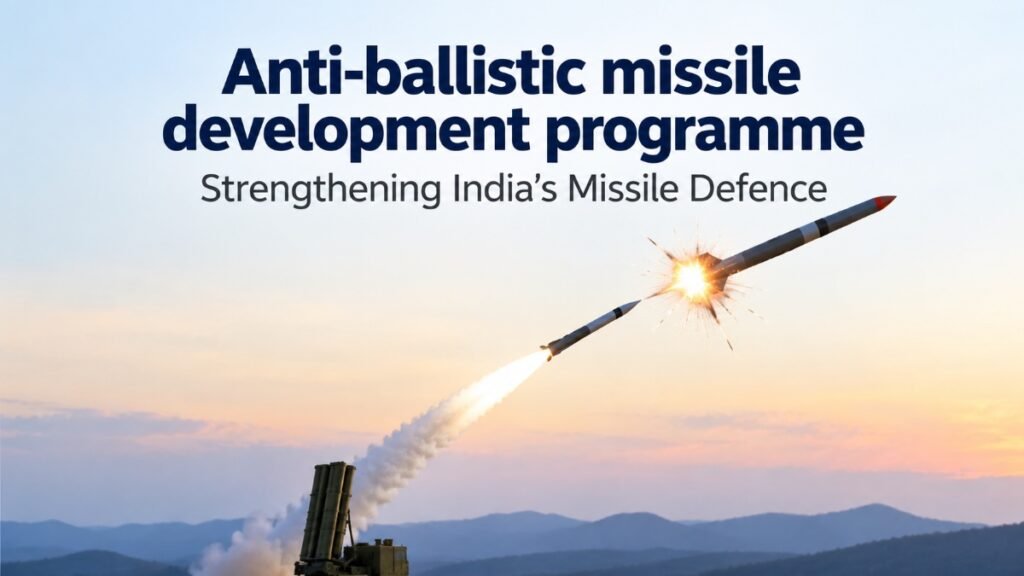
The anti-ballistic missile development programme seeks to establish such a defensive shield through advanced radars, command-and-control systems, and interceptor missiles operating at different stages of a missile’s flight.
Phases of Ballistic Missile Interception
A ballistic missile can be intercepted during any of the following phases:
- Boost Phase Interception: Missile is intercepted immediately after launch while its engines are still firing. This requires advanced surveillance and rapid-response capabilities.
- Mid-course Interception: The missile is intercepted outside the Earth’s atmosphere during its free-flight phase. It is the most preferred phase because the target is easier to track and destroy before re-entry.
- Terminal Phase Interception: The missile is intercepted during its descent towards the target within the atmosphere. This phase offers the least reaction time but serves as the final layer of defence.
Major Components of a BMD System
A modern Ballistic Missile Defence system generally consists of:
- Early Warning and Long-Range Radars: Detect and continuously track incoming missiles.
- Command, Control, Communication and Intelligence (C3I) System: Processes real-time data, assesses threats, and coordinates interception.
- Interceptor Missiles: Destroy hostile missiles through direct impact or proximity detonation.
- Communication Network: Ensures seamless data exchange between radars, command centres, and interceptor batteries.
- Mobile and Strategic Deployment: Interceptor units are deployed at strategic land and sea locations to protect vital assets.
The Ballistic Missile Defence (BMD) programme in India is developing a two-tier, automated BMD system capable of intercepting ballistic missiles at both exo-atmospheric (high-altitude) and endo-atmospheric (low-altitude) levels.
Prepare Smarter. Study Better. Ace BPSC Mains.
BPSC Mains GS Paper 1 & 2 Complete Course
Access comprehensive BPSC Mains Notes for GS Paper 1 & 2, covering 378+ topics across 24 PDF lessons, with dedicated Bihar coverage, practice questions and downloadable study material.
✓ GS Paper 1 & 2 • ✓ 378+ Topics • ✓ 24 PDF Lessons • ✓ Bihar-Specific Coverage • ✓ Downloadable Notes
3. India’s Anti-Ballistic Missile Development Programme
India launched the Ballistic Missile Defence (BMD) Programme in 1999 under the Defence Research and Development Organisation (DRDO) after the Kargil War. The Anti-ballistic missile development programme aims to develop an indigenous, multi-layered missile shield to protect the country from ballistic missile attacks, particularly from nuclear-capable adversaries.
Objectives
- Develop an indigenous multi-layered missile defence system against ballistic missile threats. The Ballistic Missile Defence (BMD) programme is designed to provide multiple layers of protection against incoming ballistic missiles.
- Strengthen India’s No First Use (NFU) nuclear doctrine by ensuring a credible second-strike capability. The India Ballistic Missile Defence system therefore complements India’s broader strategic security architecture.
- Protect strategic assets, major cities, military installations, and critical infrastructure. The India anti-ballistic missile system is intended to provide enhanced protection to these vital targets.
- Reduce dependence on imported missile defence systems and promote Atmanirbhar Bharat in defence. The DRDO missile defence programme has therefore focused on developing indigenous technologies, including Indian BMD interceptor missiles and supporting radar and command systems.
4. Architecture of India’s Ballistic Missile Defence System
India has developed a two-tier Ballistic Missile Defence (BMD) system to intercept incoming ballistic missiles at different altitudes, providing multiple layers of protection. The India Ballistic Missile Defence system is a key component of the Anti-ballistic missile development programme, while the DRDO missile defence programme focuses on developing indigenous technologies for this layered architecture.
Prithvi Air Defence (PAD) / Prithvi Defence Vehicle (PDV)
- Designed for exo-atmospheric (high-altitude) interception.
- Intercepts missiles at an altitude of about 50–150 km (PDV variant).
- Uses a two-stage solid-fuel interceptor.
- Acts as the first layer of India’s missile shield and represents an important component of the India anti-ballistic missile system.
Advanced Air Defence (AAD) / Ashwin
- Designed for endo-atmospheric (low-altitude) interception.
- Intercepts missiles at altitudes of up to 30 km.
- Uses a single-stage solid-fuel interceptor.
- Provides the second layer of defence if the first interception fails and forms part of India’s Indian BMD interceptor missiles capability.
5. Strategic Significance of India’s BMD Programme
- Strengthens India’s Nuclear Deterrence: The BMD system enhances the credibility of India’s ‘No First Use (NFU)’ doctrine by improving its second-strike capability. Even if an adversary launches a missile attack, India retains the ability to respond effectively. The Anti-ballistic missile development programme therefore adds another layer to India’s strategic deterrence.
- Protection Against Regional Threats: It provides a defensive shield against ballistic missile threats from neighbouring nuclear-armed countries such as Pakistan (Shaheen, Ghauri missiles) and China (DF series missiles), thereby improving national security. The India Ballistic Missile Defence system is particularly significant in India’s regional security environment.
- Safeguards Strategic Assets: The system can protect national capital regions, nuclear installations, military bases, command-and-control centres, air bases, and other critical infrastructure from missile attacks. The India anti-ballistic missile system is therefore important for protecting India’s critical assets.
- Promotes Self-Reliance in Defence: Developed primarily by DRDO with support from Indian industries such as BEL and L&T, the programme strengthens Atmanirbhar Bharat by reducing dependence on foreign missile defence systems. The DRDO missile defence programme has contributed to the development of indigenous defence capabilities.
- Boosts Indigenous Technological Capability: Technologies developed for BMD, including long-range radars, advanced sensors, guidance systems, and interceptor missiles, have applications in other strategic areas such as space technology, satellite tracking, and air defence systems. The development of Indian BMD interceptor missiles has therefore strengthened India’s wider strategic technology base.
- Enhances Strategic Stability: A credible missile defence system reduces the chances of successful missile attacks, thereby discouraging adversaries from initiating a first strike and contributing to long-term regional stability.
6. Challenges and Limitations
- High Development and Deployment Cost: Establishing a nationwide multi-layered BMD network requires huge investments in interceptor missiles, long-range radars, command centres, and supporting infrastructure. This remains a major challenge for the Anti-ballistic missile development programme.
- Limited Effectiveness Against Emerging Threats: The present BMD system is primarily designed to intercept ballistic missiles and is less effective against cruise missiles, hypersonic glide vehicles (HGVs), and missiles equipped with MIRVs or decoys. This creates challenges for the India Ballistic Missile Defence system as missile technologies continue to evolve.
- Coverage Constraints: Due to India’s vast geographical area, providing complete protection to all cities and strategic installations is difficult. Therefore, deployment is likely to focus on critical regions such as New Delhi, Mumbai, and strategic military assets. The India anti-ballistic missile system must consequently balance coverage with technological and financial constraints.
- Risk of Regional Arms Race: Deployment of BMD may encourage adversaries to develop more advanced missiles, decoys, or larger missile arsenals, potentially affecting strategic stability in South Asia.
- Operational Challenges: The system requires real-time detection, accurate tracking, and rapid interception. Any delay or technical failure can reduce interception success, especially during the terminal phase. Continuous advancement under the DRDO missile defence programme is therefore essential.
- No System is Foolproof: Even the most advanced missile defence systems, such as those of the United States and Israel, do not guarantee 100% interception, making BMD a deterrent rather than an absolute shield. This highlights the importance of continuously improving Indian BMD interceptor missiles and the wider defence architecture.
7. Recent Developments
- Successful Demonstration of Phase-II BMD (2024): In July 2024, DRDO successfully flight-tested the AD-1 interceptor missile, validating India’s Phase-II Ballistic Missile Defence capability. The test demonstrated the interception of a target missile using an integrated network of long-range radars, mission control centre, and interceptor missile.
- Development of AD-1 and AD-2 Interceptors: India is developing AD-1 and AD-2 interceptor missiles to counter Intermediate-Range Ballistic Missiles (IRBMs) with ranges of up to 5,000 km. While AD-1 has undergone successful testing, AD-2 is under advanced development for intercepting higher-speed and longer-range ballistic missiles.
- Multi-Layered Missile Defence Capability: India has successfully demonstrated a multi-layered BMD architecture, integrating PDV, AAD, and AD-1 interceptors with advanced long-range tracking radars and command-and-control systems to engage threats at different altitudes. This represents a major milestone in the Anti-ballistic missile development programme.
- Integration with National Air Defence Network: India’s BMD is being integrated with other air defence systems such as the S-400 Triumf, Akash, Akash-NG, and the indigenous Project Kusha (Extended Range Air Defence System) to create a comprehensive, layered air and missile defence shield.
- Progress Towards Operational Deployment: Following a series of successful interceptor trials, India is moving towards the operational deployment of Phase-II BMD, making it one of the few countries with an indigenous ballistic missile defence capability.
8. Conclusion
India’s Anti-ballistic missile development programme is a significant step towards strengthening the country’s strategic security and self-reliance in defence technology. By providing a multi-layered shield against ballistic missile attacks, it enhances India’s credible deterrence, complements its No First Use (NFU) policy, and protects critical national assets. With continuous advancements such as AD-1, AD-2, and integration with other air defence systems, India’s BMD programme is expected to play a pivotal role in the nation’s future security architecture.
BPSC Mains Practice Questions
- Explain the architecture of India’s Ballistic Missile Defence (BMD) system. Discuss how its two-tier interception mechanism strengthens India’s strategic security.
- The Anti-Ballistic Missile Development Programme is an important component of India’s quest for strategic self-reliance. Discuss its significance, major challenges, and implications for regional strategic stability.
Learn More About India’s BMD Programme
For official information on India’s Ballistic Missile Defence (BMD) programme, interceptor missile development, missile defence technologies, and related defence research, visit the Defence Research and Development Organisation (DRDO) official website: DRDO Official Website