1. Introduction
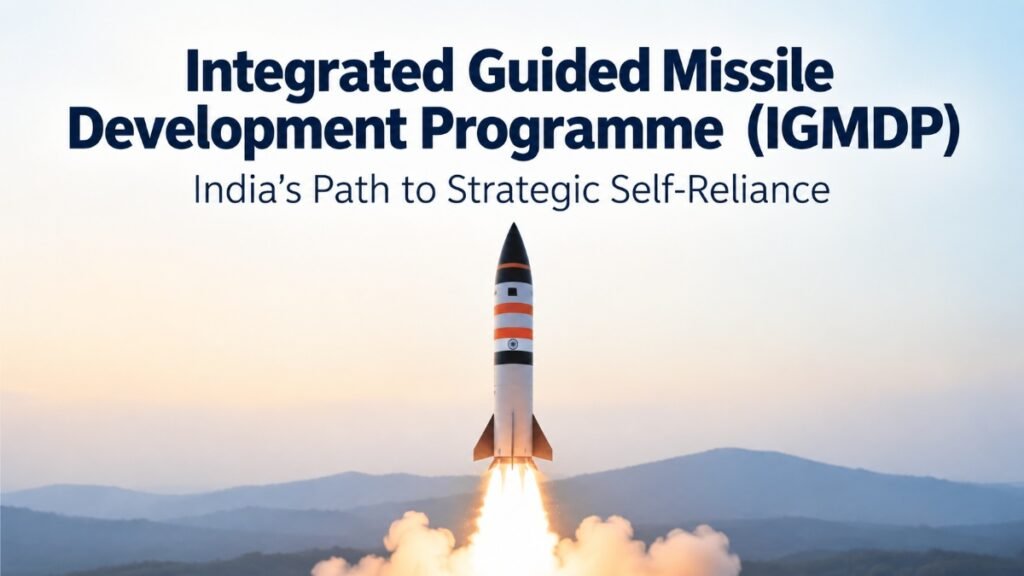
The Integrated Guided Missile Development Programme (IGMDP) was a landmark missile development programme launched by the Government of India in 1983 under the Defence Research and Development Organisation (DRDO) to achieve self-reliance in guided missile technology. The IGMDP missile programme aimed to develop a family of indigenous missiles capable of meeting the operational requirements of the Indian Army, Navy, and Air Force, thereby reducing dependence on foreign suppliers.
The programme was led by Dr. A. P. J. Abdul Kalam, who served as its Chief Executive, earning him the title “Missile Man of India.” The India missile development programme laid the foundation for India’s modern missile programme and significantly strengthened the country’s strategic and defence capabilities.
Key Facts
- Launched: 1983
- Implementing Agency: DRDO
- Programme Director: Dr. A. P. J. Abdul Kalam
- Officially Concluded: 2008
- Missiles Developed: Prithvi, Agni, Akash, Trishul, and Nag
Master Science & Technology. Maximize Your BPSC Mains Score.
Enroll in the BPSC Science & Tech Course Today
Master Science & Technology for BPSC Mains GS Paper-2 with 75+ exam-oriented topics, 6 structured lessons, and downloadable PDF notes—all in one course.
✔ 75+ Exam-Oriented Topics • ✔ 6 Comprehensive Lessons • ✔ Downloadable PDF Notes • ✔ Updated for 72nd BPSC Mains
2. Objectives of IGMDP
- Achieve Self-Reliance in Missile Technology: Develop indigenous guided missile systems and reduce dependence on foreign countries for critical defence technologies. The India missile development effort under IGMDP focused on building domestic capabilities in critical missile systems.
- Strengthen National Defence: Equip the Army, Navy, and Air Force with a wide range of missiles for tactical, strategic, air defence, and anti-tank operations. This made the IGMDP missile programme an important step towards strengthening India’s defence preparedness.
- Develop Indigenous Technologies: Build capabilities in propulsion, guidance, navigation, control systems, seekers, and warhead technologies, creating a strong domestic defence R&D base. This contributed significantly to Indian indigenous missile technology.
- Enhance Strategic Deterrence: Strengthen India’s conventional and strategic deterrence capability to safeguard national security and maintain regional stability.
- Promote Indigenous Defence Manufacturing: Encourage collaboration among DRDO, public sector undertakings, private industries, and academia to establish a robust defence industrial ecosystem. This approach became an important foundation for India’s long-term India missile development programme.
Prepare Smarter. Study Better. Ace BPSC Mains.
BPSC Mains GS Paper 1 & 2 Complete Course
Access comprehensive BPSC Mains Notes for GS Paper 1 & 2, covering 378+ topics across 24 PDF lessons, with dedicated Bihar coverage, practice questions and downloadable study material.
✓ GS Paper 1 & 2 • ✓ 378+ Topics • ✓ 24 PDF Lessons • ✓ Bihar-Specific Coverage • ✓ Downloadable Notes
3. Missiles Developed under IGMDP
Prithvi Missile
- Type: Surface-to-Surface Short-Range Ballistic Missile (SRBM).
- Variants: Prithvi-I (Army), Prithvi-II (Air Force), and Dhanush (Naval version).
- Range: Approximately 150–350 km, depending on the variant.
- Significance: India’s first indigenously developed ballistic missile, capable of carrying both conventional and nuclear warheads. The Prithvi series represents an important milestone in Indian indigenous missile technology.
Agni Missile
- Type: Surface-to-Surface Ballistic Missile (Strategic Missile).
- Variants: Agni-I, Agni-II, Agni-III, Agni-IV, and Agni-V with ranges from 700 km to over 5,000 km.
- Latest Development: In March 2024, India successfully conducted Mission Divyastra, demonstrating MIRV (Multiple Independently Targetable Re-entry Vehicle) technology on Agni-V.
- Significance: Forms the backbone of India’s credible minimum nuclear deterrence under the Nuclear Command Authority. The Agni series demonstrates the progress achieved through the India missile development effort.
Akash Missile
- Type: Medium-Range Surface-to-Air Missile (SAM).
- Range: Around 25–45 km (depending on the variant).
- Role: Designed to intercept fighter aircraft, helicopters, drones, and cruise missiles.
- Significance: Inducted into both the Indian Army and Indian Air Force and exported to friendly countries, showcasing India’s growing defence manufacturing capability. The Akash system is an important achievement of the IGMDP missile programme.
Nag Missile
- Type: Third-generation Anti-Tank Guided Missile (ATGM).
- Features: Fire-and-Forget missile equipped with an Imaging Infrared (IIR) Seeker.
- Launch Platforms: Ground-based NAMICA and helicopter-launched variant HELINA (Dhruvastra).
- Significance: Enhances India’s indigenous anti-armour warfare capability and represents an important milestone in Indian indigenous missile technology.
Trishul Missile
- Type: Short-Range Surface-to-Air Missile (SAM).
- Role: Developed to engage low-flying aircraft, helicopters, and sea-skimming missiles.
- Status: The project was closed as a technology demonstrator due to operational limitations.
- Significance: Technologies developed under Trishul contributed to several later missile programmes. The experience gained also strengthened India missile development capabilities.
4. Achievements and Significance of IGMDP
- Established Self-Reliance in Missile Technology: IGMDP transformed India from a technology importer into a nation capable of designing, developing, and producing indigenous guided missiles. The IGMDP missile programme played a crucial role in establishing this technological self-reliance.
- Strengthened Strategic Deterrence: The successful development of the Prithvi and Agni missile series significantly enhanced India’s conventional and nuclear deterrence capabilities, contributing to national security.
- Created a Strong Defence Industrial Ecosystem: The programme promoted collaboration among DRDO, DPSUs, private industries, and academic institutions, laying the foundation for indigenous defence manufacturing.
- Technological Advancements: IGMDP led to the development of critical technologies such as solid and liquid propulsion, guidance and navigation systems, seekers, composite materials, and re-entry vehicle technology, which are now used in several advanced missile systems. These achievements significantly advanced Indian indigenous missile technology.
- Foundation for Modern Missile Programmes: The experience gained through IGMDP paved the way for advanced indigenous systems such as Astra, Ballistic Missile Defence (BMD), Quick Reaction Surface-to-Air Missile (QRSAM), Rudram, Pralay, and the MIRV-enabled Agni-V (Mission Divyastra). This marked an important phase in the evolution of India missile development.
5. Challenges and Legacy of IGMDP
- Major Challenges: The programme faced technology denial regimes (such as restrictions under the Missile Technology Control Regime before India joined it in 2016), technical complexities, project delays, and cost overruns. The Trishul missile could not meet all operational requirements and was eventually discontinued as an operational system.
- Official Conclusion: The IGMDP was formally concluded in 2008, after achieving most of its primary objectives. Thereafter, missile development continued through separate DRDO programmes based on technologies developed under IGMDP. The programme became a major milestone in the India missile development programme.
- Enduring Legacy: IGMDP laid the technological foundation for India’s modern missile arsenal and established DRDO as a leading missile development organisation. It also strengthened indigenous capabilities in propulsion, guidance, navigation, seekers, and composite materials.
- Recent Developments: Building upon the IGMDP legacy, India has successfully developed advanced missile systems such as BrahMos, Astra, QRSAM, MRSAM, Rudram, Pralay, and demonstrated MIRV technology through Mission Divyastra (2024), reinforcing India’s position as a major missile power. These developments demonstrate the continuing impact of the IGMDP missile programme.
6. Conclusion
The Integrated Guided Missile Development Programme (IGMDP) marked a turning point in India’s defence history by establishing a strong indigenous missile development ecosystem. It transformed India into a self-reliant missile power, significantly enhanced national security, and laid the foundation for advanced missile programmes such as Agni-V, BrahMos, Astra, and Ballistic Missile Defence (BMD). The Integrated Guided Missile Development Programme (IGMDP) continues to inspire India’s pursuit of Atmanirbhar Bharat in defence technology and its emergence as a leading global defence and aerospace power.
BPSC Mains Practice Question
Discuss the objectives, major achievements and strategic significance of the Integrated Guided Missile Development Programme (IGMDP) in establishing India as a self-reliant missile power.
Learn More About IGMDP
For official information on India’s missile development programmes, defence research, missile systems, and indigenous defence technologies, visit the Defence Research and Development Organisation (DRDO) official website: DRDO Official Website