1. Introduction and Working of Swarm Drones
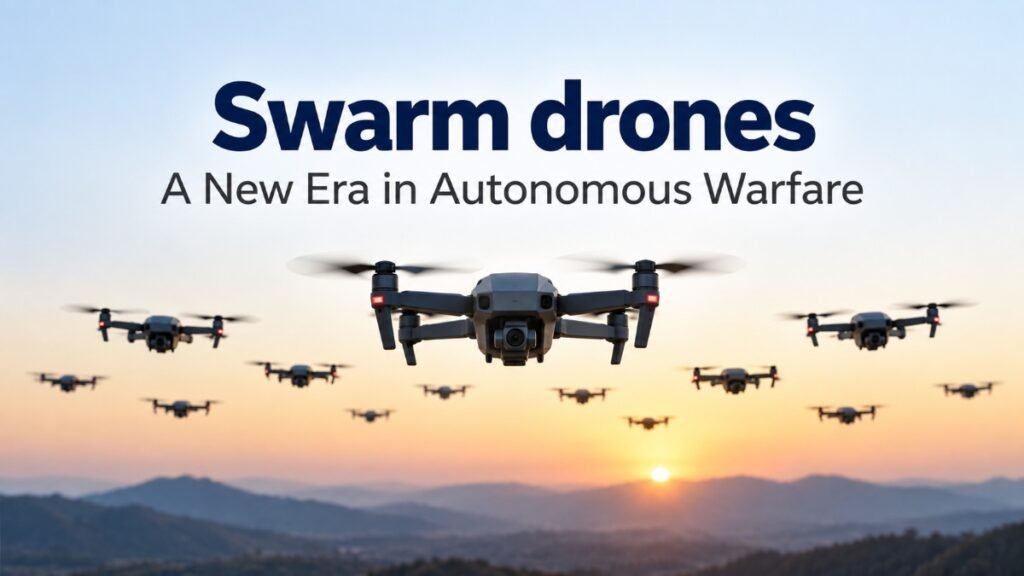
Swarm drones are a group of autonomous or semi-autonomous drones that communicate with each other and operate as a coordinated unit using Artificial Intelligence (AI), swarm intelligence, and wireless communication. Instead of being controlled individually, each drone shares real-time information with the others, enabling the swarm to collectively perform complex tasks with high efficiency. Swarm drone technology therefore allows multiple drones to coordinate their actions and operate as a unified system.
Inspired by the collective behaviour of birds, bees, and ants, swarm drones can automatically adapt to changing situations, distribute tasks among themselves, and continue the mission even if some drones are destroyed. Compared to a single drone, a swarm offers greater coverage, redundancy, flexibility, and operational effectiveness, making it valuable for both civilian and military applications. This capability has also increased the importance of drone swarm warfare in modern military operations.
Master Science & Technology. Maximize Your BPSC Mains Score.
Enroll in the BPSC Science & Tech Course Today
Master Science & Technology for BPSC Mains GS Paper-2 with 75+ exam-oriented topics, 6 structured lessons, and downloadable PDF notes—all in one course.
✔ 75+ Exam-Oriented Topics • ✔ 6 Comprehensive Lessons • ✔ Downloadable PDF Notes • ✔ Updated for 72nd BPSC Mains
2. Applications of Swarm Drones
- Defence and Military: Used for surveillance, intelligence gathering, electronic warfare, target identification, and coordinated precision attacks. The Indian Armed Forces are also exploring indigenous swarm drone capabilities. The development of swarm drone technology can significantly enhance coordinated military operations.
- Disaster Management: Assist in search and rescue operations, damage assessment, real-time monitoring, and delivery of emergency supplies in disaster-hit areas.
- Agriculture: Enable precision farming through crop monitoring, pesticide spraying, seed broadcasting, and assessment of crop health over large areas.
- Infrastructure and Environmental Monitoring: Used for inspection of power lines, pipelines, railways, forests, mining areas, and wildlife conservation, reducing time and operational costs.
- Entertainment and Scientific Research: Swarm drones are employed in drone light shows, atmospheric research, and coordinated scientific missions, replacing traditional fireworks in many public events.
Prepare Smarter. Study Better. Ace BPSC Mains.
BPSC Mains GS Paper 1 & 2 Complete Course
Access comprehensive BPSC Mains Notes for GS Paper 1 & 2, covering 378+ topics across 24 PDF lessons, with dedicated Bihar coverage, practice questions and downloadable study material.
✓ GS Paper 1 & 2 • ✓ 378+ Topics • ✓ 24 PDF Lessons • ✓ Bihar-Specific Coverage • ✓ Downloadable Notes
3. Hazards and Challenges of Swarm Drones
Emerging Threat to National Security
Swarm drones have emerged as a serious security challenge because dozens or even hundreds of drones can simultaneously attack a target, making interception extremely difficult. Unlike a single drone, a swarm can overwhelm conventional air defence systems through saturation attacks. The Indian Air Force Station, Jammu, was attacked on 27 June 2021 using explosive-laden drones, marking India’s first drone attack on a military installation. Since then, security agencies have reported hundreds of drone sightings along the India–Pakistan border, many of which were used to drop arms, ammunition, explosives, and narcotics, highlighting the growing threat of drone-based warfare. This has made drone swarm warfare an important emerging security concern for India.
Changing Nature of Modern Warfare
Recent conflicts have demonstrated that swarm drones are transforming military operations by providing a low-cost but highly effective alternative to conventional weapons. During the Russia–Ukraine War (2022–present), both sides have extensively used coordinated drone attacks for surveillance, precision strikes, and destruction of military assets. Similarly, Houthi rebels in the Red Sea region have repeatedly used drones and missiles to target commercial shipping, disrupting one of the world’s busiest maritime trade routes. These developments indicate that future wars will increasingly rely on AI-enabled unmanned systems.
Difficulty in Detection and Interception
Swarm drones are generally small, fast, and capable of flying at low altitudes, making them difficult to detect through conventional radar systems. Even if a few drones are neutralised, the remaining drones can continue the mission due to their decentralised swarm intelligence. This has created a growing demand for Counter-Unmanned Aircraft Systems (C-UAS) incorporating radars, radio-frequency jammers, directed-energy weapons, and laser systems. India has already developed indigenous anti-drone technologies through DRDO, which have been deployed to protect strategic installations and high-profile events. Strengthening counter-drone systems is therefore essential to counter the growing threat posed by swarm operations.
Cybersecurity and Autonomous Weapon Risks
Swarm drones rely on Artificial Intelligence (AI), GPS, communication networks, and software algorithms, making them vulnerable to GPS spoofing, signal jamming, hacking, and malware attacks. If hostile actors gain control over a drone swarm, it could lead to attacks on critical infrastructure such as airports, power grids, oil refineries, and communication networks. Moreover, the increasing use of AI-enabled autonomous lethal weapons has raised global ethical concerns regarding accountability, human control, and compliance with international humanitarian law.
Regulatory and Ethical Challenges
The rapid advancement of swarm drone technology has outpaced existing legal and regulatory frameworks. Issues such as privacy violations, unauthorised surveillance, misuse by non-state actors, and cross-border drone operations require stronger national and international regulations. Recognising these concerns, India has strengthened its regulatory framework through the Drone Rules, 2021, while simultaneously promoting indigenous drone manufacturing and developing advanced counter-drone capabilities to ensure national security.
4. Conclusion
Swarm drones represent a major technological advancement with significant applications in defence, disaster management, agriculture, and infrastructure development. However, their increasing use in modern warfare, terrorism, and cross-border attacks has made them a critical national security concern. For India, strengthening indigenous swarm drone technology, developing advanced counter-drone systems, and establishing a robust regulatory framework will be essential to harness their benefits while mitigating emerging security threats.
BPSC Mains Practice Question
Swarm drones are transforming the nature of modern warfare while creating new security and regulatory challenges. Discuss their applications, emerging threats, and the measures required by India to strengthen its counter-drone capabilities.
Learn More About Swarm Drones
For official information on drone technology, drone regulations, and India’s unmanned aircraft ecosystem, visit the Ministry of Civil Aviation (MoCA), Government of India official website: Ministry of Civil Aviation – Drone Rules