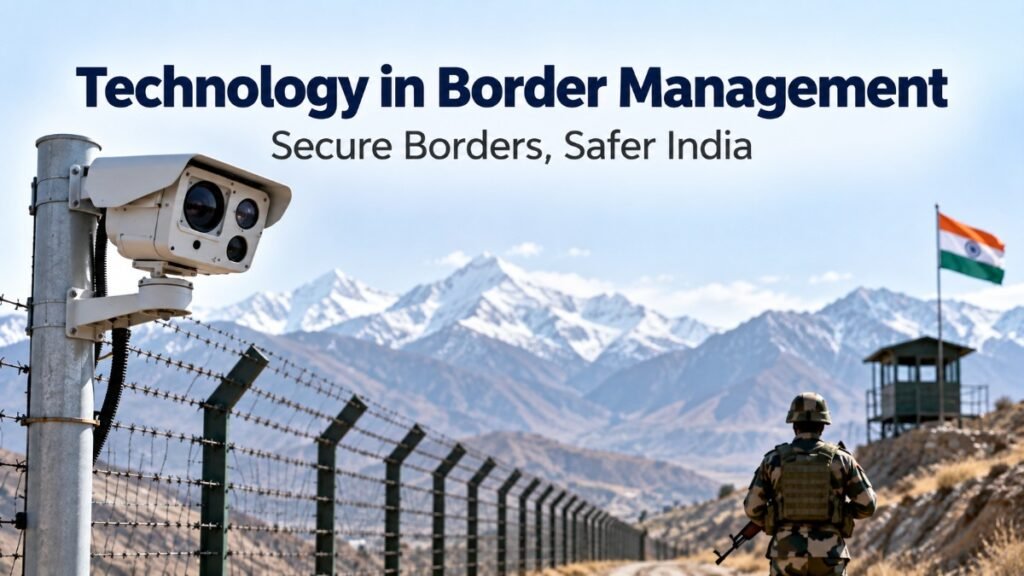
1. Smart Border Management in India
Smart Border Management in India refers to the integration of technology, infrastructure, and skilled manpower to strengthen border security and ensure effective monitoring of India’s international borders. It follows the People–Process–Technology (PPT) approach, where advanced technologies complement the efforts of border guarding forces such as the Border Security Force (BSF), Indo-Tibetan Border Police (ITBP), Assam Rifles, and Sashastra Seema Bal (SSB).
The Government of India is gradually shifting from manual border guarding to Technology in Border Management, particularly in difficult terrains such as the Himalayas, deserts, marshes, forests, and riverine borders. This approach enhances operational efficiency, minimizes human risk, and enables 24×7 real-time monitoring of border activities. The technological interventions in India’s border management can be broadly classified into two categories:
- Mobilisation and Logistics: Technologies that improve troop mobilisation, weapons deployment, military vehicles, and ordnance supply chains, ensuring rapid response during emergencies.
- Surveillance and Communication: Technologies such as drones, satellites, radars, thermal imagers, sensors, artificial intelligence (AI), communication networks, command-and-control centres, and reconnaissance systems that enable continuous border monitoring and timely detection of threats.
Smart Border Management in India increasingly relies on integrated surveillance and communication technologies to overcome geographical and operational challenges. The combination of sensors, drones, AI, satellites, and secure communication networks strengthens Technology in Border Management and improves the ability of security forces to respond rapidly to emerging threats. To strengthen border security, India has also adopted the D4R2 Strategy, which focuses on:
- Deter hostile activities,
- Detect intrusions,
- Discriminate between genuine and suspicious movements,
- Delay infiltration,
- Respond swiftly, and
- Recover from any security breach.
Thus, Smart Border Management in India represents a shift from conventional physical guarding towards a technology-enabled and integrated approach to border security.
Master Science & Technology. Maximize Your BPSC Mains Score.
Enroll in the BPSC Science & Tech Course Today
Master Science & Technology for BPSC Mains GS Paper-2 with 75+ exam-oriented topics, 6 structured lessons, and downloadable PDF notes—all in one course.
✔ 75+ Exam-Oriented Topics • ✔ 6 Comprehensive Lessons • ✔ Downloadable PDF Notes • ✔ Updated for 72nd BPSC Mains
2. Major Technologies Used in Border Management
Comprehensive Integrated Border Management System (CIBMS)
The Comprehensive Integrated Border Management System (CIBMS) is India’s flagship smart border surveillance programme developed to strengthen border security through advanced technologies. It integrates smart fencing, sensors, radars, cameras, communication networks, and command-and-control centres to enable 24×7 real-time monitoring and reduce dependence on physical patrolling, especially in difficult terrains. The Comprehensive Integrated Border Management System (CIBMS) is a key component of Technology in Border Management and represents the shift towards technology-driven border surveillance. The system follows a five-layered defence architecture:
- Layer I: Low-light CCTV cameras provide continuous visual surveillance of the border.
- Layer II: Thermal Imagers (TI) and Night Vision Devices (NVDs) detect movement during darkness up to 2–3 km.
- Layer III: Surveillance Radars track suspicious movements up to 40 km, including activities across the border.
- Layer IV: Laser Walls secure riverine gaps and infiltration-prone areas by triggering alarms whenever an object crosses the laser beam.
- Layer V: Underground Sensors detect vibrations and human movement beneath the surface, helping identify underground infiltration attempts.
A pilot project, BOLD-QIT (Border Electronically Dominated QRT Interception Technique), has been successfully implemented along the Indo-Bangladesh riverine border in Dhubri (Assam).
Artificial Intelligence (AI), Drones and Robotics
AI and drones in border security are increasingly becoming important components of Technology in Border Management. AI-enabled surveillance systems analyse real-time data from cameras, drones, and sensors to automatically detect suspicious activities and alert security personnel. The Indian Armed Forces use Searcher and Heron UAVs for Intelligence, Surveillance, Target Acquisition and Reconnaissance (ISTAR) missions, while indigenous drones such as TAPAS-BH-201 are being developed for long-endurance surveillance. AI-powered counter-drone systems are also being deployed to detect and neutralise hostile drones used for smuggling and cross-border infiltration.
The integration of AI and drones in border security strengthens Smart Border Management in India by enabling faster detection, automated surveillance, and continuous monitoring of vulnerable border areas. Robotics and unmanned platforms can further reduce the exposure of personnel to dangerous terrain and hostile activities.
Surveillance and Communication Systems
India has deployed several advanced surveillance systems to improve situational awareness along its borders. These include Long-Range Reconnaissance and Observation Systems (LORROS), Thermal Imagers, Night Vision Devices (NVDs), and Battlefield Management Systems (BMS). The Air Defence Control and Reporting System (ADC&RS) developed by DRDO integrates radar inputs for airspace monitoring, while the Centre for Artificial Intelligence and Robotics (CAIR) has developed advanced communication systems for mountainous and remote border regions. Radio Trunk Systems (RTS) and Radio Local Systems (RLS) ensure secure and uninterrupted communication among security forces.
These technologies form an important part of Technology in Border Management, enabling border guarding forces to share information rapidly and maintain effective command-and-control capabilities. Smart Border Management in India therefore depends not only on surveillance technologies but also on reliable and secure communication networks.
Smart Sensors and Satellite-based Monitoring
India increasingly uses motion sensors, seismic sensors, electro-optical sensors, laser barriers, satellite imagery, and GIS technologies for continuous monitoring of vulnerable border areas. These technologies are particularly useful in deserts, forests, marshes, and riverine borders, where physical fencing is difficult. Satellite-based monitoring also supports rapid identification of infiltration routes, illegal construction, and cross-border activities.
The integration of smart sensors and satellite-based monitoring with AI and drones in border security enhances the effectiveness of Smart Border Management in India. Together, these technologies enable wider-area surveillance, faster identification of suspicious activities, and improved situational awareness across India’s difficult and vulnerable borders.
Prepare Smarter. Study Better. Ace BPSC Mains.
BPSC Mains GS Paper 1 & 2 Complete Course
Access comprehensive BPSC Mains Notes for GS Paper 1 & 2, covering 378+ topics across 24 PDF lessons, with dedicated Bihar coverage, practice questions and downloadable study material.
✓ GS Paper 1 & 2 • ✓ 378+ Topics • ✓ 24 PDF Lessons • ✓ Bihar-Specific Coverage • ✓ Downloadable Notes
3. Challenges, Recent Initiatives and Way Forward
Challenges
- Difficult Terrain: India’s 15,106 km land border passes through the Himalayas, Thar Desert, dense forests, marshes, and riverine areas, making surveillance and maintenance of technological systems challenging. Effective Technology in Border Management therefore requires specialised systems capable of operating in extreme geographical and climatic conditions.
- Cross-Border Drone Threats: The increasing use of drones for smuggling weapons, explosives, narcotics, and counterfeit currency, particularly along the India–Pakistan border, has emerged as a major security concern. The Jammu Air Force Station drone attack (2021) exposed the vulnerability of critical military installations. This has increased the importance of AI and drones in border security, particularly for drone detection, tracking, and neutralisation.
- High Cost and Maintenance: Smart fencing, radars, satellites, AI systems, and sensor networks require substantial investment and regular maintenance, especially in extreme climatic conditions. The large-scale adoption of Technology in Border Management therefore requires sustained financial and technical resources.
- Cybersecurity Risks: Smart border systems depend on digital networks and communication infrastructure, making them vulnerable to cyberattacks, hacking, GPS spoofing, and electronic warfare. Strong cybersecurity is essential for ensuring the reliability of Smart Border Management in India.
Recent Initiatives
- Expansion of CIBMS: The Government is gradually extending the Comprehensive Integrated Border Management System (CIBMS) to vulnerable stretches of the India–Pakistan and India–Bangladesh borders. The expansion of CIBMS represents an important step towards technology-driven and integrated border surveillance.
- Deployment of Counter-Drone Systems: Indigenous anti-drone systems developed by DRDO are being deployed to detect, track, and neutralise hostile drones around military installations and border areas. These systems strengthen AI and drones in border security capabilities against emerging aerial threats.
- AI and Satellite-based Surveillance: Security agencies are increasingly integrating Artificial Intelligence (AI), satellite imagery, GIS, drones, thermal sensors, and real-time data analytics for continuous border monitoring. This integration is strengthening Smart Border Management in India by improving situational awareness and enabling faster responses.
- Atmanirbhar Bharat in Border Security: Indigenous technologies such as smart fencing, surveillance radars, communication systems, UAVs, and electronic sensors are being promoted to reduce dependence on foreign defence equipment. Such indigenisation is crucial for strengthening Technology in Border Management and ensuring reliable border-security infrastructure.
Way Forward
India should accelerate the integration of AI, drones, satellites, smart sensors, and secure communication networks to establish a fully integrated smart border management system. Strengthening indigenous defence technology under Atmanirbhar Bharat, improving cybersecurity, and enhancing coordination among border guarding forces will ensure 24×7 surveillance, faster response, and more effective border security against evolving conventional and non-conventional threats. The continued development of AI and drones in border security can further enhance India’s ability to address emerging threats while strengthening Smart Border Management in India.
4. Conclusion
Technology in Border Management has emerged as a crucial component of India’s national security strategy by integrating smart fencing, sensors, radars, drones, satellites, Artificial Intelligence, and secure communication networks. Smart Border Management in India can significantly improve 24×7 surveillance, early threat detection, rapid response, and the safety of border guarding personnel.
The effective expansion of the Comprehensive Integrated Border Management System (CIBMS), combined with AI and drones in border security, can help India address infiltration, cross-border smuggling, drone threats, and other conventional and non-conventional security challenges. By promoting indigenous technology, cybersecurity, inter-agency coordination, and skilled manpower, India can build a technology-driven, integrated, and future-ready border security system.
BPSC Mains Practice Question
“Technology has transformed border management from conventional patrolling to smart and integrated surveillance.” Discuss the role of CIBMS, AI, drones, satellites and smart sensors in strengthening India’s border security. Also examine the major challenges associated with technology-driven border management.
Learn More About Technology in Border Management
For official information on Technology in Border Management, CIBMS, border infrastructure, smart surveillance, and technological solutions for India’s international borders, visit the Ministry of Home Affairs (MHA) official website: Ministry of Home Affairs – Border Management-I Division