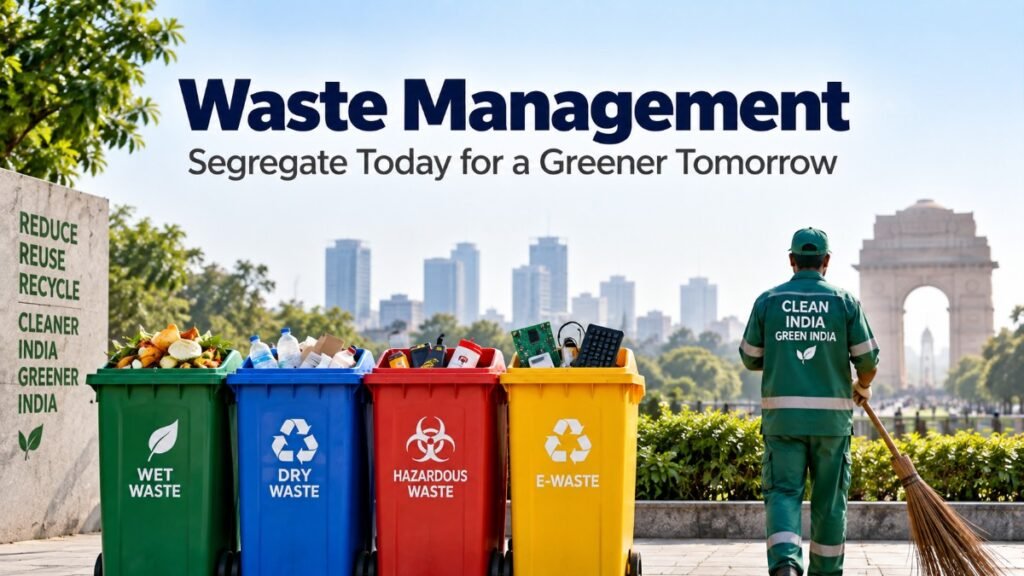
1. Waste Management: Meaning, Types and Need
Waste Management in India is the systematic process of collecting, segregating, transporting, treating, recycling, and safely disposing of waste to minimize its adverse impact on human health and the environment. With rapid urbanization, industrialization, and changing consumption patterns, the quantity of waste generated in India has increased significantly, making scientific waste management essential for sustainable development.
Major Types of Waste
- Municipal Solid Waste (MSW): Household waste, food waste, paper, glass, and other urban refuse generated by households, markets, and institutions.
- Plastic Waste: Single-use plastics, packaging materials, bottles, and carry bags that persist in the environment for long periods.
- Biomedical Waste: Waste generated from hospitals, clinics, laboratories, and healthcare facilities, including used syringes, medicines, and infectious materials.
- E-Waste: Discarded electronic items such as mobile phones, computers, televisions, batteries, and electronic appliances containing valuable as well as hazardous materials.
- Hazardous and Industrial Waste: Toxic, corrosive, flammable, and chemical wastes produced by industries, mining, and manufacturing units.
- Construction and Demolition (C&D) Waste: Debris such as concrete, bricks, cement, steel, and wood generated during construction and demolition activities.
Need for Waste Management
- Protects public health by preventing the spread of diseases and reducing pollution.
- Conserves natural resources through reuse and recycling of valuable materials.
- Reduces environmental pollution by minimizing contamination of air, water, and soil.
- Supports the Circular Economy by converting waste into useful resources such as compost, recycled products, and energy.
- Contributes to achieving the Sustainable Development Goals (SDGs), particularly SDG 11 (Sustainable Cities and Communities) and SDG 12 (Responsible Consumption and Production).
Master Science & Technology. Maximize Your BPSC Mains Score.
Enroll in the BPSC Science & Tech Course Today
Master Science & Technology for BPSC Mains GS Paper-2 with 75+ exam-oriented topics, 6 structured lessons, and downloadable PDF notes—all in one course.
✔ 75+ Exam-Oriented Topics • ✔ 6 Comprehensive Lessons • ✔ Downloadable PDF Notes • ✔ Updated for 72nd BPSC Mains
2. Waste Management Process and Scientific Methods
Waste Management Hierarchy (5R Principle)
The Waste Management in India hierarchy prioritizes minimizing waste generation before its disposal and forms the basis of Sustainable Waste Management.
- Refuse: Avoid unnecessary and single-use products (e.g., plastic bags and disposable cutlery).
- Reduce: Minimize consumption and waste generation through efficient resource use.
- Reuse: Extend the life of products by repairing or using them multiple times.
- Recycle: Convert waste materials such as paper, plastic, glass, and metals into new products.
- Recover: Recover energy or valuable resources from non-recyclable waste through technologies like bio methanation and waste-to-energy plants.
Scientific Methods of Waste Management
- Source Segregation: Separation of biodegradable, recyclable, and hazardous waste at the household level using colour-coded bins. It is the foundation of efficient Waste Management in India.
- Composting and Bio methanation: Organic waste is converted into compost or biogas, reducing landfill burden while producing manure and renewable energy.
- Recycling: Recovering materials such as paper, plastic, glass, and metals for reuse, thereby conserving natural resources and reducing pollution.
- Waste-to-Energy (WtE): Non-recyclable combustible waste is processed to generate electricity or heat, reducing landfill dependency.
- Scientific Landfilling: Only inert and non-recyclable waste is disposed of in engineered landfills equipped with systems to prevent soil and groundwater contamination.
According to the Solid Waste Management Rules, 2016, source segregation of waste is mandatory for all urban local bodies and households.
Prepare Smarter. Study Better. Ace BPSC Mains.
BPSC Mains GS Paper 1 & 2 Complete Course
Access comprehensive BPSC Mains Notes for GS Paper 1 & 2, covering 378+ topics across 24 PDF lessons, with dedicated Bihar coverage, practice questions and downloadable study material.
✓ GS Paper 1 & 2 • ✓ 378+ Topics • ✓ 24 PDF Lessons • ✓ Bihar-Specific Coverage • ✓ Downloadable Notes
3. Government Initiatives for Waste Management
Swachh Bharat Mission (Urban) 2.0
- Launched in 2021 for the period 2021–2026 with the objective of achieving Garbage Free Cities (GFC).
- Focuses on 100% door-to-door collection, source segregation, scientific processing of waste, and remediation of legacy dumpsites.
- Promotes the 3R (Reduce, Reuse, Recycle) principle and circular economy.
- Supports urban local bodies in developing modern waste-processing infrastructure.
Solid Waste Management (SWM) Rules, 2016
- Replaced the Municipal Solid Waste Rules, 2000, and expanded their scope to all urban and rural areas.
- Made source segregation of waste mandatory into biodegradable, non-biodegradable, and domestic hazardous waste.
- Assigned responsibilities to waste generators, local bodies, and bulk waste producers.
- Promotes composting, recycling, and scientific disposal while discouraging open dumping and burning.
Plastic Waste Management Rules and Extended Producer Responsibility (EPR)
- Plastic Waste Management Rules, 2016 (amended subsequently) strengthened the management of plastic waste.
- Single-use plastic items with low utility and high littering potential were banned from 1 July 2022.
- Introduced Extended Producer Responsibility (EPR), making producers, importers, and brand owners responsible for collecting and recycling plastic waste.
- Encourages recycling and reduction in plastic pollution.
E-Waste (Management) Rules, 2022
- Came into force from 1 April 2023 with a stronger focus on the circular economy.
- Established an online EPR portal for registration, tracking, and compliance by producers and recyclers.
- Fixed recycling targets for electronic waste and promoted formal recycling.
- Aims to reduce environmental and health hazards caused by improper disposal of electronic waste.
GOBARdhan Scheme (Galvanizing Organic Bio-Agro Resources Dhan)
- Launched under the Swachh Bharat Mission to convert cattle dung and organic waste into biogas, compressed biogas (CBG), and organic manure.
- Supports the establishment of biogas plants in rural and urban areas.
- Reduces open dumping of organic waste while generating clean energy and additional income for farmers.
- Contributes to the goals of the circular economy and Sustainable Waste Management.
Mission LiFE (Lifestyle for Environment)
- Launched by the Government of India in 2022 to promote environmentally responsible lifestyles.
- Encourages citizens to adopt sustainable habits such as waste segregation, recycling, reducing plastic use, and responsible consumption.
- Emphasizes “Pro-Planet People (P3)” by making individuals active participants in waste reduction.
- Complements government policies by promoting behavioural change at the community level.
4. Challenges and Way Forward
Challenges
- Poor Source Segregation: Mixed waste at the household level reduces the efficiency of recycling and scientific processing.
- Inadequate Infrastructure: Many urban local bodies lack sufficient waste collection, recycling, composting, and scientific landfill facilities.
- Rising Plastic and E-Waste: Rapid urbanization and increasing consumption have led to a sharp rise in non-biodegradable waste.
- Weak Enforcement: Poor compliance with waste management rules and limited monitoring hinder effective implementation.
- Low Public Awareness: Lack of citizen participation in waste segregation and responsible disposal remains a major challenge.
Way Forward
- Achieve 100% Source Segregation: Promote segregation of wet, dry, and hazardous waste at the household level.
- Strengthen Circular Economy: Maximize resource recovery through recycling, composting, and waste-to-energy technologies.
- Leverage Technology: Use AI, IoT, GIS, and smart bins for efficient waste collection, monitoring, and processing.
- Enhance Extended Producer Responsibility (EPR): Ensure producers take responsibility for collecting and recycling plastic and electronic waste.
- Promote Behavioural Change: Encourage public participation through Mission LiFE, awareness campaigns, and community-led Waste Management in India initiatives.
5. Conclusion
Waste should be viewed not as a burden but as a valuable resource capable of generating energy, employment, and economic value. Scientific Waste Management in India, supported by effective governance, technological innovation, and active public participation, is essential for achieving clean cities, a circular economy, Sustainable Development Goals (SDGs), and the vision of Viksit Bharat 2047.
BPSC Mains Practice Question
“Waste Management in India is essential for achieving sustainable urban development.” Discuss the major challenges of waste management in India and examine the role of government initiatives in promoting scientific and sustainable waste management.
Learn More About Waste Management in India
For official information on Waste Management in India, including solid waste management rules, plastic waste management, e-waste management, circular economy initiatives, and environmental regulations, visit the Ministry of Environment, Forest and Climate Change (MoEFCC) official website: MoEFCC Official Website