1. Plastic Pollution: Meaning, Causes and Current Scenario
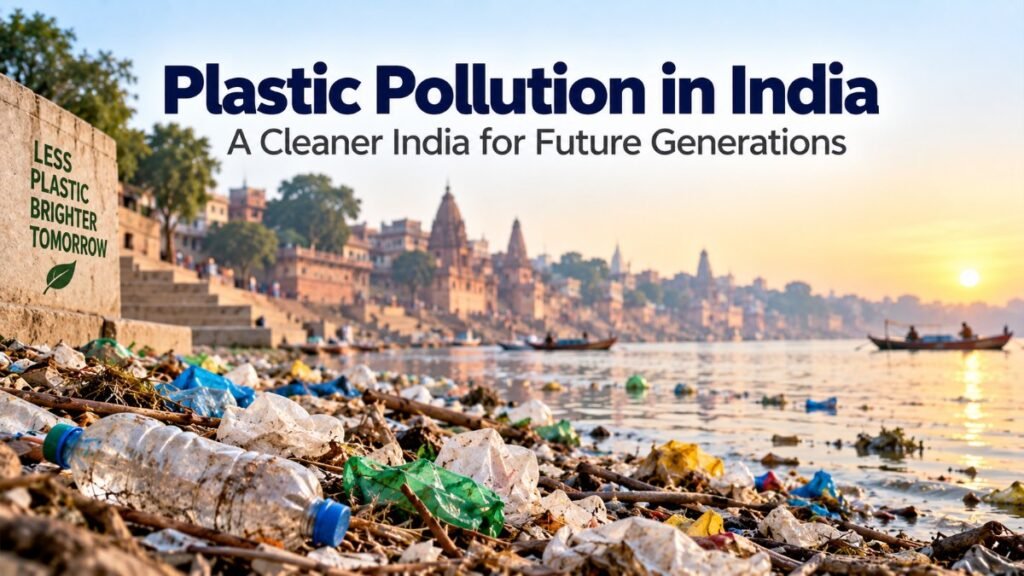
Plastic pollution refers to the accumulation of plastic waste in the environment due to its improper disposal, excessive use, and slow decomposition. Unlike biodegradable materials, most conventional plastics are derived from petroleum-based polymers and can persist in the environment for hundreds of years, causing long-term damage to ecosystems and human health. Today, Plastic Pollution in India has become one of the most pressing environmental challenges, affecting land, rivers, oceans, and even the atmosphere.
Current Scenario
- According to the United Nations Environment Programme (UNEP), the world generates over 400 million tonnes of plastic waste annually, with less than 10% being recycled.
- India is among the largest producers of plastic waste, generating about 9–10 million tonnes annually, driven by rapid urbanization and rising consumption.
- Plastic Pollution in India is no longer confined to visible waste. Microplastics (less than 5 mm) and nanoplastics have been detected in drinking water, soil, food, air, human blood, and even the placenta, highlighting the pervasive nature of the problem.
- Recognizing its transboundary nature, countries are negotiating a Global Plastics Treaty under the United Nations to develop a legally binding framework for ending plastic pollution.
Master Science & Technology. Maximize Your BPSC Mains Score.
Enroll in the BPSC Science & Tech Course Today
Master Science & Technology for BPSC Mains GS Paper-2 with 75+ exam-oriented topics, 6 structured lessons, and downloadable PDF notes—all in one course.
✔ 75+ Exam-Oriented Topics • ✔ 6 Comprehensive Lessons • ✔ Downloadable PDF Notes • ✔ Updated for 72nd BPSC Mains
2. Sources and Movement of Plastic Pollution
Major Sources of Plastic Pollution
- Single-use plastics (SUPs): Plastic bags, bottles, food packaging, disposable cups, straws, and cutlery are the largest contributors due to their short usage period and improper disposal.
- Municipal and Industrial Waste: Inadequate segregation and recycling of plastic waste from households, industries, and commercial establishments lead to environmental contamination.
- Fishing and Maritime Activities: Discarded fishing nets, ropes, and other marine plastic debris pose a major threat to aquatic ecosystems.
- Agriculture and Healthcare: Plastic mulch, irrigation pipes, fertilizer bags, and biomedical plastics add to the growing plastic waste burden.
- Poor Waste Management: Open dumping, littering, and leakage from landfills allow plastics to enter rivers, lakes, and oceans.
Movement and Spread of Plastic Pollution
- Land to Water: Most plastic waste originates on land and is transported through drains, streams, and major rivers into seas and oceans. Rivers such as the Ganga, Yangtze, and Mekong carry large quantities of plastic waste to marine ecosystems.
- Ocean Currents: Once in the oceans, plastic waste is transported over long distances by ocean currents (gyres), reaching even remote islands and polar regions.
- Formation of Microplastics: Exposure to sunlight, wind, and wave action breaks larger plastic items into microplastics (<5 mm) and nanoplastics, which persist in the environment.
- Entry into the Food Chain: Microplastics are ingested by fish, shellfish, birds, and other marine organisms, eventually entering the human food chain through seafood, drinking water, and agricultural produce.
- Global Presence: Scientific studies have detected microplastics from Mount Everest to the Mariana Trench, demonstrating that Plastic Pollution in India is part of a truly global environmental problem.
Prepare Smarter. Study Better. Ace BPSC Mains.
BPSC Mains GS Paper 1 & 2 Complete Course
Access comprehensive BPSC Mains Notes for GS Paper 1 & 2, covering 378+ topics across 24 PDF lessons, with dedicated Bihar coverage, practice questions and downloadable study material.
✓ GS Paper 1 & 2 • ✓ 378+ Topics • ✓ 24 PDF Lessons • ✓ Bihar-Specific Coverage • ✓ Downloadable Notes
3. Impacts of Plastic Pollution
Environmental and Wildlife Impacts
- Plastic pollution threatens both terrestrial and aquatic ecosystems, disrupting biodiversity and ecological balance.
- According to the United Nations Environment Programme (UNEP), over 800 marine and coastal species are affected by plastic pollution through ingestion, entanglement, and habitat degradation.
- Marine animals such as sea turtles, whales, dolphins, seabirds, and seals often mistake plastic bags and fragments for food, leading to starvation or death.
- Microplastics have been detected in more than 100 aquatic species, including fish, shrimp, and mussels consumed by humans.
- Plastic waste also blocks drains and water bodies, contributing to urban flooding and degradation of freshwater ecosystems.
Impact on Human Health
- Microplastics enter the human body through food, drinking water, and inhalation, raising concerns about long-term health impacts.
- Chemicals such as Bisphenol-A (BPA), Phthalates, and Polybrominated Diphenyl Ethers (PBDEs) used in plastics are known endocrine disruptors, affecting hormonal balance, reproduction, and child development.
- Recent scientific studies have detected microplastics in human blood, lungs, breast milk, and placenta, indicating widespread human exposure.
- Open burning of plastic waste releases toxic pollutants such as dioxins and furans, increasing the risk of respiratory diseases and certain cancers.
- Although research is still evolving, the World Health Organization (WHO) has highlighted the need for further assessment of the health risks posed by microplastics.
Economic Impacts
- Plastic pollution increases the financial burden on governments through higher costs of waste collection, landfill management, and cleaning of rivers, beaches, and urban drains.
- It adversely affects tourism, fisheries, and shipping, particularly in coastal regions where plastic debris damages natural attractions and marine resources.
- Blockage of drainage systems by plastic waste contributes to urban flooding, resulting in infrastructure damage and economic losses.
- According to UNEP, the environmental and social cost of plastic pollution runs into billions of dollars annually, highlighting its impact on sustainable economic development.
- Recycling potential is also lost when valuable plastic waste is dumped instead of being recovered under a circular economy.
Social and Gender Dimensions
- Plastic pollution disproportionately affects informal waste workers, who often work without protective equipment and are exposed to hazardous waste.
- In India, women constitute nearly 49% of waste pickers, making them particularly vulnerable to health risks and poor working conditions.
- The informal waste sector plays a crucial role by recycling nearly 30% of India’s plastic waste, yet it remains largely unrecognized and under-supported.
- Women are also major consumers of several plastic-intensive household and personal care products, including sanitary products and food packaging, increasing their exposure to plastic waste.
- Thus, addressing Plastic Pollution in India requires not only environmental action but also social inclusion, gender-sensitive policies, and improved livelihoods for waste workers.
4. Government Initiatives to Control Plastic Pollution
Plastic Waste Management (PWM) Rules, 2016
- Notified under the Environment (Protection) Act, 1986, these rules provide a comprehensive framework for the collection, segregation, recycling, and environmentally sound disposal of plastic waste.
- Introduced the concept of Extended Producer Responsibility (EPR), making producers, importers, and brand owners responsible for collecting and recycling the plastic waste generated from their products.
- Mandates local bodies to establish effective Plastic Waste Management systems and promote source segregation.
Ban on Identified Single-Use Plastics (SUP), 2022
- From 1 July 2022, the Government of India prohibited the manufacture, import, stocking, distribution, sale, and use of 19 identified single-use plastic items, including plastic cutlery, straws, stirrers, plates, cups, and polystyrene decorations.
- The ban aims to reduce plastic litter by eliminating items with low utility and high littering potential.
- It complements India’s commitment to promote sustainable alternatives and reduce Plastic Waste in India.
Extended Producer Responsibility (EPR) Guidelines for Plastic Packaging, 2022
- The Ministry of Environment, Forest and Climate Change introduced a centralized online EPR portal for registration and monitoring of producers, importers, and brand owners.
- Prescribes annual recycling and reuse targets for plastic packaging and promotes the use of recycled plastic content in manufacturing.
- Strengthens accountability by ensuring that plastic producers bear responsibility for the entire life cycle of their products.
India’s Role in the Global Plastics Treaty
- India is actively participating in the Intergovernmental Negotiating Committee (INC) process under the United Nations Environment Programme (UNEP) for developing a legally binding Global Plastics Treaty.
- The proposed treaty aims to address the entire life cycle of plastics, from production and design to recycling and final disposal.
- India’s approach emphasizes balancing environmental protection with the developmental needs of developing countries while promoting the principles of a circular economy.
5. Way Forward
- Reduce Single-Use Plastics: Promote eco-friendly alternatives such as cloth bags, paper packaging, biodegradable materials, and reusable products.
- Strengthen Circular Economy: Improve waste segregation, recycling infrastructure, and effective implementation of Extended Producer Responsibility (EPR) to ensure plastics remain in the production cycle.
- Promote Innovation and Sustainable Alternatives: Encourage research on biodegradable plastics, green packaging, and plastic substitutes through public-private partnerships.
- Enhance Public Participation: Expand awareness campaigns under Mission LiFE and Swachh Bharat Mission to encourage responsible consumption and proper disposal of plastic waste.
- Strengthen Global Cooperation: Support the early adoption of the Global Plastics Treaty and enhance international cooperation to tackle transboundary Plastic Pollution in India.
6. Conclusion
Plastic has become an indispensable material in modern life; however, its irresponsible production, consumption, and disposal have transformed it into a major environmental threat. A combination of effective policies, technological innovation, responsible industry practices, and active citizen participation is essential to combat Plastic Pollution in India. Sustainable plastic management will play a crucial role in achieving SDG 12 (Responsible Consumption and Production), SDG 14 (Life Below Water), SDG 15 (Life on Land), and the vision of Viksit Bharat 2047.
BPSC Mains Practice Question
“Plastic Pollution in India is a growing threat to environmental sustainability, human health and the economy.” Discuss its major causes and impacts, and examine the effectiveness of government measures to address the problem.
Learn More About Plastic Pollution in India
For official information on Plastic Pollution in India, plastic waste rules, Extended Producer Responsibility (EPR), single-use plastic regulations, and Plastic Waste Management, visit the Central Pollution Control Board (CPCB) official website: CPCB Official Website