1. Introduction
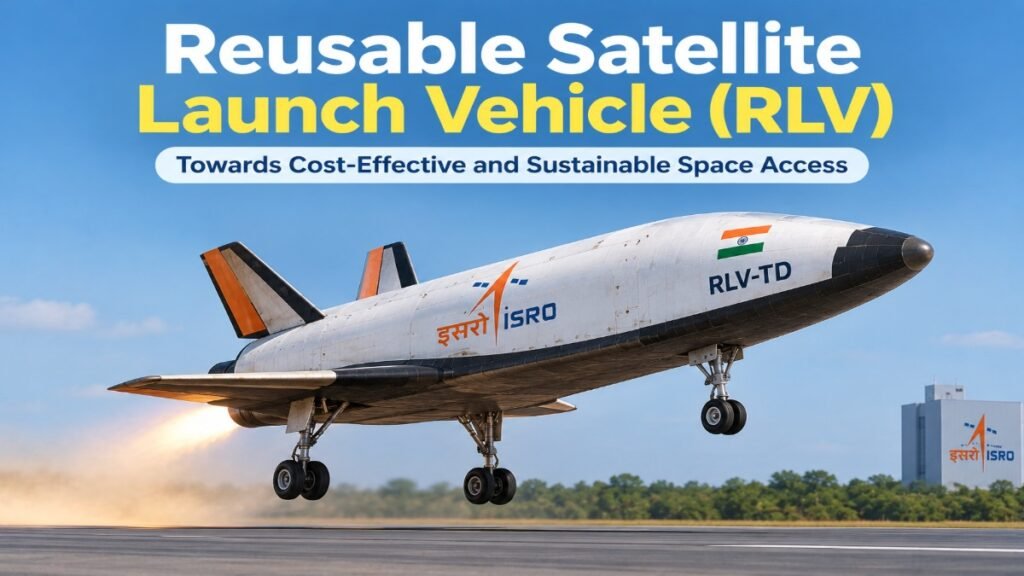
A Reusable Launch Vehicle (RLV) is a launch vehicle designed to be used multiple times, unlike conventional rockets that are discarded after a single mission. ISRO’s Reusable Launch Vehicle (RLV) Programme aims to develop a winged, reusable launch system capable of launching satellites into orbit and safely returning to Earth for reuse, thereby enabling low-cost and sustainable access to space. The ISRO Reusable Launch Vehicle programme is therefore an important step towards developing India’s future space transportation capabilities.
The current Reusable Launch Vehicle (RLV) is a technology demonstrator (RLV-TD) developed to validate critical technologies such as hypersonic flight, autonomous navigation, atmospheric re-entry, thermal protection, and autonomous runway landing. It is often referred to as India’s “space shuttle”, although the operational vehicle under development differs significantly from NASA’s retired Space Shuttle. The RLV Technology Demonstrator (RLV-TD) serves as an important platform for testing these technologies.
ISRO considers Reusable Launch Vehicle (RLV) technology as a key component of India’s future space transportation system because it has the potential to significantly reduce launch costs, improve launch frequency, and enhance India’s competitiveness in the global commercial launch market. The programme has successfully completed the Hypersonic Flight Experiment (HEX) and three Autonomous Landing Experiments (LEX-01, LEX-02, and LEX-03), paving the way for the next phase—the Orbital Re-entry Experiment (OREX).
Master Science & Technology. Maximize Your BPSC Mains Score.
Enroll in the BPSC Science & Tech Course Today
Master Science & Technology for BPSC Mains GS Paper-2 with 75+ exam-oriented topics, 6 structured lessons, and downloadable PDF notes—all in one course.
✔ 75+ Exam-Oriented Topics • ✔ 6 Comprehensive Lessons • ✔ Downloadable PDF Notes • ✔ Updated for 72nd BPSC Mains
2. Evolution and Major Milestones
- Hypersonic Flight Experiment (HEX) – 23 May 2016: ISRO successfully conducted the maiden flight of the Reusable Launch Vehicle–Technology Demonstrator (RLV-TD) from Satish Dhawan Space Centre, Sriharikota. The mission validated critical technologies such as hypersonic flight, autonomous navigation, atmospheric re-entry, and thermal protection systems, marking India’s first major step towards reusable space transportation. The RLV Technology Demonstrator (RLV-TD) provided the foundation for India’s future Reusable Launch Vehicle (RLV) development.
- Landing Experiment (LEX-01) – 2 April 2023: ISRO achieved the first autonomous runway landing of the winged RLV, named ‘Pushpak’, at the Aeronautical Test Range (ATR), Chitradurga, Karnataka. Released from an Indian Air Force Chinook helicopter, the vehicle autonomously approached and landed on the runway, demonstrating aircraft-like landing capability. This experiment marked a major milestone for the Pushpak Reusable Launch Vehicle programme.
- LEX-02 & LEX-03 – 22 March 2024 and 23 June 2024: These successive experiments demonstrated the robustness of the RLV under increasingly challenging conditions, including higher cross-range corrections, stronger winds, and reuse of the same flight hardware. With the successful completion of LEX-03, ISRO concluded the autonomous landing demonstration phase of the RLV programme.
- Next Phase – Orbital Re-entry Experiment (OREX): Following the successful HEX and LEX series, ISRO is developing the Orbital Re-entry Vehicle (ORV). According to the ISRO Annual Report 2025–26, the propulsion and avionics architecture for the ORV has been finalized. The upcoming Orbital Re-entry Experiment (OREX) will validate orbital re-entry technologies before the development of an operational Reusable Launch Vehicle (RLV).
Prepare Smarter. Study Better. Ace BPSC Mains.
BPSC Mains GS Paper 1 & 2 Complete Course
Access comprehensive BPSC Mains Notes for GS Paper 1 & 2, covering 378+ topics across 24 PDF lessons, with dedicated Bihar coverage, practice questions and downloadable study material.
✓ GS Paper 1 & 2 • ✓ 378+ Topics • ✓ 24 PDF Lessons • ✓ Bihar-Specific Coverage • ✓ Downloadable Notes
3. Significance of Reusable Launch Vehicle (RLV)
- Reduces Launch Cost: Reusability enables the same Reusable Launch Vehicle (RLV) to be used multiple times, significantly lowering the cost of satellite launches and making space missions more economical.
- Enhances India’s Commercial Competitiveness: A reusable launch system will strengthen NewSpace India Limited (NSIL) and India’s commercial launch capabilities, enabling the country to capture a larger share of the rapidly growing global space market. The ISRO Reusable Launch Vehicle can therefore support India’s ambitions in the commercial space sector.
- Supports Sustainable Space Operations: By reducing the need to manufacture new launch vehicles for every mission, Reusable Launch Vehicle (RLV) technology minimizes material consumption, space debris, and the environmental footprint of space launches.
- Promotes Advanced Indigenous Technology: The programme has helped India develop critical technologies such as hypersonic flight, thermal protection systems, autonomous navigation, precision landing, and reusable flight systems, enhancing self-reliance in the space sector. The RLV Technology Demonstrator (RLV-TD) has played a key role in validating these technologies.
- Supports Future Space Missions: Reusable Launch Vehicle (RLV) technology will play a crucial role in future satellite launches, space station logistics, human spaceflight programmes, and deep-space exploration, contributing to India’s long-term vision of affordable and sustainable access to space.
4. Challenges and Future Prospects
- Technical Challenges: Developing reliable thermal protection systems, reusable propulsion, precision autonomous landing, and ensuring vehicle durability after repeated flights remain major technological challenges. The Pushpak Reusable Launch Vehicle experiments have helped ISRO address several of these challenges.
- Need for Further Testing: Although the HEX and LEX missions have been successfully completed, the upcoming Orbital Re-entry Experiment (OREX) and subsequent orbital demonstrations are essential before an operational Reusable Launch Vehicle (RLV) can be deployed.
- Towards Low-Cost Space Transportation: Once operational, the ISRO Reusable Launch Vehicle is expected to substantially reduce launch costs, improve launch frequency, and make India a preferred destination for commercial satellite launches.
- Future Role in India’s Space Programme: The Reusable Launch Vehicle (RLV) will complement missions such as Gaganyaan, the Bharatiya Antariksh Station (BAS), and future lunar and planetary exploration programmes, strengthening India’s ambition to become a leading global space power.
5. Conclusion
The Reusable Launch Vehicle (RLV) programme represents a major technological step towards affordable, sustainable, and reliable access to space. Through the RLV Technology Demonstrator (RLV-TD) and Pushpak experiments, ISRO has successfully validated several critical technologies. With further orbital re-entry and flight testing, the ISRO Reusable Launch Vehicle can reduce launch costs, support commercial space activities, and strengthen India’s position as a major global space power.
BPSC Mains Practice Question
Q. What is a Reusable Launch Vehicle (RLV)? Discuss its major technological milestones, significance, and challenges for India’s future space programme.
Learn More About Reusable Launch Vehicle (RLV)
For official information on the Reusable Launch Vehicle (RLV), RLV-TD, its technology demonstrations and future objectives, visit the Indian Space Research Organisation (ISRO) official website: https://www.isro.gov.in/RLV-TD.html